Daisy · Volume 1
Overview & the Spine
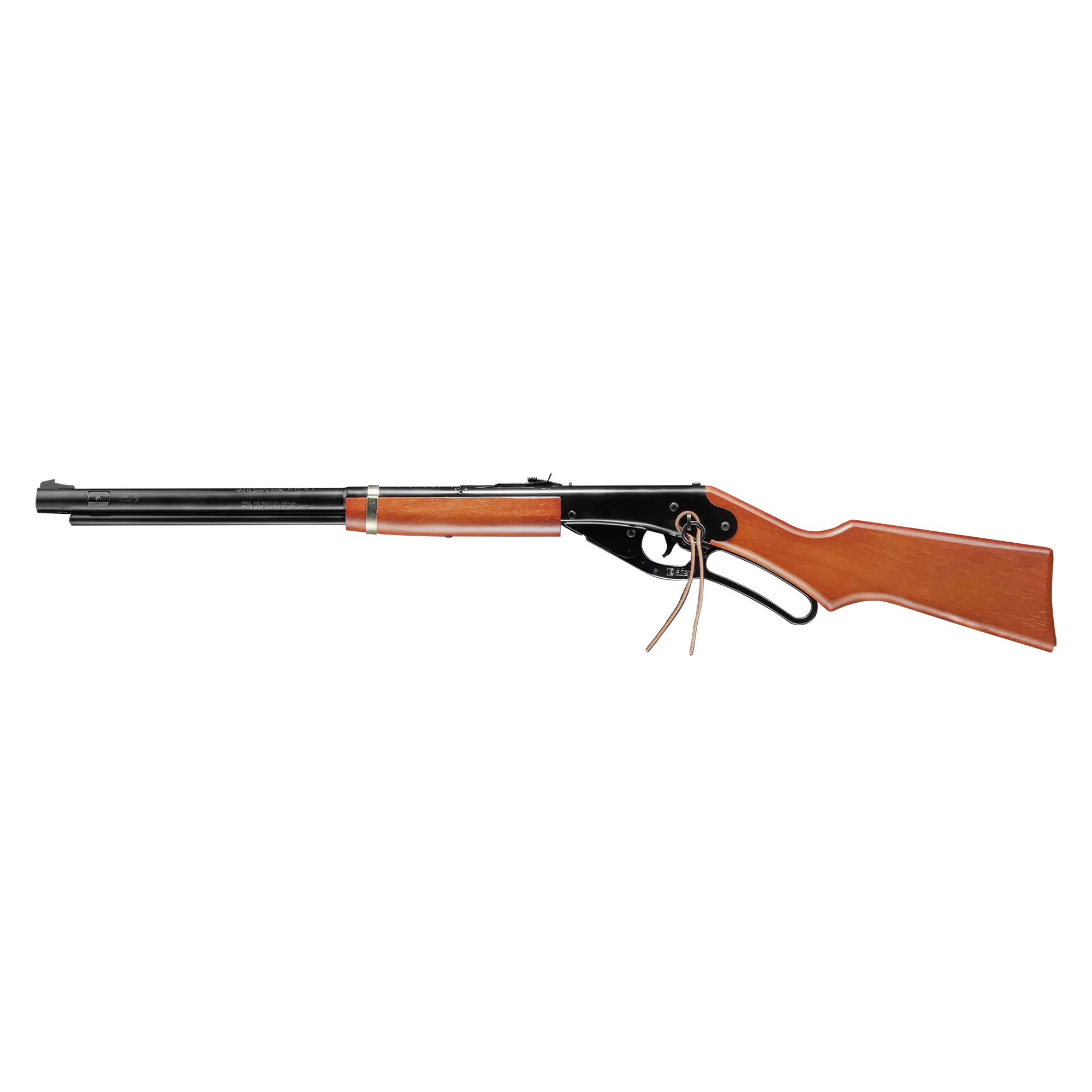
In 1882 a group of businessmen in Plymouth, Michigan organized a company to manufacture iron windmills. Within seven years the windmills were gone and the company was making air rifles. Within thirteen it had renamed itself after one. Over the following century it became the largest maker of BB guns in the world, put a lever-action carbine into the hands of something like a hundred million American children, and — for about eight months in 1968 and 1969 — built a .22 caliber rifle that ignited its ammunition with nothing but hot air, sold roughly twenty-four thousand of them, and then walked away from the whole idea.
This series is about all of that. It is seventeen volumes long because Daisy is three stories wearing one name, and the interesting parts are where they touch.
1.1 The three threads
The company (Volumes 2 through 4, and 16) is a study in how a manufacturer survives by being willing to stop being what it was. A windmill firm becomes an air-rifle firm; a Michigan firm becomes an Arkansas firm; a family business becomes a subsidiary, then an asset sale, then a private-equity holding. It is also a study in how a company remembers itself, because Daisy’s founding story is one of the best-loved origin myths in American manufacturing and it does not survive contact with the evidence.
The machines (Volumes 5 through 10, and 17) are more interesting than their reputation suggests. A Red Ryder is not a small version of a serious air rifle; it works on a different principle, and understanding that principle explains why a child can cock it, why it shoots a ball that is deliberately the wrong size for its own bore, and why the number printed on the box has never been the number a chronograph reports.
The V/L (Volumes 11 through 15) is why this dive runs long. It is the one time Daisy built something that was not an air gun at all, and the reason it stopped is a genuine historical puzzle that fifty-seven years of writing has failed to resolve — mostly by not noticing there was a puzzle.
1.2 Who this is for
A reader who likes mechanisms and does not want to be condescended to. The engineering volumes give the actual sequence of events inside the gun, in order, with pressures and timings where the sources support them. The history volumes distinguish between what is documented and what is merely repeated. Nothing here is written for a child, though the subject spent a century being sold to them.
There is also a local dimension. Plymouth is in Wayne County, roughly twenty-five miles from Detroit, and Daisy spent its first seventy-six years there. For a reader in southeast Michigan this is not distant industrial history; it is the next town over. Volume 14 closes on a symmetry that only becomes visible from Michigan.
1.3 The traps, with the answers stated up front
Several claims about Daisy are repeated everywhere and are wrong, unverifiable, or more complicated than their usual telling. Because they recur across the series, the corrections are stated here first so that nothing downstream can drift from them.
The founding story is folklore, and Daisy says so. The tale of Lewis Cass Hough firing Clarence Hamilton’s prototype into a wastebasket and exclaiming “Boy, that’s a daisy!” traces to a single source: Cass S. Hough’s It’s a Daisy! of 1976, written by the grandson of the man in the anecdote, himself a Daisy president, eighty-eight years after the event. The quotation is unstable across retellings, the Plymouth Historical Museum’s own finding aid omits the episode entirely, and Daisy’s website prefixes it with the words “According to company legend.” When a firm declines to assert its own founding miracle, no one else should. Volume 2 lays out the full case, and does it without smugness — the durability of a good sentence is its own subject.
A steel BB is not .177 caliber. The bore is .177, or 4.5 mm. The ball is 0.171 to 0.173 inches, deliberately undersize, and that gap is not sloppiness — it is load-bearing. Volume 6 traces the three-number dimensional history from the 0.180 lead birdshot of 1886 through 0.175 in the early 1900s to the modern figure.
A Red Ryder is a catapult with an air booster, not a miniature spring-piston rifle. The air column shoves the BB off its magnetic seat first and the blast then kicks it in the tail. This is why the mainspring can be light enough for a child to cock, and it is the direct mechanical consequence of the undersize ball. Volume 5.
350 fps is a rated maximum, not a measurement. Chronographed Red Ryders commonly run around 270 fps. Both numbers are true; they answer different questions. Similarly, the Powerline 880 does not shoot 880 fps — that is a retailer confusing a model number with a velocity. It shoots 750 fps with BBs and 715 with pellets.
The gun in A Christmas Story is not a Red Ryder. The compass and sundial in the stock came from the No. 107 Model 36 Buck Jones Special of 1934 to 1942, the only Daisy that ever had a stock compass. Daisy is on record that when Jean Shepherd asked in 1982 for 1940 Red Ryders “with a sundial and compass,” he was wrong — and the six props built for the film wore a silk-screened, non-functional sundial. Volume 8 treats this generously, because it is a memoirist compressing a childhood, not a blunder.
Daisy did not make the WWII wooden training rifles. Those were Parris-Dunn of Clarinda, Iowa. Daisy’s war work was subcontract metal stamping. Volume 3.
The V/L is a firearm, and that is a statement about physics before it is a statement about law. The spring piston compresses air, but the air’s only job is to get hot enough to ignite a propellant charge moulded onto the base of the bullet. The bullet is driven by burning propellant, at firing-chamber pressures between 12,000 and 30,000 psi. Any description of the V/L as “an air rifle that shoots .22” has the mechanism exactly backwards. Volume 12.
The V/L’s compressed air probably does not reach 2,000 °F. That figure appears in nearly every account and in no primary source. Van Langenhoven’s own patents specify air at 400 to 700 °F igniting a propellant formulated to light at 400 to 600 °F — two documents, written by the inventor, describing the system from opposite ends and agreeing within a hundred degrees. The 2,000 °F number traces to an October 1967 Popular Mechanics article and, behind it, probably to a Daisy press kit. Volume 12 presents both, traces both, and declines to merge them.
Nobody has ever produced the ATF ruling that supposedly killed the V/L. That ATF regards the V/L as a firearm is certain and documented — it is listed by name on the Curios or Relics List, and that list contains only firearms. But no formal, numbered, published ruling has ever surfaced. Cartridge collectors went looking in 2011 and again in 2019 and found nothing. The earliest traceable printed source is a single sentence in Guns & Ammo for February 1993, twenty-four years after the fact, with no date and no document number. Volume 14 lays out four competing accounts of the ending and explains which one the evidence actually supports.
The V/L’s caseless ammunition was not unreliable. The usual story has it failing in the field. In 2021 a tester fired nine rounds of 1969-vintage ammunition and got nine first-strike ignitions averaging 1,194 fps — above the original specification, half a century on. What actually killed the rifle commercially was price: $39.95 against a $23.95 Winchester Model 121. Volume 13.
1.4 What this series does not claim
Where the record is thin, these volumes say so rather than filling the gap. Van Langenhoven’s birth and death dates could not be established. The Model 99 could not be sourced at all. Daisy’s own BB manufacturing could not be documented, and the widely repeated shot-tower story appears to be a lead-era technique retro-fitted onto a steel-era product. The exact date Victor Comptometer acquired Daisy remains open, as do the wording of the 2001 CPSC settlement and the reasoning of the dissenting commissioner. No Presentation-model certificate is attested anywhere despite frequently being mentioned.
Those gaps are listed because a reference is only as trustworthy as its willingness to show you its own floor. One of them is actionable: ATF’s classification correspondence from 1968 and 1969 is in principle obtainable under the Freedom of Information Act, and there is no evidence that anyone has ever asked for it. Fifty-seven years of repetition rests on a records request nobody has filed.
1.5 The spine
Volumes 2 through 4 build the company from a Plymouth machine shop to a Rogers, Arkansas corporation that shares a brand but not a legal identity with its predecessor. Volume 5 opens the guns up and Volume 6 examines the projectile, because the ball explains the powerplant. Volumes 7 and 8 handle the Red Ryder and the film that made it immortal for the wrong reasons. Volumes 9 and 10 walk the rest of the catalogue, historic and current. Volumes 11 through 15 are the V/L: the inventor, the mechanism, the cartridge, the ending, and the place of all of it in the long, repeatedly unsuccessful history of ammunition without a case. Volume 16 covers safety, litigation, and the 2024 acquisition that consolidated most of the American airgun industry under one owner. Volume 17 is the collector’s cheatsheet.
The through-line, if there is one, is that Daisy has spent a hundred and forty years being underestimated — as a toy company, as a marketing operation, as a footnote — and that the most interesting thing it ever built was killed by a distinction almost nobody bothered to examine.
Comments (0)