Daisy · Volume 17
Collecting Daisy: Dating, Values, and a Cheatsheet
Daisy is an unusually forgiving field to collect in. The guns were made by the million, most of them survive in attics rather than safes, and almost nothing in the catalogue commands the kind of money that attracts sophisticated forgery. That is the good news. The bad news is that the same abundance makes the field noisy: the model nomenclature is inconsistent (Volume 7), the dating stamps changed systems mid-stream and overlapped while they did it, and the two most desirable Red Ryder variants are precisely the ones a seller has the most incentive to claim. This volume is the practical residue of the preceding sixteen — what to look at, what the marks mean, and where the traps are.
One framing note before the details. Values in this volume are deliberately sparse. Airgun prices move, they vary enormously by condition, and the authoritative reference — the Blue Book of Airguns — is a paid product that revises annually. Where a figure appears here it is a rough order of magnitude drawn from the research behind this series, not a valuation. Anyone buying at a level where the number matters should own the current Blue Book.
17.1 Reading a Red Ryder
Almost every Daisy question that reaches a forum is really the same question: what is this Red Ryder and when was it made? The answer comes from three places on the gun — the stock, the forearm, and the number.
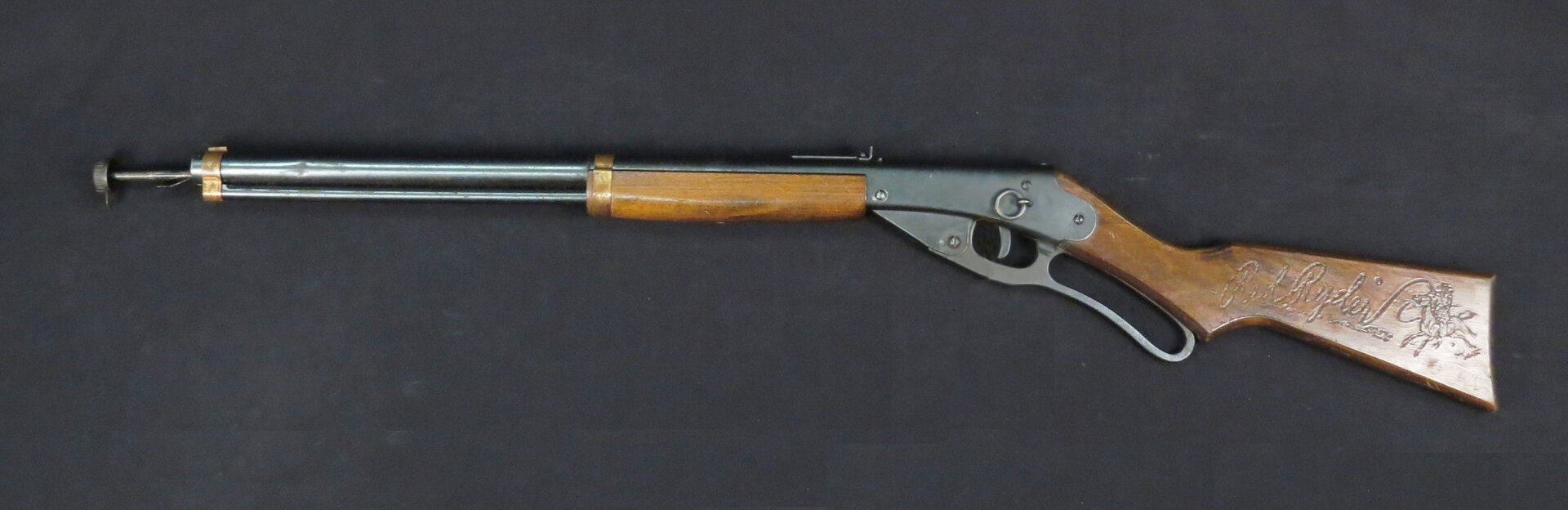
The stock and forearm are the fastest read, because the wood-to-plastic transition is well documented and roughly sequential. The first variant of the No. 111 Model 40 (1940–41) has a wood stock and a wood forearm, copper-plated bands with the front band pinched into place, a cast-iron lever, and the Red Ryder name burned into the left side of the stock.1 Variant 3 (1941–42) moves to blued barrel bands and switches the logo from burned to silk-screened in black on red — and is described by the Blue Book as the rarest Red Ryder of them all.2 Variant 4 (1946) is the last Red Ryder made with a wood forearm, which makes it a useful mental bookmark: wood forearm means 1946 or earlier.3 By Variant 6 (1950–51) the forearm is plastic and the lever is black-painted cast aluminium; by Variant 8 (December 1952 to mid-1953) both stock and forearm are plastic.4
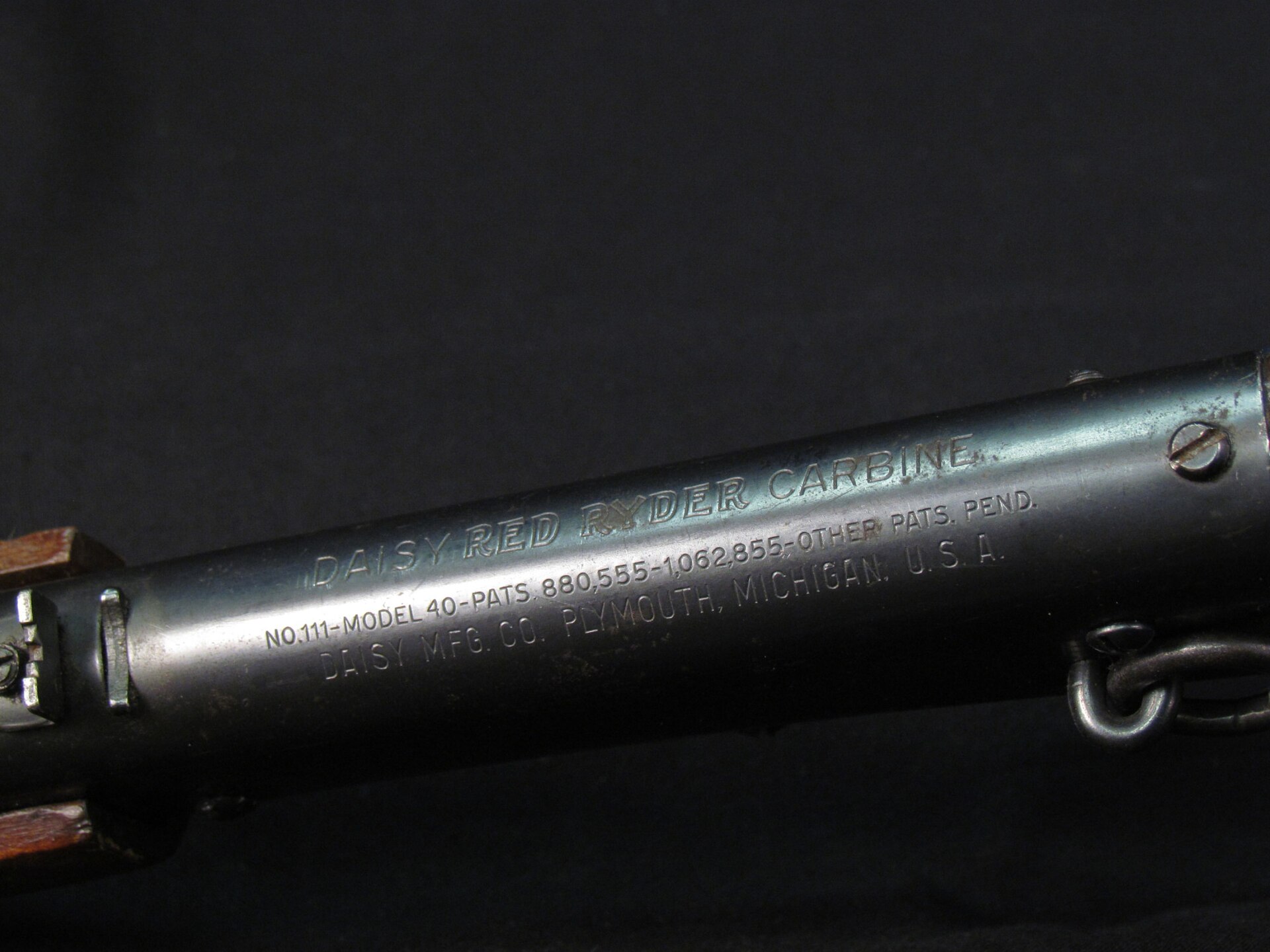
The number is the second read, and it is where people go wrong. Daisy used “REG. NO.” — a Register Number — from 1952 to 1972, and “LOT NO.” after 1972.5 That sounds like a clean boundary and is not one. Lot numbers appear on some guns as early as April 1973, but Register Numbers continued on the 1938 Red Ryder into at least 1979. The two systems overlap for the better part of a decade, so the stamp type narrows a date range rather than fixing it. For guns made between 1972 and 1982 the number decodes as a month-code letter, then the last digit of the year, then a five-digit production number.5 Guns made for the 1988 50th Anniversary use a special numbering system of their own.5
Table 1 — Reading a Red Ryder
| Marking | Period | What it tells you |
|---|---|---|
| ”REG. NO.” | 1952–1972 (persisting to at least 1979 on the 1938) | Narrows the range; does not fix a year |
| ”LOT NO.” | After 1972 (appearing from April 1973) | Overlaps with REG. NO.; not a clean cutover |
| Letter + digit + 5 digits | 1972–1982 | Month code, year digit, production number |
| Special system | 1988 only | 50th Anniversary guns |
The confidence on all of the above is medium — it rests on a single well-organised collector source rather than on factory documentation, and no factory literature confirming the 1938A and 1938B introduction dates (usually given as 1978 and 1979) was found in the research behind this series.6 Treat the decoding as a strong working tool, not as a certificate.
17.2 The anniversary-math trap
A collector who dates guns by their anniversary editions will end up two years out, consistently, and it is worth understanding why. Daisy counts the Red Ryder’s birth from 1938 — the year of the conversation that produced the idea — not from April 1940, when the first gun was actually built (Volume 7). Every anniversary edition follows that convention: 1988 is the 50th, 1998 the 60th, 2003 the 65th, 2010 the 70th, the 75th arrives dated 2015 but released just before Christmas 2014, and 2018 is the 80th.7 None of these dates is wrong; they are simply counted from a different event than the one a production-focused collector has in mind.
The commemorative run is long and the list in the research behind this series is explicitly partial. Beyond the anniversaries there is a 2000 Millennium edition with special engraving, an American Legion limited edition, and — for the United States semiquincentennial — a 2026 250th Anniversary “Liberty Edition” in three variants.8
17.3 The two Christmas guns, and the forgery problem
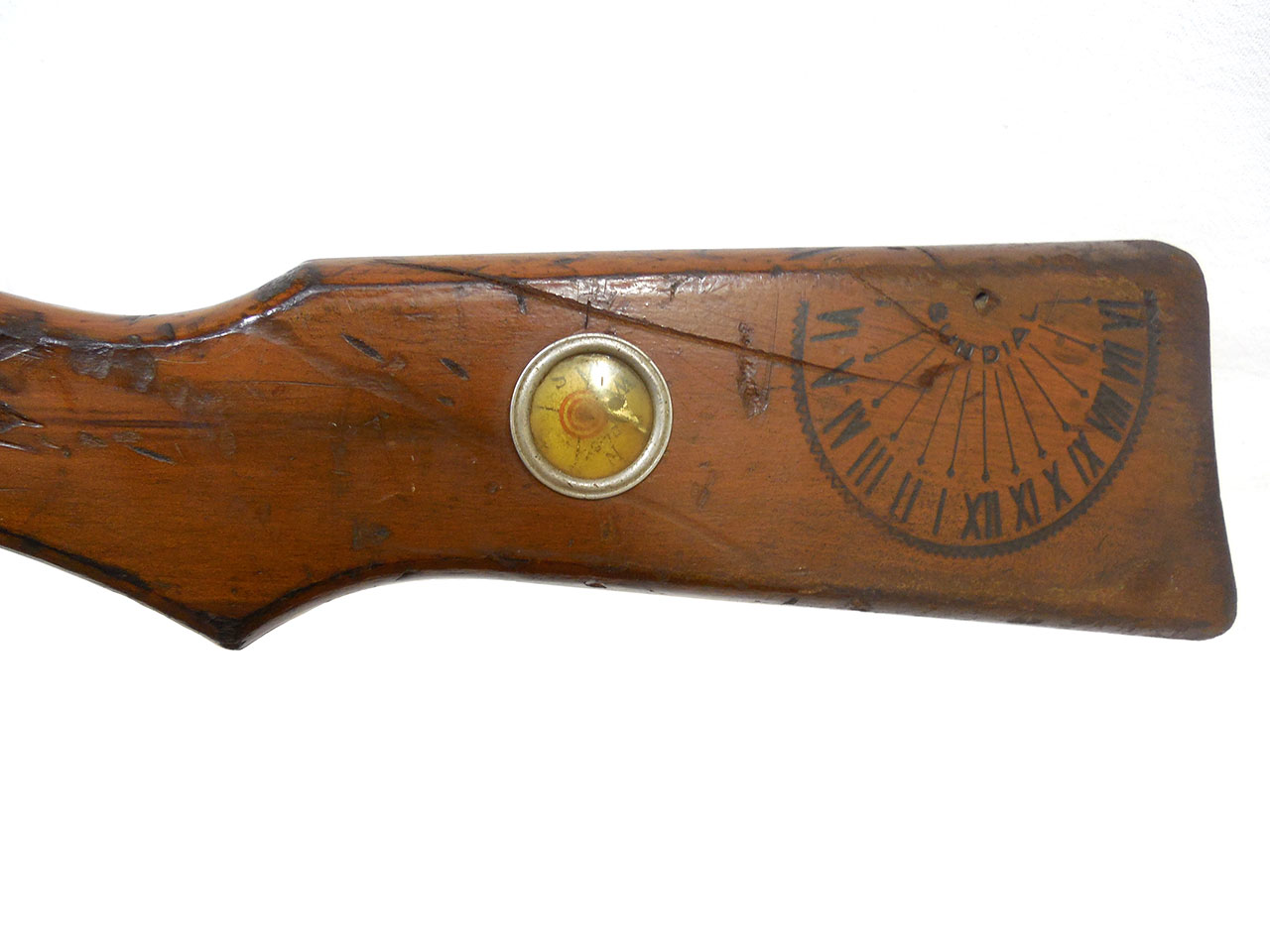
The single most faked object in Daisy collecting is a direct consequence of the confusion Volume 8 describes. Because A Christmas Story put a compass and a sundial in the stock of a gun that never had them, Daisy eventually built guns that did. The 1983 and 1984 “Christmas Dream” Red Ryder carries a compass and sundial and was made only in those two years — and it is, in the plain words of the sources, heavily faked today.9 A compass and sundial can be added to any Red Ryder by anyone with a drill and patience, and the short two-year production window means genuine examples are scarce enough to be worth faking. Provenance, box, and paperwork matter more here than on anything else in the catalogue.
The 2020 “A Christmas Wish” limited edition also carries a compass and sundial.10 It is recent, was produced in quantity, and should not be confused with the 1983–84 guns.
And the genuinely rare object in this corner is not a Red Ryder at all: it is the No. 107 Model 36 Buck Jones Special (1934–42), the only Daisy that ever carried a compass in its stock as original equipment, and the actual source of the film’s iconography.
17.4 Beyond the Red Ryder
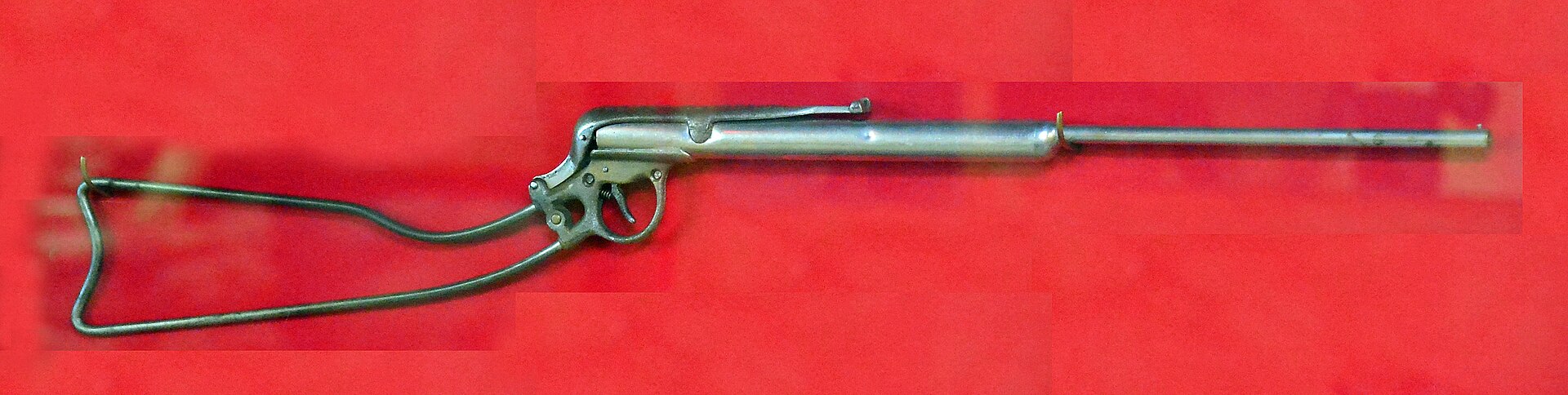
The cast-iron era is the connoisseur’s end of the field. The earliest Daisys, from 1888 through roughly the turn of the century, used cast-iron frames with wire or cast stocks, and the wire-stock first gun is the recognised collector benchmark.11 These are genuinely old industrial objects and are priced accordingly.
The Model 25 pump has been reissued enough times that provenance matters: a commemorative collector’s edition in 1986, a return to regular production in 2009, a Centennial edition around 2014, and a current catalogue item.12 A Model 25 is not automatically old. One sits in the NRA Museum collection.13
The 1894 Spittin’ Image ran 1961–1986, also appearing as the 1894 Western Carbine and, in one variant, the “Lever Matic.”14
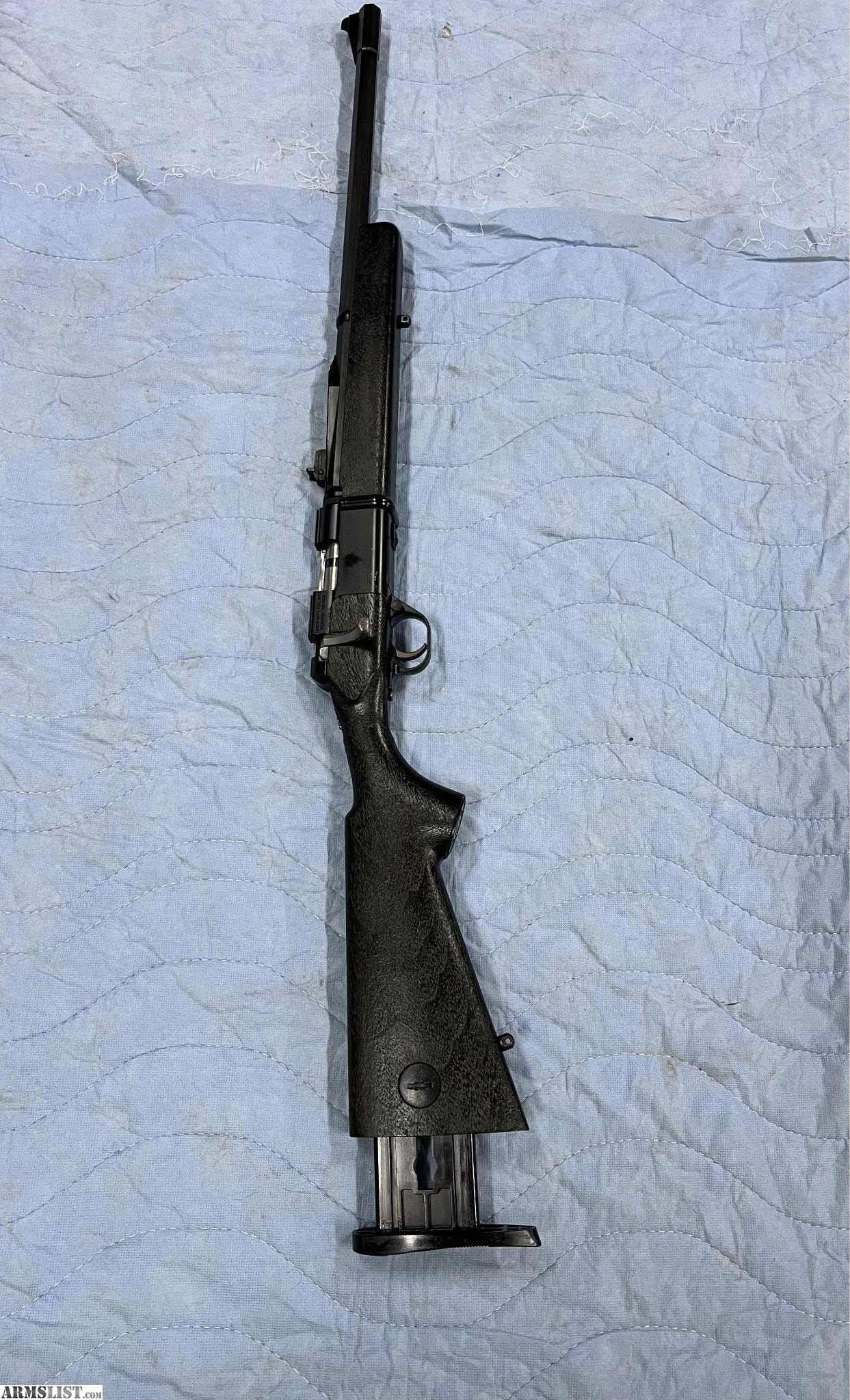
The .22 rimfires are the oddity worth knowing about, because most people do not know Daisy made centrefire-style rimfire rifles at all. The bolt guns run roughly $250 in good condition, which makes them one of the better value-per-story items in the field.15
The Model 99 is the honest hole in this volume. It is described in collector circles as a target or Champion-grade lever BB gun of the 1960s and 1970s with peep sights, a step above the standard youth guns — but the research behind this series returned nothing citable, and no specifications, dates, or production figures are asserted here.16 It wants a Blue Book of Airguns lookup.
17.5 The V/L, as a collecting proposition
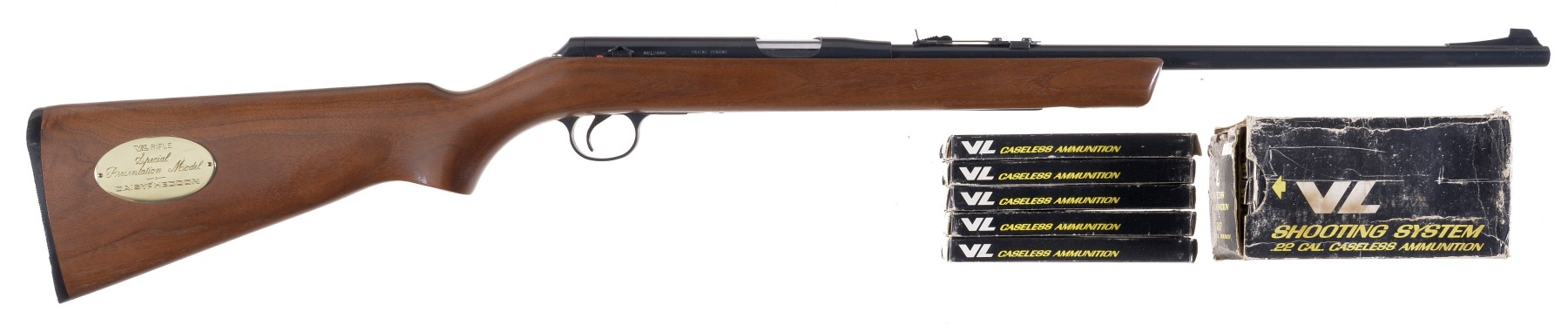
The V/L is a different kind of object from everything else in this volume, and the difference is legal rather than aesthetic. It is a firearm — that is the whole story of Volumes 11 through 15 — and it appears by name on ATF’s Curios or Relics List, which is a list of firearms.17 A V/L is not an air rifle that happens to be old, and it should not be bought, sold, shipped, or stored as though it were. Anyone transacting one should confirm the current requirements rather than relying on this paragraph or on a seller’s assurance.
On rarity: the production figure best supported by the research is roughly 24,000 total, broken out as about 19,000 standard rifles, some 4,000 Presentation models, and 1,000 collector packages.18 That is scarce but not vanishingly so. The Presentation model — walnut stock, brass plate, fitted case, and 1,000 rounds of ammunition at $125 in period — is the desirable variant. No certificate is attested in any source consulted, so a “certificate” offered with a Presentation model should be treated as a question rather than as confirmation.
Ammunition is its own market. Roughly 47 million rounds were made by Canadian Industries Ltd, about 2,000 for every rifle ever built, and unfired ammunition nonetheless commands real money — a reminder that survival rate, not production volume, sets scarcity.
17.6 The cheatsheet
- Wood forearm on a Red Ryder means 1946 or earlier. This is the single fastest useful read on the gun.
- Logo burned into the stock points to the earliest variant; silk-screened black-on-red points to Variant 3, the rarest.
- “REG. NO.” means roughly 1952–1972; “LOT NO.” means after 1972. They overlap through the 1970s — do not treat the stamp as a hard date.
- 1972–1982 numbers decode as month letter + year digit + five-digit production number.
- Daisy anniversaries count from 1938, not 1940. Expect a two-year offset against production dates.
- A compass and sundial on a Red Ryder means a 1983–84 Christmas Dream, a 2020 Christmas Wish, or a fake. The 1983–84 guns are heavily faked; demand provenance.
- A compass on a Buck Jones Special is factory-original — that is the gun the film was actually remembering.
- 350 fps is a rated maximum. Real Red Ryders commonly chronograph around 270 fps.
- A V/L is a firearm, is on ATF’s Curios or Relics List, and must be handled as one.
- Presentation-model “certificates” are unattested. Ask questions.
- The Blue Book of Airguns is the variant authority for the No. 111 Model 40 and the reference to own before spending real money.
17.7 Bibliography
Footnotes
-
Blue Book of Airguns, “Daisy No. 111 Model 40 Red Ryder Variant 1.” https://bluebookofgunvalues.com/products/daisy-no-111-model-40-red-ryder-variant-1 (confidence: high). ↩
-
Blue Book of Airguns, “Daisy No. 111 Model 40 Red Ryder Variant 3” — described as the rarest of all Red Ryders. https://bluebookofgunvalues.com/products/daisy-no-111-model-40-red-ryder-variant-3 (confidence: medium-high). ↩
-
Variant 4 (1946) as the last wood-forearm Red Ryder — Blue Book variant series (confidence: medium). ↩
-
Blue Book of Airguns, “Daisy No. 111 Model 40 Red Ryder Variant 6” and “Variant 8.” https://bluebookofgunvalues.com/products/daisy-no-111-model-40-red-ryder-variant-6 ; https://bluebookofgunvalues.com/products/daisy-no-111-model-40-red-ryder-variant-8 (confidence: medium). ↩
-
JG Airguns, “Daisy Register, Lot and Serial Numbers Explained.” https://www.jgairguns.biz/daisy-register-lot-and-serial-numbers-explained-ezp-55.html (confidence: medium; single collector source, no factory documentation located). ↩ ↩2 ↩3
-
The 1938A and 1938B introduction dates, usually given as 1978 and 1979, are collector consensus; no factory literature confirming them was found in the research behind this series (confidence: low on the specific years). ↩
-
Anniversary-edition dates as listed in the research file; the 1988 50th Anniversary special numbering implies Daisy counts from 1938. See https://daisy.com/product/80th-anniversary-red-ryder/ and https://airgunmaniac.com/daisy-red-ryder-1938-75th-anniversary-special-edition-review/ (confidence: medium). ↩
-
Daisy, “250th Anniversary Red Ryder Liberty Edition Kit.” https://daisy.com/product/250th-anniversary-red-ryder-liberty-edition-kit/ ; https://www.ssusa.org/content/daisy-marks-america-s-250th-with-limited-edition-red-ryders (confidence: medium-high). ↩
-
NRA Family, “Limited Edition Daisy Christmas Dream Air Rifle.” https://www.nrafamily.org/articles/2017/11/24/limited-edition-daisy-christmas-dream-air-rifle/ ; forum discussion at https://forum.daisymuseum.com/1984-christmas-dream-red-ryder_topic10624.html (confidence: high on the two-year run and on the prevalence of fakes). ↩
-
The Firearm Blog, “Daisy Christmas Story Red Ryder” (2020). https://www.thefirearmblog.com/blog/2020/10/27/daisy-christmas-story-red-ryder/ (confidence: medium-high). ↩
-
Tom Gaylord, “Daisy wire-stock first BB gun, Part 1,” Pyramyd Air blog. https://www.pyramydair.com/blog/2010/01/daisy-wire-stock-first-bb-gun-part-1/ (confidence: medium). ↩
-
Daisy, “Model 25 Pump BB Gun.” https://daisy.com/product/model-25-pump-bb-gun/ ; https://www.shootingtimes.com/editorial/daisy-model-25-centennial-bb-gun/482194 ; https://shoot-on.com/the-daisy-model-25-108-years-and-counting/ (confidence: medium-high). ↩
-
NRA Museum, “Daisy Model 25 Slide Action Air Rifle.” https://www.nramuseum.org/guns/the-galleries/for-the-fun-of-it/case-48-airguns/daisy-model-25-slide-action-air-rifle-(1).aspx (confidence: high). ↩
-
Tom Gaylord, “Daisy 1894 Western Carbine, Part 1,” Pyramyd Air blog. https://www.pyramydair.com/blog/2015/02/daisy-1894-western-carbine-part-1/ ; NRA Museum, “Daisy Model 1894 Lever-Matic.” https://www.nramuseum.org/guns/the-galleries/for-the-fun-of-it/case-48-airguns/daisy-model-1894-lever-matic-repeating-air-rifle.aspx (confidence: medium). ↩
-
Guns.com, “We remember when Daisy used to make .22LR rifles” (2021). https://www.guns.com/news/2021/06/09/we-remember-when-daisy-used-to-make-22lr-rifles ; https://bluebookofgunvalues.com/products/daisy-rifles-bolt-action-disc-legacy-models-2202-2212 (confidence: medium-high). ↩
-
The Model 99 could not be sourced. Collector descriptions exist but nothing citable was located; no specifications are asserted here (confidence: unverified). ↩
-
ATF Curios or Relics List, listing “Daisy, Model V/L, cal. .22 caseless rifle, manufactured during 1968-1969.” See Volume 14 for the full discussion and for the caveat that automated retrieval of the ATF PDF was blocked (confidence: high on the listing text, which should nonetheless be re-verified against the ATF document directly). ↩
-
Guns & Ammo, February 1993 (Forker) — the only production figure located with a named author and page numbers. See Volume 14 for the competing figures and why this one is preferred (confidence: medium-high). ↩
Comments (0)