Headspace · Volume 9
The Bolt-Face End — Why Headspace Is a Property of the Whole Action
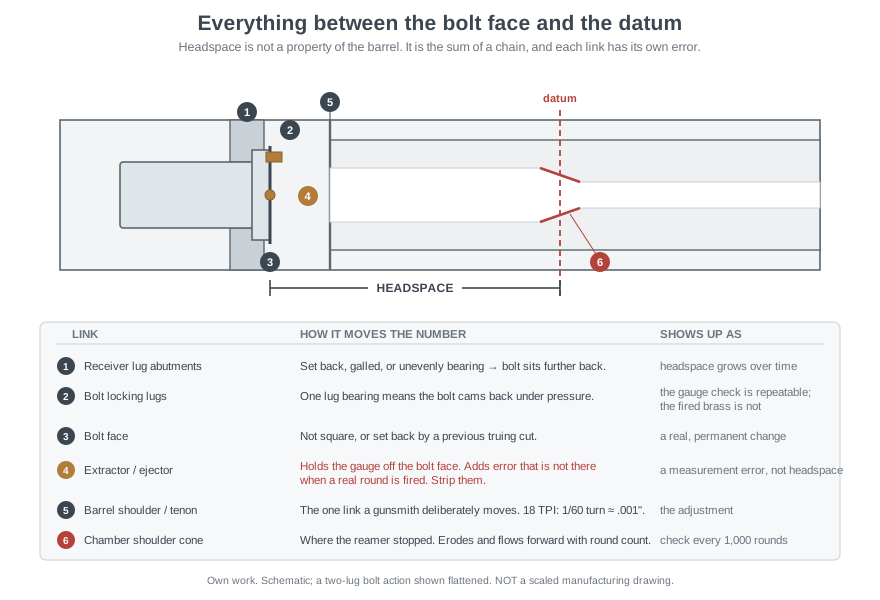
People talk about a barrel’s headspace, and it is a convenient shorthand that is wrong in a way that matters. SAAMI’s chamber drawings measure the headspace dimension from a line labelled BREECH BOLT FACE.1 The bolt face is not on the barrel. Everything between those two surfaces — the receiver’s lug abutments, the bolt’s lugs, the bolt body, the bolt face itself, and the barrel tenon that ties the whole thing together — is in the dimension. Change any of it and the number changes.
This volume walks the chain link by link. It is the answer to the question Vol 6 explicitly cannot answer: you have a number, and now you want to know where it came from.
9.1 The Chain
On a conventional turn-bolt, the load path when a round fires runs backwards from the case head to the bolt face, back along the bolt body to the locking lugs, across the lug faces into the receiver’s abutments, and from there into the receiver ring and forward again through the threads into the barrel tenon. Headspace is the closure of that loop.
Six things sit in it.
9.2 Link One — The Receiver’s Lug Abutments
The lug abutments are the surfaces in the receiver that the bolt lugs bear against. They take the full bolt thrust of every round the rifle has ever fired.
How it moves the number: abutments that have been peened, galled, or set back allow the bolt to sit further rearward at lock-up, which lengthens headspace. On a hard-used military action or one fed a diet of overpressure handloads, this is the classic mechanism by which headspace grows.
Why it matters more than it sounds: this is the failure mode behind Forster’s advice to “routinely check rifle chamber headspace every thousand rounds.”2 A barrel does not usually get longer. Abutments set back.
How it shows: headspace that has increased since a previous measurement with no work done on the rifle. Which is only detectable if you took a previous measurement — the whole argument of this series in one sentence.
9.3 Link Two — The Bolt Lugs
How it moves the number: a two-lug bolt where only one lug bears does two things. First, the bolt sits at whatever position that single lug allows, which may be anywhere within the manufacturing difference between the two. Second, and worse, under 60,000 psi the bearing lug deflects and the bolt cams back further than it does under gravity on the handle.
The symptom that gives it away: a gauge check that is perfectly repeatable while the fired brass says the chamber is longer than the gauge says it is. This is the one situation where the brass and the gauge disagree and the brass is right — the gauge measures the rifle at rest, the brass measures it under load.
The other symptom is in Vol 6’s procedure: a transition that is mushy across two or three thousandths rather than crisp within one. If the bolt keeps creeping further closed as you lean on it, the lugs are not both bearing.
Diagnosis: lug lap with a marking compound, or simply smoke the lugs and close the bolt on a resistance. Both lugs should print. Lapping to full contact is standard accurizing work and it will change headspace — usually reducing it slightly as the bolt seats further forward, though on an action where the bolt was riding on one high lug it can go the other way. Gauge it again afterwards. Every time.
9.4 Link Three — The Bolt Face
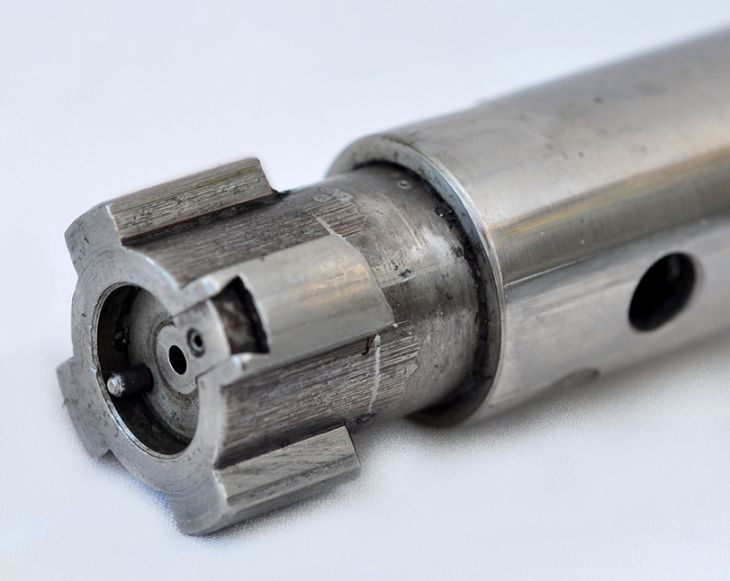
The origin of the dimension, and a real surface with real problems.
Squareness. A bolt face that is not perpendicular to the bore axis contacts the case head on one side. Headspace is then different around the circumference of the case, the case head is loaded unevenly, and the primer will show it — a lopsided flow pattern or one-sided cratering. Truing kits exist for exactly this and are ordinary gunsmithing work.
Depth. Truing a bolt face removes metal, and every thousandth removed adds a thousandth of headspace. This is direct, it is permanent, and it is the reason a bolt-face truing job on a rifle already at the loose end of the band can push it out of spec in one cut. Measure before, plan the cut, measure after.
Counterbore condition. On a recessed bolt face, the rim of the counterbore is what the case head enters. Burrs, carbon build-up, or a swelled counterbore change where the case sits. This is also the surface a headspace gauge lands on, so crud here corrupts the measurement as well as the shooting.
Firing pin protrusion. Not headspace, but it shows up in the same symptoms and gets blamed on headspace constantly. A short or bound firing pin gives light strikes; so does excess headspace, by letting the round move forward under the pin’s blow. If you are chasing light primer strikes, measure both before concluding anything.
9.5 Link Four — The Extractor and the Ejector
These do not affect headspace at all, and they wreck the measurement of it. That is why they get their own link.
A rimmed extractor claw, an extractor that grips rather than slips, or an ejector plunger standing proud of the bolt face all hold a gauge off the surface it must contact. The result reads short — the rifle looks tighter than it is, which is the unsafe direction.
Manson’s warning is worth repeating because it names the failure that is hardest to spot: make sure the ejector plunger “can be pushed below the bolt face — it may be too long, or jammed with crud and protrude to give a false gauge reading.”3 A gummed-up plunger is a constant offset on every reading you have ever taken with that bolt.
The honest complication is that Manson also argue a full-diameter gauge head locates more consistently than a relieved one, and that a plunger ejector does get compressed in normal use: “as the action is closed, the gauge centers up against the shoulder of the chamber, which forces the gauge straight within the chamber and the gauge head against the bolt face.”4 They are right that this yields a valid pass/fail. They also concede that with more than minimum headspace “the minimum gauge may remain slightly tipped.”4
A tipped gauge is fine for a verdict and fatal for a measurement. Vol 6 strips the bolt for that reason.
9.6 Link Five — The Barrel Tenon
The one link a gunsmith deliberately moves, and the one with the cleanest arithmetic.
The barrel threads into the receiver until its shoulder lands. That shoulder’s position relative to the chamber shoulder sets how far forward the chamber sits, and therefore the headspace. Turn it in further and headspace decreases; back it out and headspace increases.
The number to know, from Manson: on an 18 TPI barrel, one sixtieth of a turn changes headspace by about 0.001 inches.5 One sixtieth of a turn is the distance a minute hand moves in a minute — a barely visible rotation. Which explains the accompanying warning: “It will not take much rotation to change headspace significantly.”
The arithmetic generalises. Headspace change per turn is 1 divided by the thread pitch:
Table 1 — The arithmetic generalises. Headspace change per turn is 1 divided by the thread pitch
| Thread | Per full turn | Per 1/60 turn |
|---|---|---|
| 16 TPI | 0.0625” | 0.00104” |
| 18 TPI | 0.0556” | 0.00093” |
| 20 TPI | 0.0500” | 0.00083” |
| 24 TPI | 0.0417” | 0.00069” |
Two consequences worth holding onto.
A shouldered pre-fit has no adjustment. The maker set the relationship between the external shoulder and the chamber; you torque it and check it. If it is wrong, it is wrong, and the fix is the maker’s not yours.5
A barrel-nut pre-fit will move as you torque it, in one of two directions, and the direction is a property of that action and repeats. Vol 5 covers the timing procedure. The relevant point here is that a headspace reading taken before final torque is not the reading — always recheck after torque.
And Manson’s rule about doing this safely, once more, because it is the expensive one: “Never tighten the barrel or barrel nut with the bolt closed on a headspace gage!“5
9.7 Link Six — The Chamber Shoulder Itself
Where the reamer stopped.
How it moves the number: it is cut once and it does not move — except that it does, slowly, through erosion. Hot gas and jacket material work on the throat and the leade first, and on a high-round-count barrel the shoulder region sees enough of it to matter. Combined with brass flow, headspace on a hard-shot barrel creeps.
This is the second half of why the thousand-round check exists. Link one is set-back; link six is erosion. Both are gradual, neither announces itself, and both are invisible to a pass/fail check until they cross a boundary.
9.8 The AR-15 Has a Shorter Chain
Worth calling out because it changes both the diagnosis and the repair.
On an AR, the bolt lugs lock into the barrel extension, which is threaded and pinned to the barrel. The upper receiver carries none of the load. So the chain is: bolt face, bolt body, bolt lugs, barrel extension lugs, barrel extension threads, barrel. Three links instead of six, and the receiver is not one of them.
Practical consequences:
- Headspace is a property of the bolt-and-barrel pair. Swap either and you have changed it. Swapping a bolt between two uppers without gauging is a genuinely bad habit, and it is common.
- You can gauge it on the bare barrel, which is the cleanest way and the method Vol 5 describes.
- Excess headspace on an AR is often fixed by fitting a different bolt, because bolts vary within tolerance and the barrel extension is the expensive part. This is a real repair path rather than a bodge, provided the result is gauged.
- Lug set-back happens in the barrel extension, not the receiver. It is a barrel-assembly problem.
9.9 Putting a Number in Context
Suppose Vol 6 gave you 1.6348 on a .308 — plus 0.0048 over minimum. What produced it?
If the rifle is new or newly barrelled: almost certainly link five. That is where the chamber was left, and if you want it tighter that is where to change it.
If the number has grown since a previous reading: links one, two or six. Set-back, lug wear, or erosion. Look at the lugs first because it is free.
If a gauge reading and the fired brass disagree, with the brass reporting more headspace: link two, the lugs deflecting under load. A gauge cannot see this and never will.
If the number changed after work on the bolt: link three. A truing cut is a permanent addition to headspace and it is exactly as many thousandths as you removed.
If the number is different every time you measure: link four, or a dirty chamber. Strip the bolt, clean everything, remeasure. If it is still inconsistent, go back to link two.
That decision tree is the payoff for measuring instead of gauging. A verdict tells you a rifle is or is not serviceable. A number, taken twice, tells you which part is moving.
9.10 Bibliography
Footnotes
-
ANSI/SAAMI Z299.4-2015, “223 Remington V&P Test Barrel”, printed p. 264, and “308 Winchester V&P Test Barrel”, printed p. 306. Both originate the X dimension at BREECH BOLT FACE. Held in the project Reference Library. ↩
-
Forster Products, User Instructions for Headspace Gages, Issue 4, § 1.0. https://www.forsterproducts.com/wp-content/uploads/2024/08/Headspace_Gage_Instructions.pdf ↩
-
Manson Precision Reamers, “Instructions for Using Manson Headspace Gauges.” Emphasis added. https://mansonreamers.com/using-manson-headspace-gauges/ ↩
-
Manson Precision Reamers, “Ejector/Extractor Relief on Headspace Gauges.” https://mansonreamers.com/ejector-extractor-relief-on-headspace-gauges/ ↩ ↩2
-
Ray Gross, Manson Precision Reamers, “Headspacing Pre-fit Barrels,” August 2024. https://mansonreamers.com/headspacing-pre-fit-barrels/ ↩ ↩2 ↩3
Comments (0)