Headspace · Volume 2
The Four Breeching Types, and the Datum That Makes a Cone Measurable
Ammunition designers had to solve one problem four different ways, and the four solutions are why “headspace” means four different physical measurements depending on what is in the magazine. ANSI/SAAMI Z299.4-2015 organises its headspace-gauge section along exactly these lines, with a separate drawing and a separate dimension table for each: shoulder-breeching, belt-breeching, rim-breeching, and mouth-breeching.1 Get the type wrong and every number that follows is wrong, because you will be measuring a distance the chamber does not care about.
2.1 The Problem All Four Solve
A cartridge has to stop somewhere. It goes into the chamber nose-first under spring pressure or thumb pressure, and something has to arrest it at a repeatable station so that the primer sits a known distance from a firing pin and the case head sits against the bolt face. That stop has to work with a dirty chamber, a cold rifle, and brass that has been through a sizing die eleven times.
The four families differ only in which feature of the case is nominated as the stop.
2.2 Shoulder-Breeching
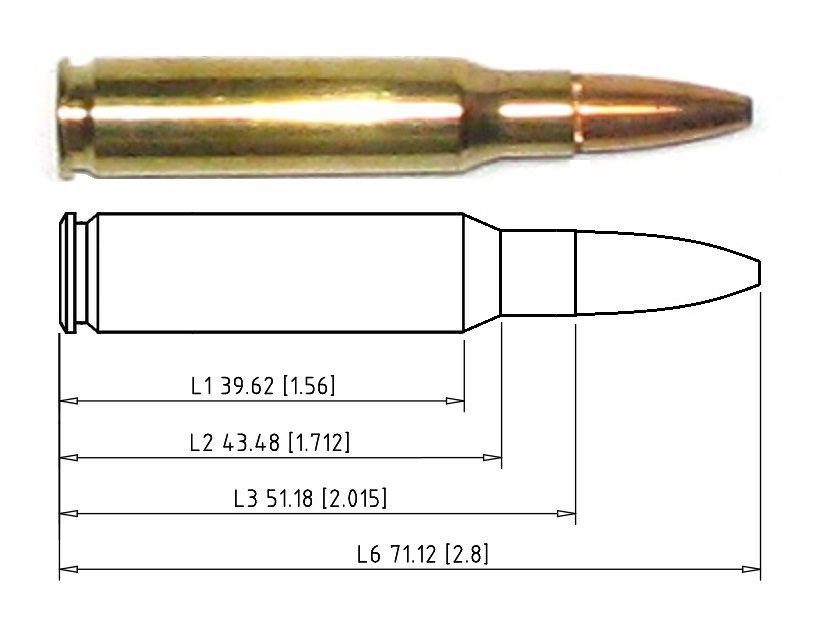
The rimless bottleneck case — .223 Remington, .308 Winchester, .30-06 Springfield, 6.5 Creedmoor, and most of what a modern rifle shooter owns — stops on its shoulder cone. The chamber narrows through a matching cone, and the case wedges in it.
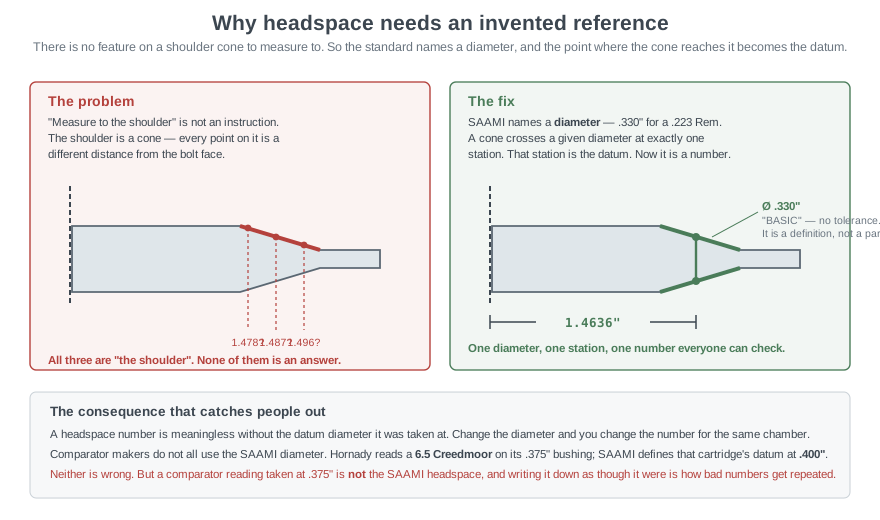
This is the elegant solution and it is also the awkward one to measure, because a cone has no edge. Every point along it is a different distance from the bolt face. “Measure to the shoulder” is not an instruction anyone can act on.
SAAMI’s answer is the datum diameter. The standard nominates a diameter — 0.330 inches for the .223 Remington, 0.400 for the .308 Winchester, 0.375 for the .30-06 — and defines the headspace as the distance from the bolt face to the station where the cone reaches that diameter.2 A cone crosses a given diameter at exactly one place, so this converts an ambiguous surface into a single number.
On SAAMI’s chamber drawings the datum diameter is printed with a B suffix, for BASIC: an exact theoretical reference carrying no tolerance of its own.3 It is not a feature you could point at on a part. It is a definition, and the tolerances live on the dimension measured to it.
Vol 3 shows how to read both off a drawing. The consequence to hold onto here is that a headspace number is meaningless without the datum diameter it was taken at. Change the diameter and you change the number for the same physical chamber. This sounds like pedantry until Vol 7, where it turns out that comparator makers do not all use the SAAMI diameter.
Here are the SAAMI figures for a representative set, read directly from the Figure I table. F MIN is the minimum chamber, F MAX the maximum, M the datum diameter.2
Table 1 — Shoulder-Breeching
| Cartridge | Min (GO) | Max | Band | Datum dia. |
|---|---|---|---|---|
| 223 Remington | 1.4636 | 1.4736 | .010 | 0.3300 |
| 222 Remington | 1.2936 | 1.3036 | .010 | 0.3300 |
| 22-250 Remington | 1.5749 | 1.5849 | .010 | 0.3470 |
| 220 Swift | 1.8060 | 1.8160 | .010 | 0.3350 |
| 243 Winchester | 1.6300 | 1.6400 | .010 | 0.4000 |
| 308 Winchester | 1.6300 | 1.6400 | .010 | 0.4000 |
| 6.5 Creedmoor | 1.5410 | 1.5510 | .010 | 0.4000 |
| 6.5 x 55 Swedish | 1.3460 | 1.3560 | .010 | 0.3600 |
| 270 Winchester | 2.0487 | 2.0587 | .010 | 0.3750 |
| 30-06 Springfield | 2.0487 | 2.0587 | .010 | 0.3750 |
| 280 Remington | 2.1000 | 2.1100 | .010 | 0.3750 |
| 257 Roberts / +P | 1.7937 | 1.8037 | .010 | 0.3750 |
| 7mm Mauser (7x57) | 1.7937 | 1.8037 | .010 | 0.3750 |
| 300 Savage | 1.6017 | 1.6117 | .010 | 0.3968 |
| 7.62 x 39 | 1.2520 | 1.2620 | .010 | 0.3622 |
| 30 Remington AR | 1.1590 | 1.1690 | .010 | 0.4000 |
Two things fall out of that table immediately.
The band is 0.010 inches in every single row. Not approximately — exactly. SAAMI gives every shoulder-breeching centerfire rifle cartridge the same ten-thousandths of latitude between minimum and maximum chamber.
Several cartridges share a row. The .243 Winchester and the .308 Winchester have identical headspace dimensions, because the .243 is the .308 necked down and nothing forward of the shoulder changed. Same for the .270 Winchester and the .30-06. This is not a coincidence to be admired; it is a practical fact you can spend money on. Forster’s own interchangeability chart confirms it from the other direction — the .270 Winchester is gauged with the .30-06 gauge, the .260 Remington and 7mm-08 with the .243 Winchester gauge, the 6x45mm with the .223 Remington gauge.4 One gauge covers a family.
2.3 Belt-Breeching
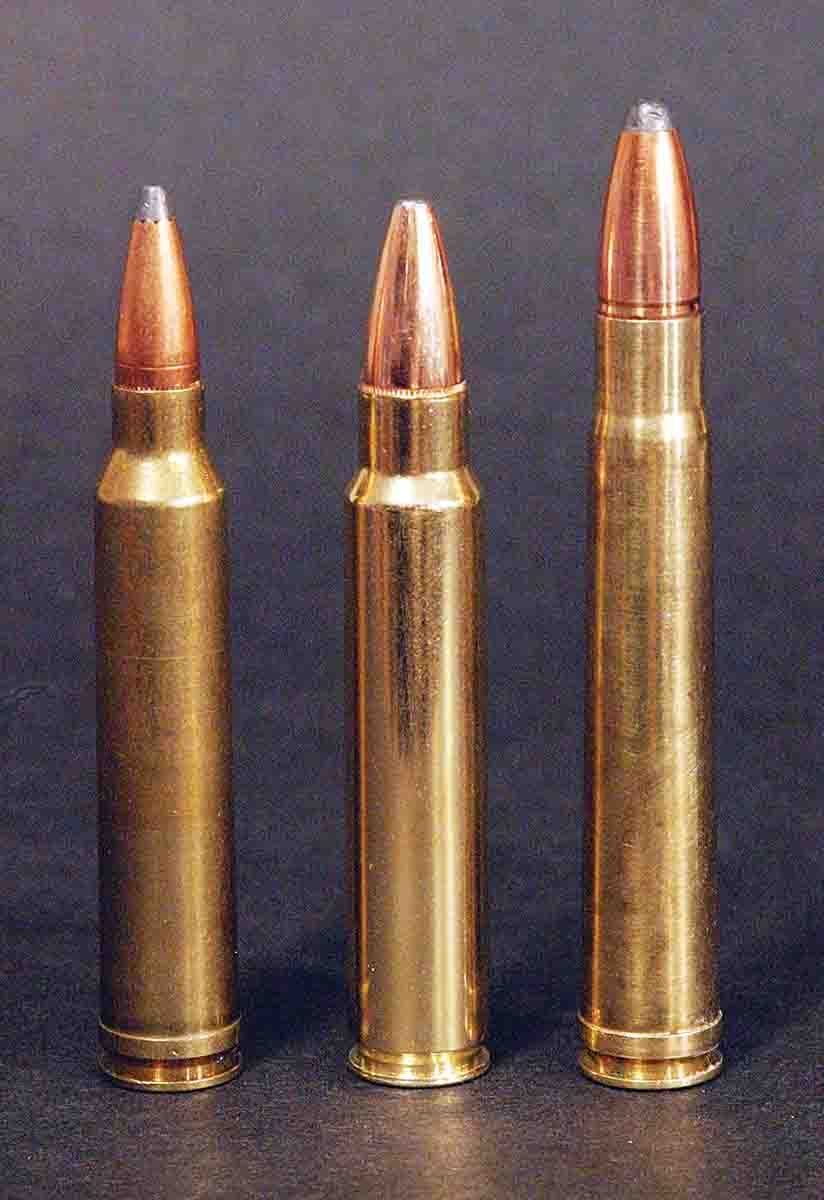
The belted magnum — .300 Winchester Magnum, 7mm Remington Magnum, .338 Winchester Magnum, the Weatherbys — carries a raised band of brass just ahead of the extractor groove, and the front face of that belt is the stop. The chamber has a matching counterbore, and the case drops in until belt meets shoulder-of-counterbore.
The shoulder up front is doing nothing at all.
This changes the character of the measurement completely. Belted headspace is a belt thickness, not a length:5
Table 2 — Belt-Breeching
| Cartridge | Min (GO) | Max | Band |
|---|---|---|---|
| 7mm Remington Magnum | 0.220 | 0.227 | .007 |
| 300 Winchester Magnum | 0.220 | 0.227 | .007 |
| 338 Winchester Magnum | 0.220 | 0.227 | .007 |
| 8mm Remington Magnum | 0.220 | 0.227 | .007 |
| 257 Weatherby Magnum | 0.220 | 0.224 | .004 |
| 7mm Weatherby Magnum | 0.220 | 0.224 | .004 |
| 300 Weatherby Magnum | 0.220 | 0.224 | .004 |
Note two things. The band is 0.007 inches, not 0.010 — belted cases get less latitude than shoulder cases. And the Weatherby rows are tighter still at 0.004 inches. That was read twice off the table; the standard gives no explanation for why, and this series does not invent one.
The belt exists for a historical reason that has almost entirely evaporated. It came from the .375 H&H family, where a long tapered case with a shallow shoulder made a shoulder stop unreliable, and a positive mechanical stop was worth the extra machining. Most modern belted magnums have shoulders perfectly capable of doing the job. Vol 11 covers what serious reloaders actually do about this, which is to headspace their brass on the shoulder and treat the belt as an anachronism they are obliged to clear.
2.4 Rim-Breeching
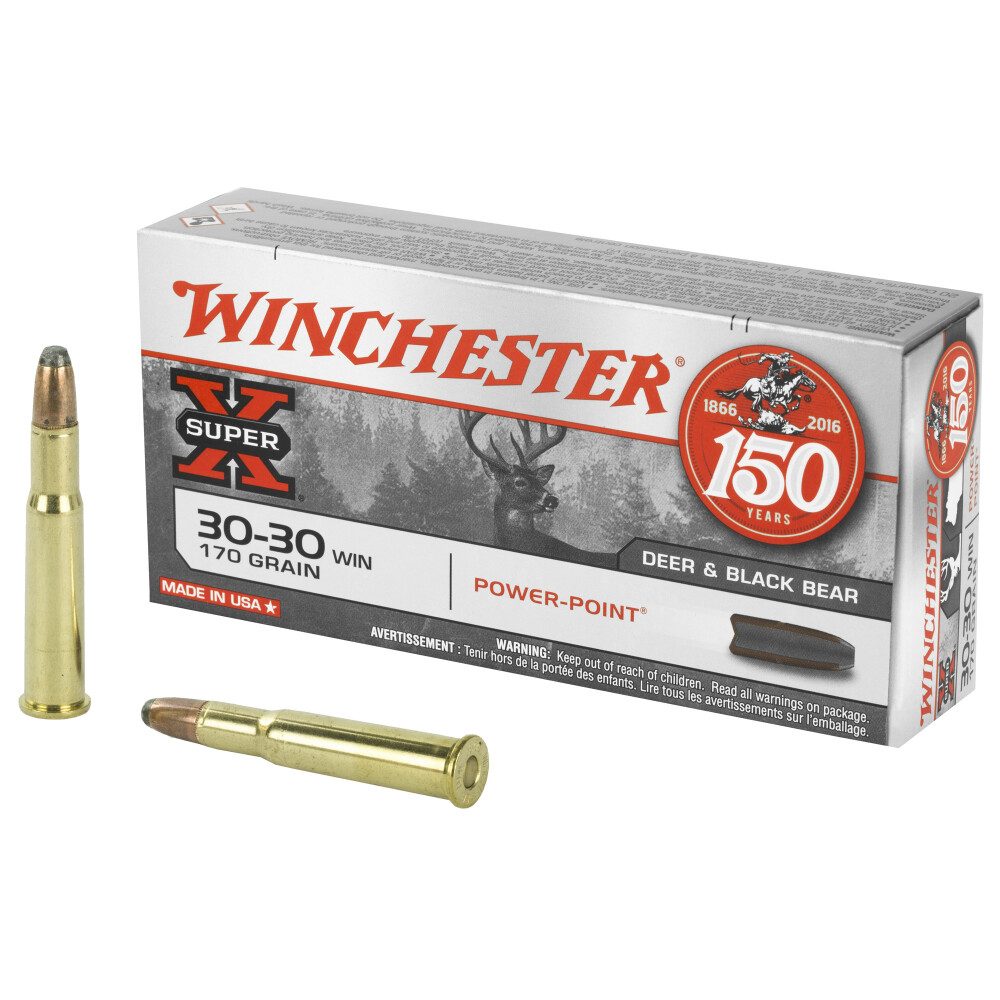
The rimmed case — .30-30 Winchester, .303 British, .45-70 Government, .22 Hornet — stops on the front face of its rim. The barrel breech is counterbored to a depth, the rim sits in it, and headspace is that depth. The gauge, correspondingly, is a disc of a defined thickness. SAAMI calls this dimension B on Figure III.6
Table 3 — Rim-Breeching
| Cartridge | Min (GO) | Max | Band |
|---|---|---|---|
| 30-30 Winchester | 0.0630 | 0.0700 | .007 |
| 32 Winchester Special | 0.0630 | 0.0700 | .007 |
| 25-35 Winchester | 0.0630 | 0.0700 | .007 |
| 303 British | 0.0640 | 0.0710 | .007 |
| 30-40 Krag | 0.0640 | 0.0710 | .007 |
| 22 Hornet | 0.0650 | 0.0720 | .007 |
| 32-20 Winchester | 0.0650 | 0.0720 | .007 |
| 348 Winchester | 0.0700 | 0.0770 | .007 |
| 45-70 Government | 0.0700 | 0.0770 | .007 |
The numbers look startling next to a shoulder case until you notice they are the same measurement expressed against a different origin. A .30-30’s headspace is 0.063 inches; a .308’s is 1.630. Both are “bolt face to the seating surface.” The rimmed case just happens to seat on something 63 thousandths in front of the bolt face rather than a inch and a half.
Two practical consequences. First, the band is again 0.007, not 0.010. Second — and this catches people who move from bottleneck to rimmed cartridges — a rimmed case’s shoulder position is irrelevant to headspace, so sizing die adjustment cannot fix a headspace complaint and cannot cause one either. What can is rim thickness variation between brass lots, which on rimmed brass is real and worth measuring.
2.5 Mouth-Breeching
The straight-wall rimless case stops on its own case mouth, which butts against a step at the front of the chamber. Z299.4 lists only two rifle cartridges in this family:7
Table 4 — Mouth-Breeching
| Cartridge | Min (GO) | Max | Band |
|---|---|---|---|
| 30 Carbine | 1.2900 | 1.3000 | .010 |
| 450 Bushmaster | 1.7000 | 1.7100 | .010 |
Every rimless pistol cartridge — 9mm Luger, .40 S&W, .45 ACP — works the same way, though those live in Z299.3, which this project does not hold.
Forster flags the peculiarity of these in their own instructions: “When they are not designed for a bottleneck case, such as with the 30 Carbine Headspace Gage, rimless gages perform slightly differently. Their headspace is the overall length of the case.”8
This is the family where trimming a case changes its headspace, and it is the single most important exception in Vol 11. A .223 Remington case trimmed 0.010 inches short still headspaces perfectly on its shoulder. A .45 ACP case trimmed 0.010 short has 0.010 inches of excess headspace and will produce light primer strikes and inconsistent ignition. Same operation, entirely different consequence, and the reason so much reloading writing muddles “trimming” and “headspacing” into one topic.
2.6 How the Gauges Are Made
All four SAAMI gauge drawings share a specification block worth knowing, because it explains why a headspace gauge costs what it costs and why you can trust one: AISI-O6 steel or equivalent, heat treated to Rc 60-64, surface finish 32, general tolerances ±0.005 inches.1
The critical dimension is toleranced far tighter, and asymmetrically. On the minimum (GO) gauge the length is F + .0002 / −0; on the maximum gauge it is F − .0002 / +0.2 Read that again, because the sign is the entire point: a GO gauge may only ever err long, and a NO-GO gauge may only ever err short. A gauge that drifts within its tolerance therefore always fails a marginal chamber. It can never pass one it should have caught. That is a deliberate, safety-directed choice baked into the standard, and it is why gauges are worth buying rather than turning.
All four drawings also show an optional “PARTIAL VIEW — EXTRACTOR CLEARANCE” cut. Optional is the operative word, and Vol 5 covers the genuine disagreement between makers about whether that relief is a help or a hindrance.
2.7 Getting the Type Right
The type is a property of the cartridge, not of the rifle, and it is almost always obvious from the case. If it has a rim wider than the body, it is rim-breeching. If it has a belt, it is belt-breeching regardless of how prominent the shoulder is. If it has a shoulder and no belt, it is shoulder-breeching. If it has neither, it is mouth-breeching.
The one that trips people is the belted case, precisely because it has an obvious shoulder. A .300 Winchester Magnum looks like a shoulder-breeching cartridge and is not, and a gauge or a comparator applied to its shoulder measures something real but not its headspace.
The one genuinely awkward case is the Ackley Improved rimless chambering, where the case is held at neither the full shoulder nor a rim. Vol 4 covers how Ackley and Manson deal with it, because the answer — a GO gauge deliberately ground short — is not something you would guess.
2.8 Bibliography
Footnotes
-
ANSI/SAAMI Z299.4-2015, Section III, “HEADSPACE GAUGES”, pp. 212-220. Four figures, four cartridge families, four dimension tables. Material and hardness callouts appear on all four drawings. Held in the project Reference Library. ↩ ↩2
-
ANSI/SAAMI Z299.4-2015, Figure I, “SHOULDER-BREECHING CENTERFIRE RIFLE HEADSPACE GAUGES”, pp. 212-215. Columns as labelled on the drawing: F MIN / F MAX are the headspace dimension limits; M is the basic datum diameter; the F tolerance callouts are printed on the figure itself. ↩ ↩2 ↩3
-
ANSI/SAAMI Z299.4-2015, “223 Remington V&P Test Barrel”, p. 264. Datum diameter printed as
.330 (8.38) B; drawing noteX = HEADSPACE DIMENSION;B = BASIC. ↩ -
Forster Products, Gunsmithing Tools catalogue, Table 2, “Headspace Gage Order Guide”. https://www.forsterproducts.com/wp-content/uploads/2024/08/Gunsmithing_Headspace_Gages_Cat82_38-42.pdf ↩
-
ANSI/SAAMI Z299.4-2015, Figure II, “BELT-BREECHING CENTERFIRE RIFLE HEADSPACE GAUGES”, pp. 216-217. ↩
-
ANSI/SAAMI Z299.4-2015, Figure III, “RIM-BREECHING CENTERFIRE RIFLE HEADSPACE GAUGES”, pp. 218-219. ↩
-
ANSI/SAAMI Z299.4-2015, Figure IV, “MOUTH-BREECHING CENTERFIRE RIFLE HEADSPACE GAUGES”, p. 220. ↩
-
Forster Products, User Instructions for Headspace Gages, Issue 4, § 6.1. https://www.forsterproducts.com/wp-content/uploads/2024/08/Headspace_Gage_Instructions.pdf ↩
Comments (0)