Headspace · Volume 4
GO, NO-GO and FIELD — In Full, Including the Part Nobody Mentions
Three hardened steel plugs, each a dummy cartridge ground to a length. You drop one in the chamber, close the bolt, and the rifle tells you something. That is the whole system, it has worked for a century, and it is the right first check on any rifle you cannot vouch for. This volume is about what each gauge actually represents, because the popular account — “GO is minimum, NO-GO is maximum, FIELD is dangerous” — is wrong in the middle and misleading at the end.
4.1 The Popular Account, and Where It Fails
Ask around and you will be told: GO is the SAAMI minimum, NO-GO is the SAAMI maximum, FIELD is beyond the maximum and means the rifle is dangerous.
The first clause is correct and universal. The second is wrong for at least one major maker. The third is backwards for at least one major maker. Neither error is anybody’s fault; they come from the fact that SAAMI defines only two dimensions and the industry sells three gauges, so the third has to be invented, and different companies invented it differently.
4.2 What Forster Says
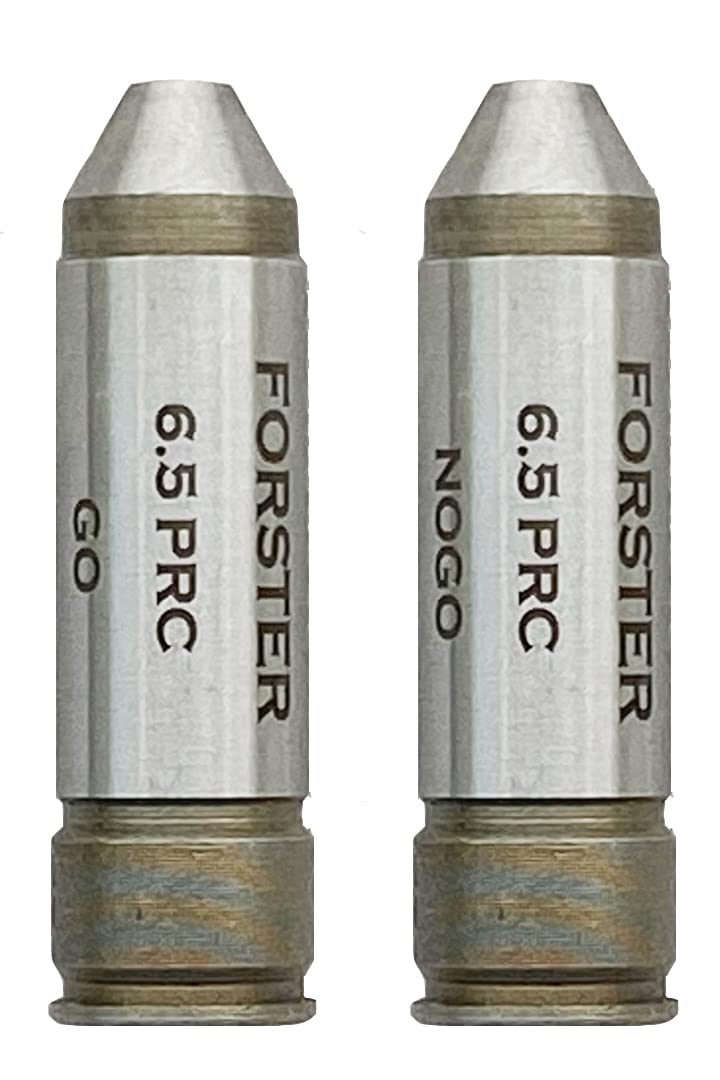
Forster Products publish their definitions in the instruction sheet that ships with every gauge. Verbatim:1
GO: Corresponds to the minimum chamber dimensions. If a rifle closes on a GO gage, the chamber will accept ammunition that is made to SAAMI maximum specifications. The GO gage is essential for checking a newly-reamed chamber in order to ensure a tight, accurate, and safe chamber that will accept SAAMI maximum ammo.
NO-GO: Corresponds to the maximum headspace we recommend for gunsmiths’ chambering new bolt-action rifles. This is not a SAAMI-maximum measurement. If a rifle closes on a NO-GO gage, it may still be within SAAMI specifications, or it may have excessive headspace. To determine if there is excessive headspace, the chamber should then be checked with a FIELD gage.
FIELD: Corresponds to the longest safe headspace. If a rifle closes on a FIELD gage, its chamber is dangerously close to, or longer than, SAAMI-specified maximum chamber size. FIELD gages are slightly shorter than the SAAMI maximum in order to give a small safety margin.
Read the two emphasised sentences again. Forster’s NO-GO is not the SAAMI maximum — it is a build standard, a line Forster recommends a gunsmith hold to when cutting a new chamber. And Forster’s FIELD is shorter than the SAAMI maximum, deliberately, so that a rifle which trips it is caught before it is actually out of spec.
Forster’s summary of what a good rifle does: “A rifle with the correct headspace should close easily and without feel on the GO gage, but should not close on the FIELD gage. If it does close on the NO-GO gage, but not on the FIELD gage, the rifle is still serviceable.”1
That last sentence surprises people who have been taught that closing on NO-GO condemns a rifle. By Forster’s own definitions, it does not.
4.3 What Manson Says
Manson Precision Reamers publish theirs too, and they open the topic with exactly the problem this volume exists to explain:2
“Confusion often arises when comparing headspace readings generated by gauges from different manufacturers — a rifle may accept both ‘GO’ and ‘NO GO’ gauges from one maker but only the ‘GO’ from another. This would lead a reasonable person to ask, ‘why?’ The answer lies in the dimensions and tolerances to which the gauges are made.”
“It’s important to understand that the various makers of headspace gauges do not use the same dimensions for what is termed ‘GO’, ‘NO GO’ and ‘Field’.”
Their own scheme, verbatim:
“In rimless, shouldered calibers, our ‘GO’ gauge corresponds to the SAAMI (or industry) minimum; ‘NO GO’ is ground to minimum plus .004”; ‘Field’ corresponds to SAAMI maximum (min. plus .010”).”
And their reasoning for having three at all:
“We use both a two-gauge and three-gauge system for checking headspace. Three gauges (‘GO’, ‘NO GO’, and ‘Field’) are used with rimless, shouldered rifle calibers, eg. 30-06. This is done because SAAMI allows .010” between minimum and maximum headspace for these chamberings. Many feel (ourselves included) that only knowing headspace within .010” is imprecise and that an intermediate gauge is called for.”
For everything else — shotgun, rimfire, rimmed, belted, and rimless pistol cases such as the .45 ACP — Manson use a two-gauge system: GO at the SAAMI minimum, NO-GO at the SAAMI maximum, and no FIELD gauge at all.
4.4 Putting Them Side by Side
Table 1 — Putting Them Side by Side
| Forster | Manson | |
|---|---|---|
| GO | SAAMI minimum | SAAMI minimum |
| NO-GO | a recommended build limit; explicitly not the SAAMI maximum; dimension unpublished | SAAMI minimum + 0.004”, stated |
| FIELD | slightly shorter than the SAAMI maximum | the SAAMI maximum exactly (min + 0.010”) |
| Non-shouldered cases | three gauges offered for most | two gauges; no FIELD |
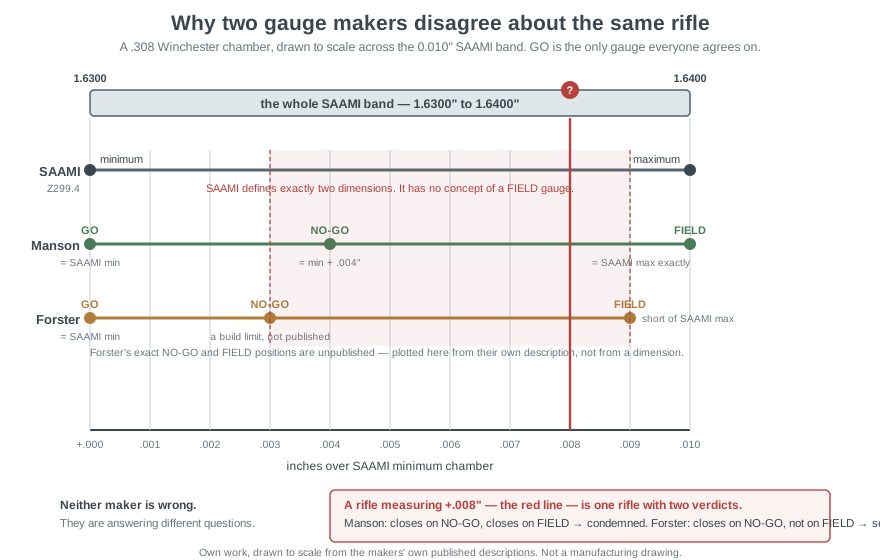
Take a .308 Winchester chamber measuring 1.6380 inches — that is 0.008 inches over the SAAMI minimum of 1.6300, well inside the 1.6400 maximum. Perfectly legal, if loose.
- Against Manson gauges: closes on GO (1.6300). Closes on NO-GO (1.6340). Does not close on FIELD (1.6400). Verdict: in spec, sloppy, serviceable.
- Against Forster gauges: closes on GO. Closes on NO-GO. Whether it closes on FIELD depends on exactly where Forster put FIELD, which they do not publish — but since it is “slightly shorter than the SAAMI maximum,” a rifle at +0.008 is uncomfortably near it.
Move that rifle to 1.6395 — still in spec, 0.0005 under the SAAMI maximum — and it will very likely close on a Forster FIELD gauge, which Forster’s own warning says means do not fire it. The same rifle will not close on a Manson FIELD gauge, which by Manson’s scheme means it is in spec.
Neither maker is wrong. Forster is answering “is there margin left?” and Manson is answering “is it in spec?” Those are different questions and they deserve different answers. But if you own one brand’s gauges and read another brand’s advice on the internet, you will reach a conclusion neither company intended.
This is the whole argument for Vols 6 through 8. A number does not have a brand.
4.5 The NATO Gauges
Forster publish actual dimensions for their NATO gauges, which makes them the most useful published numbers in the whole gauge market:1
Table 2 — The NATO Gauges
| Order no. | Description | Length |
|---|---|---|
| HG0223G | 5.56 NATO minimum chamber | 1.4636” |
| HG556NATOMax | 5.56 NATO maximum chamber | 1.4736” |
| HG762NATOMin | 7.62 NATO minimum chamber | 1.6355” |
| HG762NATOMax | 7.62 NATO maximum chamber | 1.6455” |
Two things jump out.
7.62 NATO sits 0.0055 inches longer than .308 Winchester at both ends — 1.6355/1.6455 against SAAMI’s 1.6300/1.6400. Forster note explicitly that “the 7.62 NATO Headspace Gages do not conform to SAAMI tolerances.”1 This is the real, documented difference between the two chamberings, and it is why a .308 GO gauge in a 7.62 NATO chamber will read tight, and why military brass fired in a NATO chamber can be a handful in a commercial .308.
Forster’s 5.56 NATO minimum gauge is literally the .223 Remington GO gauge — same part number, HG0223G — and their 5.56 maximum is 1.4736, which is the SAAMI .223 maximum exactly. On the headspace dimension alone, Forster treat 5.56 and .223 as identical.
That last point is worth dwelling on, because Manson say something different. Manson’s account of why 5.56 ammunition raises pressure in a .223 chamber lists the differences as: “the 5.56 chamber is slightly larger in diameter than the 223 in the body and neck areas, has slightly longer headspace and, most importantly, a throat configuration both larger in diameter and longer with a more gradual lead angle into the rifling.”3
So one maker says the headspace differs slightly and the other sells one gauge for both minimums. This series does not resolve that. The honest statement is that the dominant difference between the two chamberings is the throat, that both companies agree on this, and that whatever headspace difference exists is small enough that two of the largest gauge makers in the country do not agree it is there. There is also a widely repeated claim that MIL-DTL-71186A specifies a 5.56 GO of 1.4646” and a NO-GO of 1.4706”; that could not be verified against the specification itself and it contradicts Forster’s own catalogue, so it is not printed here as fact.
The safety guidance both makers agree on completely, and it is worth stating plainly: do not fire 5.56 NATO ammunition in a chamber marked .223 Remington. The reverse is fine.3
Forster also note that for the NATO chamberings “there is not a mid-range NO-GO gage available” — two gauges only.1
4.6 Ackley Improved Chambers
An improved rimless chambering has a blown-out body and a sharper shoulder, and its headspace behaves differently in a way that is not intuitive.
When you fire a standard factory round in an improved chamber to fireform it, the case is not supported along its whole shoulder — the improved chamber’s shoulder is in a different place and at a different angle. Manson explain: “the base of the cartridge contacts the breech face in the usual manner, but the front of the case is contacted only at the neck/shoulder junction and not along the entire length of the shoulder.”4
Because the case must be held securely during that fireforming shot, the distance from breech face to that neck/shoulder junction becomes the critical dimension, and it must be tighter than standard. Manson quote Ackley’s own recommendation: reduce it “by .004”/.006” from the standard minimum for a particular caliber.”4
The consequences follow directly:
- A barrel being converted to an improved chambering must be set back by at least 0.004 to 0.006 inches. Manson add the practical note that “it’s often best to set the barrel back one full turn — this allows plenty of material to work with when re-cutting the chamber and will result in any barrel markings being in the same place.”
- Manson’s improved GO gauge is 0.004 to 0.006 inches shorter than the standard GO gauge, with the same shoulder angle as the original.
- The standard GO gauge is used as the NO-GO gauge in an improved chamber. That is a clean, memorable rule and it means an Ackley conversion needs one extra gauge, not two.
- Gauging an improved chamber needs “a lighter touch” because the gauge makes only line contact at the neck/shoulder junction.4
Improved versions of rimmed and belted cases present none of this difficulty — headspace is still controlled by the rim or the belt, and standard gauges apply unchanged.4
4.7 What a Gauge Is Physically
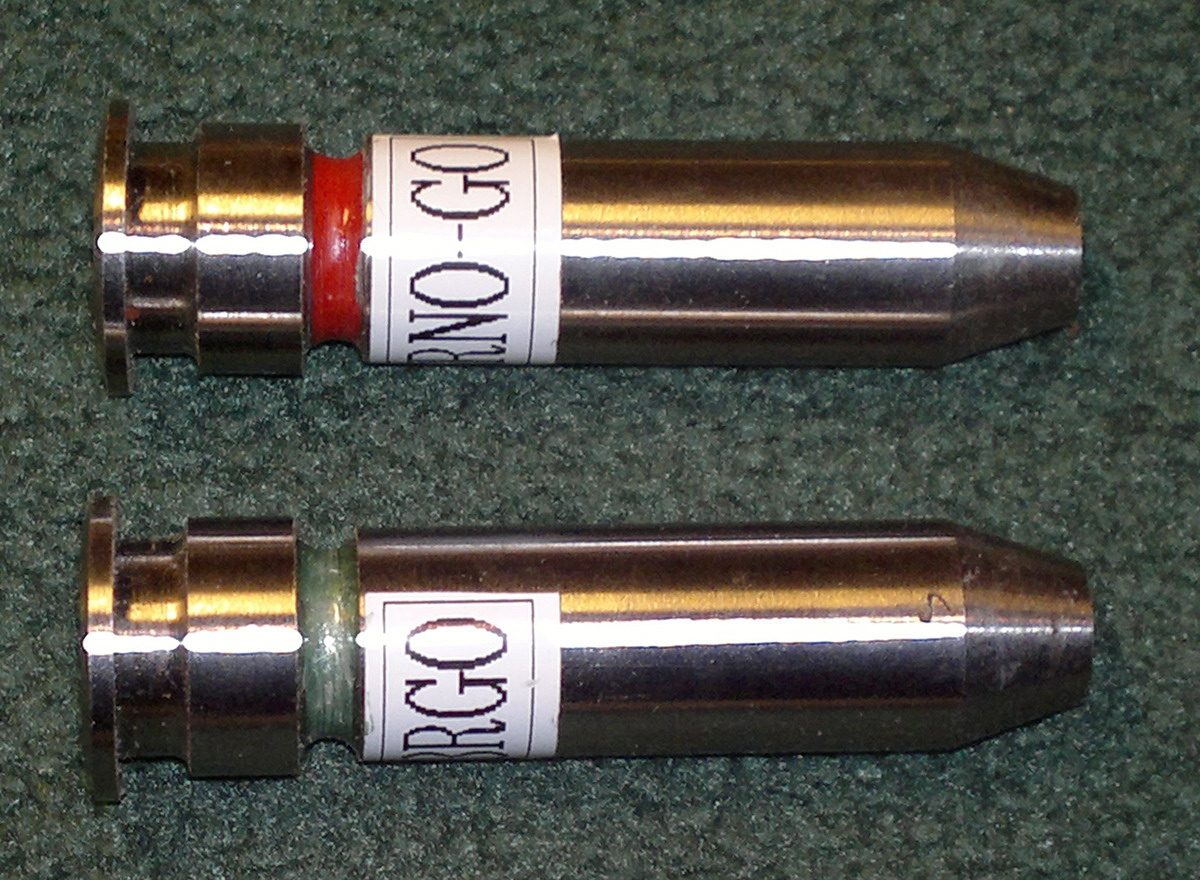
From the SAAMI drawings: AISI-O6 steel or equivalent, hardened to Rc 60-64, surface finish 32.5 Forster hold the headspace dimension to ±0.00015 inches and inspect every gauge with NIST-certified instruments.6 Manson state that their “manufacturing tolerances are such that actual gauge measurement will always fall within SAAMI limits.”2
A gauge is therefore a considerably better length standard than most of what is on a home bench, which is exactly what makes the feeler-stack method of Vol 6 work: you are not measuring an unknown against an unknown, you are measuring a small increment against a certified reference.
4.8 Buying Them
Forster’s catalogue includes an interchangeability table that saves real money, because one gauge covers a family of cartridges sharing a parent case.7 A few of the useful ones:
Table 3 — Forster's catalogue includes an interchangeability table that saves real money, because one gauge covers a family of cartridges sharing a parent case.[^forster-chart] A few of the useful ones
| You shoot | You buy the gauge for |
|---|---|
| 270 Winchester, 25-06, 6.5-06 | 30-06 Springfield |
| 260 Remington, 7mm-08 | 243 Winchester |
| 6x45mm | 223 Remington |
| 22-284, 6mm-284, 25-284, 6.5-284, 270-284 | 284 Winchester |
| 7mm Mauser (7x57), 6.5x257 Roberts | 257 Roberts |
| 219 Donaldson Wasp, 219 Zipper, 22 Savage Hi-Power, 25-35 WCF, 7mm-Int. R | 30-30 WCF |
| 257 Weatherby, 264 Win Mag, 270 Weatherby, 6.5 Rem Mag, 7mm Rem Mag, 275 H&H | standard belted magnum, .535” O.D. |
That last row is the good news about belted cases: because headspace is a belt thickness and the belt is common across the family, one gauge set covers most of the belted magnums you are likely to own.
The bad news is the corollary. Since a belted GO gauge is checking a belt counterbore that barely wears, a belted magnum can pass its headspace check comfortably while the chamber’s shoulder has moved far enough forward that your brass is stretching badly. Vol 11 covers what to do about that.
4.9 Bibliography
Footnotes
-
Forster Products, User Instructions for Headspace Gages, Issue 4, §§ 3.4, 4.0, 6.3 and Table 1. Emphasis in the quoted definitions added. https://www.forsterproducts.com/wp-content/uploads/2024/08/Headspace_Gage_Instructions.pdf ↩ ↩2 ↩3 ↩4 ↩5
-
Manson Precision Reamers, “Dimensions and Tolerances of Manson Headspace Gauges.” Emphasis added. https://mansonreamers.com/dimensions-and-tolerances-of-manson-headspace-gauges/ ↩ ↩2
-
Manson Precision Reamers, “Why Does Firing 5.56 Ammo in a 223 Rem Chamber Result in Higher-Than-Normal Pressures?” https://mansonreamers.com/why-does-firing-5-56-ammo-in-a-223-rem-chamber-result-in-higher-than-normal-pressures/ ↩ ↩2
-
Manson Precision Reamers, “How Ackley Improved Chambers are Headspaced.” https://mansonreamers.com/how-ackley-improved-chambers-are-headspaced/ ↩ ↩2 ↩3 ↩4
-
ANSI/SAAMI Z299.4-2015, Section III, “HEADSPACE GAUGES”, printed pp. 212-220, material and hardness callouts on all four figures. Held in the project Reference Library. ↩
-
Forster Products, Gunsmithing Tools catalogue, “Headspace Gages” features list. https://www.forsterproducts.com/wp-content/uploads/2024/08/Gunsmithing_Headspace_Gages_Cat82_38-42.pdf ↩
-
Forster Products, Gunsmithing Tools catalogue, Table 2, “Headspace Gage Order Guide”. ↩
Comments (0)