Headspace · Volume 7
Measuring the Actual Number — Comparators and Dial Instruments
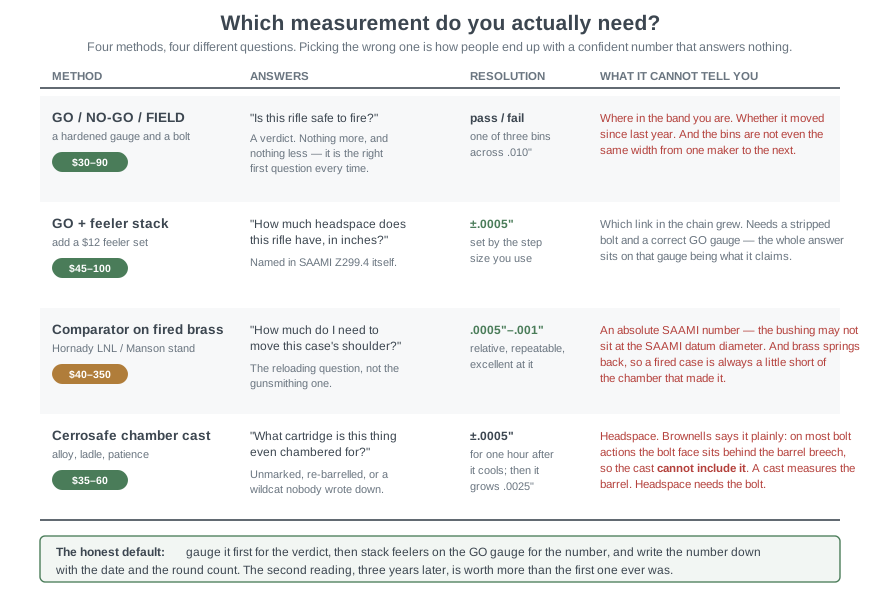
Comparators are the instruments most shooters actually own, and they are the ones most often used to produce a number that means something other than what the owner thinks it means. A Hornady Lock-N-Load bushing on a caliper is an excellent tool doing exactly what its maker claims. What its maker claims is narrower than what it gets used for, and the gap is where bad headspace numbers come from.
7.1 What a Comparator Is
A comparator is a bushing with a hole in it, sized so the hole’s edge intersects the case shoulder cone at a chosen diameter. Put it on a caliper jaw, drop a case in nose-first until the shoulder wedges in the hole, close the caliper on the case head, and read. You have measured from the case head to a point on the shoulder — the case’s own headspace dimension.
Hornady’s Lock-N-Load system attaches to a caliper blade via the B-2000 body, shared with their bullet comparator. Manson’s Cartridge Comparator is a standalone dial-indicator stand doing the same job with more precision. Both are measuring the case, never the chamber, and inferring the chamber from a fired case.
7.2 The Hornady Lock-N-Load
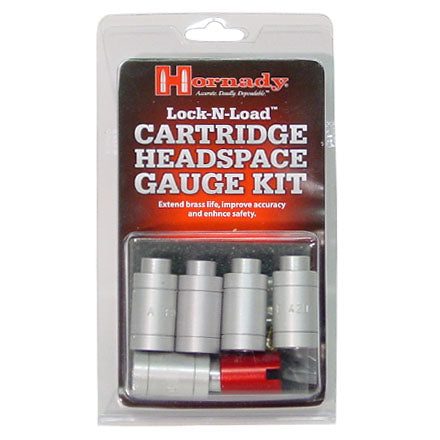
Setting it up. “Insert the brass Thumb Screw into the threaded hole in the B-2000 Body, which will allow the Body to center on your caliper blade. Select the proper Bushing from the chart and insert into the Body. Then position the assembly on your caliper blade. Close the caliper blades snugly to align the assembly with your caliper, then tighten the Set Screw and Thumb Screw.”1
Aligning the body by closing the caliper on it, before tightening, is the step people skip. A body clamped crooked reads crooked and it will do so consistently, so you will never notice.
Choosing a bushing. Hornady give a rule and a chart. The rule: “If you add the neck diameter and the shoulder diameter and divide that number by two, you will know the proper bushing diameter to use.”1
The chart:1
Table 1 — The Hornady Lock-N-Load
| Bushing | Cartridges |
|---|---|
| F — .188” | blank, drill and ream your own for sizes not listed |
| G — .240” | 17 Hornet |
| A — .330” | 17 Rem, 204 Ruger, 221 Rem FB, 222 Rem, 222 Rem Mag, 223 Rem, 220 Swift |
| B — .350” | 22 PPC, 22-250 Rem, 6 PPC, 6 BR Rem, 250-3000 Savage, 7 BR Rem, 300 Blackout, 6.5 Grendel, 6mm ARC |
| C — .375” | 6mm Rem, 257 Rob, 25-06, 270 Win, 7x57 Mauser, 280 Rem, 30-30 Win, 30-06, 300 H&H, 7.62x39, 6.5x55 Swedish, 7mm WSM, 30-40 Krag, 6.5 Creedmoor, 6.5x47 Lapua |
| D — .400” | 223 WSSM, 243 Win, 243 WSSM, 260 Rem, 270 WSM, 7mm-08, 300 Savage, 308 Win, 35 Rem |
| E — .420” | 6.5x284, 6.5 PRC, 284 Win, 7mm Rem Mag, 300 WSM, 300 Wby, 325 WSM, 338 Win Mag, 350 Rem Mag, 375 H&H, 264 Win Mag, 7mm SAUM, 7mm STW, 300 RSAUM, 300 Win Mag, 300 RUM, 8mm Rem Mag, 338 RUM, 35 Whelen |
Ackley Improved chambers “use the same bushing size as the parent case.”2
Taking a reading. “Open the caliper and center the case shoulder into the Bushing. Bring the caliper blade to rest on the case head and rotate the case as you remove slack, then take a reading. Be consistent.”1
Rotating the case as you remove slack is the technique. A case sitting slightly cocked in the bushing reads long; rotating it lets it find its seat. Doing it the same way every time matters more than doing it any particular way.
7.3 The Divergence Nobody Mentions
Compare Hornady’s bushing assignments against the SAAMI datum diameters from Vol 2, read out of Z299.4’s Figure I table.3
Table 2 — The Divergence Nobody Mentions
| Cartridge | Hornady bushing | SAAMI datum | Same? |
|---|---|---|---|
| 223 Remington | A — .330” | 0.3300 | yes |
| 222 Remington | A — .330” | 0.3300 | yes |
| 308 Winchester | D — .400” | 0.4000 | yes |
| 243 Winchester | D — .400” | 0.4000 | yes |
| 30-06 Springfield | C — .375” | 0.3750 | yes |
| 270 Winchester | C — .375” | 0.3750 | yes |
| 6.5 Creedmoor | C — .375” | 0.4000 | no |
| 7.62 x 39 | C — .375” | 0.3622 | no |
| 6.5 x 55 Swedish | C — .375” | 0.3600 | no |
| 220 Swift | A — .330” | 0.3350 | no |
For a .223 or a .308 the Hornady bushing sits at the SAAMI datum diameter and a reading is directly comparable to a SAAMI number. For a 6.5 Creedmoor it is not. Hornady read that cartridge on the .375 bushing; SAAMI define its datum at .400. A 6.5 Creedmoor read on a .375 bushing will give a number roughly 0.030 inches longer than the SAAMI dimension, because .375 is further down the cone toward the body.
Neither is wrong. Manson explain exactly why this happens, and say so in their own instructions:
“Please note that the datum diameter given on the List may not be the same as specified in SAAMI for a particular cartridge. Many different datum diameters are used commercially; in order to keep the required Datum Blocks to a reasonable number, we’ve converted headspace dimensions of some chamberings to use the more common datum diameters.”4
Five or seven bushings have to cover a hundred cartridges. Rounding several cartridges onto a shared bushing is a sensible engineering compromise for a tool whose stated purpose is comparing your brass to your brass.
The failure is not the tool. The failure is writing the reading down as if it were a chamber dimension. Hornady are precise about what their tool does: it “measures variations in your brass before and after firing, or resizing. It allows comparison between fire-formed brass and your resized brass.”2 Variations. Comparison. Both words are doing work.
So: a comparator reading is a relative measurement, excellent at what it does. A comparator reading is not your chamber’s SAAMI headspace unless the bushing happens to sit at the SAAMI datum diameter, and you have checked that it does.
7.4 The Manson Cartridge Comparator
Manson’s instrument is the same idea built properly: “a base, column and indicator holder. The indicator holder carries a .001” plunger-type Dial Indicator, with a 3/8” flat contact button, and can be raised or lowered relative to the base and locked in place as required.”4
The base carries a base datum that locates individual datum blocks central to the indicator’s shaft. “Each end of a Datum Block has the datum diameter of that end etched on it.” All gauge and datum blocks are ground to 1.000 inch long, and a solid 1.000-inch reference gauge block is supplied. The base itself acts as a .560-inch datum block for very large cases.4
Manson state its three functions plainly:4
- Measure headspace of factory or reloaded ammunition
- Quantify chamber headspace by measuring headspace of fired cases
- Ensure minimal shoulder set-back when setting up reloading dies
The middle one is the interesting claim, and Manson hedge it correctly: “by measuring headspace of a fired case, the shooter can come very close to knowing the headspace of the chamber in which the round was fired.”
7.4.1 The procedure
Condensed from Manson’s instructions:4
- Select the datum block from the supplied Cartridge List. Clean every surface of the block and the base datum.
- Place the headspace gauge nose-down in the datum block. This is the step that makes the whole method absolute rather than relative — you are calibrating against a certified length.
- Lower the indicator holder until the button just contacts the base of the gauge and the pointer sits a little past 12 o’clock; lock the thumbscrew, “being careful not to over-tighten.”
- Rotate the datum block — not the gauge — “until the headspace gauge settles into the Block and the pointer no longer bounces or wobbles. It’s important that only the Datum Block rotates and doesn’t rock. Your fingers should not contact the gauge as this may prevent it from seating properly.”
- Zero the bezel against the pointer.
- Raise the button, swap the gauge for the case to be measured, lower the button onto the case head.
- Rotate the datum block again until the case settles.
- “You can accurately determine the headspace by noting how much, plus or minus, the case differs from the headspace gauge and adding or subtracting the difference from the dimension of the gauge.”
For cases whose head-to-datum length exceeds the indicator’s one inch of travel, stack the solid 1.000-inch gauge block on top of the datum block — “the solid Block should be on top of the top Datum Block so the Indicator Button bears on a solid surface.”4
Step 2 is what separates this from a bushing comparator. Zeroing against a headspace gauge of known dimension converts a relative instrument into an absolute one. The output is a real number in the SAAMI frame, subject only to whether the datum block matches SAAMI’s diameter — which is the caveat Manson themselves flag.
7.5 Reading a Fired Case, and Its Two Limits
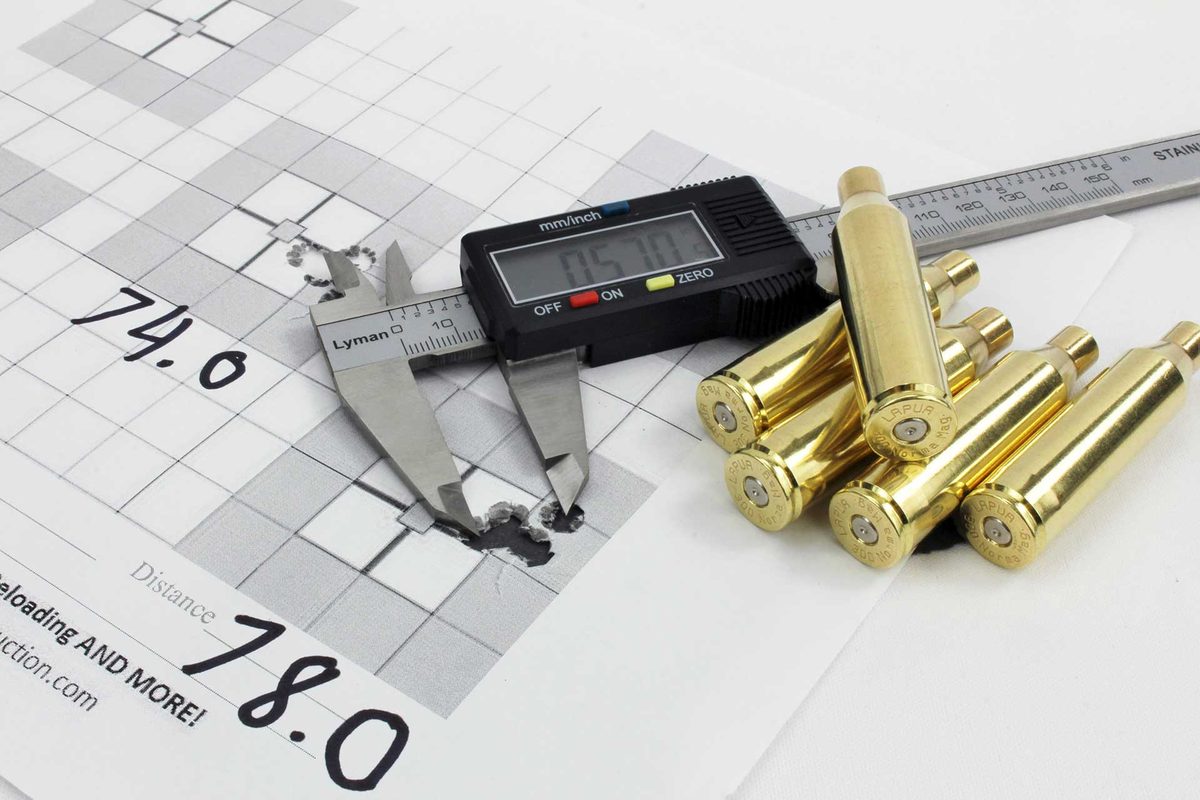
Both instruments infer the chamber from a fired case. There are two reasons that inference is imperfect and one reason it can be flatly wrong.
7.5.1 Springback
Brass fired at 60,000 psi expands to the chamber and then relaxes. A fired case is therefore always a little shorter than the chamber that made it — commonly quoted as one to two thousandths, varying with pressure, brass hardness, alloy, and how many times that case has been worked. Hornady’s own warning: “Different lots of fire-formed brass may measure differently due to alloy and temper variations in the brass. Also, work-hardening, which results from re-sizing and firing, will have an effect.”1
Low-pressure loads produce cases that have not fully filled the chamber at all, and those read much shorter. If you want a fired case to represent the chamber, fire a full-pressure load in a case that has been through the chamber at least once already.
7.5.2 The primer
This is Manson’s contribution and it is the sharpest practical detail in the whole comparator topic. Two conditions on a fired case will corrupt a head-to-datum measurement, and both are common in exactly the rifles you would most want to measure.4
Protruding primer — “often the result of chamber headspace being longer than headspace of the cartridge. Occurs when the firing pin pushes the round forward in the chamber and the primer then backs out when full pressure is realized and the case grips the chamber walls, preventing it from fully contacting the breech face.”
Note the mechanism, because it is the whole story of excess headspace in miniature: the firing pin shoves the round forward, the primer backs out to meet the bolt face, then the case body grips the chamber and never comes back. The primer is left standing proud.
Manson’s instruction: “In this situation, chamber headspace must be measured from the shoulder to the rear of the protruding primer.” That is not a workaround — the proud primer is where the bolt face was, so measuring to it measures the real thing.
Cratered primer — metal extruded back into the firing-pin hole. “The ‘splash’ must be removed before gauging headspace to achieve a true measurement.” Remove it by flat-filing or sanding the protruding material, “or simply decapping the case, being careful not to expand the neck, which could cause shoulder movement.”
That parenthesis is worth its own line. Decapping can move the shoulder if the decapping stem’s expander ball drags through the neck on the way out. If you are decapping specifically in order to measure, use a decapping die with no expander, or pull the expander.
If both conditions are present: “remove the protruding primer material without changing the location of the primer and take headspace measurements including the protruding primer.”4
7.5.3 When the inference is simply wrong
A case fired in a chamber with substantial excess headspace may have stretched at the web rather than filling the chamber at the shoulder — the failure mode drawn in Vol 12. In that case the shoulder never reached the chamber shoulder, the head-to-datum reading is short, and the comparator will report a tighter chamber than you actually have.
A comparator on fired brass therefore has an unsafe failure mode: it under-reports headspace on exactly the rifles where headspace is a problem. That is a good reason to keep a GO gauge on the bench even if you own a comparator, and it is the argument for Vol 6’s method as the primary tool for anything that is not your own well-known rifle.
7.6 What Each Instrument Is Actually For
Hornady LNL bushing comparator — around $40 with the bushing set. Excellent at the one job Hornady claim: telling you how far you moved a shoulder. Every reloader should own one. Not a source of absolute chamber dimensions unless the bushing coincides with the SAAMI datum, which for six of the ten cartridges checked above it does not.
Manson Cartridge Comparator — a few hundred dollars. Higher resolution, more repeatable, and — because it zeroes against a headspace gauge — capable of producing an absolute number. If you set up dies for many cartridges, or you want fired-case data you can compare against SAAMI, it earns its keep.
Neither replaces a GO gauge and feeler stack for the question “is this rifle’s chamber within spec.” Comparators measure brass. Vol 6 measures the chamber.
7.7 Bibliography
Footnotes
-
Hornady Manufacturing, Lock-N-Load Headspace Bushings instruction sheet, including the bushing size chart and the bushing-selection rule. Emphasis added. https://static.hornady.media/presscenter/docs/1410991969-Headspace-Bushing-Instructions1613061381.pdf ↩ ↩2 ↩3 ↩4 ↩5
-
Hornady Manufacturing, Lock-N-Load Headspace Comparator Kit instruction sheet (item HK66). https://static.hornady.media/presscenter/docs/1410996170-Lock-N-Load-Headspace-Comparator-Kit-Instructions1674495305.pdf ↩ ↩2
-
ANSI/SAAMI Z299.4-2015, Section III, Figure I and tables, printed pp. 212-215; column M is the basic datum diameter. Held in the project Reference Library. ↩
-
Manson Precision Reamers, “Instructions for the Manson Cartridge Comparator.” Emphasis added in the datum-diameter and finger-contact passages. https://mansonreamers.com/instructions-for-the-manson-cartridge-comparator/ ↩ ↩2 ↩3 ↩4 ↩5 ↩6 ↩7 ↩8
Comments (0)