Headspace · Volume 3
Reading SAAMI — Where the Numbers Actually Come From
Everything quoted in this series traces back to one 375-page document, and it is worth knowing how to open it yourself rather than taking anyone’s word for a dimension. ANSI/SAAMI Z299.4-2015, Voluntary Industry Performance Standards for Pressure and Velocity of Centerfire Rifle Ammunition, is the American National Standard for centerfire rifle ammunition, sponsored by the Sporting Arms and Ammunition Manufacturers’ Institute and approved through ANSI’s consensus process. A copy is in this project’s Reference Library.
The title says pressure and velocity, and about two-thirds of the document is exactly that. The other third is why a gunsmith wants it.
3.1 What the Standard Is, and Is Not
SAAMI standards are voluntary. ANSI prints the disclaimer in the front matter of every one of them: “The use of American National Standards is completely voluntary; their existence does not in any respect preclude anyone… from manufacturing, marketing, purchasing, or using products, processes, or procedures not conforming to the standards.”1
That is not a loophole so much as an accurate description of the industry. SAAMI has no enforcement power. What it has is near-universal voluntary adoption, which is why a box of factory .308 from any of the member companies will chamber in any commercial .308 rifle. The membership list on the title page reads like the American firearms industry: Beretta, Browning, CCI/Speer, Colt, Federal, Fiocchi, Glock, Hodgdon, Hornady, Marlin, Mossberg, Olin/Winchester, Remington, Ruger, SIG SAUER, Smith & Wesson, Savage, Weatherby.2
The practical reading of “voluntary”: a rifle that is out of SAAMI spec is not illegal, and a wildcat or a proprietary chambering has no SAAMI dimension at all. It just means nobody has promised you anything about it, and you will have to measure it yourself.
3.2 The Four Things in It That Matter Here
Section III, “HEADSPACE GAUGES”, printed pages 212 to 220. Four drawings and four dimension tables — one per breeching type. This is where GO and NO-GO dimensions live.
The V&P test-barrel drawings, printed pages roughly 233 through 350. One per cartridge. Each is a chamber print carrying the headspace dimension, the datum diameter, throat geometry, and rifling specification. This is where the chamber itself is defined.
Section II procedures, printed page 165. The mounting instructions for test barrels, which contain a sentence that turns out to authorise the entire measurement technique in Vol 6.
Velocity and pressure data, Section I. Not a headspace topic, but it is where maximum average pressure per cartridge lives if you ever need it.
3.3 Reading a Chamber Drawing
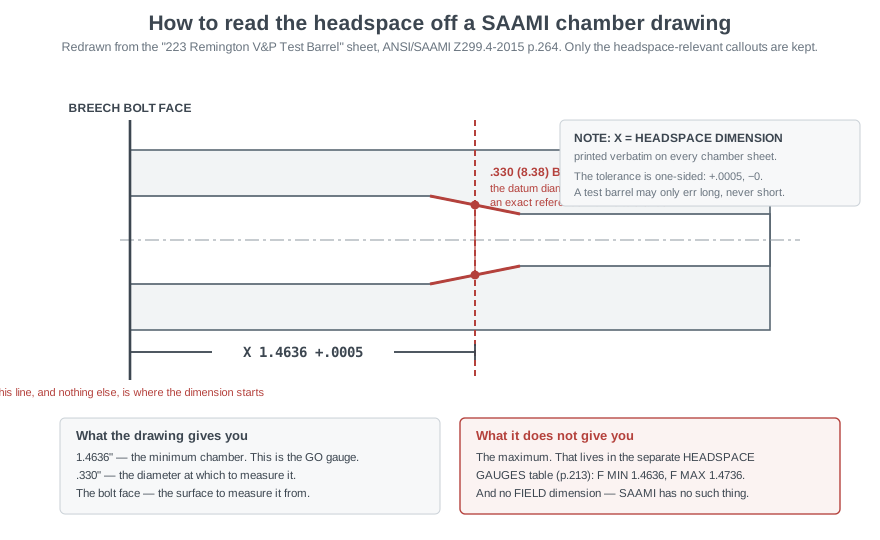
Take the sheet titled 223 Remington V&P Test Barrel, issued 1980-05-20, revised 2004-12-31, on printed page 264.3
Find the dimension prefixed with an X. On this sheet it reads:
X 1.4636 +.0005 (37.175 +0.013)and the drawing’s note block says, in as many words:
NOTE:
X = HEADSPACE DIMENSION
That dimension runs from a line labelled, in capitals on the drawing, BREECH BOLT FACE.
This is the single most useful fact in the whole document for the purposes of this series, and it is worth stating baldly: SAAMI measures headspace from the bolt face. Not from the barrel breech, not from the receiver face, not from anything you can put a caliper on with the rifle assembled. The gauge you buy is a physical proxy for this dimension; the dimension itself is defined against a surface that lives on the bolt. Vol 9 is entirely about the consequences of that.
Now find the datum diameter. On the same sheet it is printed near the shoulder as:
.330 (8.38) BThe B means BASIC, and the drawing’s note block defines it: B = BASIC. A basic dimension is an exact theoretical value with no tolerance of its own — the tolerances apply to features located from it.
So the .223 Remington chamber sheet tells you three things: the minimum headspace is 1.4636 inches, it is measured at a shoulder diameter of 0.330 inches, and it is measured from the bolt face.
The .308 Winchester sheet is identical in structure: X 1.6300 +.0005 (41.402 +0.013) from BREECH BOLT FACE, datum diameter .400 (10.16) B.4
3.3.1 The one-sided tolerance
+.0005 / −0 deserves a moment. The chamber may be up to half a thousandth longer than nominal and not one part of a thousandth shorter. That is the same asymmetry the gauge drawings use, pointing the same direction: err toward the chamber accepting a maximum cartridge, never toward it crushing one.
3.3.2 What the drawing does not give you
The chamber sheet gives you the minimum and nothing else. There is no maximum on it. The maximum lives in the separate Section III gauge table, and you have to go and look.
3.4 Reading the Gauge Table
Section III Figure I is a drawing of a shoulder-breeching headspace gauge with letter callouts — A through M — followed by pages of tabulated values, one row per cartridge.
Only two columns matter for headspace:
Column F, split into MIN and MAX. This is the gauge’s length from base to datum. The MIN value is the GO dimension; the MAX value is SAAMI’s maximum chamber. For the .223 Remington: F MIN 1.4636, F MAX 1.4736.5
Column M. The datum diameter, printed under a BASIC heading. For the .223 Remington: 0.3300. It agrees with the chamber sheet exactly, as it must.
The other columns are gauge construction — head diameter, rim thickness, shoulder angles, lengths, radii. Column D reads 0.2000 BASIC on every single shoulder gauge in the standard, which trips people up: it is a feature of how the gauge is built, not a datum.
Cross-checking a chamber sheet against the gauge table is a two-minute habit worth having, because it catches transcription errors in both directions.
3.5 The Sentence That Licenses Vol 6
Printed page 165, under “VELOCITY & PRESSURE BARRELS: MOUNTING IN RECEIVERS”:
“It is essential that close headspace be maintained in velocity-pressure testing equipment if reliable test results are to be achieved.
In mounting test barrels to Universal Receivers or test actions, a headspace not exceeding 0.003” (0.07 mm) over minimum should be maintained. This may be measured by headspace gauges, shim stock or feeler gauges, or a combination thereof whichever is most appropriate for the type of equipment being used.”6
Two things there.
First, the method. Stacking shim stock or feeler gauges to arrive at a number is not a workshop improvisation people invented because gauges are expensive. It is the method the standard names, in the standard’s own text, for the standard’s own laboratory work. Vol 6 is a detailed treatment of a technique that is already blessed here in one sentence.
Second, the number. SAAMI’s own laboratories hold their test barrels to no more than 0.003 inches over minimum — less than a third of the 0.010-inch band the same standard permits a commercial chamber. That is a useful benchmark to keep in mind when you have measured your own rifle and are trying to decide how you feel about the result. A hunting rifle at +0.006 is entirely in spec. It is also twice as loose as SAAMI would accept in a pressure barrel, and the difference shows up in your brass.
The same page lists the three ways headspace is adjusted on a Universal Receiver, which is a compact summary of how you shim any bolt-in-a-hole system: formed shim stock behind the firing-pin plate, formed shim stock on the rear bearing shoulder of the barrel collar, or adjustment of the breech-block locking screws.6
3.6 What SAAMI Does Not Define
This is where careful reading earns its keep, because the absence is as load-bearing as anything present.
There is no FIELD gauge in SAAMI. Search the whole document. Section III defines a minimum and a maximum for every cartridge in every one of the four breeching families, and that is the complete set. The word “field”, in the sense of a third gauge, does not appear. FIELD is entirely a commercial invention, and — as Vol 4 shows — the two largest makers do not put it in the same place.
There is no NO-GO in SAAMI either, strictly speaking. What SAAMI has is a maximum. Some makers grind their NO-GO to that maximum; others grind it somewhere short of it and call the maximum something else. The vocabulary is the industry’s, not the standard’s.
Cartridge drawings are not in this document. Z299.4 as held here carries chamber and test-barrel drawings but not cartridge sheets, so case length and trim-to length cannot be verified from this copy. Vol 11 flags every case-length figure it quotes as secondary-sourced for that reason.
Rimfire, handgun and shotshell are separate standards. Rimfire is Z299.1, centerfire pistol and revolver Z299.3, shotshell Z299.2. None of them are held here, so the .22 LR figures in Vol 11 carry the same caveat.
3.7 A Note on Copyright and on Using This
The standard is published by SAAMI and carries a full reservation of rights.7 The copy in the Reference Library is held for reference; this series quotes specific dimensions and short passages for technical discussion and cites every one of them to a page. If you work on firearms for other people, buy your own copy — you will open it more than you expect, and the ability to point a customer at a printed page is worth the money on its own.
3.8 Bibliography
Footnotes
-
ANSI/SAAMI Z299.4-2015, front matter, “American National Standard” notice. ↩
-
ANSI/SAAMI Z299.4-2015, title page, sponsor and membership listing. ↩
-
ANSI/SAAMI Z299.4-2015, “223 Remington V&P Test Barrel”, printed p. 264. Issued 05/20/1980, revised 12/31/2004. ↩
-
ANSI/SAAMI Z299.4-2015, “308 Winchester V&P Test Barrel”, printed p. 306. Issued 05/20/1980. ↩
-
ANSI/SAAMI Z299.4-2015, Section III, Figure I and the accompanying tables, printed pp. 212-215. ↩
-
ANSI/SAAMI Z299.4-2015, Section II, “VELOCITY & PRESSURE BARRELS: MOUNTING IN RECEIVERS”, printed p. 165. Emphasis added. ↩ ↩2
-
ANSI/SAAMI Z299.4-2015, copyright page: “Copyright 2015 by Sporting Arms and Ammunition Manufacturers’ Institute, Inc. All rights Reserved.” ↩
Comments (0)