Headspace · Volume 13
Corrective Work — What It Takes to Change a Number
Having measured a rifle and not liked the answer, the next question is what can be done about it. This volume covers the standard corrections at reference depth: what each involves, what equipment it needs, what it does to the rest of the rifle, and — for each — the honest assessment of whether it is a home-shop job. Some of them genuinely are. One of them is the most common piece of gunsmithing in America. Several of them are not, and saying so is more useful than pretending otherwise.
Everything here assumes you have a measured number from Vol 6, not a verdict. You cannot plan a 0.004-inch correction from “closes on NO-GO.”
13.1 Deciding Whether to Do Anything
Before reaching for a tool, three questions.
Is it actually out of spec, or just loose? A .308 at +0.008 is inside SAAMI’s 0.010-inch band. It is not unsafe. It is eating brass, and if it is a hunting rifle you shoot forty rounds a year through, the correct action is to buy factory ammunition, note the number, and get on with your life.
Is it moving? A single number is a snapshot. A rifle that reads +0.008 and read +0.008 four years and three thousand rounds ago is stable. A rifle that read +0.004 then and reads +0.008 now is doing something and needs investigating before it needs correcting.
Is the headspace the actual complaint? Vol 12’s reading order exists to keep you from re-barrelling a rifle whose real problem was a bolt riding on one lug, or brass that had been neck-sized nine times.
13.2 Barrel Set-Back — The Standard Correction
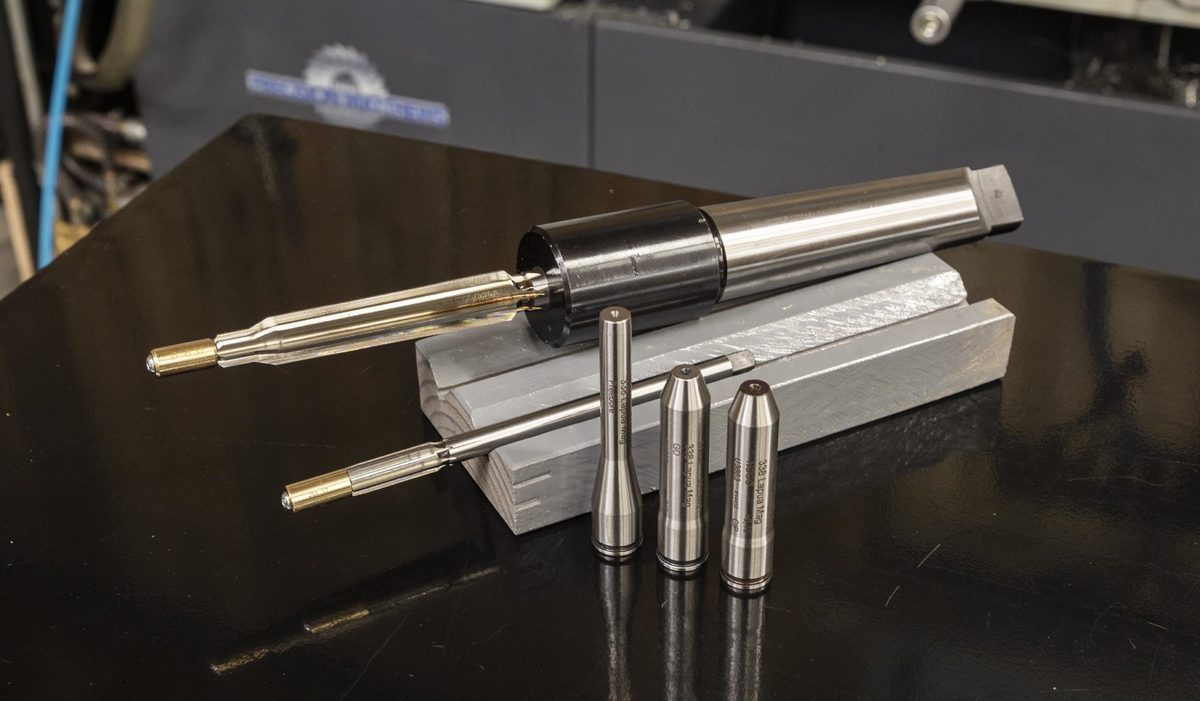
By a distance the most common headspace correction, and the one every gunsmith with a lathe does.
What it is. The barrel is unscrewed, a measured amount is faced off the shoulder and the tenon, the tenon is re-threaded if needed, the chamber is re-cut to depth with a finish reamer, and the barrel is reinstalled. Screwing the barrel further into the receiver moves the chamber back toward the bolt face, reducing headspace.
How much. Set-back is usually a full thread — one complete turn — rather than a fraction, because a partial turn leaves the extractor cut, the sights, and any markings clocked wrong. One turn on an 18 TPI tenon is 0.0556 inches of chamber that has to be recut. Manson recommend exactly this approach for Ackley conversions: “it’s often best to set the barrel back one full turn — this allows plenty of material to work with when re-cutting the chamber and will result in any barrel markings being in the same place.”1
What it needs. A lathe with a spindle bore big enough to pass the barrel, a four-jaw or a spider setup to dial the bore in true, a finish reamer for the chambering, a floating reamer holder, an action wrench and barrel vice, and the gauges. Plus the judgement to dial the bore true rather than the outside of the barrel, which is the part that separates a good job from a rifle that shoots worse than it did.
Verdict. Genuine machine-shop work. Well within reach of a properly equipped home shop with lathe experience, and squarely out of reach without one. The chambering cut is unforgiving — a reamer run 0.003 too deep cannot be undone.
13.3 Re-Barrelling
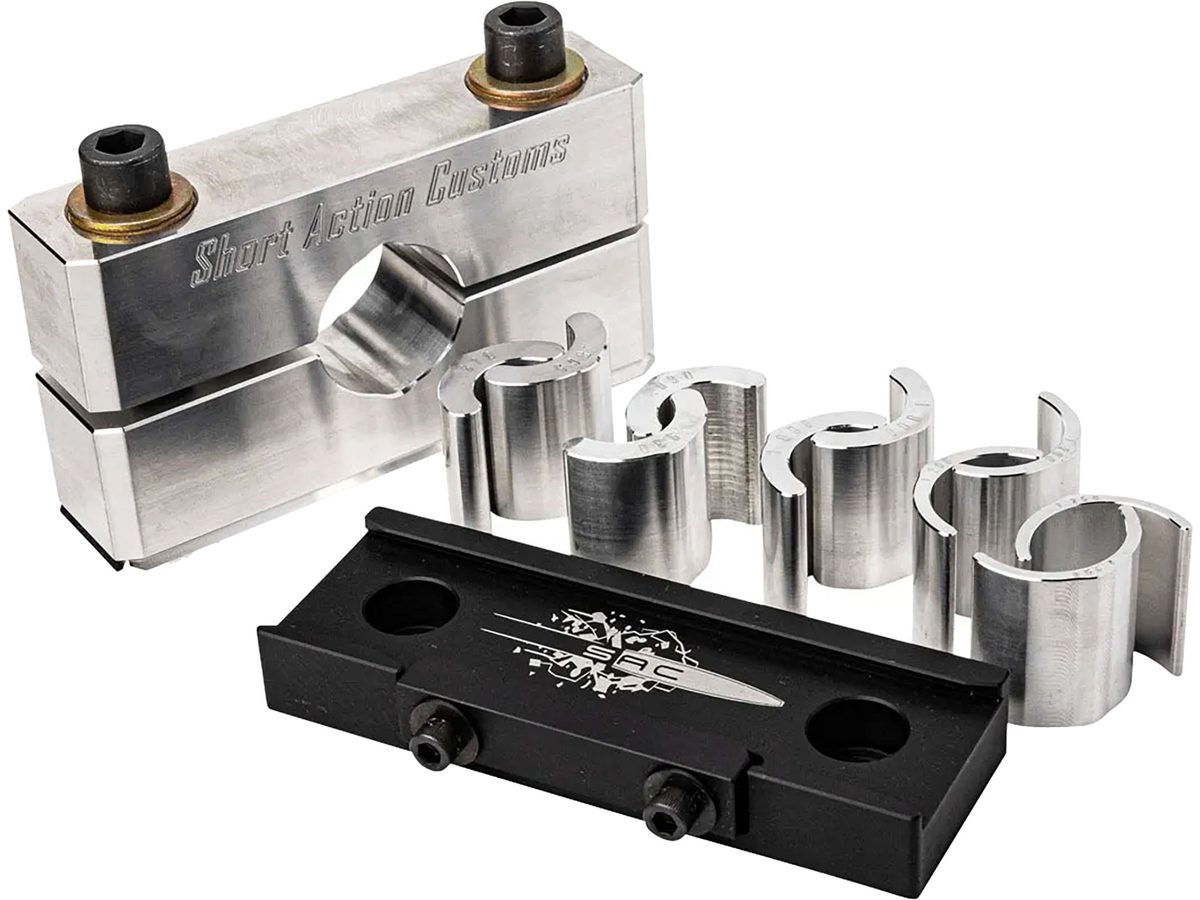
If the barrel is worn out anyway, headspace stops being a repair and becomes a setup parameter.
Shouldered pre-fit. The maker controls the relationship between external shoulder and chamber shoulder for a specific action. Thread it in, torque it, gauge it. No user adjustment — if it is wrong, it is the maker’s problem.2
Barrel-nut pre-fit. You set the headspace, using the procedure in Vol 5 and the 1/60-turn-per-thousandth rule from Vol 9. This is the most accessible route to a correctly headspaced rifle for someone without a lathe, and it is the honest recommendation for most people reading this: a barrel nut, a set of gauges, an action wrench, and a torque wrench will get you there.
Full custom chambering. Blank barrel, thread it, chamber it, headspace it. The set-back skills plus threading.
The rules from Vol 5 apply to all three, and one of them is expensive to break: never tighten a barrel or barrel nut with the bolt closed on a gauge.2
13.4 Bolt Work
Lug lapping. Marking compound on the lugs, work the bolt against a resistance, lap until both lugs bear evenly. This is standard accurizing and it is home-shop work. It changes headspace, usually reducing it as the bolt seats further forward, and it must be re-gauged afterwards. It also fixes the under-load problem from Vol 9 that no amount of static gauging can see.
Lapping cannot add material. If the lugs are set back far enough to matter, lapping reduces the contact area further and makes things worse.
Bolt-face truing. Facing the bolt face square to the bore axis. Fixes uneven case-head support and one-sided primer flow. Adds headspace by exactly the depth of the cut, one for one. Needs a truing kit or a lathe fixture, and needs the headspace measured before and after because you have just spent some of your margin.
Bolt-nose and lug re-hardening or welding. Building up set-back lugs by welding and re-machining is done, and it is specialist work — the heat treatment is the hard part, not the metal. This is a job for someone who does it regularly.
Fitting a different bolt. On an AR-15 this is the standard fix and a good one (below). On a turn-bolt it usually means fitting an oversize bolt and re-machining the lugs to the receiver, which is again specialist work.
13.5 The AR-15
The short chain from Vol 9 makes this the easiest platform to correct.
Headspace is a property of the bolt and barrel-extension pair. So:
Excess headspace: try another bolt. Bolts vary within manufacturing tolerance, and swapping one is a five-minute, forty-dollar experiment. Gauge the result. This is a legitimate repair, not a bodge — as long as it is gauged, and as long as the bolt is a quality part properly headspaced to that barrel.
Insufficient headspace on a new build usually means a barrel extension threaded slightly far or a chamber cut slightly shallow. A different bolt may fix it; if not, it is the barrel maker’s problem.
Set-back in the barrel extension is a barrel-assembly failure. The extension is pinned and threaded to the barrel; replacing it is a job, and on a barrel worn enough to have set-back lugs the answer is usually a new barrel.
The habit to break: swapping bolts between uppers without gauging. It is common, it is easy, and it changes headspace every time.
13.6 Rimmed and Belted Cartridges
Rimmed. Headspace is the rim recess depth in the barrel breech. Excess headspace is corrected by setting the barrel back and re-cutting the recess to depth, or on some designs by a shim. On a revolver it is a cylinder problem, not a barrel problem, and each chamber is independent.
Belted. Headspace is the belt counterbore depth. Same correction — set back and re-cut. This is rare, because a belt counterbore is a shallow feature that sees little wear. If a belted rifle is chewing brass but gauges fine on the belt, the problem is not headspace and Vol 10’s shoulder-bump approach is the fix.
13.7 Shims — When, and When Not
Shimming appears in SAAMI’s own text. Z299.4 lists the ways headspace is adjusted on a Universal Receiver: “Formed shim stock behind the firing-pin plate. Formed shim stock on the rear bearing shoulder of the Barrel Collar. Adjustment of the Breech Block Locking Screws.”3
Note what those are. A Universal Receiver is a laboratory test fixture designed to be shimmed, with parts made to accept it. That is a very different proposition from shimming a sporting rifle.
On a sporting rifle, shims to correct headspace are almost always the wrong answer:
- A shim under a barrel shoulder changes headspace and also changes the thread engagement and the alignment of everything indexed off the barrel.
- A shim behind a barrel-nut recoil lug is carrying full recoil through a thin washer that was not designed to.
- Anything shimmed into a load path is a fatigue item.
The exception is a recoil-lug washer on an action designed for one, where changing washer thickness on a barrel-nut setup is a legitimate part of the fitting process rather than a headspace correction as such.
A rifle should not need a shim to be safe. If it does, the correct fix is set-back or re-barrelling.
13.8 When to Stop
Some rifles should not be corrected.
A soft or damaged receiver. If the lug abutments have set back once, they will again, and a correction resets the clock without changing the outcome. Some older and some military actions were never heat-treated to modern standards, and a rifle whose headspace has grown twice is telling you about its receiver, not its barrel.
A rifle whose value is historical. A collectible military rifle with excess headspace is not a project. Measure it, record the number, hang it on the wall, and shoot the reproduction.
A rifle where the correction costs more than the rifle. Set-back with a chambering cut is real money. A common surplus rifle at the wrong end of the band is often better replaced than corrected, and there is no shame in that arithmetic.
Anything where you are not certain. This is the honest ending. Measurement is a skill worth having and this series has spent twelve volumes on it because a number is genuinely more useful than a verdict. Cutting on a chamber is a different skill with a different failure mode, and the failure mode is a rifle that looks fine and is not. If the number says work is needed and the work is beyond your bench, the answer is a gunsmith — and you will arrive with a measured number, a date, a round count and a diagnosis, which puts you ahead of most of their customers.
13.9 Bibliography
Footnotes
-
Manson Precision Reamers, “How Ackley Improved Chambers are Headspaced.” https://mansonreamers.com/how-ackley-improved-chambers-are-headspaced/ ↩
-
Ray Gross, Manson Precision Reamers, “Headspacing Pre-fit Barrels,” August 2024. https://mansonreamers.com/headspacing-pre-fit-barrels/ ↩ ↩2
-
ANSI/SAAMI Z299.4-2015, Section II, “VELOCITY & PRESSURE BARRELS: MOUNTING IN RECEIVERS”, printed p. 165. Held in the project Reference Library. ↩
Comments (0)