Headspace · Volume 8
Chamber Casting, Direct Metrology, and What a Cast Cannot Tell You
Sooner or later you meet a barrel with no marking, an ambiguous marking, or a marking you have reason to distrust — a re-barrelled military rifle, a wildcat somebody stopped documenting, an import with a chamber that is not quite what the stamp says. Before headspace is a meaningful question you have to know what the chamber is. That is what a chamber cast is for, and this volume covers it, along with the direct-measurement approaches people reach for when a gauge is not available and the specific reason none of them fully substitutes for one.
The heading to remember: a chamber cast measures the barrel. Headspace needs the bolt. They are not the same measurement and one of them is not in the casting.
8.1 Cerrosafe, and Its Peculiar Behaviour
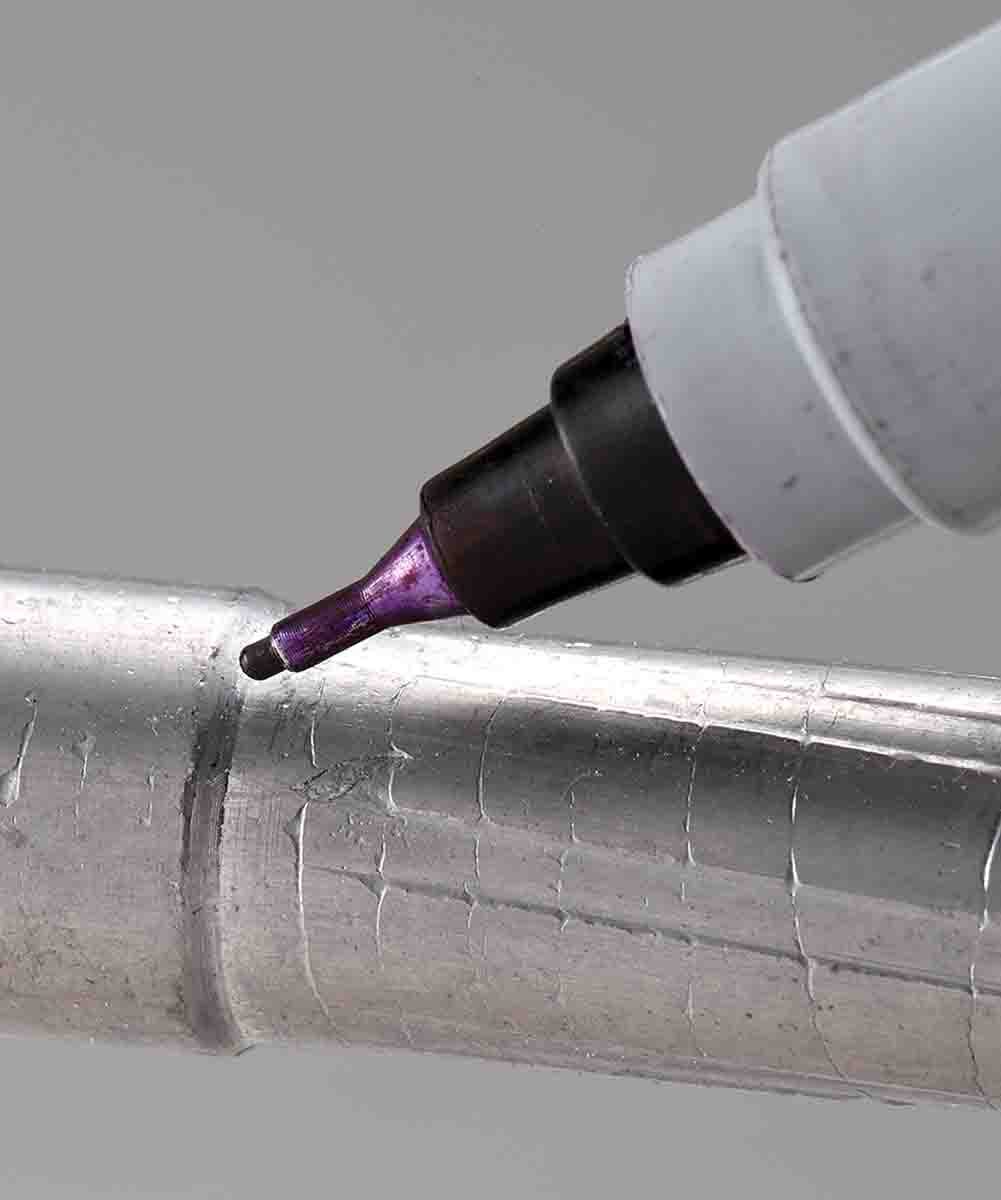
Cerrosafe is a low-melting bismuth alloy sold for exactly this purpose. What makes it useful is not that it melts low — plenty of alloys do — but that it does something specific and repeatable as it cools.
Brownells’ instruction sheet, verbatim:
“Cerrosafe shrinks slightly during initial cooling. It then expands to the chamber’s original size about one hour after cooling to room temperature. After cooling for about 200 hours, the chamber cast will expand about .0025” over the actual chamber size.”1
So there is a window. Cast it, let it shrink so it will come out, push it out, and then wait: at roughly one hour after it reaches room temperature the cast is the size of the chamber, and it holds that size for the next several days before slowly growing about two and a half thousandths.
That figure is not a nuisance, it is a documented offset. Brownells note that “this factor is well known by all toolmakers and they will take it into consideration when making dies or reamers or gauges from your cast.” But for your own measurements, measure inside the window and note when you did.
Melting range is 158 to 190 °F, and there is a warning attached: “Overheating may cause separation of the components of Cerrosafe alloy.”1 Melt it by clean indirect heat — a double boiler, a ladle heated from below with a low torch flame, or a hot-air gun. Do not put a torch into the alloy.
It is fully reusable. Remelt the cast when you are done and pour it back into the tin.
8.2 The Casting Procedure
From the Brownells sheet, condensed but keeping their specifics:1
- Clean and dry the barrel and chamber. Any oil or fouling comes back on the cast as detail you will misread.
- Make a dam. “Insert a tight-fitting cotton cleaning patch on a jag into the bore from the muzzle… Position the cleaning patch about ½” to 1” into the bore, ahead of the throat of the chamber.” This is what stops the alloy running down the barrel, and it also means the cast will include the throat and leade — useful, because that is often what you actually needed to see.
- Warm the barrel. “Heat the barrel at the chamber just to the point where it is uncomfortable to hold with your bare hand.” This is a real instruction with a real reason: pour into a cold barrel and the alloy freezes before it fills the corners, and the cast comes out missing the detail you needed.
- Melt and pour. Fill “until it shows a slight mound at the rear of the chamber.” Brownells warn that excess alloy at the rear can prevent removal — if it happens, remelt it in place and pour it back out.
- Push it out within half an hour. “Push out the Cerrosafe chamber cast within one-half hour after casting. If more than one hour elapses after casting before attempting to remove the chamber cast, the Cerrosafe will start to expand and will have to be remelted and allowed to cool in the chamber to remove it.”
- Push it out gently. Nylon-covered steel rod, brass jag. Clamp the barrelled action horizontally in a padded vice and start it free with a palm tap on the rod handle, then finish by hand over a folded towel. “Although the chamber cast is relatively hard, it can be damaged if dropped onto a hard surface.”
For actions with no straight-line access to the chamber — bolt and lever guns — you need a pouring tube: “Tubes can be made of steel, brass, or aluminum tubing and should have a piece of material flared into a funnel form at the upper end. Keep the tube as short as possible so the molten Cerrosafe will not solidify in the tube during the pour.”1 An assistant with pliers and a propane torch keeping the tube warm during the pour is worth having.
Revolvers cast successfully if you clamp a plate of aluminium or Masonite over the front of the chamber mouths, with a clearance hole cut for the gas ring or centre-pin bearing, and remove the extractor star from a double-action cylinder.1
8.2.1 When not to cast
Brownells are specific, and this one costs people barrels:
“CAUTION: Cerrosafe should not be used to make a chamber cast if you suspect the chamber is bulged, badly pitted or scored, or if the throat is eroded larger in diameter than the chamber mouth. In these instances, the chamber cast will become ‘mechanically locked’ into the chamber and can be removed only by remelting the Cerrosafe and pouring it from the chamber.”1
A bulge or a deep pit is an undercut, and a solid cast cannot come out past an undercut. It is recoverable — heat the breech with the barrel muzzle-up and pour the alloy back out — but do not walk into it on a suspect barrel.
8.3 Measuring a Cast
Micrometer, calipers, and a print of the SAAMI chamber drawing for whatever you suspect it is. Take base diameter, diameter just ahead of the extractor groove, shoulder diameters, the datum diameter station if you can find it, neck diameter and length, and overall length to the shoulder. Compare against the drawing.
Brownells’ caution on interpretation is a good one:
“Published dimensions for cartridges are usually based on measured examples of cartridges, and a sample of several ‘identical’ cartridges from different lots or from different manufacturers may differ significantly. Also, don’t forget that a chamber will almost always be several thousandths of an inch larger in all dimensions than the cartridge to allow for proper feeding and functioning. Manufacturing tolerances of chamber reamers must be taken into account.”1
You are identifying a chamber, not verifying a cartridge. Expect it to be bigger than the round.
8.4 The Limitation That Matters Here
Brownells state it themselves, and it is the reason this volume is not the answer to “how do you measure your headspace”:
“With many bolt action rifles and some pumps and auto-loaders, you will not be able to make a chamber cast of the complete chamber, including the rim section, since the bolt face is set back from the breech of the barrel.”1
On most bolt actions the barrel breech is not where the bolt face is. There is a gap — the bolt nose enters a counterbore, or the barrel is set back from the receiver face, or both — and the cast simply stops at the end of the barrel. The alloy has nothing to form against beyond it.
Headspace is measured from the bolt face, per SAAMI’s own chamber drawings.2 The bolt face is not in the cast. So:
- A cast tells you what cartridge the barrel is chambered for.
- A cast tells you the chamber’s shoulder position relative to the barrel breech.
- A cast tells you throat length, leade angle, neck diameter, and whether the chamber is pitted or eroded.
- A cast does not tell you headspace, because the other end of the dimension is on a part that was not in the barrel when you poured.
On a design where the barrel breech is the bolt face — some break-opens, some single-shots — the cast can carry the whole dimension. That is the exception, not the rule.
8.5 Other Direct Approaches, Honestly Assessed
People reach for these when a gauge is not to hand. Each has a real use and a real limit.
Depth micrometer through the ejection port. On some actions you can measure from the receiver face to the bolt face, and separately from the receiver face to the chamber shoulder. Add or subtract and you have something. In practice the datum station on a shoulder cone is not a surface a depth mic can find, so this gives you a barrel-seating dimension rather than a headspace dimension. Genuinely useful for confirming a barrel has not moved. Not a substitute for a gauge.
A fired case as a reference. Covered in Vol 7. Measure it on a comparator, use it as a stand-in for a GO gauge, stack feelers behind it as in Vol 6. This produces a number that is repeatable and useful for that rifle and is not a SAAMI number, for the two reasons Vol 7 gives: springback, and the datum diameter your comparator actually used.
A sized case with a soft solder or wax pip on the case head. The old trick: crush a small blob against the bolt face on closing, measure the resulting thickness, add it to the case’s head-to-datum length. It works, in the sense that it produces a number of roughly the right size. The blob deforms under an unknown force, and you cannot separate “how much clearance was there” from “how hard was the bolt closed,” so the repeatability is poor. Fine as a rough check; do not build a barrel on it.
Casting the chamber and measuring the bolt separately, then adding. In principle the correct decomposition, and on an action where you can establish a common reference face it works. In practice, finding a reference plane both measurements can share is the hard part, and it is exactly what a headspace gauge does for you in one step for the price of a tank of fuel. This is the approach to take when you are building a rifle for a chambering no gauge exists for — and then you are making your own gauge, which is a different project.
8.6 The Honest Recommendation
If the question is “what is this chamber?” — cast it. Nothing else answers that.
If the question is “how much headspace does this rifle have?” — buy the GO gauge and use Vol 6’s method. It is thirty to ninety dollars, it takes twenty minutes, and it is the only approach in this series that produces a number in the SAAMI frame with a known uncertainty.
If the question is “has anything changed since last time?” — that is Vol 7’s comparator on your own fired brass, and it is the cheapest and most sensitive answer of the three.
8.7 Bibliography
Footnotes
-
Brownells, Inc., Cerrosafe Chamber Casting Alloy instruction sheet 076-200-446 (June 2006 revision), from the Brownells Gunsmiths Data Ring Binder. Emphasis added in the quoted passages. https://feeds.brownells.com/userdocs/learn/Inst-446.pdf ↩ ↩2 ↩3 ↩4 ↩5 ↩6 ↩7 ↩8
-
ANSI/SAAMI Z299.4-2015, “223 Remington V&P Test Barrel”, printed p. 264. The headspace dimension X originates at a line labelled BREECH BOLT FACE. Held in the project Reference Library. ↩
Comments (0)