Headspace · Volume 11
Trimming, and the Correction Most Reloaders Need
Case trimming and headspace get discussed in the same breath so often that a great many reloaders believe trimming a case sets its headspace. For most of what people shoot, that is flatly false, and believing it leads to trimming cases in pursuit of a chambering problem that trimming cannot touch. For one family of cartridges it is exactly true, and getting it wrong there produces real excess headspace. This volume separates the two.
11.1 The Correction
On a bottleneck case, trim length has nothing to do with headspace. The shoulder is the stop. A .308 Winchester case trimmed to 1.990 inches and one trimmed to 2.015 inches headspace identically, because both are located by their shoulders and the mouth is nowhere near anything.
On a mouth-breeching case, trim length is exactly headspace. The case mouth is the stop. Trim a .45 ACP or a .30 Carbine case 0.008 inches short and you have created 0.008 inches of excess headspace, with all the consequences of Vol 1.
Same operation. Opposite significance. The determining factor is which of Vol 2’s four breeching types you are loading for.
11.2 Why Bottleneck Trim Length Is Loose
The evidence is in the tolerance the standard allows. SAAMI publish the .223 Remington case length as 1.760 −0.030 inches — a thirty-thousandths band running from 1.730 to 1.760.1
Compare that with the same cartridge’s headspace tolerance from Vol 2: ten thousandths, from 1.4636 to 1.4736. Three times tighter on a dimension nobody trims, three times looser on the dimension everybody trims.
Nothing that controls headspace is toleranced at thirty thousandths. The case length is loose precisely because it is not doing a locating job.
(This figure is flagged as secondary-sourced. Cartridge drawings are not in the copy of Z299.4 held in this project’s Reference Library — it carries chamber and test-barrel drawings only. See Vol 3.)
11.3 What Trimming Actually Does on a Bottleneck Case
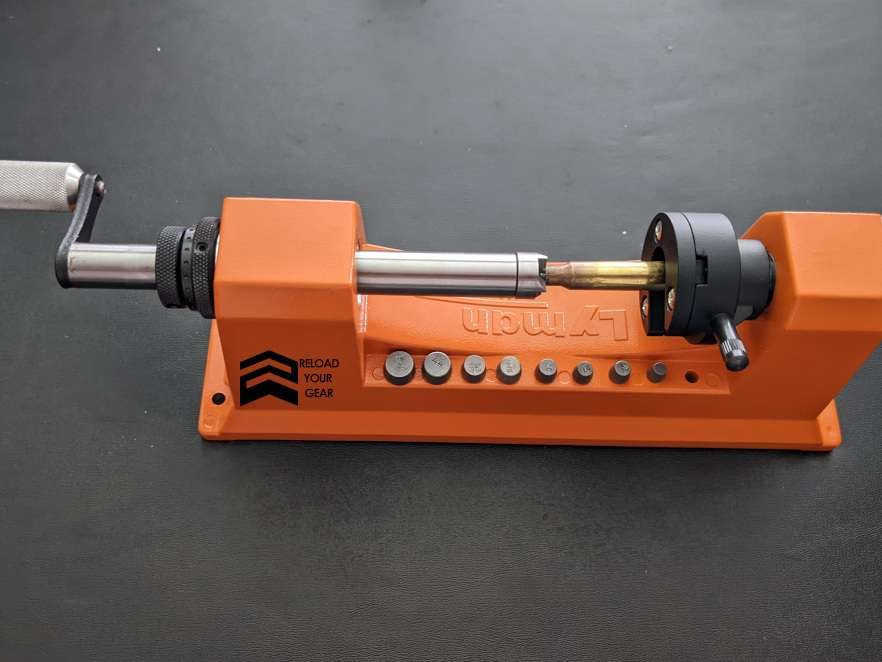
Four real jobs, none of which is headspacing.
It keeps the mouth clear of the chamber’s throat. A chamber has a step where the neck ends. A case too long jams its mouth into that step, and when the bullet tries to release, the neck cannot expand. Pressure goes up sharply and unpredictably. This is the actual danger of an over-long case, and it is a chamber-mouth interference problem, not a headspace problem.
It makes crimps consistent. A roll or taper crimp is set by die height. Cases of different lengths get different crimps — some heavy, some none — and the resulting velocity spread will show on a chronograph.
It makes neck tension consistent by giving every case the same length of neck gripping the bullet.
It removes the growth caused by sizing. Full-length sizing squeezes the body and the brass has to go somewhere: forward, into the neck. Cases grow as you reload them, which is why trimming is a repeating chore.
11.4 Case Growth Is a Symptom Worth Reading
Here is the genuine connection between trimming and headspace, and it runs the opposite way from what people assume.
Cases do not lengthen because of trimming. Cases lengthen faster when headspace is excessive, because brass is being drawn forward out of the web on every firing. Vol 12 shows the mechanism.
So the diagnostic is: if your cases need trimming much more often than seems reasonable, measure your headspace. A rifle that grows its brass 0.004 inches per firing is telling you something a rifle that grows it 0.001 per firing is not. Trimming is treating the symptom; the number from Vol 6 is the diagnosis.
The other cause of rapid growth is over-generous full-length sizing — squeezing the body harder than needed, which pushes more brass forward. Sizing only as much as required (Vol 10) reduces trimming as a side effect.
11.5 Mouth-Breeching Cases — Where Trimming Is Headspacing
Z299.4 lists two rifle cartridges in this family: the .30 Carbine (1.2900 to 1.3000 inches) and the .450 Bushmaster (1.7000 to 1.7100).2 Every rimless straight-wall pistol cartridge — 9mm Luger, .40 S&W, .45 ACP, 10mm Auto — behaves the same way, though those live in Z299.3, which this project does not hold.
Forster spell out the difference: “When they are not designed for a bottleneck case, such as with the 30 Carbine Headspace Gage, rimless gages perform slightly differently. Their headspace is the overall length of the case.”3
Consequences that follow directly:
Trim only when necessary, and never past the minimum. On a bottleneck case, trimming a bit short costs you nothing. On a mouth-breeching case, every thousandth below the minimum is a thousandth of excess headspace.
Do not over-crimp. A heavy roll crimp on a case that headspaces on its mouth rolls the mouth over, and the surface that was supposed to stop against the chamber step is now a rounded edge that slides past it. The round sits deeper, the primer sits further from the pin, and you get light strikes and hangfires. Use a taper crimp on these — the whole reason taper crimp dies exist.
Sort straight-wall brass by length if the rifle or pistol is fussy about ignition. In a bottleneck cartridge, mixed case lengths are cosmetic. Here they are mixed headspace.
The symptom to watch for is inconsistent ignition — occasional light strikes, occasional hangfires, a wide velocity spread with no other explanation. That is short cases, and no amount of primer-brand changing will fix it.
11.6 Rimmed Cases — Trim Length Is Irrelevant, Rim Thickness Is Not
On a rimmed case the rim’s front face is the stop, so trim length has as little to do with headspace as it does on a bottleneck case. What does matter, and gets no attention at all, is rim thickness.
The chamber tolerance is 0.007 inches on most rimmed rifle cartridges — a .30-30 Winchester runs 0.0630 to 0.0700.4 Brass rims vary between makers and between lots by an appreciable fraction of that. Mixed-headstamp .30-30 brass in a rifle at the loose end of the band can give you noticeably different ignition and case life between lots.
If you shoot rimmed cartridges seriously, measure rim thickness on a micrometer and sort by it. It is the rimmed-cartridge equivalent of shoulder bump, and almost nobody does it.
11.7 Trim-To Lengths, With a Caveat
The commonly published pairs:
Table 1 — The commonly published pairs
| Cartridge | SAAMI maximum | Common trim-to |
|---|---|---|
| 223 Remington | 1.760” | 1.750” |
| 308 Winchester | 2.015” | 2.005” |
| 30-06 Springfield | 2.494” | 2.484” |
The convention is a trim-to length ten thousandths below maximum, giving room to grow before the next trim. Any current loading manual carries the full table.
These figures are secondary-sourced and are flagged as such for the reason in Vol 3: cartridge drawings are not in the copy of Z299.4 held here, so they could not be verified against the standard. Lyman’s manual is the usual citation for the .308 pair. Take them from your loading manual, which is what a manual is for.
11.8 Rimfire — A Note, Fully Flagged
Rimfire cartridges are rim-breeching: headspace is the rim recess depth, and the cartridge’s own rim thickness is the corresponding case dimension.
The commonly published SAAMI figures for .22 Short, Long and Long Rifle are chamber headspace 0.043 to 0.051 inches and cartridge rim thickness 0.036 to 0.043 inches. Forster sell their .22 rimfire GO gauge at 0.043 inches, consistent with that minimum.
These are secondary-sourced. Rimfire is ANSI/SAAMI Z299.1, which this project does not hold, so none of it could be verified against the standard. They are printed because they are the numbers in circulation and because a rimfire owner should know the family they belong to — not because this series has confirmed them.
What is worth saying regardless: rimfire ammunition is not reloadable, so there is no reloader’s half to this. Rim thickness is a manufacturing variable you can measure and sort by, and benchrest rimfire shooters do exactly that. Everyone else buys ammunition their rifle likes and does not worry about it.
11.9 The Short Version
- Bottleneck rimless — trim for throat clearance, crimp consistency and neck tension. Not for headspace. Headspace is the shoulder, and Vol 10 sets it.
- Mouth-breeching straight-wall — trim length is headspace. Do not over-trim, do not roll-crimp, sort by length if ignition is inconsistent.
- Rimmed — trim length is irrelevant; rim thickness is the dimension that matters and nobody measures it.
- Belted — the belt sets chamber headspace, but reload to the shoulder (Vol 10). Trim length is irrelevant.
- Rapid case growth is a headspace symptom. Trimming treats it. Vol 6 diagnoses it.
11.10 Bibliography
Footnotes
-
Commonly published SAAMI .223 Remington case length, 1.760 −.030 inches. Secondary-sourced: cartridge drawings are not present in the copy of ANSI/SAAMI Z299.4-2015 held in this project’s Reference Library, which carries chamber and test-barrel drawings only. ↩
-
ANSI/SAAMI Z299.4-2015, Section III, Figure IV, “MOUTH-BREECHING CENTERFIRE RIFLE HEADSPACE GAUGES”, printed p. 220. ↩
-
Forster Products, User Instructions for Headspace Gages, Issue 4, § 6.1. Emphasis added. https://www.forsterproducts.com/wp-content/uploads/2024/08/Headspace_Gage_Instructions.pdf ↩
-
ANSI/SAAMI Z299.4-2015, Section III, Figure III, “RIM-BREECHING CENTERFIRE RIFLE HEADSPACE GAUGES”, printed pp. 218-219. ↩
Comments (0)