Headspace · Volume 14
Cheatsheet — Laminate-Ready
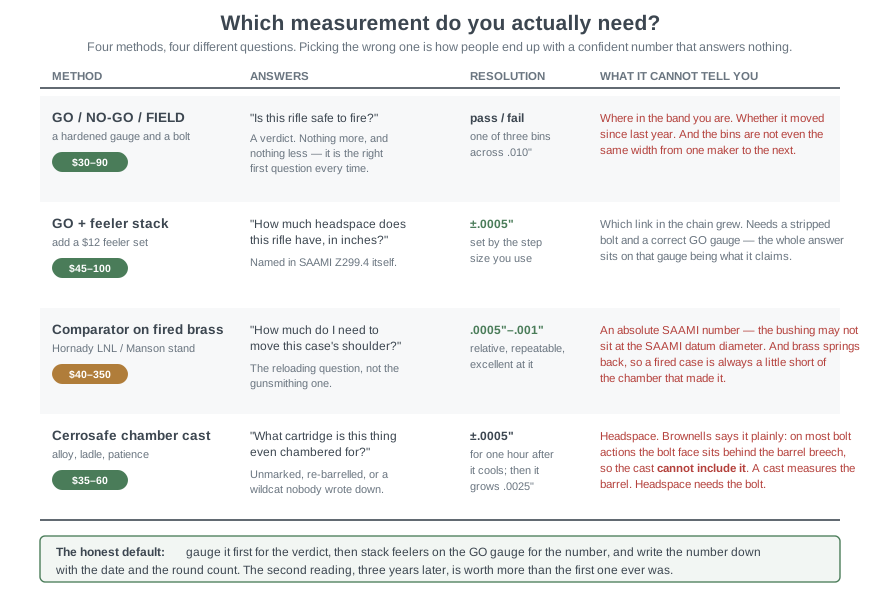
Print this one. Everything below is a condensation of Vols 1 through 13, arranged for the bench rather than for reading, with every number traced to its source in the earlier volumes.
14.1 The Definition
Headspace: “the distance from the face of the closed breech of a firearm to the surface in the chamber on which the cartridge case seats.” — SAAMI, quoted by Forster.
Measured from the bolt face. SAAMI’s own chamber drawings originate the dimension at a line labelled BREECH BOLT FACE.
14.2 The Four Breeching Types
Table 1 — The Four Breeching Types
| Type | Stop | Headspace is | Examples |
|---|---|---|---|
| Shoulder | shoulder cone at the datum diameter | a length | 223, 308, 30-06, 6.5 CM |
| Belt | front face of the belt | a belt thickness | 300 Win Mag, 7mm Rem Mag |
| Rim | front face of the rim | a rim thickness | 30-30, 303 British, 45-70 |
| Mouth | case mouth | the case length | 30 Carbine, 450 Bushmaster, all rimless pistol |
14.3 SAAMI Dimensions — Shoulder-Breeching
Min = GO. Max = SAAMI maximum. Datum = the diameter the length is measured to. Band is 0.010 on every row.
Table 2 — SAAMI Dimensions — Shoulder-Breeching
| Cartridge | Min (GO) | Max | Datum |
|---|---|---|---|
| 222 Remington | 1.2936 | 1.3036 | 0.3300 |
| 223 Remington | 1.4636 | 1.4736 | 0.3300 |
| 22-250 Remington | 1.5749 | 1.5849 | 0.3470 |
| 220 Swift | 1.8060 | 1.8160 | 0.3350 |
| 243 Winchester | 1.6300 | 1.6400 | 0.4000 |
| 308 Winchester | 1.6300 | 1.6400 | 0.4000 |
| 6.5 Creedmoor | 1.5410 | 1.5510 | 0.4000 |
| 6.5 x 55 Swedish | 1.3460 | 1.3560 | 0.3600 |
| 7.62 x 39 | 1.2520 | 1.2620 | 0.3622 |
| 300 Savage | 1.6017 | 1.6117 | 0.3968 |
| 257 Roberts / 7x57 | 1.7937 | 1.8037 | 0.3750 |
| 270 Winchester | 2.0487 | 2.0587 | 0.3750 |
| 30-06 Springfield | 2.0487 | 2.0587 | 0.3750 |
| 280 Remington | 2.1000 | 2.1100 | 0.3750 |
14.4 SAAMI Dimensions — Other Types
Table 3 — SAAMI Dimensions — Other Types
| Cartridge | Min (GO) | Max | Band |
|---|---|---|---|
| Belted — 7mm Rem Mag, 300 / 338 Win Mag, 8mm Rem Mag | 0.220 | 0.227 | .007 |
| Belted — 257 / 7mm / 300 Weatherby | 0.220 | 0.224 | .004 |
| Rim — 30-30 Win, 32 Win Spl, 25-35 | 0.0630 | 0.0700 | .007 |
| Rim — 303 British, 30-40 Krag | 0.0640 | 0.0710 | .007 |
| Rim — 22 Hornet, 32-20 | 0.0650 | 0.0720 | .007 |
| Rim — 45-70 Govt, 348 Win | 0.0700 | 0.0770 | .007 |
| Mouth — 30 Carbine | 1.2900 | 1.3000 | .010 |
| Mouth — 450 Bushmaster | 1.7000 | 1.7100 | .010 |
14.5 NATO Chamberings — Forster’s Published Numbers
Table 4 — NATO Chamberings — Forster's Published Numbers
| Chambering | Minimum | Maximum |
|---|---|---|
| 5.56 NATO | 1.4636” | 1.4736” |
| 7.62 NATO | 1.6355” | 1.6455” |
7.62 NATO is 0.0055” longer than .308 Win at both ends and does not conform to SAAMI tolerances. Do not fire 5.56 NATO in a chamber marked .223 Remington. The reverse is fine.
14.6 What the Gauges Mean — Read Your Maker’s Definition
Table 5 — What the Gauges Mean — Read Your Maker's Definition
| Forster | Manson | |
|---|---|---|
| GO | SAAMI min | SAAMI min |
| NO-GO | a build limit, not the SAAMI max | SAAMI min + 0.004” |
| FIELD | shorter than SAAMI max | SAAMI max exactly |
They are not the same gauges. A rifle can pass one maker’s FIELD and fail the other’s. This is the reason to measure a number.
14.7 Gauging Procedure
- Verify unloaded. Eye protection.
- Bolt out. It must run freely — a sticky bolt has no feel.
- Strip the extractor and the plunger ejector. Check the plunger can go below the bolt face.
- Clean the chamber and the bolt face. Dry them.
- Insert the gauge. Close on gravity on the bolt handle. Nothing more.
Should close on GO. Should not close on FIELD. Closes on NO-GO but not FIELD: still serviceable per Forster.
Never force a bolt closed on a gauge. Never force a break-open action closed on a gauge. Never tighten a barrel or barrel nut with the bolt closed on a gauge. Never fire a rifle that closes on a FIELD gauge.
14.8 Measuring the Number — The Feeler Stack
- Micrometer every feeler blade you will use. Write the real values on them.
- Strip the bolt. Clean chamber and bolt face.
- Bare GO gauge — confirm the bolt closes.
- Add shim behind the gauge head, against the bolt face.
- Work up in 0.0005–0.001 steps until the bolt will not close.
- Confirm the transition twice in each direction.
headspace = GO dimension + thickest shim that still closedRecord: number / over-minimum / date / round count / gauge used / step size.
Benchmark: SAAMI’s own test barrels are held to no more than +0.003 over minimum.
14.9 Barrel Rotation to Headspace
Table 6 — Barrel Rotation to Headspace
| Thread | Per full turn | Per 1/60 turn |
|---|---|---|
| 16 TPI | 0.0625” | 0.00104” |
| 18 TPI | 0.0556” | 0.00093” |
| 20 TPI | 0.0500” | 0.00083” |
| 24 TPI | 0.0417” | 0.00069” |
1/60 of a turn is the distance a minute hand moves in one minute.
14.10 Reloading Numbers
Table 7 — Reloading Numbers
| Shoulder bump, bolt action | 0.001–0.002” (Hornady) |
| Shoulder bump, gas gun | 0.003–0.006” (common practice, not a standard) |
| Body diameter under fired | 0.003–0.005” (common practice) |
| Zero the comparator on | your longest fired case |
| Measure a sample of | ten cases, note the spread |
Bottleneck: trim length is not headspace. Mouth-breeching: trim length is headspace. Do not over-trim. Taper crimp only. Rimmed: trim length is irrelevant; sort by rim thickness. Belted: gauge on the belt, reload to the shoulder.
Lube technique changes your bump. Set the die with the same lube you will run the batch with.
14.11 Hornady Bushings vs SAAMI Datum
Table 8 — Hornady Bushings vs SAAMI Datum
| Cartridge | Bushing | SAAMI datum | Match? |
|---|---|---|---|
| 223 Rem | A .330 | 0.3300 | yes |
| 308 Win / 243 Win | D .400 | 0.4000 | yes |
| 30-06 / 270 Win | C .375 | 0.3750 | yes |
| 6.5 Creedmoor | C .375 | 0.4000 | no |
| 7.62 x 39 | C .375 | 0.3622 | no |
| 6.5 x 55 | C .375 | 0.3600 | no |
A comparator reading is your brass compared to your brass. It is not a SAAMI chamber number unless the bushing sits at the SAAMI datum.
14.12 Cerrosafe
- Melts 158–190 °F. Indirect heat only — overheating separates the alloy.
- Patch dam ½”–1” into the bore ahead of the throat.
- Warm the barrel until “uncomfortable to hold with your bare hand.”
- Push the cast out within half an hour. After an hour it expands and must be remelted.
- Exactly chamber size about one hour after cooling to room temperature. After ~200 hours it grows about 0.0025”.
- Do not cast a chamber that is bulged, badly pitted, or has a throat eroded wider than the chamber mouth.
- A cast cannot give you headspace — on most bolt actions the bolt face is behind the barrel breech and is not in the casting.
14.13 Reading Fired Brass — In Order
- Proud primer — earliest excess-headspace signal. Confirm with a full-pressure load.
- Bright ring ¼–⅜” ahead of the extractor groove — thinned brass.
- Paper-clip hook dragged up the inside — a catch at the ring means one firing from separation. Scrap the batch, gauge the rifle.
- Head-to-datum, ten cases, note the spread. Wide spread points at lug bearing.
- Case length growth — 0.001”/firing normal, 0.004–0.005” is a symptom.
- Body diameter just ahead of the extractor groove.
When the gauge and the brass disagree, the brass is right. The gauge measured the rifle at rest.
14.14 Symptom to Cause
Table 9 — Symptom to Cause
| Symptom | Look at |
|---|---|
| Number grew since last reading | lug abutment set-back, lug wear, throat erosion |
| Gauge is fine, brass says otherwise | lugs deflecting under load |
| Number changed after bolt work | bolt-face truing — one thousandth removed is one added |
| Number different every measurement | extractor / ejector left in, or a dirty chamber |
| New rifle, number is what it is | where the chamber was reamed |
| Light primer strikes | headspace, or firing pin protrusion — measure both |
| Cases need trimming constantly | excess headspace, or over-generous sizing |
| Case separated | stop. Extract the body. Gauge the rifle before shooting it again |
14.15 The Kit
Minimum: GO gauge for the cartridge, feeler set, micrometer, chamber brush and solvent. Under $120 for most cartridges.
Reloading: add a comparator with the right bushing, and a caliper you trust.
Gunsmithing: add NO-GO and FIELD, action wrench and barrel vice, torque wrench.
Diagnostic: add Cerrosafe, a dental pick, and a notebook.
Buy by family — one gauge covers a group. 270 Win uses the 30-06 gauge; 260 Rem and 7mm-08 use the 243 Win gauge; most belted magnums share one standard .535” O.D. belted gauge.
14.16 The Two Things Worth Remembering
Check every thousand rounds. Forster’s own interval. Headspace changes, and the only way you find out is by looking.
Write the number down. The first measurement is worth very little. The second one, three years later, is worth everything — it is the only way to see movement, and movement is what actually hurts you.
Comments (0)