Headspace · Volume 1
What Headspace Is, and Why the Number Matters More Than the Verdict
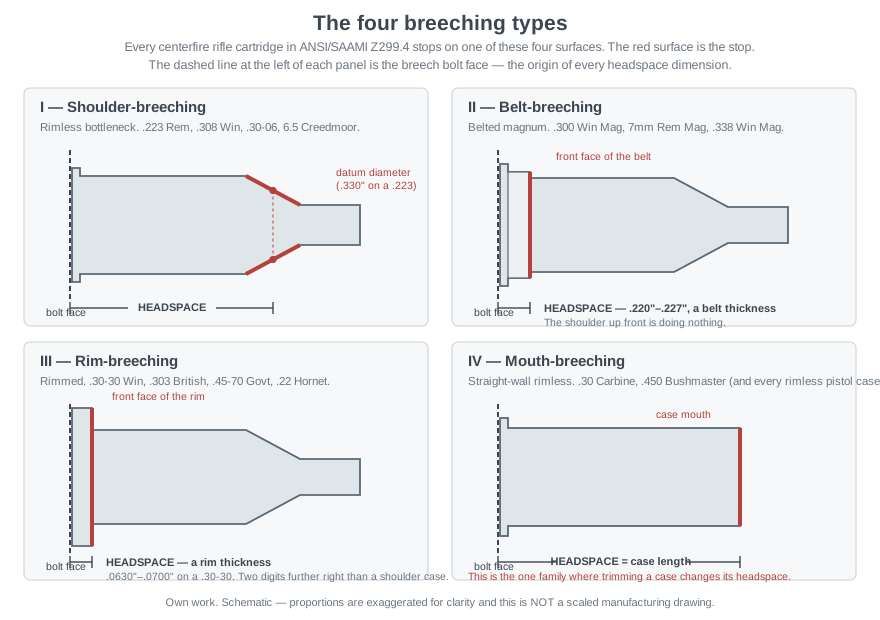
Headspace is one dimension, and the whole trade agrees on what it means. The Sporting Arms and Ammunition Manufacturers’ Institute defines it as “the distance from the face of the closed breech of a firearm to the surface in the chamber on which the cartridge case seats.”1 That is the entire concept. Everything difficult about headspace comes from three follow-up questions the definition does not answer: which surface in the chamber, measured how, and — the one this series is really about — measured to what precision.
Most of what is written about headspace answers the first question well, the second question adequately, and the third question not at all. You will find a hundred articles explaining that a GO gauge should let the bolt close and a FIELD gauge should not. You will find very few that tell you your rifle has 1.6347 inches of headspace, that this is 0.0047 inches over minimum, that it was 0.0031 inches over minimum four thousand rounds ago, and that the rate of change is what you should actually be watching. This series is built around that second kind of answer.
1.1 The Two Failure Modes
A cartridge case in a chamber is a pressure vessel with one job that nobody designs for: it has to seal a joint that is deliberately not tight. The case is smaller than the chamber in every dimension, because it has to fall in freely when dirty and cold. On firing, the brass expands to the chamber walls, grips them, and stops the gas from coming backward past the case head. It is an obturating seal made of dead-soft brass, and it works remarkably well — right up to the point where you ask it to stretch too far.
Too much headspace and the case is not held against the bolt face when it fires. Forster puts the consequence plainly: “Excessive headspace may lead to gas leakage around the case or head separation and the sudden release of high-pressure gas.”2 The mechanism has three acts, and Vol 12 walks through the fired brass that records each one. The short version: the front of the case grips the chamber first, the head is then driven back to the bolt face, and the only brass thin enough to yield is a narrow band just ahead of the solid web. Stretch that band far enough, often enough, and the case parts across it. The front half stays in the chamber. The back half comes out on the extractor. What is left is a chamber full of hot gas with a hole at both ends.
Too little headspace is less dramatic and more common than people expect. Again from Forster: “Insufficient or excessively tight headspace may cause malfunctions, such as failure to lock. It often makes extraction difficult and may cause dangerous stresses on the mechanism, which may, in turn, shorten component life expectancy or lead to failure.”3 A rifle that will not quite close on a round is annoying. A rifle that closes on a round only because the shooter leaned on the bolt handle is something else — the case is being crushed into the chamber shoulder, and the pressure curve it produces is not the one the load data assumed.
Between those two failures is a band. For every shoulder-breeching centerfire rifle cartridge in ANSI/SAAMI Z299.4-2015, that band is exactly 0.010 inches wide.4 Ten thousandths. A rifle at the bottom of it and a rifle at the top of it are both, by the standard, correct.
1.2 Why “Correct” Is Not Enough
Here is the problem with the ten-thousandths band, and it is the argument that runs through this entire series.
A rifle sitting at the very bottom of the band and a rifle sitting at the very top are equally “in spec,” and they will behave completely differently. The tight one will give you fifteen or twenty reloads out of a case. The loose one will give you four, and it will show a bright ring around the web on the third. Neither rifle is unsafe. Only one of them is worth owning.
Worse: headspace moves. Forster’s own recommendation is to “routinely check rifle chamber headspace every thousand rounds,”2 which is only sensible advice if the number can change — and it can, through lug abutment set-back, bolt lug wear, and erosive flow at the chamber shoulder. But a pass/fail gauge check cannot see movement. A rifle that reads +0.002 and a rifle that reads +0.009 both produce exactly the same result from a GO/NO-GO check on many makers’ gauges: closes on GO, does not close on NO-GO. You will run that check every thousand rounds for a decade and learn nothing at all, right up until the day the verdict flips — by which point the rifle has been quietly eating brass for years.
Manson Precision, who make the gauges, say it themselves. Their stated reason for offering a third, intermediate gauge is that “SAAMI allows .010” between minimum and maximum headspace for these chamberings. Many feel (ourselves included) that only knowing headspace within .010” is imprecise and that an intermediate gauge is called for.”5 They are right, and an intermediate gauge is a genuine improvement — it turns one bin into two. Vol 6 shows how to turn it into twenty, using the gauge you already own and a set of feeler stock, in a method that ANSI/SAAMI Z299.4 names in its own text.
1.3 The Second Headspace
There is a second thing called headspace, and conflating the two is the single most common source of confusion in this subject.
The chamber has headspace: bolt face to the seating surface, a fixed property of an assembled rifle. The cartridge also has headspace: case head to the corresponding surface on the case, a property of that particular piece of brass, which you control every time you size it. Forster’s instruction sheet devotes a whole section to disentangling this, noting that in popular speech “headspace” is used for the dimensions of the cartridge, the dimensions of the chamber, and the difference between them — and that only the third one is what actually matters in a rifle.2
Both halves get full treatment here, because they are the same measurement taken on two different objects, and the arithmetic between them is where case life comes from. Vols 2 through 9 are the chamber. Vols 10 and 11 are the cartridge. Vol 12 is what the fired brass tells you about both.
1.4 What the Rest of This Series Does
Vol 2 takes the four breeching types apart — shoulder, belt, rim, mouth — because “the surface in the chamber on which the cartridge case seats” is four different surfaces depending on what you are shooting, and the datum diameter concept that makes a shoulder measurable at all.
Vol 3 reads ANSI/SAAMI Z299.4-2015 directly: how to find your cartridge’s headspace dimension on a chamber drawing, how to read the gauge tables, and — importantly — what SAAMI does not define. A copy is in the Reference Library and every number quoted in this series comes out of it.
Vol 4 is GO, NO-GO and FIELD in full, including the part that surprises people: two reputable makers grind those gauges to different dimensions, and the same rifle can pass one maker’s FIELD check and fail another’s.
Vol 5 is the physical procedure — stripped bolts, extractors, the correct amount of force, and the specific handling of bolt actions, break-opens, AR-15s, semi-auto pistols, revolvers, and pre-fit barrels.
Vols 6, 7 and 8 are the numeric half: the feeler-gauge stack, comparators and dial instruments, and chamber casting. Vol 9 is the bolt-face end of the measurement — everything in the chain between the bolt face and the datum, and how each link corrupts the number.
Vols 10 and 11 are reloading: shoulder bump, and then the correction most reloaders need about case trimming. Vol 12 reads fired brass as a diagnostic. Vol 13 is corrective work. Vol 14 is a laminate-ready cheatsheet.
1.5 The Safety Frame
This series describes measurement in detail because measurement is how you find out whether a firearm is safe, and it treats the reader as someone who owns tools and knows what a thousandth of an inch feels like. It does not thereby become a licence to press on past a bad number.
Two rules, taken verbatim from the people who make the gauges, are load-bearing throughout and are not softened anywhere in this series:
“Do not force the bolt closed on a Headspace Gage.”2
“Do not fire any rifle that will close on the FIELD gage. It may have dangerously excessive headspace.”2
The first one has a corollary Manson states even more forcefully for break-open actions: “DO NOT FORCE a break-open action closed. There is tremendous leverage here and your gun could be damaged by the hardened gauge if forced shut.”6 The gauge is Rc 60-64 tool steel.4 Your receiver is not. In any argument between them, you lose.
And the honest limit on all of it: knowing a number does not qualify you to change one. Vol 13 covers what corrective work involves specifically so the scale of it is clear before anyone starts cutting on a tenon.
1.6 Bibliography
Footnotes
-
Sporting Arms and Ammunition Manufacturers’ Institute, quoted verbatim in Forster Products, User Instructions for Headspace Gages, Issue 4, § 1.0, and again in Forster’s Gunsmithing Tools catalogue, “What Is Headspace?”. https://www.forsterproducts.com/wp-content/uploads/2024/08/Headspace_Gage_Instructions.pdf ↩
-
Forster Products, User Instructions for Headspace Gages, Issue 4, §§ 1.0, 3.4, 4.0 and the § 3.4 warning block. https://www.forsterproducts.com/wp-content/uploads/2024/08/Headspace_Gage_Instructions.pdf ↩ ↩2 ↩3 ↩4 ↩5
-
Forster Products, Gunsmithing Tools catalogue, “Headspace Gages” page. https://www.forsterproducts.com/wp-content/uploads/2024/08/Gunsmithing_Headspace_Gages_Cat82_38-42.pdf ↩
-
ANSI/SAAMI Z299.4-2015, Voluntary Industry Performance Standards for Pressure and Velocity of Centerfire Rifle Ammunition, Section III, “HEADSPACE GAUGES”, pp. 212-220. Figure I (shoulder-breeching) gives F MIN and F MAX for every listed cartridge; the difference is 0.010 in every row. Gauge material and hardness are specified on all four figures. Held in the project Reference Library. ↩ ↩2
-
Manson Precision Reamers, “Dimensions and Tolerances of Manson Headspace Gauges.” https://mansonreamers.com/dimensions-and-tolerances-of-manson-headspace-gauges/ ↩
-
Manson Precision Reamers, “Instructions for Using Manson Headspace Gauges.” https://mansonreamers.com/using-manson-headspace-gauges/ ↩
Comments (0)