Hand Mortars · Volume 9
Surviving Originals and Where to See Them
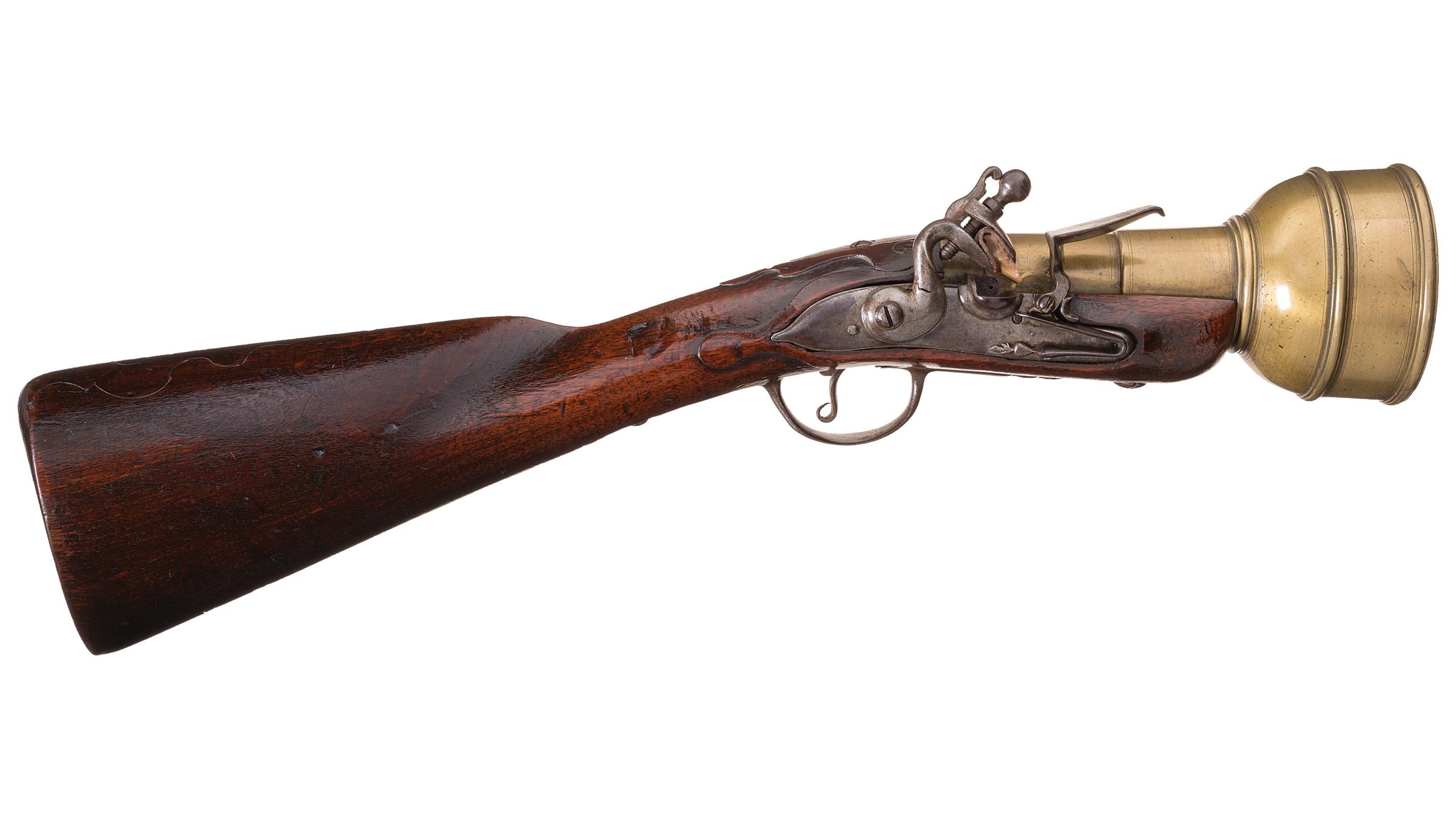
There are not many of these, and most of the ones that exist are not for sale. Rock Island - who handle as many antique arms as anybody in North America - describe the situation exactly:
These devices do not appear to have been used in large numbers, and very few of these guns survive today. Many that do, originated in Germany or the U.K., and are generally contained within museum collections which makes examples on the private market in the U.S. incredibly hard to find.
This volume is the census: what survives, where, and what the documented examples actually are.
9.1 The benchmark auction piece
The gun above is Rock Island lot 1173, sold September 2020, and it is the best-documented hand mortar on the open market in recent memory. The catalog description is worth having in full because it is a model of what you want to know about any candidate:
- Origin unknown, likely Dutch or German, mid-eighteenth century.
- Cup diameter 3⅓ inches. Barrel 7 inches, round.
- Iron furniture, a bare butt with a carved finial on the heel, tear-drop flats and carving at the breech.
- Barrel secured by the tang screw, the rear lock screw, and a screw in the bottom of the stock - three fasteners, no barrel pins, no wedges.
- The only mark is a small “HE/M” maker’s mark inside the lock.
- Condition: fine, with a crack in the neck of the intact hammer, aged patina on crisp brass, mechanically fine.
- Estimate $6,500-$9,500.
Note where the mark is. Inside the lock, where nobody sees it and nobody fakes it. That is the kind of detail Volume 10 turns into a buying checklist.
9.2 The institutional collections
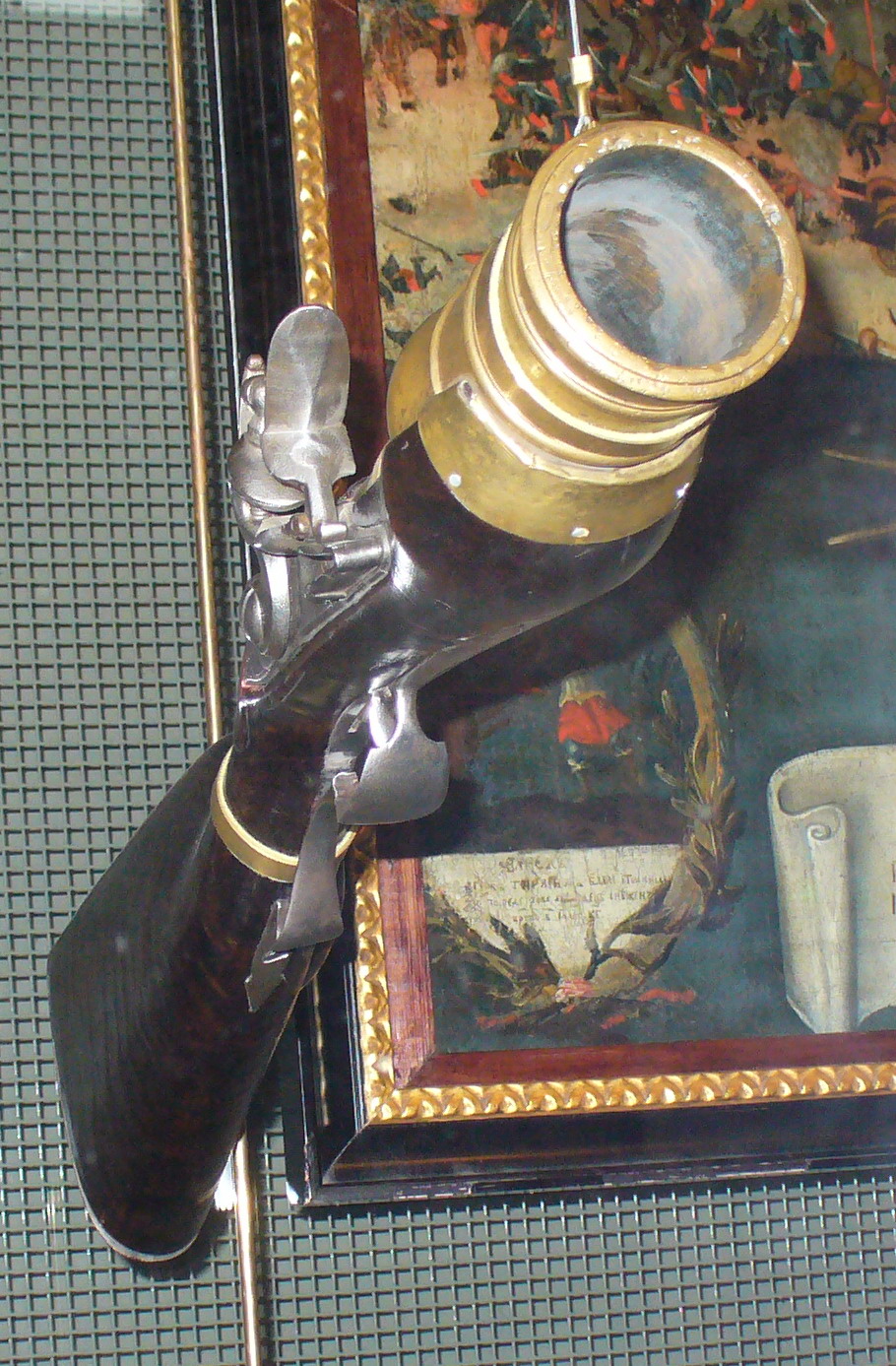
The survivors cluster in a short list of museums:
Table 1 — The survivors cluster in a short list of museums
| Collection | What it holds |
|---|---|
| British Museum, London | A bone-inlaid piece with a stepped brass cup - the lead figure of Volume 1 |
| Skoklosters slott, Sweden | The best group of wheellock grenade guns, 1575-1600 - four of them, Volume 2 |
| State Historical Museum (GIM), Moscow | A Russian bombardier hand mortar, first quarter of the eighteenth century, above |
| Bayerisches Nationalmuseum, Munich | Four early-modern grenade guns displayed together - Volume 10’s lead |
| Marinmuseum, Sweden | Bossemorsare m/1700, MM 2261, made at Ronneby in 1703 - Volume 4’s lead |
| Royal Artillery Museum, Woolwich | An early-seventeenth-century piece, engraved by John Hewitt - Volume 4 |
| National Army Museum, London | A British flintlock hand mortar, c.1760-1770, acc. 1968-10-15-1 |
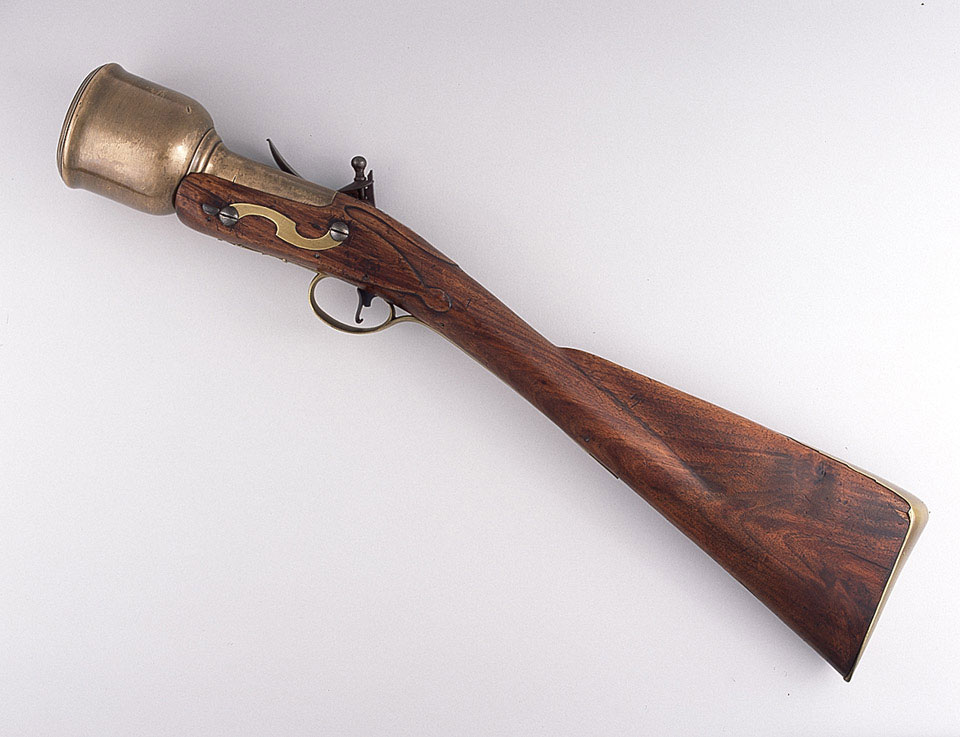
That National Army Museum date - 1760 to 1770 - is worth flagging, because it sits after the point at which most researchers say the type was finished. dave_person on the Muzzleloading Forum records that he has never seen or heard of hand mortars used after about 1740 or 1750, and that most references barely mention them after 1700. A gun catalogued at 1760-70 is either a late survival, a stored arsenal piece, or an example of the non-military branch. It is a good reminder that “the type ended in 1750” is a statement about use, not about existence.
9.3 Production numbers, and what they imply
The only hard production figure in the literature is Berlin’s Royal Foundry: 302 hand mortars between 1672 and 1740. Sixty-eight years, three hundred and two guns - about four and a half a year from a major state arsenal at the absolute peak of the type’s popularity.
Set against that, four made at Ronneby in 1703 for the Swedish crown, at seven silver dalers each, and the picture is consistent: these were made in tens and hundreds, not thousands, by state arsenals and named makers, over a period when muskets were being made by the hundred thousand.
Surviving makers’ marks trace to Strasbourg and Württemberg.
9.4 The uncomfortable question
Forgotten Weapons raises something that anybody spending real money needs to sit with: some experts debate whether surviving stocked hand mortars are authentic military devices at all, or later fabrications, on the grounds that the recoil makes repeated firing from a shoulder stock implausible.
That is a strong claim and it should not be over-read. The Swedish m/1700 is an arsenal product with a museum number, a manufacture date, a location and a price. The Skokloster wheellocks are sixteenth-century. The Berlin production figure is a record, not a legend. The type is real.
But the argument has a defensible narrower form, and it is the form that should shape your buying: some proportion of “hand mortars” on the market are marriages or later assemblies - a genuine mortar barrel stocked up in the nineteenth or twentieth century, or a decorative piece built to sell to collectors. The recoil objection is really an objection to the stock, and stocks are the part that gets replaced.
Volume 10 turns this into something you can use with a torch and a magnet.
Sources
Rock Island Auction lot 1173 catalog description; Wikipedia, Hand mortar; Forgotten Weapons, “Flintlock Hand Mortar”; the Muzzleloading Forum thread 113282 (dave_person); Marinmuseum record MM 2261; National Army Museum acc. 1968-10-15-1; Skoklosters slott, British Museum, State Historical Museum Moscow and Bayerisches Nationalmuseum collection records via Wikimedia Commons.
Comments (0)