Hand Mortars · Volume 3
The Grenadier Century, 1670-1750
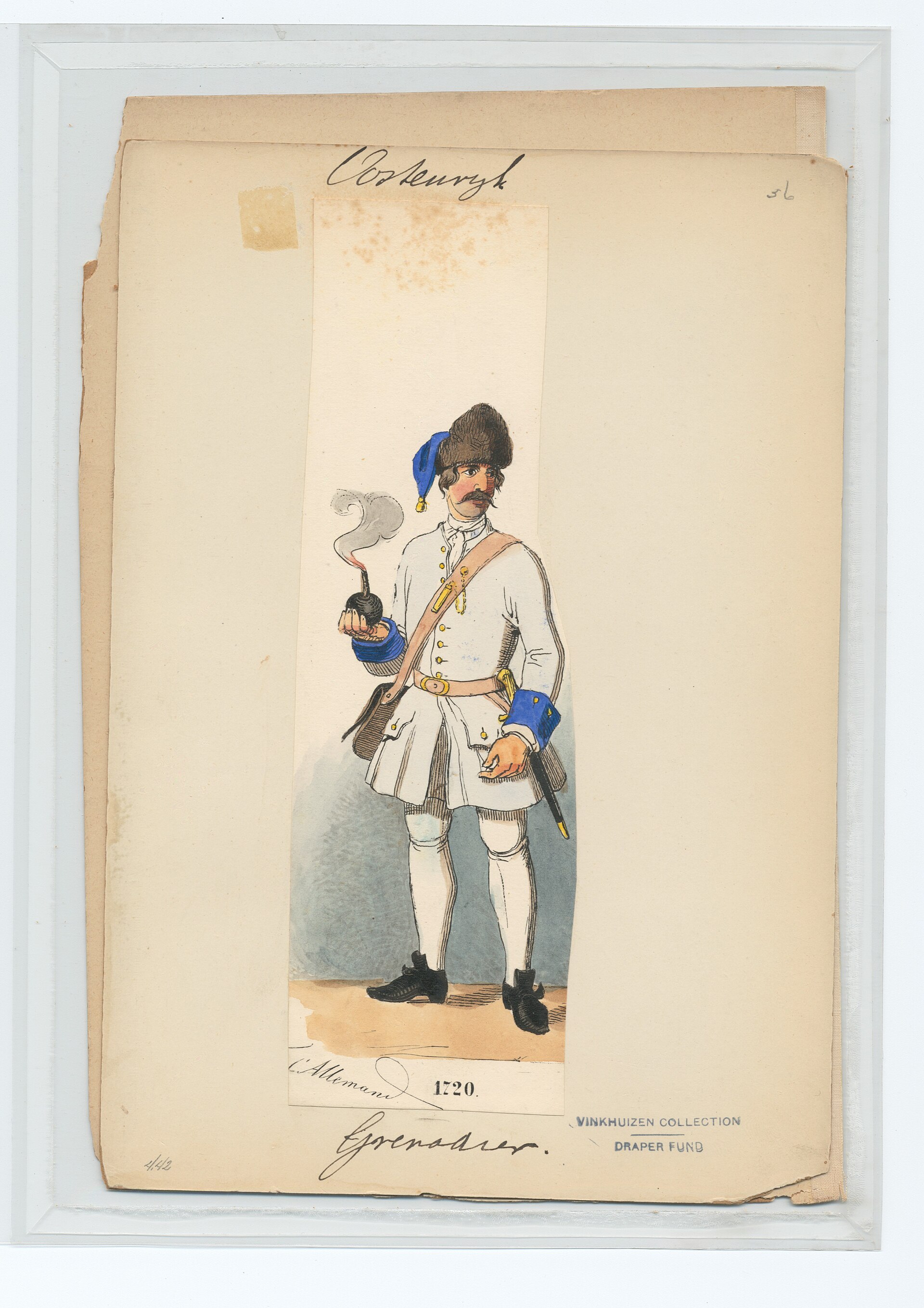
For eighty years the hand mortar had a job, a doctrine, and a branch of the army built around it. Then it did not, and the men kept the name.
Wikipedia and The Vintage News agree on the window: first developed in the mid-1500s, the type reached its peak of popularity between 1670 and 1750. Berlin’s Royal Foundry turned out 302 hand mortars between 1672 and 1740. The Dutch engineer Menno van Coehoorn (1641-1704), whose name still attaches to the portable mortar, is associated with the type; a John Tinker appears as an inventor in 1681. Surviving makers’ marks trace back to Strasbourg and Württemberg.
3.1 Where the name grenadier comes from
The reenactor Grenadier1758, whose unit has actually fired both a hand mortar and a musket-mounted launcher, puts the lineage in one sentence:
The hand mortars were used by troops that became known as “grenadiers”, which is why a flaming bomb is their universal badge design.
That badge is still on collar dogs and cap plates across a dozen armies, and so is the match case that went with it. Grenadiers were throwing grenades long before the launcher existed - selected for size and nerve, sent forward to get close enough to a wall or a barricade to put a bomb over it by hand. The launcher was a labour-saving device for men already doing a lethal job.
3.2 What was actually being thrown
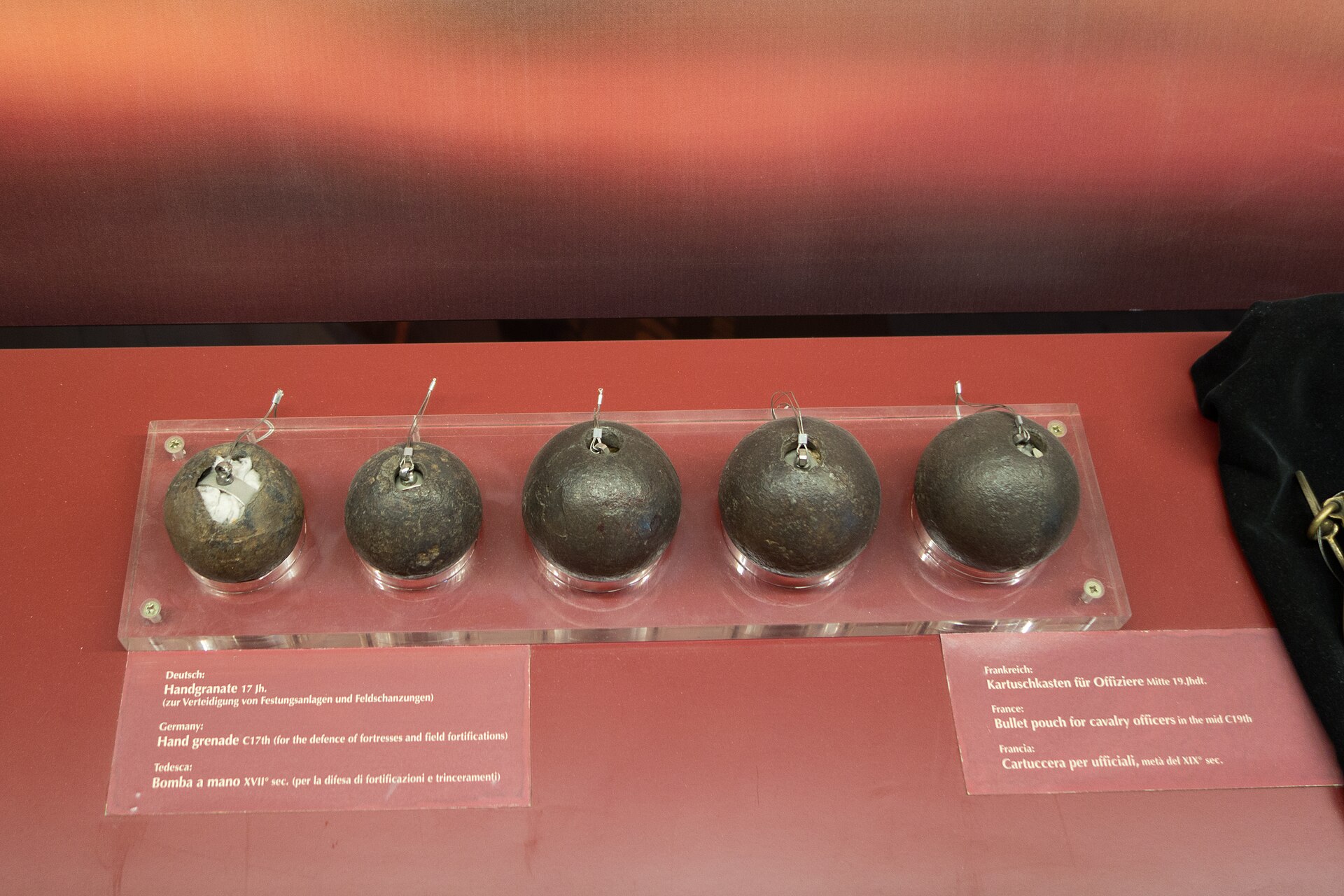
The standard object was a hollow cast-iron sphere filled with powder, with a hole for a fuse. Contemporary accounts describe the fuse as a wooden cone packed with a slow composition, jammed into the hole; the sphere, lobbed over a wall, would spray fragments over a wide area. One forum contributor with practical experience of the type puts the effective fragment radius at a fifty-yard circle, which is why they were a fortification and trench weapon and not something you used in the open next to your own people.
They were not all iron. Wikipedia records grenades made from brass, glass, and possibly clay, with incendiary projectiles made from canvas.
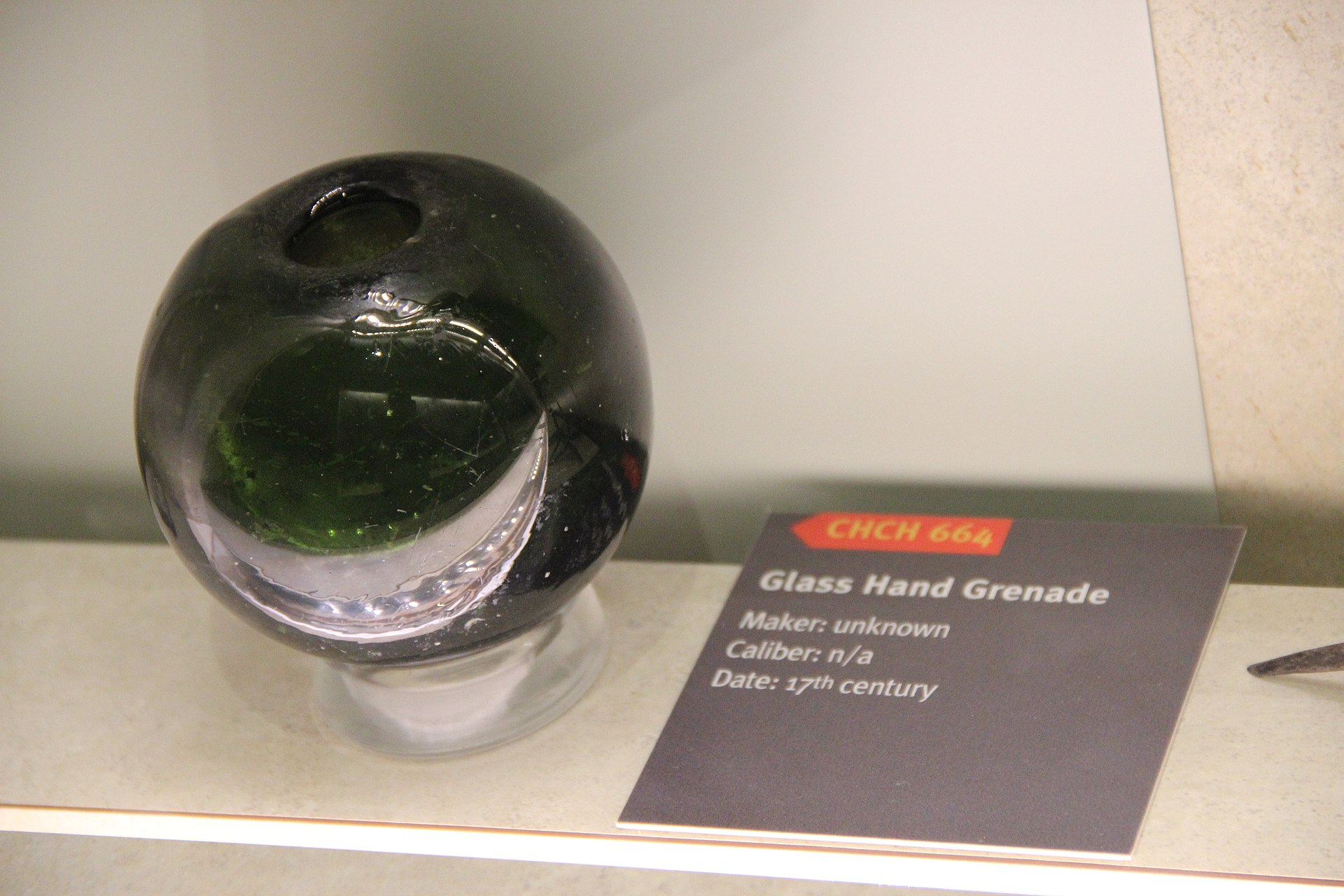
Glass looks like a strange choice until you consider what it does. It is cheap, it is available anywhere with a glasshouse, and it fragments viciously without needing an iron foundry. It is also fragile enough that carrying a case of them into an assault was its own adventure.
The weights involved explain everything about how these guns were handled. A contributor to the Muzzleloading Forum describes the launched load as a two-and-a-half-pound projectile. Two and a half pounds, out of a barrel weighing a few pounds itself, on a stock you are holding.
3.3 The three delivery systems
By the early eighteenth century a besieging army had three ways to get a grenade over a wall, and they were not interchangeable:
The stocked hand mortar. A dedicated gun, big cup, tiny chamber, fired with the butt on the ground under an artillery officer’s direction. This is the object this dive is about.
The musket-mortar. A cup that clamped to the muzzle of a service musket in the manner of a bayonet, using the bayonet lug as a position guide. De Witt Bailey records these in British service from about 1720 through the 1750s, shoulder-fired with six drams - 165 grains - of powder to throw a grenade 250 yards. Howard Blackmore documents a short-lived version of about 1740.
Critically, a properly designed musket cup has a deliberate gap between the cup and the muzzle. Close that gap and the cup becomes a barrel obstruction, and the musket becomes a pipe bomb. Grenadier1758 is explicit about this, and it is the single most useful piece of information in the whole thread.
The coehorn. A small, genuinely portable ground mortar carried by two or four men. The point of comparison is unflattering: a coehorn’s range runs up to 1,200 yards with a charge of a few hundred grains. Nothing you hold in your hands is going to do that.
3.4 Why it ended
The consensus among people who have read the primary sources is unusually tidy. dave_person, on the Muzzleloading Forum:
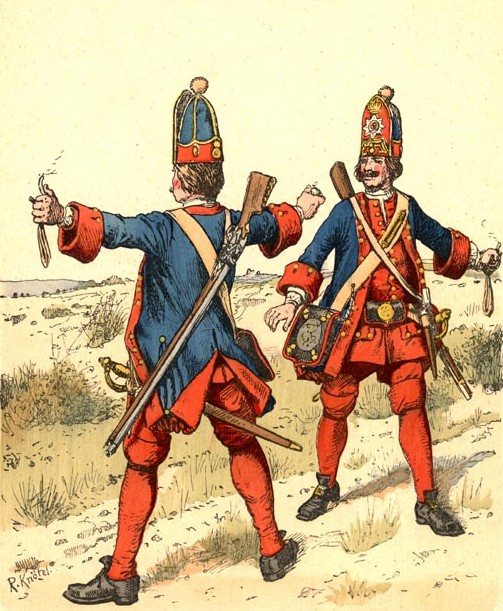
By the mid 18th century, their grenade shooting and throwing days were mostly over and they were turned in to large and imposing shock troops attached to infantry battalions. I’ve never seen or heard of hand mortars being used after about 1740 or 1750. Most of the references I am familiar with hardly mention them after 1700… Grenade launching was a dangerous business to the launcher as much as the enemy, which is why they eventually disappeared.
And from Grenadier1758, the tactical half of the same answer:
Once mortars became more practical and portable, the need for grenadiers to run up to a wall or barrier and toss grenades over the obstacle was eliminated. Then the grenadiers became the elite infantry unit.
So two things killed it at once. The coehorn made the mission unnecessary, and the casualty rate among launcher crews made it unattractive. What survived was the uniform.
3.5 The last documented military use
The type does not vanish cleanly. The Hessians used hand mortars at the Siege of Charleston in 1780, and the drill that has come down to the present is worth reading twice. From Many Klatch on the Muzzleloading Forum:
Shooting it was a two man job. One man aimed and shot the weapon. The other lit the fuse. There was a rope tied to the gun. If the fuse was lit and the gun misfired, they tossed the weapon out of the trench and waited for the explosion. After the boom they hauled on the rope and brought the gun back into the trench.
There is a whole institutional memory in that rope. Somebody had worked out, presumably the hard way, that the gun was cheaper than the crew.
A note of caution on late dates generally: a French hand mortar signed Moynat à Lyon is offered as “circa 1780,” but dave_person argues from the hardware and the unbridled frizzen that it belongs to the 1740s or early 1750s - by the 1760s virtually all French military guns had bridled frizzens, so an 1780 gun with an unbridled one was either built from salvage or is not from 1780. Volume 10 turns that into a checklist.
Sources
Wikipedia, Hand mortar; The Vintage News (2016); The Muzzleloading Forum threads 113282 and 113322 (dave_person, Grenadier1758, WKD, Many Klatch, Alden); De Witt Bailey and Howard Blackmore as cited therein; New York Public Library Vinkhuizen Collection; Richard Knotel plates.
Comments (0)