Hand Mortars · Volume 2
Origins: The Wheellock Grenade Guns, 1580-1650
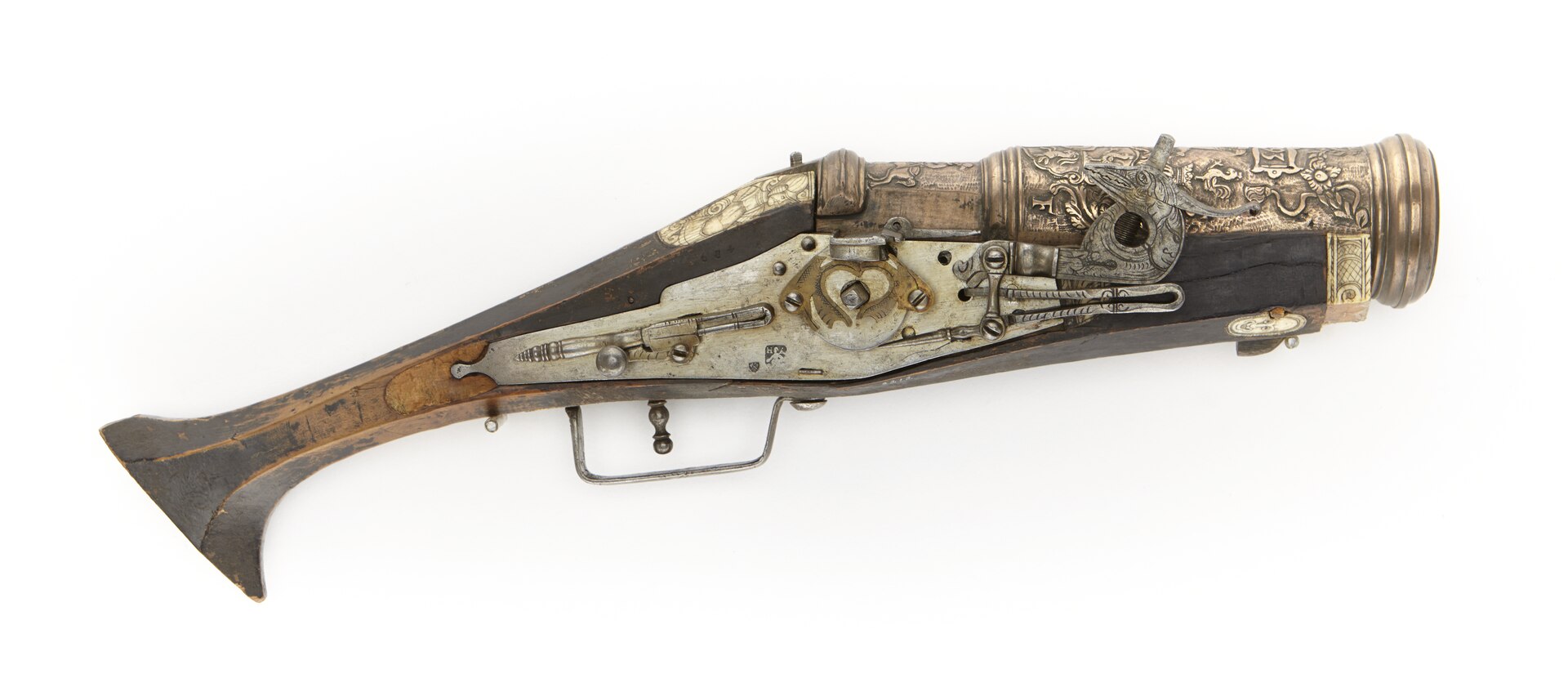
The hand mortar did not begin with the flintlock. It began roughly a century earlier, with the most expensive, most temperamental ignition system ever fitted to a shoulder arm, on guns that survive today mostly because they were too valuable to throw away.
The Rifle Shoppe, who cast parts from originals and therefore have to know, put the date plainly in their own catalog: “The earliest known Hand Mortars (grenade launchers) were Wheellocks of the 1580’s.” The Vintage News gives the same window from the other end, describing the type as first developed in the mid-1500s.
2.1 What came first was the grenade
The launcher is a solution, and the problem arrived earlier.
The first reference to the kind of grenade these guns threw appears in a 1472 work titled Valturius, where what may have been an incendiary prototype is described. Widespread use of the genuinely explosive grenade does not arrive until the early-to-mid sixteenth century, under Francis I of France.
The consequences were immediate and are recorded in the casualty lists. Count de Randan died of shrapnel wounds to the legs from a grenade at the Siege of Rouen in 1562 - an early, well-documented death by a weapon that was still novel.
By then the tactical logic was obvious to everyone. A grenade thrown by hand goes as far as one strong man can throw it, which under fire, in armour, over a wall, is not far. Anything that adds distance adds survival. The launcher follows.
2.2 Why a wheellock, of all things
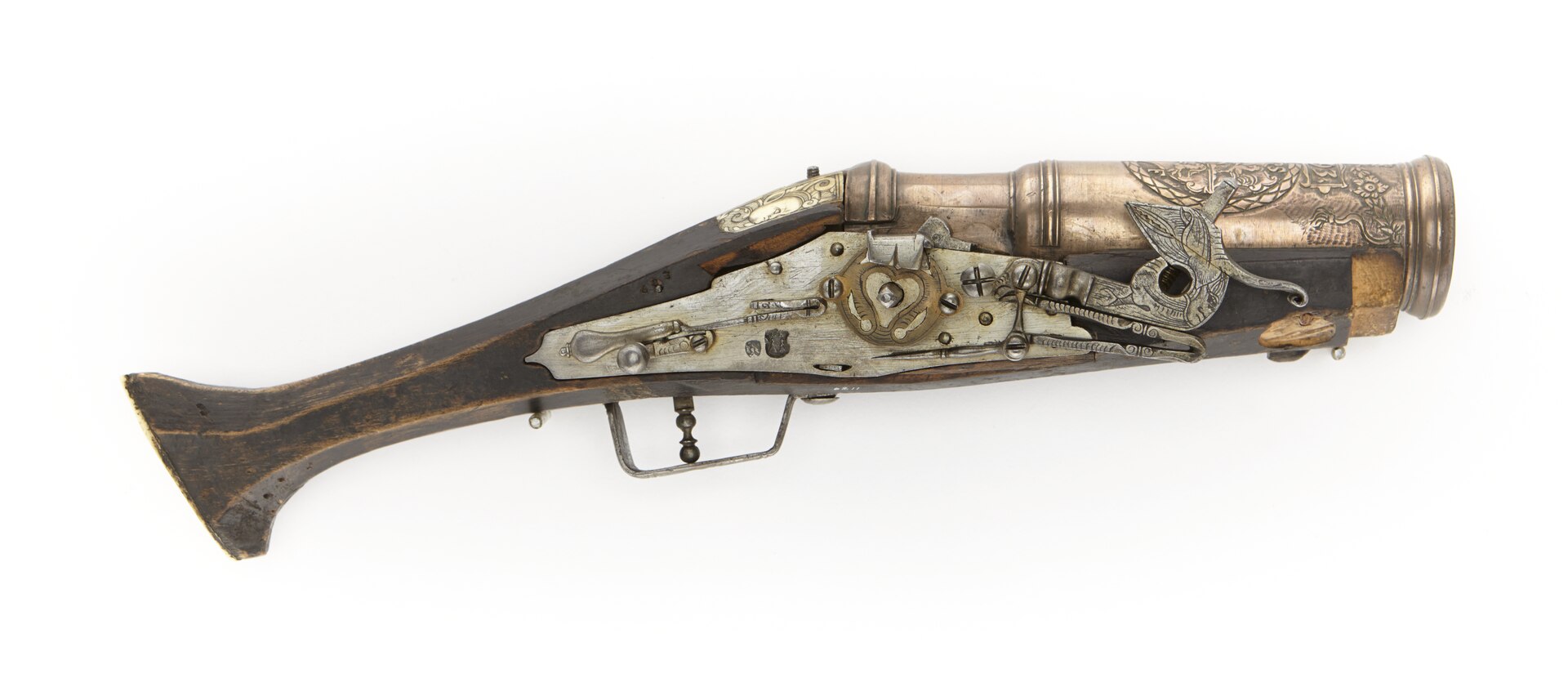
It looks like a strange choice. The wheellock is complicated, expensive, and prone to failure. Fitting one to a crude bomb-thrower is like putting a Swiss movement in a sledgehammer.
The answer is that in the 1580s there was no alternative that would work. A matchlock needs a burning slow-match held near the pan - which is a poor arrangement when the thing you are about to launch is packed with powder, and a worse one when you are lying in a siege trench in the rain. The wheellock is self-contained and ready: spanned, primed, and inert until the trigger drops. For a device you might carry loaded for an hour and fire once, that is worth the money.
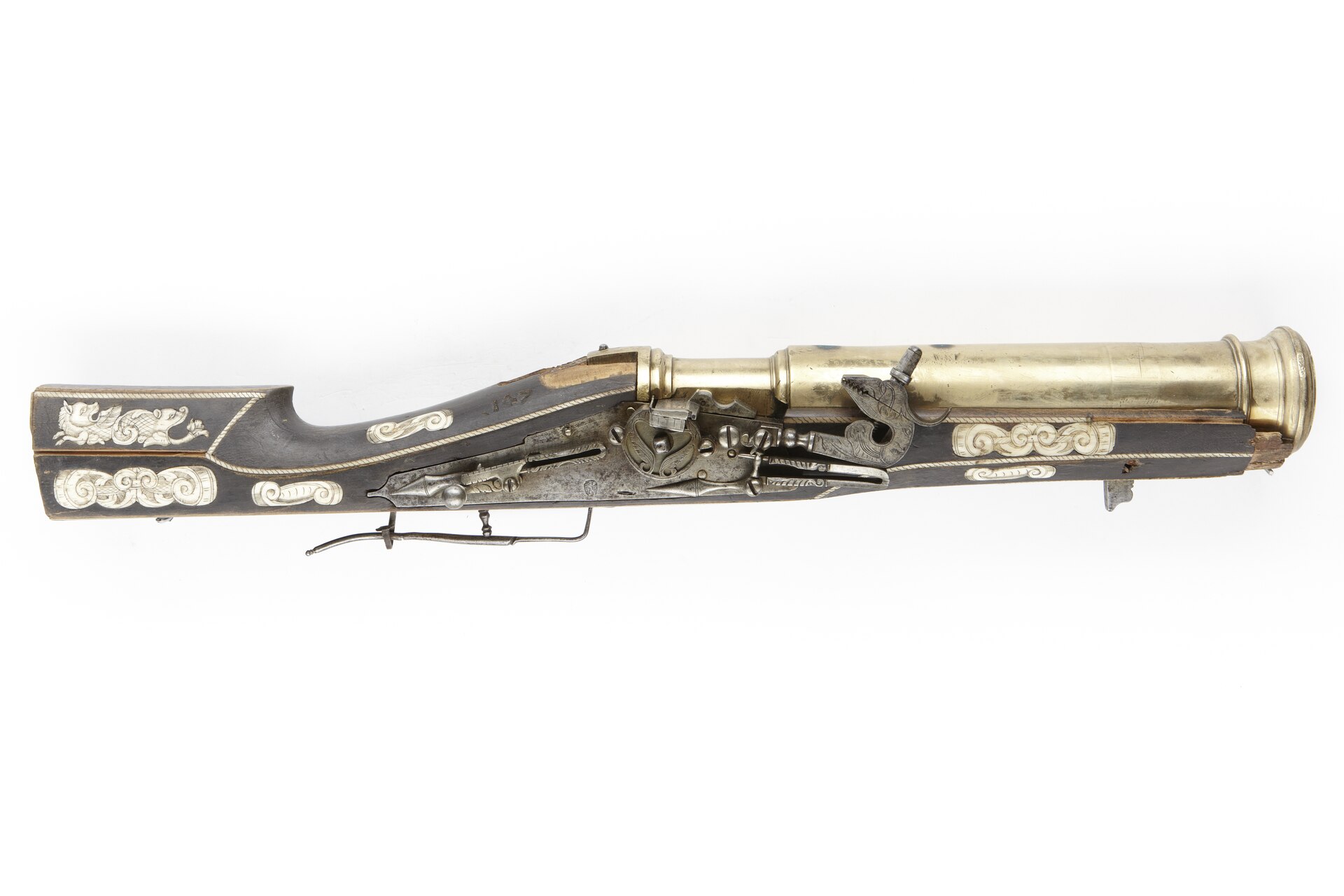
It is also why the survivors are so decorated. Wheellock grenade guns were the property of arsenals and princes, not the common soldier. The Skokloster pieces are inlaid with bone and engraved brass because they came out of a collection where such things were kept. The plain ones got used up.
There was even a combined solution. Among the very few surviving late-sixteenth-century grenade launchers is a combined wheellock-and-matchlock piece - belt and braces, on a weapon where a misfire had consequences.
2.3 Two firing methods, one bad idea
The early practice split into two techniques, and Forgotten Weapons names them:
Single firing put the grenade in fuse-down, in contact with the launching charge, on the theory that the charge would light the fuse on the way out.
Double firing put the grenade in fuse-up and had somebody light the fuse by hand before the gun was fired.
Double firing is the one that made it into popular history, and it is the one every dramatic retelling reaches for - the image of a man holding a lit bomb in a barrel while praying his lock does not hang fire. The Rifle Shoppe’s own catalog note preserves the memory: “The grenades were lit separately then the gun was fired to launch it.”
What almost nobody mentions is that it was solved. Forgotten Weapons records that by 1650, it was understood that the heat of firing would light the fuse without anyone touching it. The dangerous method belongs to the first seventy years of a type that lasted a hundred and seventy. Volume 5 takes this apart properly, because the misunderstanding is load-bearing for a lot of bad advice.
2.4 What these early guns tell a builder
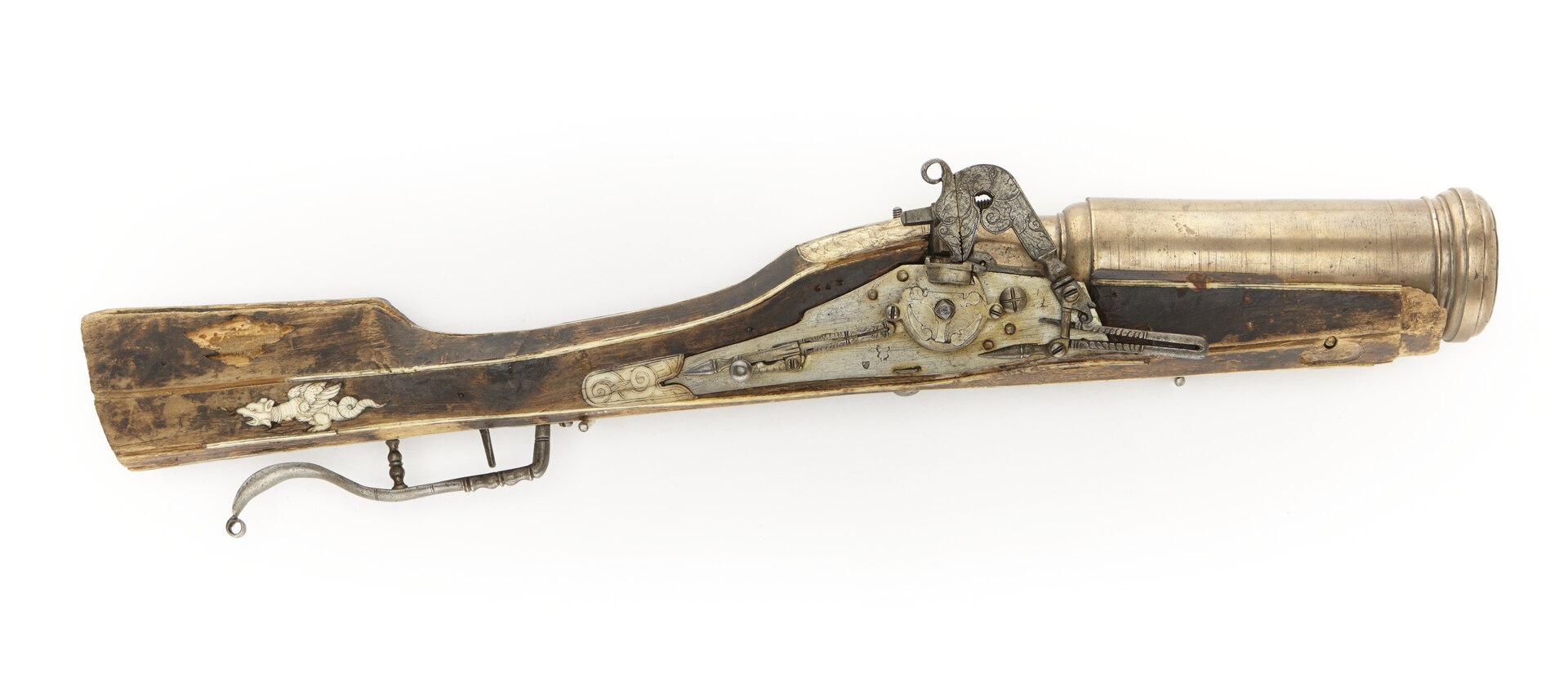
Line the four Skokloster pieces up and a few things become obvious that no written description conveys:
- The barrel length is not standardised, at all. Two of these are stub-cup pieces; one carries a barrel long enough to belong on a fowling piece. The type had not settled.
- The butt is a fishtail, not a shoulder. Broad, flat, splayed - shaped to be planted on the ground and braced, or to be gripped, not to be tucked into a shoulder pocket. That shape is doing structural work, and Volume 5 explains what.
- The brass is stepped and ringed at the muzzle. Not decoration for its own sake: those rings are reinforcing bands at the point of maximum hoop stress, in the tradition of cast bronze ordnance.
- The lock is mounted high and forward, close to the breech, because the chamber is tiny and the touch hole has to reach it.
If you are building from castings, this is the period the fanciest patterns come from - and the hardest to source. The realistic reproductions in Volume 11 are all flintlocks of a century later, for the good reason that a wheellock is an entire second project.
Sources
The Rifle Shoppe catalog page 819; The Vintage News (2016); Wikipedia, Hand mortar; Forgotten Weapons, “Flintlock Hand Mortar”; Skoklosters slott collection records via Wikimedia Commons.
Comments (0)