Hand Mortars · Volume 10
Buying an Original
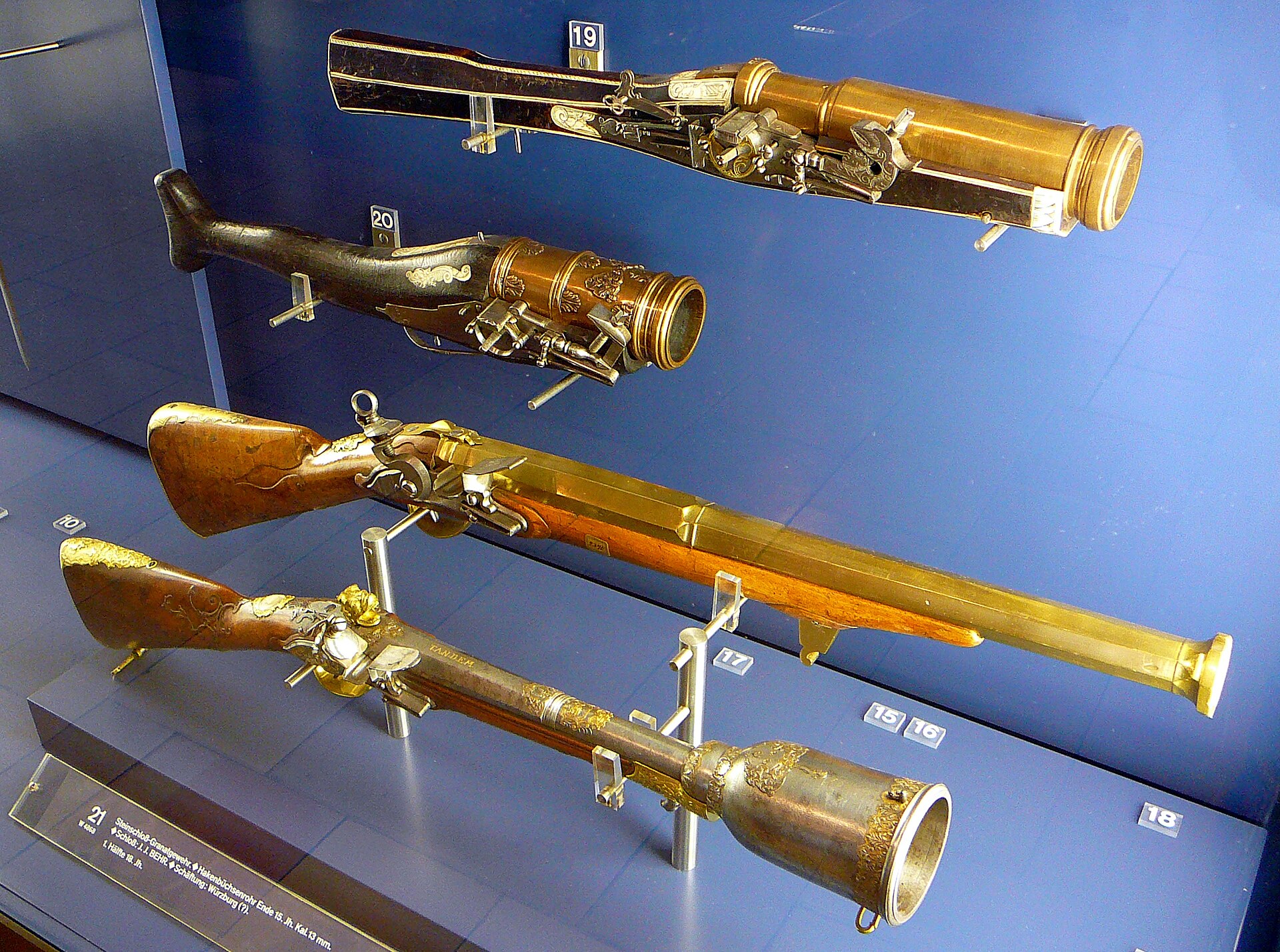
That case is the buying problem in one photograph. Four pieces, all correctly catalogued as grenade guns, and no two of them share a length, a lock, a bore profile or a stock architecture. There is no “standard pattern” to check a candidate against. You have to date the parts.
This volume assumes you are actually going to do this, with original pieces rather than reproductions. This is what that looks like.
10.1 What they cost
The reference points available are these:
Table 1 — The reference points available are these
| Piece | Type | Figure |
|---|---|---|
| Rock Island lot 1173, mid-18th c., likely Dutch or German | genuine original, complete, mechanically fine | estimate $6,500-$9,500 |
| A finished custom repro (Rifle Shoppe parts, Ben Coogle bronze barrel) | modern | $1,400 asked, seller’s stated cost of parts and assembly |
| A used Veteran Arms repro, unfired | modern import | $750 private sale, 2024 |
| A used Veteran Arms repro at a dealer | modern import | $1,495 listed |
The gap is the whole story. An original is four to ten times a good reproduction, and that ratio is exactly why the fraud risk exists.
10.2 The five checks
10.2.1 Date the lock, not the caption
This is the single highest-value check and it is the one the sources actually demonstrate.
A French hand mortar was offered by a dealer as “signed Moynat à Lyon, circa 1780.” dave_person - who researches this period seriously - took it apart on the forum:
I do not believe the gun dates to the 1780s. The hardware and lock are styles used on trade guns during the 1740s and early 1750s… The lock is an old design without a pan bridle anchoring the frizzen. By the 1760s virtually all French military guns all had bridled frizzens. If it was made in the 1780s it likely was from old salvaged parts.
He also questioned the military attribution on hardware grounds: it is not the product of St. Étienne, Maubeuge, or Charleville, so calling it a French military arm requires an argument nobody had made.
What to do with that: learn the frizzen-bridle transition, the lock-plate profiles and the furniture styles for the nation and decade being claimed, and check the gun against them before you check the story against them. A seller’s date is a hypothesis.
10.2.2 Look inside the lock
Rock Island’s lot 1173 carries one mark, “HE/M”, inside the lock plate. That is where period marks live and where fakers do not think to put them. Pull the lock. An honest gun has honest surfaces underneath: consistent patina, tool marks that match the period, screw holes that have only ever had one screw in them.
10.2.3 Ask whether the barrel and the stock grew up together
Forgotten Weapons’ authenticity objection - that recoil makes a stocked hand mortar implausible for repeated firing - is really an objection to the stock. Barrels survive; stocks get replaced, damaged, or added.
Signs a barrel has been re-stocked:
- Inletting that is fresh, crisp, or a different colour inside than the visible wood.
- Fastener count and type that do not match the barrel’s provisions. RIA’s lot 1173 is held by three specific screws - tang, rear lock, and one up through the bottom of the stock. A barrel drilled for a fastening arrangement the stock does not have has been somewhere else.
- Wear patterns that do not line up. Three hundred years of handling leaves a stock polished where hands go and dented where it was set down. A gun that was fired butt-down should show it on the butt.
10.2.4 Measure all three diameters
Get the cup outside diameter, the bore, and - if you can get a rod and a light in there - the chamber. A listing will give you one and it is usually the flattering one. The chamber step is also the fastest way to tell the military family from the pyrotechnic family: a light, thin, shallow-belled piece is a signal or firework mortar and should be priced and described as one.
10.2.5 Decide what condition problems you will accept
RIA’s lot 1173 is graded fine and still has a crack in the neck of the hammer. That is normal for a three-hundred-year-old gun, it is disclosed, and it is priced in. What matters is that it is disclosed. A description that mentions no faults on an eighteenth-century arm is telling you about the cataloguer, not the gun.
10.3 Where to look
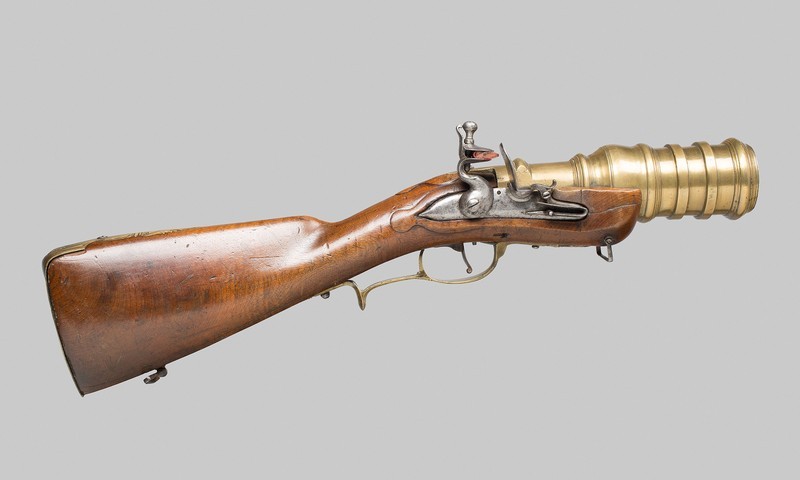
- Rock Island Auction is the realistic US route, and they have handled originals (lots 1173, 1273) and reproductions (lots 5014/485, 2060/930). Their catalog copy is detailed enough to buy from, and the fact that they explicitly separate “reproduction” into the lot title is itself worth paying for.
- European auction houses and dealers see more of them, since that is where they were made. Expect to deal with import paperwork and to date the gun yourself.
- The Muzzleloading Forum classifieds turn up finished custom builds and occasionally originals. This is where the $1,400 TRS-parts-and-Coogle-barrel gun was offered, and where a used Veteran Arms went at $750.
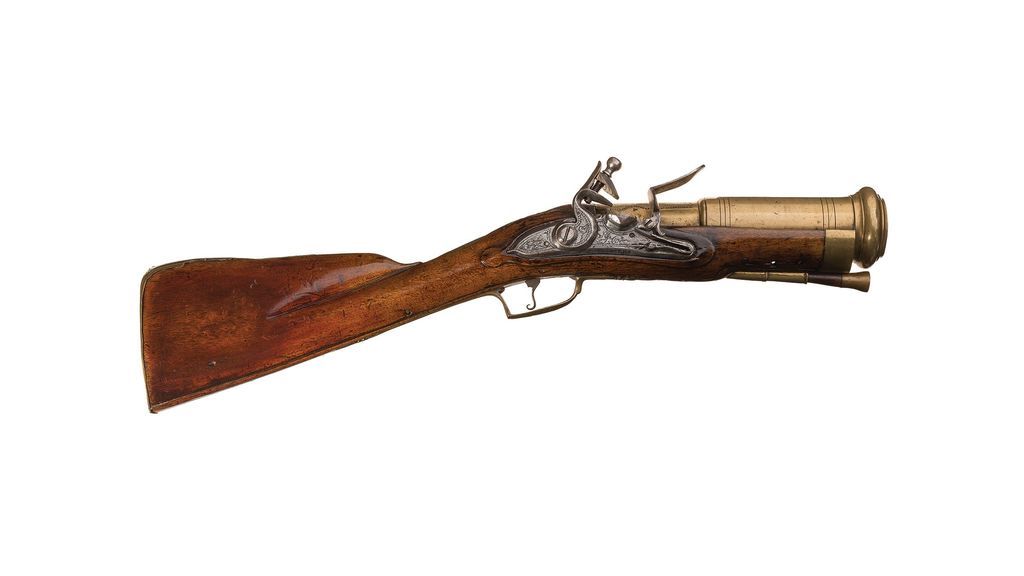
- Estate and general auctions are where a genuine one shows up mis-catalogued as a blunderbuss - which is worth knowing, because “blunderbuss” is the wrong word and the difference is not subtle. A blunderbuss has a long barrel and a flared muzzle and shoots a load of shot at a man. A hand mortar has a chamber step, almost no barrel, and lobs.
10.4 The honest recommendation
If the goal is to own a piece of the history, buy an original, budget for the RIA range, and do the five checks or pay someone who can.
If the goal is to shoot one - which, honestly, it partly is - do not shoot an original. Buy or build a reproduction for that, and let the original hang on the wall. A three-hundred-year-old bronze barrel with an unknown service history and a cracked hammer neck is not a range gun, and there is no version of this where damaging it is recoverable.
Volumes 11 and 12 cover the shooters.
Sources
Rock Island Auction lots 1173, 1273, 5014/485 and 2060/930; the Muzzleloading Forum threads 113282, 113803 and 174346 (dave_person, Glenn Osborne, ljspoon); Forgotten Weapons, “Flintlock Hand Mortar”; mg34.com listing; Bayerisches Nationalmuseum via Wikimedia Commons; peashooter85 (Lock, Stock and History).
Comments (0)