Hand Mortars · Volume 6
The Other Half: Signal, Line-Throwing and Firework Mortars
Everything so far has treated the hand mortar as a weapon. That is the half of the story that got written down, because armies keep records and pyrotechnicians do not. It is not the whole story, and for anyone who wants to actually shoot one of these in the twenty-first century, it may not even be the important half.
6.1 The evidence that there were two families
Forgotten Weapons states it directly: hand mortars proliferated through the 1600s and 1700s in two variants - military grenade launchers withstanding significant pressure, and lighter signal flare and fireworks launchers. Their example, they judge, is the latter.
Rock Island Auction reaches the same conclusion from the objects: “They could be used for launching pre-lit fused grenades, weighted lines, and grappling hooks further distances than could be thrown by hand. Some may have been used for launching fireworks. The varied shape of some of the barrels certainly suggest some had different purposes.”
Wikipedia records the maritime end: a naval variant that could throw a leaden projectile and a line 80 yards (73 m), documented in an 1872 work on lifesaving equipment. That is more than two centuries after the wheellock grenade guns, and it is a rescue tool, not a weapon.
And on the Muzzleloading Forum, when a member asks about a French piece that does not look military, dave_person - one of the most careful researchers on that board - offers the obvious alternatives without hesitation: “Fireworks or signaling were two uses that crossed my mind.” The original poster had already heard the same: “I’ve heard stories of hand mortars used for things like fireworks displays back in the day.”
Four independent sources, converging.
6.2 Why the barrel shape is the tell
If you are looking at an unattributed piece, the profile tells you which family it belongs to before any paperwork does:
- A deep, heavy cup with pronounced reinforcing rings and a thick wall is built to contain a real launching charge behind a heavy iron sphere. Military.
- A thin, light, shallow bell, often longer and more slender, is built to throw something that weighs ounces. Signal or pyrotechnic.
- A long barrel with a small nozzle - like the Swedish model 1700 in Volume 4 - is the line-throwing and long-range family.
Wall thickness at the muzzle and the depth of the chamber step are the two measurements that separate them, and neither appears in a sale listing. You have to look.
6.3 Why an army had the same problem as a fireworks maker
The overlap is not a coincidence and it is not a curiosity: fireworks and artillery were the same profession.
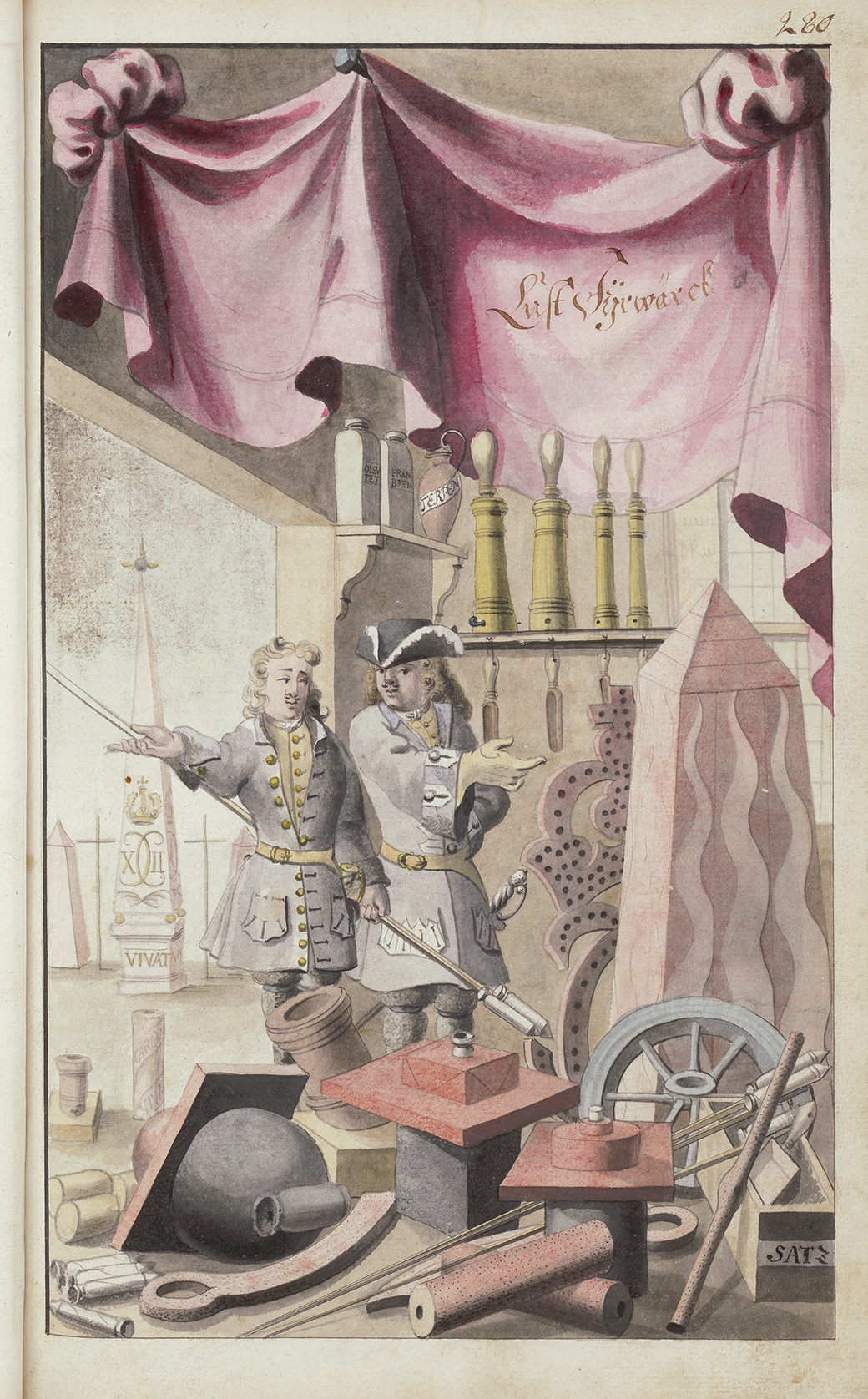
The image above is a firework maker’s shop, and the men standing in it are artillery officers. The tools on the floor - the rammers, the formers, the cased shells, the box of Satz, the mortars - are artillery tools used for entertainment. A man who could compute a mortar’s elevation, fill a shell, cut a fuse to a burn time and lay a train could put on a show or reduce a fortification with the same skill set, and frequently did both for the same employer.
This is why the office Elizabeth I created had the word “master” in it, why Ambrose Dudley - the man who staged the Warwick display in Volume 7 - was Master-General of the Ordnance, and why period plates of firework construction look exactly like period plates of ammunition construction. Volumes 7 and 8 follow that thread.
6.4 The mortar family, in scale order
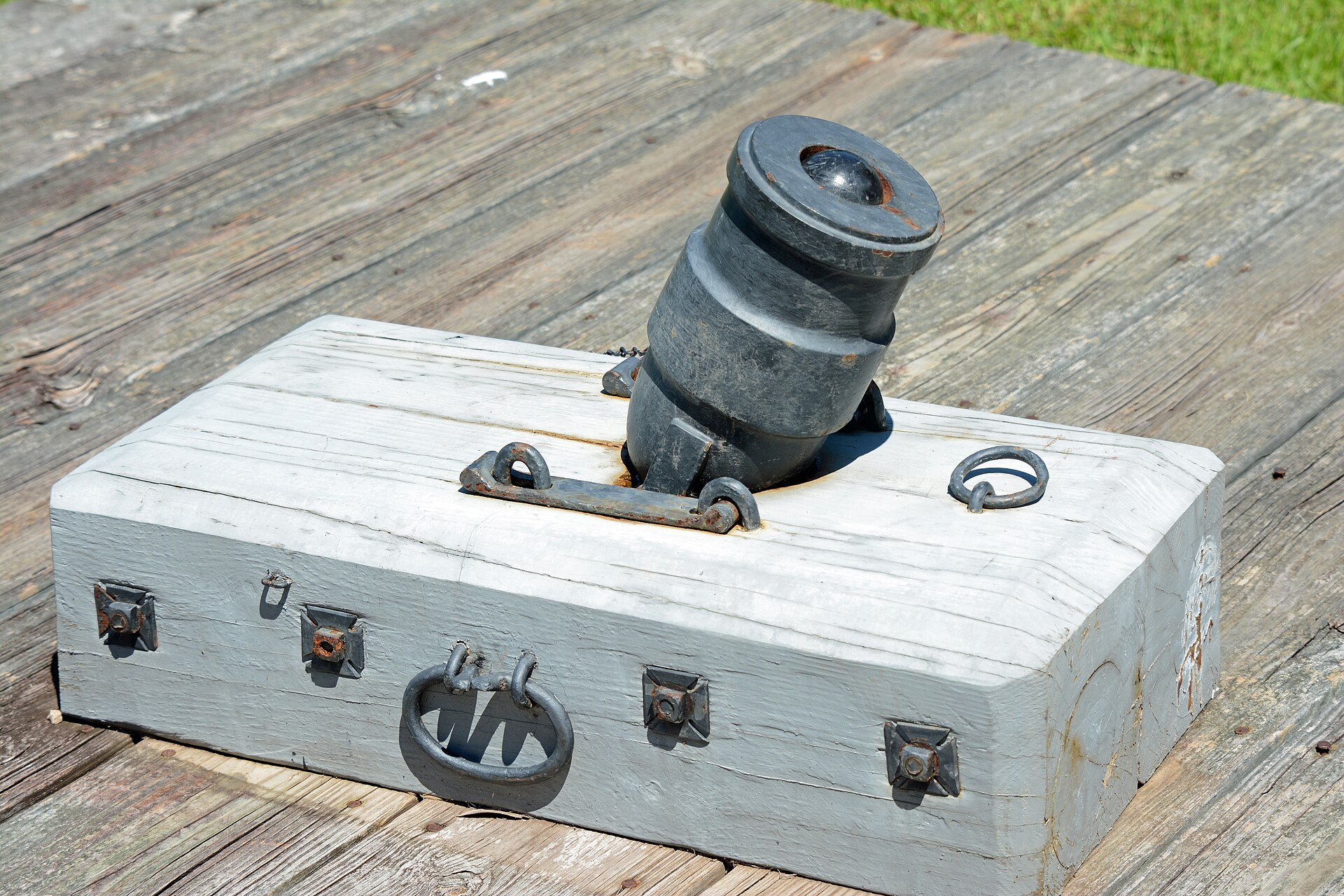
Put the family side by side and the hand mortar’s niche becomes obvious:
Table 1 — Put the family side by side and the hand mortar's niche becomes obvious
| Device | Carried by | Bore | Range | Job |
|---|---|---|---|---|
| Hand mortar | one man, slung | 2-2.5 in | short - see Volume 5 | a grenade over a wall, a signal, a firework |
| Musket-mortar (cup on a musket) | one man, clamped to his own musket | grenade-sized | 250 yd (period figure) | the same, with the gun he already has |
| Coehorn | two to four men, on a bed | ~4.5 in | up to 1,200 yd | actual bombardment |
| Siege mortar | a team and a wagon | 8-13 in | miles | reducing works |
The coehorn is the reason the hand mortar died as a weapon. It is also the reason the hand mortar survived as something else: nobody wants to drag a coehorn onto a ship’s deck to throw a lifeline, or into a palace garden to send up a star.
6.5 What this means for you
If you are buying, building or shooting one today, the pyrotechnic and signalling branch is the living branch. It is the use that:
- has a continuous history from the 1600s to the present, through signal mortars and line-throwing guns;
- is the one explicitly carved out of the federal destructive-device definition, as Volume 15 covers - “signaling, pyrotechnic, line throwing, safety, or similar device” is statutory language, not a euphemism;
- and is the only one you can legally and safely reproduce, because the military branch requires making a bomb.
Volume 14 is the practical volume on it. Volumes 7 and 8 are why it is more interesting than it sounds.
Sources
Forgotten Weapons, “Flintlock Hand Mortar”; Rock Island Auction lot 1173 catalog description; Wikipedia, Hand mortar; the Muzzleloading Forum thread 113282 (dave_person, hyuzu, Alden); 26 U.S.C. § 5845(f)(3).
Comments (0)