Hand Mortars · Volume 4
Anatomy: Bore, Chamber, Lock and Stock
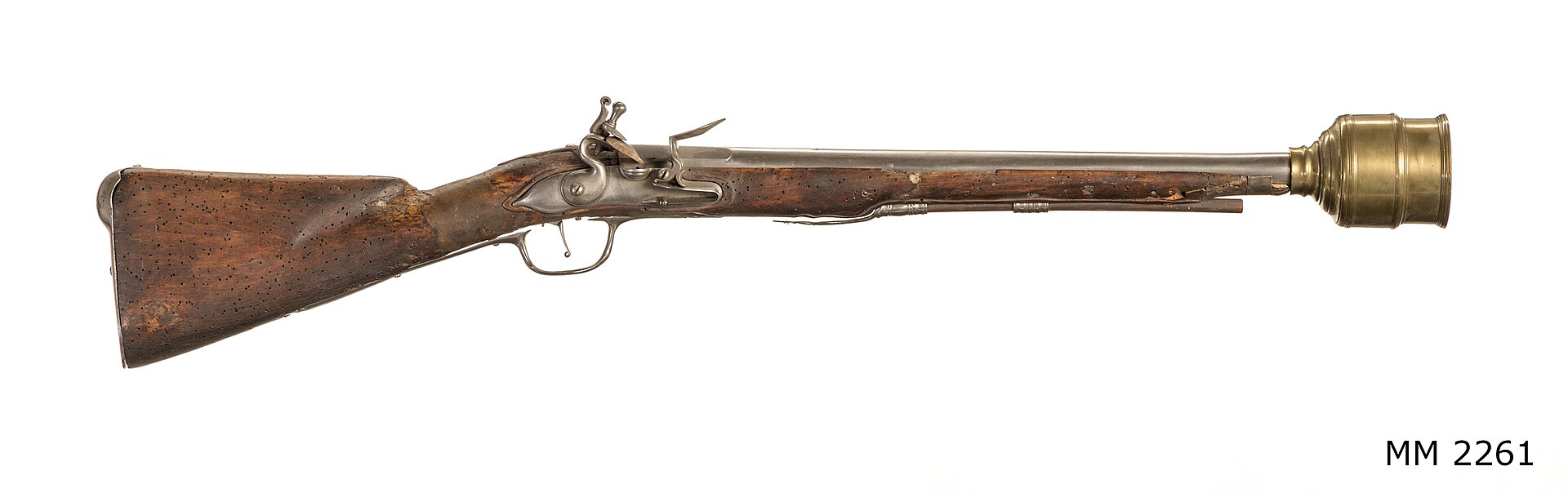
The Swedish model 1700 is the best single teaching object in the whole class, because it is documented down to the price. It was made for three-pound hand grenades. Its barrel is 930 mm long. Its muzzle nozzle is 75 mm in diameter. Four were made at the Ronneby Armory in 1703, and each cost seven silver dalers.
Notice what that description does to the stereotype. This is not a stubby cup on a club. It is a long-barrelled arm with a launching nozzle at the end - closer in architecture to the musket-mortar than to the fat-cup German pieces, and it is a state-manufactured, numbered, priced service item, not a curiosity.
4.1 The bore, and the number that will mislead you
Published bores for the type cluster at 2 to 2.5 inches. Barrel length is typically 2 to 4 inches, with outliers reported to 13 inches.
But when you read a sale listing, be careful which number you are being given. Rock Island’s catalog entry for their lot 1173 lists the barrel as 7 inches round and separately notes that “the ‘cup’ has a 3⅓ inch diameter”. Those describe two different things: the external flare of the bell and the working bore behind it are not the same measurement, and neither is the chamber.
Three numbers matter, and a seller will usually give you one:
- Cup outside diameter - the impressive one, quoted most often.
- Bore - what you can actually seat. The Rifle Shoppe’s reproduction barrel is 8 inches overall with a 2½ inch bore, and Veteran Arms advertise a 2.5 inch bore.
- Chamber diameter - what the powder sits in. Veteran Arms give this as .75 calibre, which is the number that tells you the piece was engineered rather than drilled.
4.2 The stepped breech, and why it is the clever part
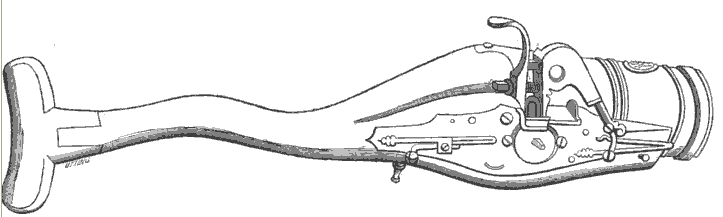
Forgotten Weapons identifies the single most interesting engineering feature of these guns: the barrel is chambered and stepped at the breech, with a narrow powder chamber behind the wide projectile bore.
This is the high-low pressure system, and it is the same principle a modern 40 mm grenade launcher uses. Burning the charge in a small, strong chamber produces high pressure where the metal can take it, and the gas then expands into the large bore at much lower pressure to push the projectile out. Two things follow:
- The tube is reinforced where it needs to be and can be thin, light brass everywhere else.
- The projectile is not crushed. A hollow iron grenade - or a paper firework shell, or a tennis ball - sitting directly on top of a full-bore charge would be deformed or destroyed before it moved. The step is what makes a fragile projectile survivable.
Veteran Arms’ figures make it concrete: a .75 calibre chamber feeding a 2.5 inch bore. The chamber cross-section is roughly a eleventh of the bore’s. That ratio is the whole design.
For anyone building: the Rifle Shoppe sells the 819 barrel with the breech plug already fitted, which removes the one operation on this gun that genuinely wants a lathe and a gauge.
4.3 The lock
There is no such thing as a hand-mortar lock. The type ran through matchlock, wheellock and flintlock as each became current, and the locks fitted are ordinary military or trade locks of their period. That is a gift to a builder and a trap for a buyer.
For the builder, it means lock parts are conventional. The Rifle Shoppe’s 819 lock is a normal English-style flintlock, sold either as a set of castings at $150 or assembled at $495 - plate, cock, top jaw, frizzen, frizzen spring, pan, tumbler, bridle, sear, sear spring and mainspring.
For the buyer, it means the lock dates the gun, and Volume 10 makes that a checklist. dave_person’s dismantling of the “1780 Moynat” attribution turns entirely on an unbridled frizzen at a date when French military locks all had bridled ones.
4.4 The stock, the butt, and the missing forestock
Look again at the British Museum piece in Volume 1 and the Woolwich engraving above. What you will not find is a shoulder-shaped butt.
The butt on most hand mortars is broad, flat and splayed, sometimes into a pronounced fishtail. On the eighteenth-century flintlock pieces it flattens into a wide plate. This is not a stylistic tic. It is a bearing surface, because these guns were fired with the butt planted on the ground. Volume 5 covers the drill; the point here is that the geometry tells you the answer before anyone explains it.
Other recurring stock features:
- Sling swivels, front and rear, on a surprising number of survivors - including both Rifle Shoppe part numbers. These were slung and carried.
- Little or no forestock forward of the lock. Nothing to hold, nothing to protect, and nothing to burn.
- A ramrod on some, none on most. The Swedish m/1700 has pipes and a rammer; the short-cup pieces do not, because a hand mortar is loaded by pouring and seating, not by ramming.
- Iron or brass furniture, according to nation and period. Rock Island’s lot 1173 is iron-furnitured with a bare butt and a carved finial on the heel - a German or Dutch habit.
4.5 Materials
Barrels are bronze or brass. This is not decoration and it is not because iron was unavailable. Cast bronze was the ordnance material of the period: it can be cast to a stepped internal profile in one piece, it does not rust in a damp trench or a ship’s locker, and it fails by bulging rather than by fragmenting. Every serious reproduction still uses it - the Rifle Shoppe’s 819 barrel and the custom Ben Coogle barrels are both bronze.
Stocks are walnut or a local hardwood, plain on the military pieces and inlaid with bone or engraved brass on the arsenal and princely ones.
4.6 What this means at the bench
If you are building or evaluating one, the anatomy gives you a short list of what actually matters:
- The breech step must be right. It is the safety feature and the performance feature. Buy a barrel with the plug fitted rather than making one.
- The butt is a structural component. Do not slim it for looks. It is going on the ground.
- The lock has to be right for the claimed date, or the gun is a marriage.
- Bore, cup and chamber are three numbers. Get all three before you send money.
Sources
Marinmuseum record MM 2261 via Wikimedia Commons; Forgotten Weapons, “Flintlock Hand Mortar”; Rock Island Auction lot 1173 catalog description; The Rifle Shoppe catalog page 819; Veteran Arms product specifications; Wikipedia, Hand mortar; John Hewitt engraving of the Royal Artillery Museum, Woolwich piece; the Muzzleloading Forum thread 113282.
Comments (0)