Hand Mortars · Volume 1
What a Hand Mortar Actually Is
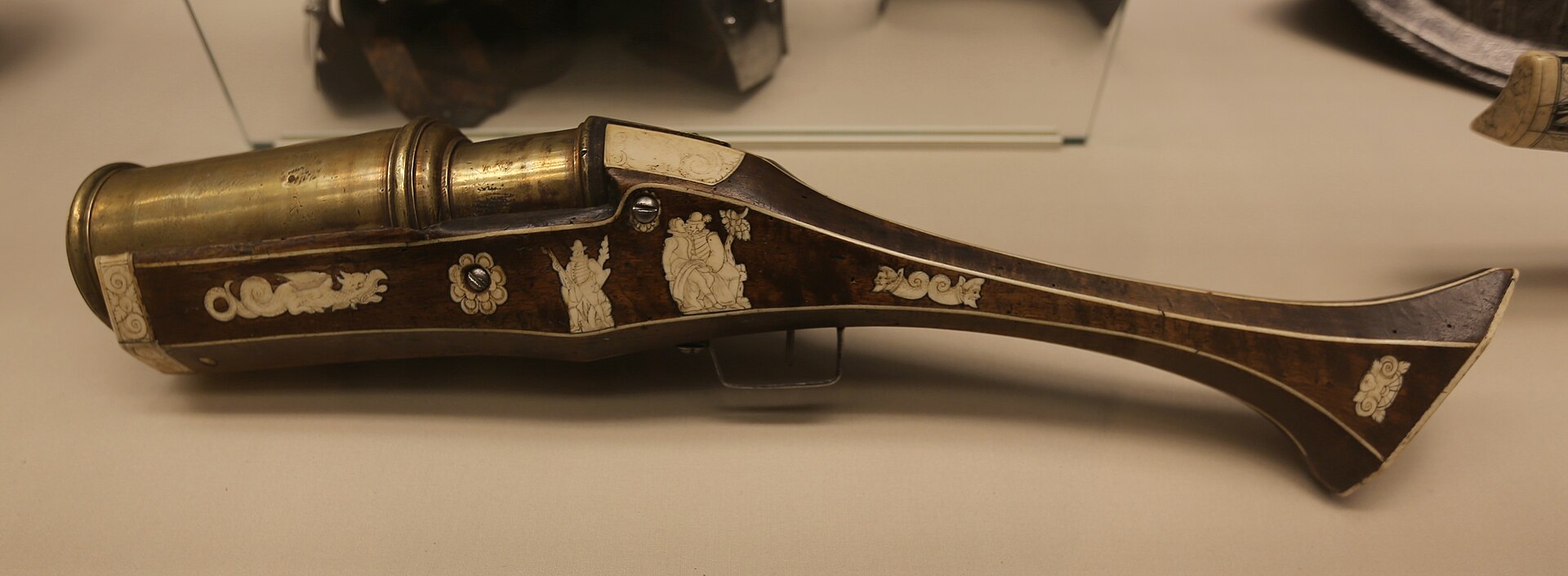
Pick one up and the first thing you notice is that the proportions are wrong. A musket is mostly barrel. This is mostly stock, with what looks like a brass drinking vessel screwed onto the front. That impression is not far off: the barrel on a hand mortar is often shorter than the bore is wide. It is a gun built around a hole.
The hand mortar is a short, very large-bore muzzleloader, stocked like a musket or a carbine, made to lob something rather than shoot it. Bore runs typically 2 to 2.5 inches - fifty to sixty-four millimetres - and the barrel is usually only two to four inches long, though examples are recorded out to thirteen. Barrels are bronze or brass; the lock is whatever was current, which over the life of the type means matchlock, wheellock, and flintlock in turn. It is the direct ancestor of the M79 and the M203, arrived at three centuries early and abandoned for reasons that had nothing to do with the idea being wrong.
1.1 The one-line definition, and why it is not enough
Say “hand mortar” to a collector and they will picture a grenade launcher. That is half right, and the missing half is the reason most writing on the subject is confused.
Forgotten Weapons makes the structural point better than anyone: these things proliferated through the 1600s and 1700s in two distinct families. There were military grenade launchers, built heavy enough to take a real launching charge behind a two-and-a-half-pound iron bomb. And there were lighter signal-flare and firework launchers, built to throw something that weighed almost nothing, and built accordingly.
Rock Island Auction says the same thing from the other direction in its catalog copy for a mid-eighteenth-century European piece: “The varied shape of some of the barrels certainly suggest some had different purposes… Some may have been used for launching fireworks.”
That single observation reorganises the whole subject. A hand mortar is not one object with one job. It is a launching tube on a shoulder stock, and what came out of it depended entirely on who owned it. Grenadiers threw bombs. Ships threw lines. Pyrotechnicians threw stars. Somebody in the Netherlands in 1872 was still using a naval version to put a leaden projectile and a line eighty yards onto a wreck.
1.2 Three words, three different devices
The vocabulary is worse than the object. A military dictionary of 1810 - quoted on the Muzzleloading Forum from Google Books - draws distinctions that modern writers collapse into one term:
Firelock-Mortars … are small mortars, fixed at the end of a firelock: they are loaded as all common firelocks are; and the grenade, placed in the mortar at the end of the barrel, is discharged by a flint-lock; and, to prevent the recoil hurting the bombardier, the bombard rests on a kind of halberd, made for that purpose.
And, listed separately as a different weapon entirely:
Hand mortars … fixed at the end of a staff 4½ feet long, the other end being shod with iron to stick [in the ground].
So the object that collectors, auction houses and this dive all call a “hand mortar” is, in period language, closer to a firelock-mortar. The period “hand mortar” was a tube on a pole. There was also a third thing - a cup that clamped onto the muzzle of an ordinary musket like a bayonet, turning a Brown Bess into a grenade launcher for as long as you left it fitted.
None of this is pedantry you can skip. It matters when you are reading a sale listing, because a seller writing “hand mortar” may mean any of the three, and the price difference is thousands of dollars.
1.3 The shape of the thing
A few features recur across almost every survivor, and each of them is a clue about use:
- A cup, not a tube. The muzzle end flares into a wide, usually ringed brass cup. It is a seat for a round projectile, not a shot-spreader.
- A chambered, stepped breech. Behind the wide bore sits a much narrower powder chamber. This is the high-low pressure principle that modern 40 mm grenade launchers use: it reinforces the tube and it keeps the launching charge from simply crushing the projectile it is trying to throw.
- No ramrod, usually, and no forestock to speak of. There is nothing to ram. You pour, you seat, you fire.
- Sling swivels. Common enough to be diagnostic. These were carried.
- A butt shaped to be planted, not shouldered. More on that in Volume 5, which is where most of the received wisdom about these guns falls apart.
1.4 Why it matters that so few survive
Rock Island, who see more antique firearms than nearly anyone, are blunt about it: “These devices do not appear to have been used in large numbers, and very few of these guns survive today. Many that do, originated in Germany or the U.K., and are generally contained within museum collections which makes examples on the private market in the U.S. incredibly hard to find.”
One period assessment quoted by Wikipedia writes the whole class off as “only a toy … never intended for service.” Berlin’s Royal Foundry made 302 of them between 1672 and 1740 - a real programme, and still a rounding error next to musket production over the same seven decades.
Scarcity shapes everything downstream. It is why there is a genuine kit market for a weapon almost nobody has heard of. It is why a good original carries a five-figure auction estimate. And it is why, if you want one on the bench, the realistic answer for most people is to build it.
1.5 Where this dive goes
Volumes 2 and 3 run the history: the wheellock grenade guns of the 1580s, then the grenadier century when the type peaked and died. Volume 4 takes one apart. Volume 5 corrects how they were fired, which almost every popular account gets wrong. Volume 6 picks up the forgotten half - signal, line-throwing and firework mortars - and Volumes 7 and 8 follow that thread into the Tudor and Stuart fireworks world, including a queen who loved fireworks enough to invent a court office for them and, on one August evening in 1572, burn down part of a town.
Volumes 9 and 10 cover surviving originals and how to buy one without being sold a marriage. Volumes 11 and 12 cover the kits - what exists, what it costs, what it takes. Volumes 13 and 14 cover shooting one, with inert projectiles and with fireworks. Volume 15 covers the law and delivers the verdict.
Sources
Wikipedia, Hand mortar; Forgotten Weapons, “Flintlock Hand Mortar”; Rock Island Auction lots 1173 and 1273; The Vintage News (2016); A military dictionary (1810) via the Muzzleloading Forum; The Rifle Shoppe catalog page 819.
Comments (0)