Hand Mortars · Volume 8
Fire-Drakes, Green Men and the Girandola
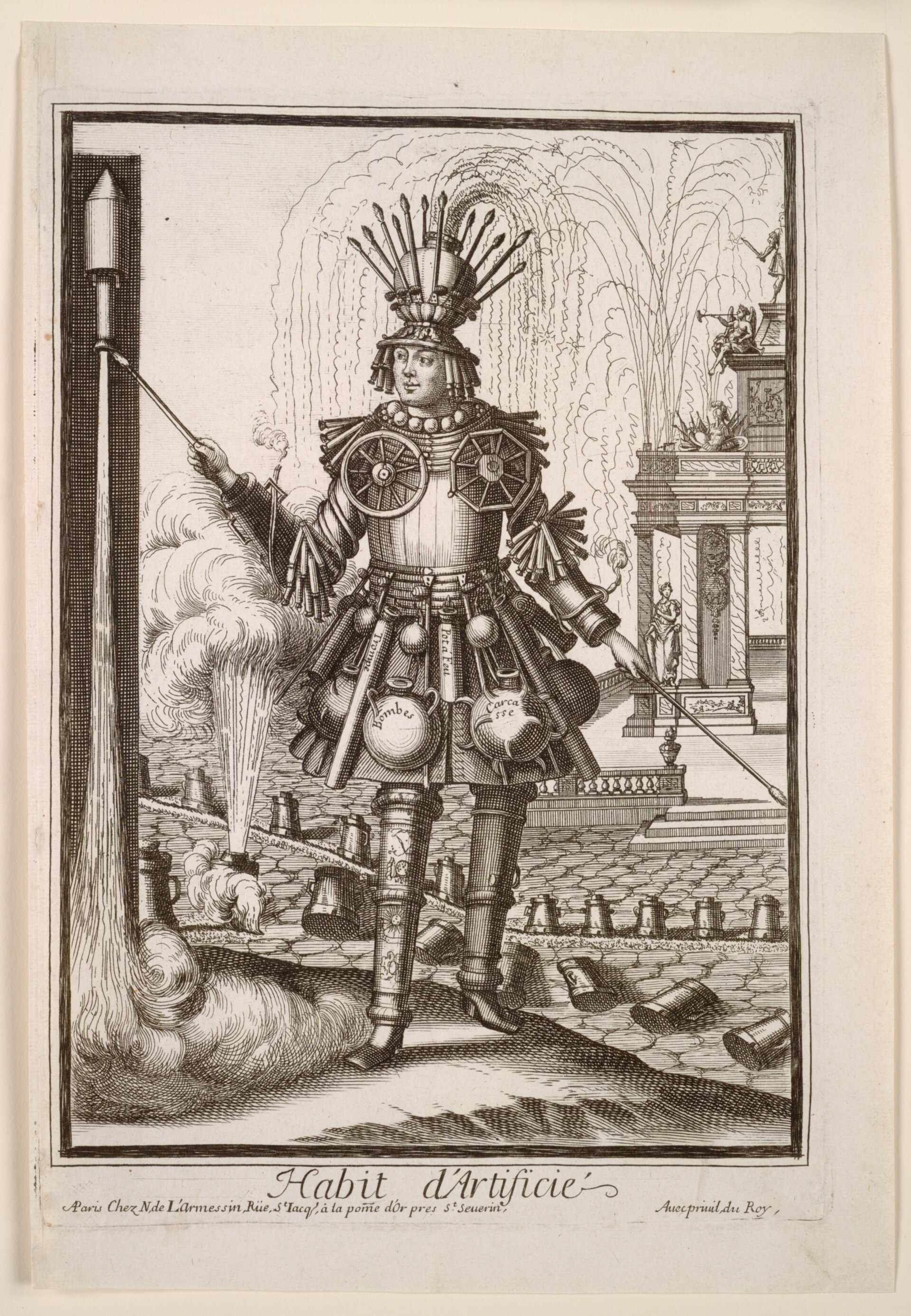
Look at what Larmessin put on the ground behind his fireworks-maker. Two files of squat, flanged tubes, standing in rows, laid across the pavement in the middle distance. Those are mortars. That is the trade.
This volume is the world the pyrotechnic hand mortar belongs to - the profession, the literature and the great displays - because a tool only makes sense next to the job it was for.
8.1 The literature
The men doing this work wrote it down, and the books survive.
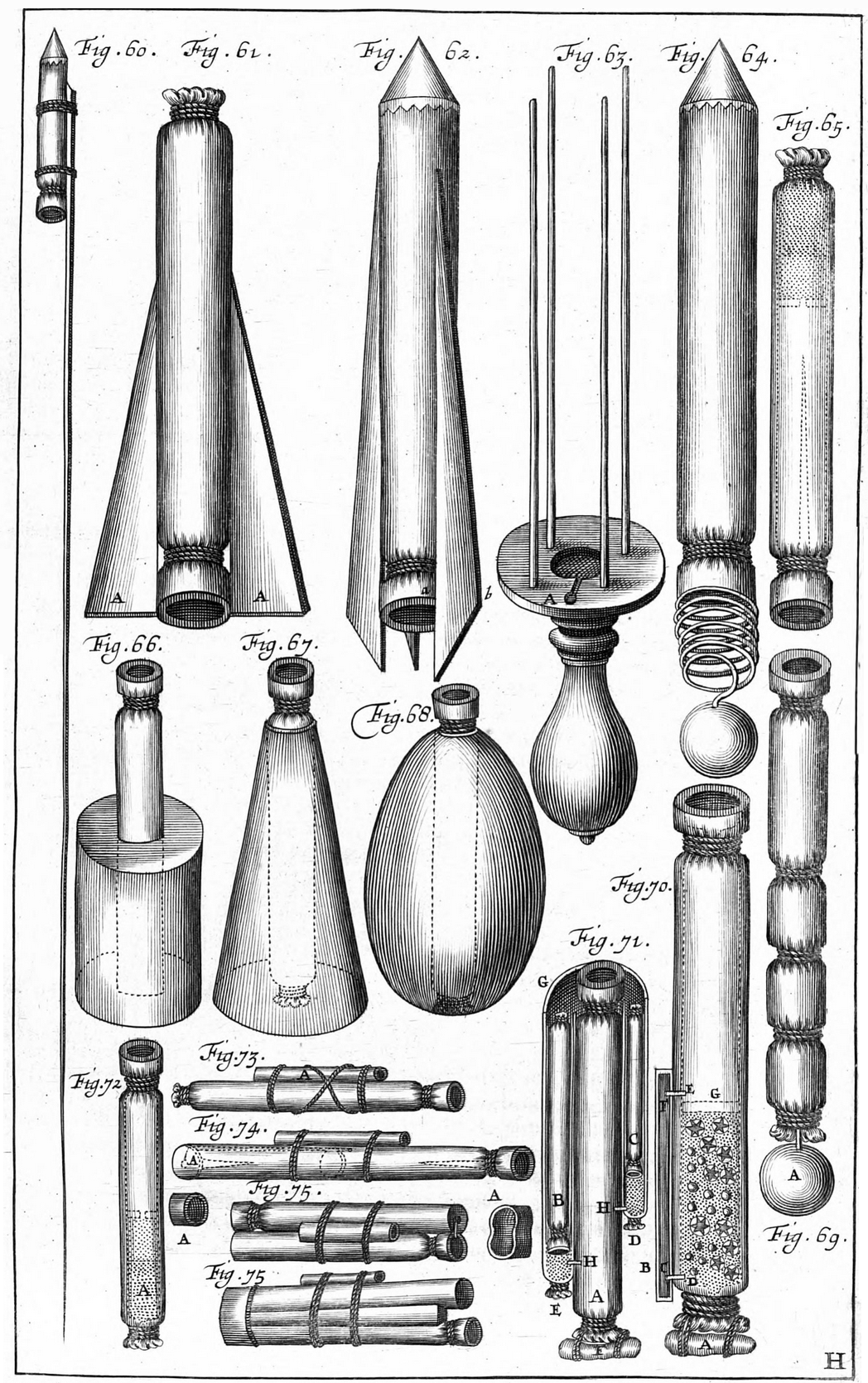
Casimir Siemienowicz, Artis Magnae Artilleriae (1651), is the great one. Look at what is on that page: staged rockets, finned rockets, clustered rockets, sectioned cases showing exactly where the propellant sits and where the stars go, and a shell slung beneath a lifting case. It is a shell-construction manual, and the drawing conventions are those of an ordnance treatise because that is what it is. Siemienowicz was an artillery officer.
Earlier, Rudolf von Deventer’s sixteenth-century manuscript - the fire-drake in Volume 7 - is doing the same work in a less systematic way: here is a dragon, here is what makes it fly, here is the wheel and the globe.
Joseph Furttenbach, in the seventeenth century, documents the display as staged theatre.
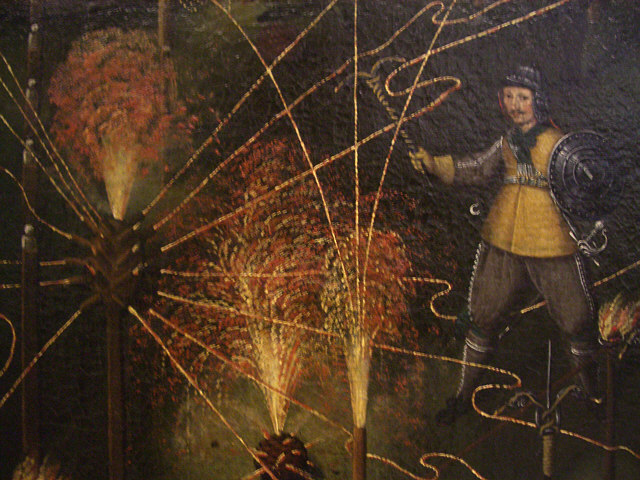
That figure - armoured, costumed, carrying fire as a prop and walking through the display rather than standing behind it - is the ancestor of the “green men” and wild men who cleared the way at Tudor and Stuart pageants, and the direct ancestor of Larmessin’s Artificier. Being a firework maker was a performance, not a job you did from behind a safety line.
8.2 The set-piece
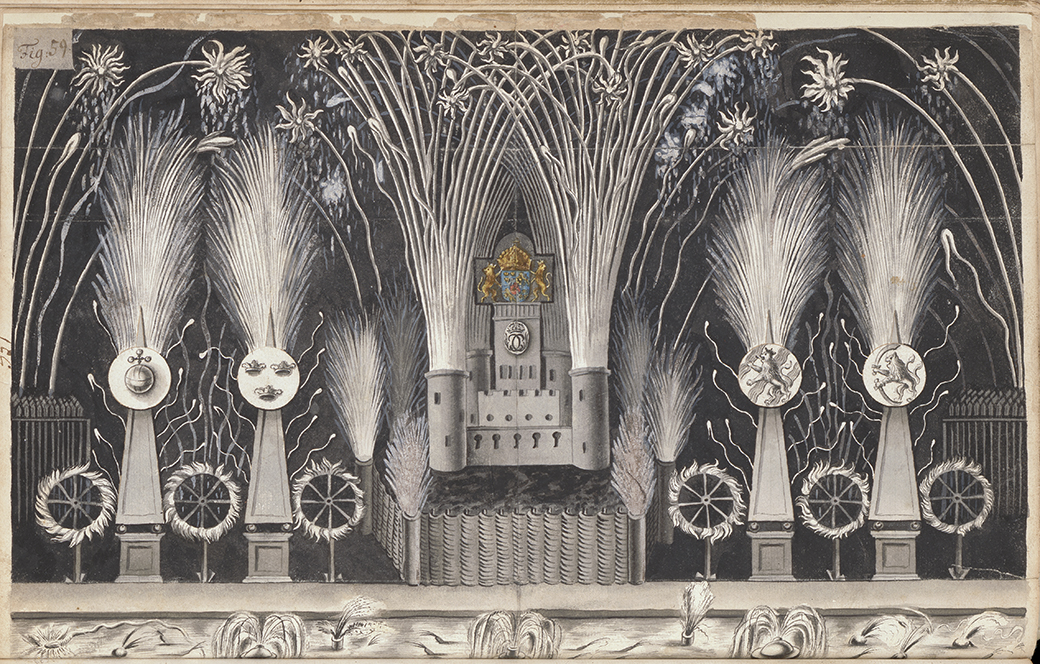
By the eighteenth century a display was an architectural commission. Somebody drew it - elevations, positions, effects - and somebody else built a temporary building to carry it. Note the row of fire-jets along the base of that drawing, and the palisade fence behind: the working end of a display was a battery, hidden from the audience, laid out and fired in sequence.
That is exactly the arrangement in Volume 14’s lead figure, and it is exactly what a hand mortar is: one tube from a battery, given a stock so a man can carry it and aim it.
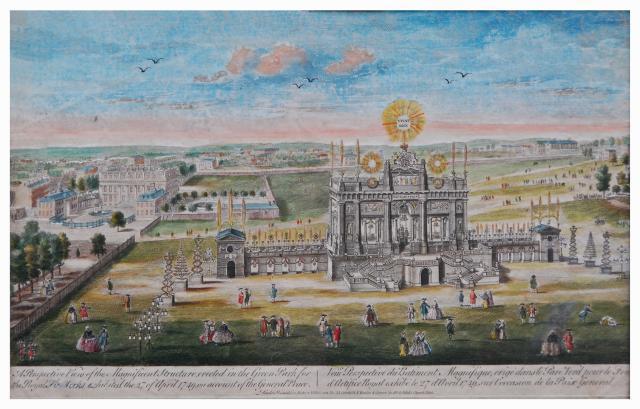
The best-known British example is the Green Park machine of 27 April 1749, built for the peace of Aix-la-Chapelle and remembered mostly because Handel wrote music for it. It is one hundred and seventy-seven years after Warwick, and the lineage is unbroken: a temporary building, a battery behind it, a court paying for it.
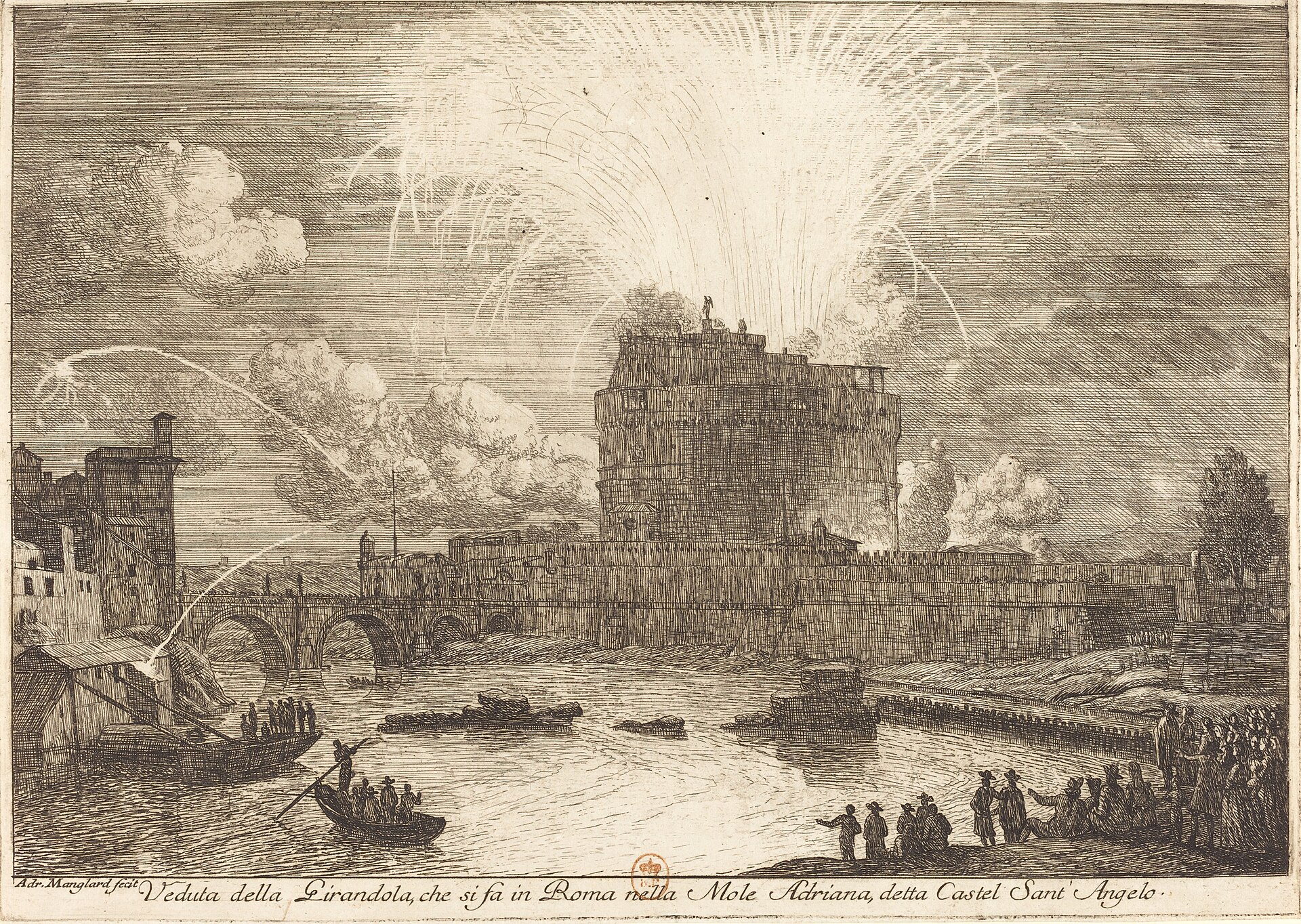
And the European benchmark everybody was measuring themselves against was the Girandola at Castel Sant’Angelo in Rome - the display that ran for centuries, painted by everyone who visited, and the reason the Italian pyrotechnician Robert Dudley imported for Kenilworth in 1575 was worth importing.
8.3 Why this is in a dive about a gun
Three connected reasons, and they are the through-line of this whole dive:
One: the same men. Artillery officers ran fireworks. Elizabeth’s Warwick display was staged by the Master-General of the Ordnance. Siemienowicz’s fireworks treatise is an artillery treatise. The shop in Volume 6 is full of ordnance tools.
Two: the same components. A firework shell is a hollow case with a fuse and a bursting charge, lifted out of a tube by a charge underneath it. A grenade is a hollow case with a fuse and a bursting charge, lifted out of a tube by a charge underneath it. Siemienowicz’s plate above draws them with the same pen.
Three: the same tube. Which is why the surviving hand mortar population contains both heavy military pieces and light ones that would never have survived a two-and-a-half-pound iron sphere - and why the statute that governs these things in the United States today carves out, in so many words, devices redesigned as “signaling, pyrotechnic, line throwing, safety, or similar.” The pyrotechnic hand mortar is not a loophole. It is the original other use.
Sources
Casimir Siemienowicz, Artis Magnae Artilleriae (1651); Rudolf von Deventer, sixteenth-century manuscript illustrations; Joseph Furttenbach; Nicolas de Larmessin II, Habit d’Artificier, Cleveland Museum of Art; contemporary prints of the Green Park machine, 1749; Adrien Manglard, view of the Girandola at Castel Sant’Angelo; English Heritage, “History of Fireworks”; Tudor Society on Kenilworth 1575; 26 U.S.C. § 5845(f)(3).
Comments (0)