Hand Mortars · Volume 13
Shooting It: Loads, Projectiles and the Drill
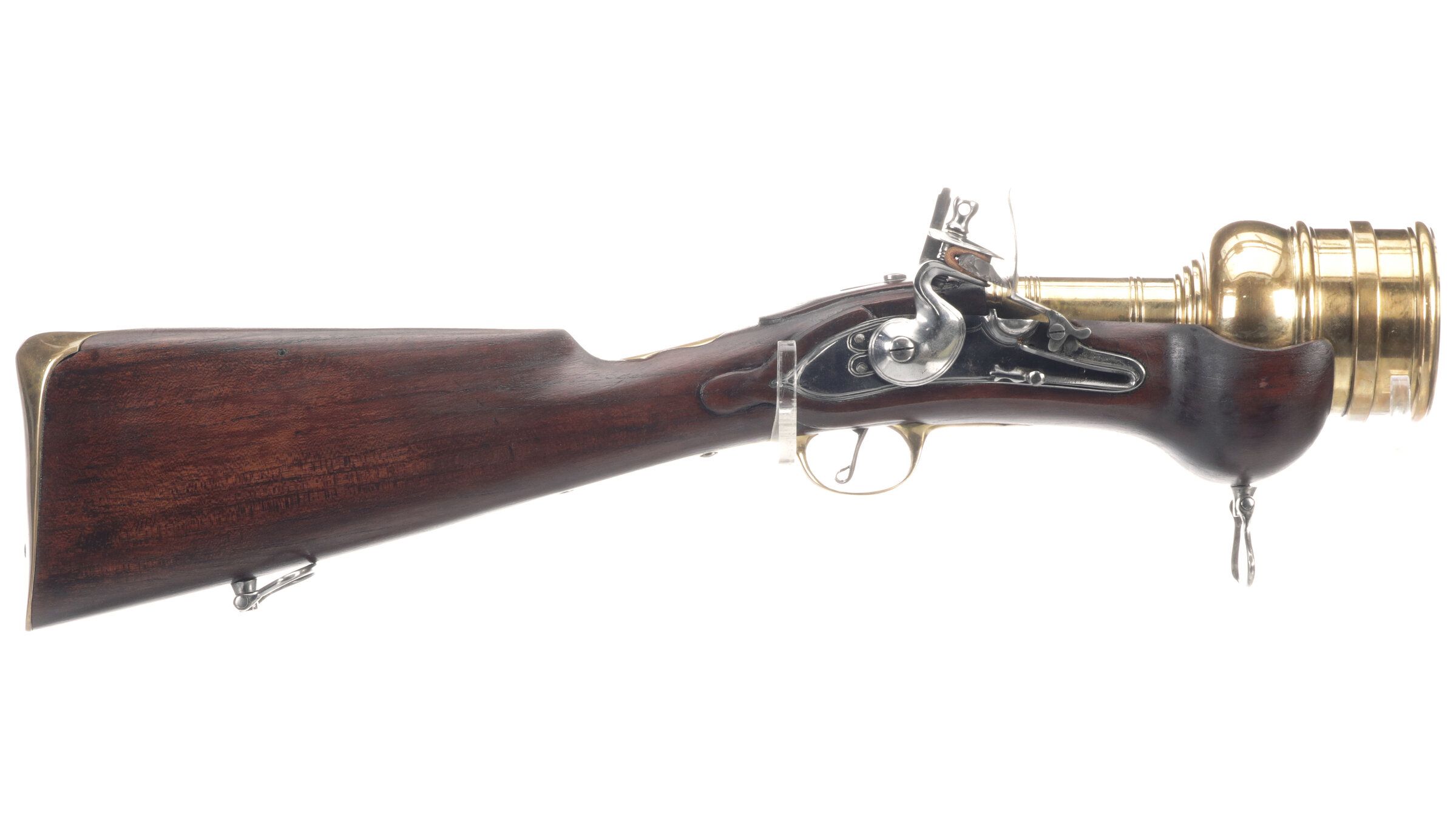
The good news about shooting a hand mortar is that everyone who does it agrees on the essentials. The bad news is that almost none of that agreement has been written down anywhere except a handful of forum threads, which is what this volume is for.
Everything here assumes a modern reproduction, inert projectiles, and a private range. Volume 15 covers why that is not a stylistic choice.
13.1 The load
The documented charges from people who actually shoot these:
Table 1 — The documented charges from people who actually shoot these
| Source | Charge | Notes |
|---|---|---|
| Grenadier1758 (TRS-built gun, reenacting unit) | 80-100 gr | with a tennis-ball projectile |
| Commodore Swab (two Veteran Arms guns) | “About 120 grains lob nicely” | |
| De Witt Bailey (period musket-mortar) | 165 gr (6 drams) | grenade to 250 yd, shoulder-fired |
So the working envelope for a modern repro throwing a light ball is 80 to 120 grains, and 120 is the number an experienced owner reaches for.
Powder: black powder or a black-powder substitute rated for muzzleloading arms. Not smokeless, not under any circumstances, in any quantity, in a bronze cup barrel with a thin muzzle wall. The same rule that governs every other gun in this section governs this one, only more so.
Start low and work up. Begin at 60 grains on a new or unknown gun and come up in ten-grain steps, watching where the projectile lands and how the gun behaves. There is no published load data for hand mortars. You are developing it.
The charge goes in the chamber, not the bore. This is the whole point of the stepped breech from Volume 4. A charge that fills into the wide bore is not doing what the gun was designed for.
13.2 The projectile
Tennis balls are the standard, universally, for the good reason that they are the right diameter for a 2½ inch bore, they weigh almost nothing, and they are free by the barrel. Flint62Smoothie: “I lucked out and bought a barrel full of used tennis balls for $50! Ammo to spare.”
Lacrosse balls are better for distance. WKD, who has done a lot of this: “Lacrosse balls are great for distance and will not tear apart like a tennis ball.” A lacrosse ball is solid rubber at about 5¼ ounces against a tennis ball’s 2 - more mass, more momentum, and it survives the launch instead of deforming.
Wadding. Between chamber and projectile you want a wad that seals reasonably and does not become a projectile of its own. Card or a light fibre wad works. Do not use anything that will hold fire and stay lit on the ground downrange.
Paint them. Glenn Osborne’s plan for reenactments was black-painted tennis balls, and it is a good one for two reasons: they look like grenades, and you can find them afterwards.
13.2.1 What not to shoot
The historical reenactment load was a tennis ball with 80 grains of black powder and flour, with a short fuse, lit by blow-by on launch. It is documented, it is what units did, and it is described here as history rather than as a recipe. Two reasons to leave it alone:
- WKD’s warning from inside the same conversation: “Also flour and flames mixed are explosive.” A flour-and-powder charge in a sealed ball is a dust explosion waiting for an ignition source, which is exactly what you are giving it.
- The legal line. A projectile with an explosive charge and a fuse is a grenade. Volume 15 covers what that means. It is not a grey area.
Inert balls for practice, commercial pyrotechnics for display (Volume 14). That is the whole menu.
13.3 The drill
Two people. One loads and lays, one fires. Everybody else is behind the firing line.
- Confirm the bore is clear. Rod it. Every time.
- Charge the chamber. Measured, from a separate measure, never from the flask or can directly.
- Wad.
- Seat the projectile by hand, firmly, down onto the wad. No ramming - there is nothing to ram and the projectile is compressible.
- Prime. Fine priming powder in the pan. Nothing else about the lock differs from any other flintlock.
- Plant the butt on the ground. Both hands on the stock, body behind and to the side of the axis, not over it. Do not shoulder it - see Volume 5, and the reenactor who tried it once.
- Set the angle by eye. There are no sights and there never were. Elevation is your only variable and it is set by feel and by watching where the last one went.
- Call the range clear, and fire.
13.3.1 Misfires and hangfires
The advantage of an inert ball is that the misfire drill is trivial: wait the full hangfire interval with the muzzle in a safe direction, then roll the projectile back out of the muzzle. Glenn Osborne, relaying a unit’s practice: “for safety [they] were able to roll the tennis ball out of the mussel if the mortar misfired.”
Wait the full interval before you do anything. A flintlock hangfire on a big chamber is not instant.
For historical interest, and as a measure of how much worse this was with a live grenade: the Hessians at the Siege of Charleston tied a rope to the gun, and on a misfire with a lit fuse they threw the entire gun out of the trench, waited for the explosion, and hauled it back. Nobody has ever devised a better argument for not pre-lighting a fuse.
13.4 Range expectations
Set your expectations from Volume 5’s table rather than from any single claim. The published figures for tennis balls from a hand mortar range from 200-300 feet to 200-300 yards - the same seller quoted both in one conversation. The shorter number is what the physics supports at 80 to 120 grains with a 2-ounce ball.
Measure your own. Range a landmark, fire a group at a given charge, and write it down. Ten minutes with a laser rangefinder will give you better data than three hundred years of published claims.
The comparison that puts it in perspective: a coehorn - the real portable mortar - reaches up to 1,200 yards on a charge of a few hundred grains. Nothing held in the hands is in that conversation.
13.5 The range itself
- Private land. Reenactment safety officers generally prohibit launching any projectile at all. Grenadier1758: “be aware that the launching of a projectile is usually prohibited. Similar grenades used at a tactical reenactment caused great consternation among the safety officers.” Do not assume an event will let you demonstrate this.
- A downrange area you can see all of and walk all of. You are lobbing something that comes down out of sight of the firing point.
- Fallout zone. Everything you launch comes down. Plan for where.
- Eye and ear protection, and gloves for whoever is handling the barrel between shots. Bronze holds heat.
13.6 Cleaning
Ordinary black-powder practice, with one difference: the chamber is small and deep relative to the bore, and it is where all the fouling is. A bore brush sized to 2½ inches will sweep the bore and never touch the chamber. Get a rod, a properly sized jag or brush for the chamber, and clean it separately. Fouling left in a stepped chamber is exactly where the next hangfire comes from.
Bronze does not rust but it does corrode with black-powder residue. Clean it the same day.
Sources
The Muzzleloading Forum threads 113282, 113322, 113803, 91706 and 174346 (Grenadier1758, WKD, Glenn Osborne, Commodore Swab, Flint62Smoothie, Many Klatch, Alden); De Witt Bailey via MLF; The Rifle Shoppe catalog page 819; Forgotten Weapons, “Flintlock Hand Mortar”; Rock Island Auction lot 2060/930.
Comments (0)