Hand Mortars · Volume 5
How They Were Actually Fired
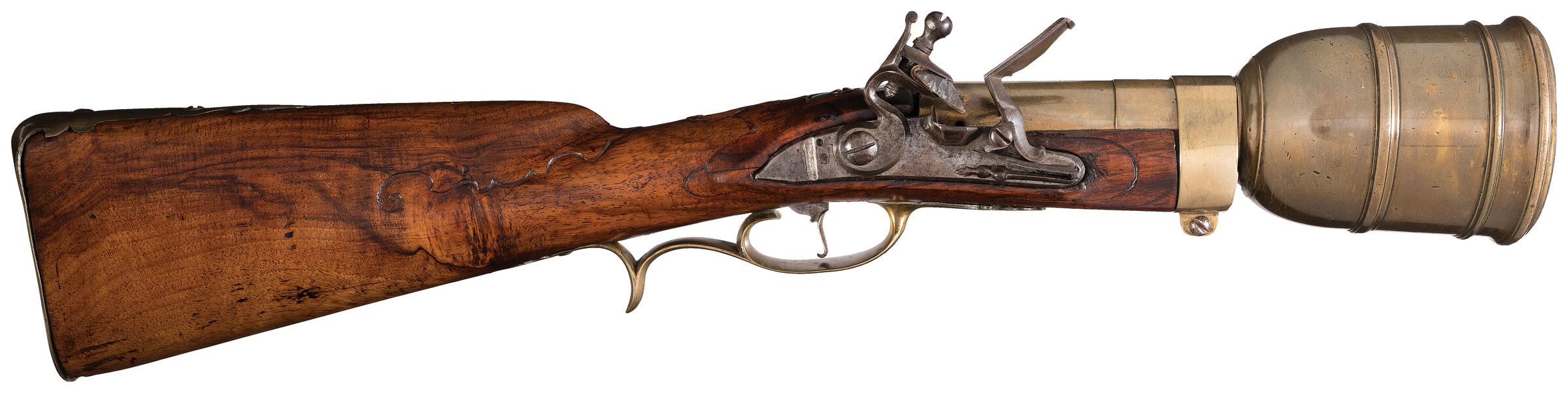
This is the volume where the received wisdom falls apart. Almost every popular account of the hand mortar contains two claims. Both are repeated by Wikipedia. One is repeated in Rock Island’s own catalog copy. Both are, at best, half true - and one of them will hurt you if you act on it.
The claims are: you fired it from the shoulder, and you had to light the grenade fuse by hand before firing.
5.1 Correction one: it is not a shoulder weapon
The most valuable testimony on this subject comes from Grenadier1758 on the Muzzleloading Forum, a reenactor whose unit built a hand mortar from the Rifle Shoppe kit and has fired both it and a musket-mounted launcher. He is unambiguous:
These are not shoulder fired weapons. Recoil is fierce. The butt is placed on the ground and roughly aimed… Yes, the launcher was fired in the fashion of a mortar under direction of the embedded artillery officers.
And then, the sentence that settles it:
Since one of the members of our unit had one of the hand launchers, he just had to fire it from his shoulder. Needless to say he learned that the direction as stated according to the artillery procedures was quite correct. Firing one of these launchers even with a tennis ball with some black powder and flour to make a smoke cloud was something you didn’t want to do twice.
Elsewhere he adds the physical explanation: “Even a tennis ball with flour and a black powder is much heavier than a ball [and] produces enough recoil to cause severe bruising to the shoulder.”
WKD, in a separate thread, arrives independently at the same conclusion from the artefacts: “Many of the originals were designed to be fired from the ground, the recoil from firing a 2½ lb projectile with a sufficient lift charge would be brutal.”
The stock geometry agrees. A wide flat splayed butt is a bearing plate, not a shoulder pocket.
5.1.1 The exceptions, which are real
Do not over-correct. Two documented variants were fired off the shoulder:
The musket-mortar. De Witt Bailey, cited by Grenadier1758, records that the cup-on-a-Brown-Bess launchers were indeed shoulder fired, with six drams - 165 grains - of powder to launch a grenade 250 yards. The mass is lower and the recoiling system is a full-weight musket.
The rested firelock-mortar. The 1810 military dictionary describes a device where “to prevent the recoil hurting the bombardier, the bombard rests on a kind of halberd, made for that purpose.” Contemporary art shows exactly this - a Russian grenadier of the early eighteenth century using a polearm as a rest, and a plate in Funcken’s The Lace Wars showing one being let off past a very startled officer’s hat.
So the honest formulation is: the heavy stocked hand mortar goes on the ground; the lighter musket-mounted launcher and the halberd-rested type do not. Anybody who tells you all of them worked one way has read one source.
5.2 Correction two: do not light the fuse
This is the one that matters for safety.
The popular version, preserved in Rock Island’s own catalog: “The fact that the grenades generally had to be prelit certainly seems dangerous given flintlocks routinely misfire.” Wikipedia describes the same drill: prime, charge, light the fuse, seat the grenade, fire.
That describes double firing - the early technique - and Forgotten Weapons records that it was superseded. By 1650 it was understood that the heat of firing would light the fuse. The practitioners agree. Grenadier1758:
Note: The fuse on the grenade is lit by the blow by of the discharge. There is more than enough flame to light the fuse.
And WKD, who has done a lot of it, in capital letters:
NEVER light the fuse!!! If the tennis ball “grenade” has a charge and a fuse load it with a short fuse facing out the charge will wrap a flame around the ball igniting the fuse as it exits the barrel. If you light the fuse and you flash the pan you now have a bomb in your hands!
There is a lot of flame available. The charge burns in a small chamber and vents past a projectile that does not seal the bore. Blow-by is not a marginal effect here - it is the dominant one.
5.2.1 Which way the fuse points
Fuse up and out, away from the launching charge. Every practitioner says the same thing, and there is a specific failure mode behind it.
Load fuse-down, in contact with the charge, and the blast can drive the fuse into the projectile and function it in the bore. Grenadier1758 has not seen this happen with fuse-up loading, but agrees on the mechanism: “The fuse is pointed away from the charge and relies on the blow by flash to light the fuse. If the fuse is pointed at the launching powder, I can see it being possible for the fuse to be blown into the grenade.”
That is also the tidy explanation for why “single firing” was tried and dropped. It works right up until it does not.
5.3 The drill
Reassembling the practice from the sources gives something like this:
- Prime and charge. The launching charge goes in the chamber, not the bore.
- Seat the projectile, fuse up. Nothing is lit.
- Plant the butt. On the ground, angle set by eye or by an officer’s direction. Period practice put this under artillery control, and artillery procedure - not infantry practice - governed it.
- Fire. The blow-by lights the fuse as the projectile clears the cup.
- On a misfire, do not disassemble anything in a hurry. With an inert or ball projectile you can roll it back out of the muzzle, which is exactly what modern reproduction shooters do. With a live grenade in a trench, the Hessians at Charleston used a rope tied to the gun: throw the whole thing out, wait for the bang, haul it back.
Two men, not one. Every account that describes a crew describes two: one to load and lay, one to fire. Under the old lit-fuse drill it was one to light and one to fire - which is the arrangement that made the rope necessary.
5.4 Range: the numbers do not agree, and you should say so
Published figures for what a hand mortar throws span an order of magnitude. Set them side by side rather than quietly picking one:
Table 1 — Published figures for what a hand mortar throws span an order of magnitude. Set them side by side rather than quietly picking one
| Source | Projectile | Charge | Range |
|---|---|---|---|
| The Rifle Shoppe (Ben Coogle’s gun) | tennis ball | not stated | 200-300 yards |
| Glenn Osborne, MLF (repro with Coogle barrel) | fused tennis ball, flour and a little BP | not stated | 300 feet |
| Glenn Osborne, quoting TRS | tennis ball | not stated | 200+ yards |
| Grenadier1758, MLF (musket-mortar) | tennis ball | one cartridge | ~200 feet, well over a fort wall |
| De Witt Bailey (period musket-mortar) | grenade | 165 gr | 250 yards |
| Alden, MLF (for contrast: coehorn) | mortar shell | few hundred gr | up to 1,200 yards |
The same seller, in the same conversation, quotes both “300 feet” and “200-plus yards.” Those cannot both be right for the same gun and load. The physics favours the shorter figure for a light ball at 80 to 120 grains; the longer figures probably belong to heavier charges, heavier projectiles, or optimism.
The only range number worth trusting is one you have measured yourself, on your own gun, with your own load, with a rangefinder. Volume 13 covers how to work up to it.
Sources
The Muzzleloading Forum threads 113282, 113322, 113803 and 91706 (Grenadier1758, WKD, dave_person, Glenn Osborne, Many Klatch, Alden); Forgotten Weapons, “Flintlock Hand Mortar”; Rock Island Auction lot 1173 and 1273 catalog descriptions; Wikipedia, Hand mortar; De Witt Bailey via MLF; A military dictionary (1810) via MLF; Funcken, The Lace Wars, as described on MLF.
Comments (0)