Arcade Light Guns · Volume 1
Reading the Arcade Gun — Four Ways a Cabinet Finds the Aim, and Thirty Cabinets on One Page
Optical, positional, infrared-marker and camera guns sorted by what the service manuals actually show inside them; a dated catalogue with gun-assembly part numbers; how to read a parts list; and why Operation Wolf's Uzi is a light gun after all
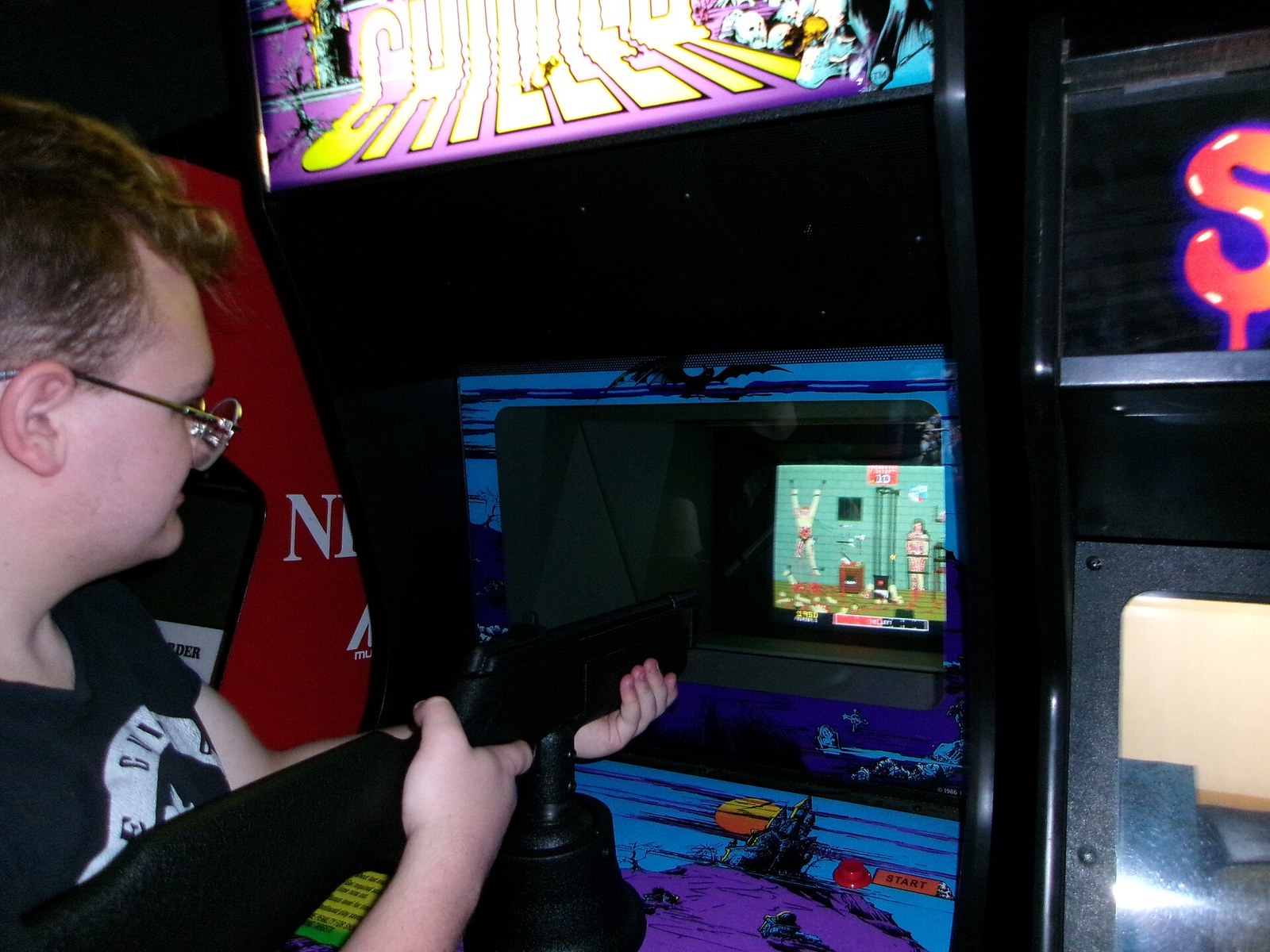
An arcade gun is a different object from a console gun. It never leaves the cabinet, it is fed from the cabinet’s own supplies, it is serviced by a technician with a manual, and it was built to survive thousands of players a week. That last fact is why the operator and service manuals are such good sources. A maker who expects a stranger to replace the sensor board at two in the morning publishes an exploded drawing, a parts list with part numbers, a test screen, and a troubleshooting table. Read together, those manuals answer the questions that the collector forums argue about: how the gun knows where it is pointing, what makes it kick, and why it will or will not work on the display a cabinet has today.
This dive is built on those manuals. Every sensing method, part number and recoil type below comes from a maker’s manual where one could be found, and the source is named each time. Where only an emulator’s source code or a collector site could be found, that is said.
1.1 What This Dive Covers
In scope: coin-operated video cabinets with guns, from Exidy’s Crossbow of 1983 to Raw Thrills’ Aliens Armageddon of 2014; the gun assembly of each as its manual describes it; arcade recoil mechanisms as hardware (what moves, what drives it); and what it takes to keep one running, including the CRT dependency.
Out of scope, and where it lives instead:
- The story of the light gun, including the pre-video electro-mechanical rifle ranges (Seeburg’s Ray-O-Lite of 1936, Nintendo’s projected-film Wild Gunman of 1974) and the narrative of the 1990s arcade boom: History of Light Guns, Volumes 1 and 5. This dive does not retell it.
- Console guns, including the home versions of arcade games and Namco’s GunCon: Console Light Guns.
- How a recoil solenoid works: force, stroke, heat, flyback and drive, with the Time Crisis and Ghost Squad solenoids as worked examples. That is Solenoid Recoil, whose Volume 1 already surveys the Namco blowback guns. Volume 5 here covers the other arcade recoil mechanisms and links there for the physics.
- The theory of reading a CRT: CRT Timing (planned). Potentiometer and inertial aiming: Positional and Inertial (planned). Camera-and-marker tracking: IR Point Tracking (planned).
- Running arcade game software on other hardware (PC loaders, JVS I/O emulation): Arcade Hardware (planned).
1.2 Four Ways a Cabinet Finds the Aim
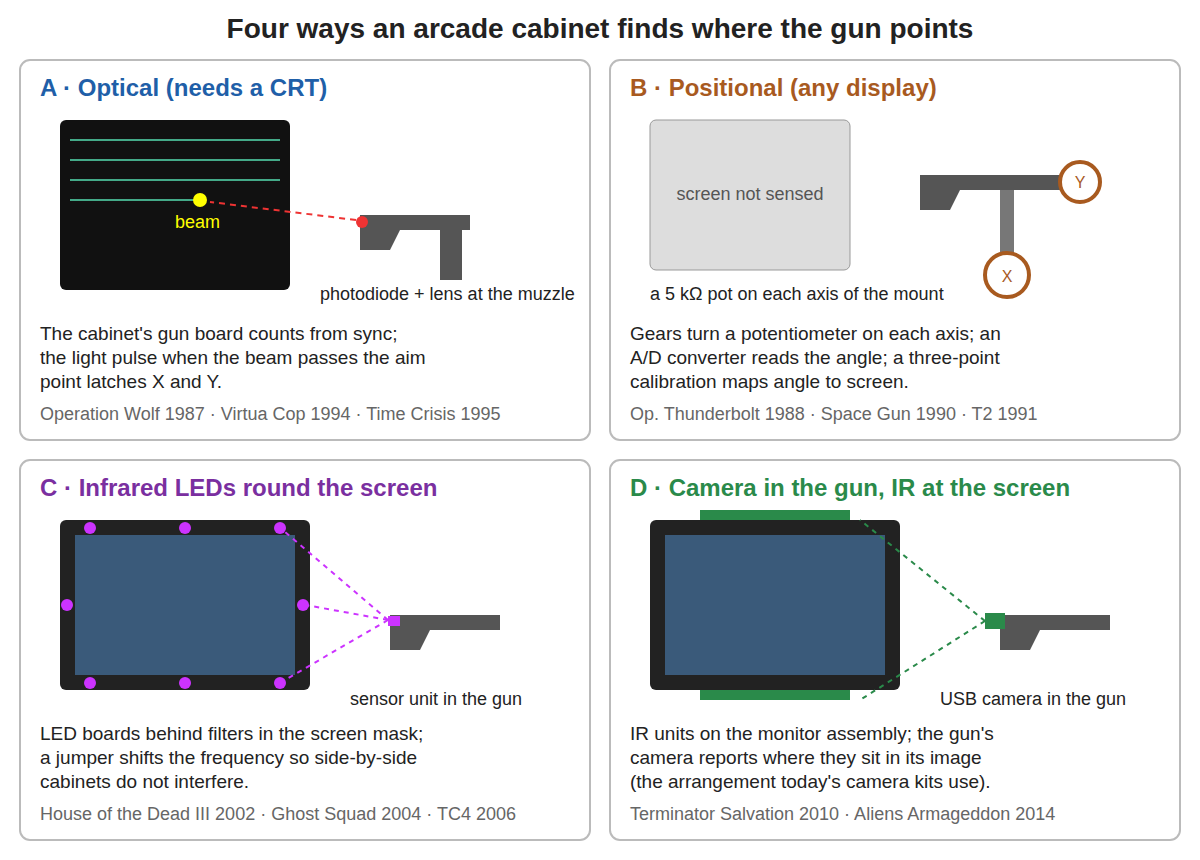
The manuals sort arcade guns into four families by the parts they list. The families matter more than the maker or the decade, because each one fixes what the gun needs from the display.
A. Optical. A photodiode or phototransistor sits on a small board behind a lens in the barrel. Namco’s Time Crisis parts list names both, “Lens NA-V1472050” and “Sensor PCB”, at the muzzle;1 Sega’s Virtua Cop has a “sensor board” that “fits in between LENS HOLDER L and LENS HOLDER R”;2 Atari Games’ Area 51 calls its guns “Optic Gun Assembly”.3 The gun sees light from the screen, and a board in the cabinet compares the moment it sees it with the video timing. Namco’s Point Blank schematic shows this plainly: the game board sends composite sync (“C.SYNC”) to a separate “POSITION PCB Assy”, which receives each gun’s sensor line and returns “1P SHOOT” and “2P SHOOT” to the game.4 Some games flash the screen white when the trigger is pulled to give the sensor something to see; Midway’s CarnEvil exposes the flash as an operator setting (Volume 2). Every optical gun depends on a cathode-ray tube’s scanning beam, which is the whole of the modern problem (Volume 6).
B. Positional. The gun is fixed to the cabinet on a mount that turns on two axes, and each axis turns a potentiometer through gears. The cabinet never senses the screen at all; it reads two voltages through an A/D converter and maps them to screen positions with a calibration stored in non-volatile memory. Midway’s Terminator 2 parts list has a “Potentiometer, 5K, Long Life” and a gear drive and pinion;5 Taito’s Space Gun has gears and a “B-5K” variable resistor;6 Sega’s Line of Fire has a “V.R. GEAR” meshing with an adjustment gear.7 A positional gun works on any display, including a projector or an LCD, which is why the method never went away (Volume 3).
C. Infrared LEDs round the screen, sensor in the gun. From Sega’s The House of the Dead III (2002) and Namco’s Time Crisis 4, the mask around the screen carries small LED boards behind infrared filters, and the gun carries a sensor unit. Sega’s mask assembly lists ten “LED BD GUN SENSE HOD” boards and ten “IR COVER”s;8 the Time Crisis 4 manual tells the operator to clean “the following sensor section’s filters (20 locations) on the Monitor Mask everyday”.9 Both manuals warn that two cabinets of the same type side by side will interfere, and both provide a jumper to change the operating frequency (Volume 4).
D. A camera in the gun, infrared units at the screen. Raw Thrills’ cabinets built by Play Mechanix name the part outright: the Aliens Armageddon deluxe gun contains a “Camera Assembly (Complete)” on a 12-conductor USB harness, and the service routine includes “Check the camera lens” and checking the “IR sensors … directly below and above the printed marquee”.10 The Terminator Salvation manual has a “GUN CAMERA TEST” that warns of “a dirty or poorly functioning camera inside the gun”.11 This is the arrangement the open-source home guns use today (Open-Source Firmware).
Two cautions about the vocabulary. First, mounted is not positional. Operation Wolf’s Uzi and Chiller’s rifle are both mounted on the cabinet, and both are optical. Second, makers’ names for parts are not physics. Sega calls the gun’s part a “sensor unit” and the screen’s parts “LED BD”; Raw Thrills calls the screen’s parts “IR sensors” in a cabinet whose gun holds the camera. Where the manual’s word and the part’s likely function disagree, this dive quotes the word and says what is inferred.
1.3 The Catalogue at a Glance
Thirty cabinets, in date order. Sensing uses the four letters above. Source is where the sensing and part numbers come from: a maker’s manual (M), the MAME emulator’s driver source (E), or both. Part numbers are as printed; distributor numbers (UK editions) are marked. A dash means the manual read for this dive does not give it.
Table 1 — The Catalogue at a Glance
| Year | Cabinet | Maker | Sensing | Gun assembly part no. (key parts) | Recoil | Source |
|---|---|---|---|---|---|---|
| 1983 | Crossbow | Exidy | A (beam detect) | — | — | M, E |
| 1986 | Chiller | Exidy | A (beam detect), mounted | — | — | E |
| 1987 | Operation Wolf | Taito | A, mounted | Sensor P.C. board assy; geared motor | Motor-driven crank and weight | M, E |
| 1988 | Operation Thunderbolt | Taito | B (two 5 kΩ pots) | Solenoid assy M9001569 (Taito America 140-913023) | Solenoid | M, E |
| 1989 | Beast Busters | SNK | B | Gun parts A8002-0xx; solenoid assy, weight | Solenoid and weight | M |
| 1989 | Line of Fire | Sega | B | Gun unit GUN-2000; volume gear 601-5943 | Solenoid | M |
| 1990 | Space Gun | Taito | B (B-5K pots) | Pump-action slide, solenoid | Solenoid | M, E |
| 1991 | Laser Ghost | Sega | B (“volume” each axis) | LED board, motor weight | Motor and weight | M |
| 1991 | Terminator 2: Judgment Day | Midway | B | Gun assembly A-14415; pot 5014-12909-00 | ”Coil” (shakes gun) | M, E |
| 1992 | Lethal Enforcers | Konami | A | Gun + lead red 21236, blue 21237 (UK distributor) | — | M, E |
| 1993 | Alien3: The Gun | Sega | B (B 5 kΩ lin pots) | Vibrate motor | Motor | M |
| 1994 | Revolution X | Midway | B | — | Outputs for 3 guns | E |
| 1994 | Point Blank | Namco | A (separate position PCB) | Gun assy XPB-GUNRED / XPB-GUNBLUE (UK distributor) | Solenoid blowback, +24 V | M |
| 1994 | Virtua Cop | Sega | A | Sensor unit COP-2020; I/O option board 837-11131 | — | M |
| 1995 | Time Crisis | Namco | A | Gun ASSY 296-903 (blue); lens NA-V1472050; sensor PCB 296-467 | Solenoid ST-0860A2 blowback | M |
| 1995 | Area 51 | Atari Games | A | Optic gun A054890-01 (blue), -02 (red); gun PCB A051987-01 | — | M |
| 1995 | Virtua Cop 2 | Sega | A | Sensor unit COP-2020; gun-sensor board 837-12079 | — | M |
| 1995 | Gunblade NY | Sega | B | — | — | E |
| 1997 | Time Crisis II | Namco | A | Gun Assy 296-902 (red), 296-903 (blue) | Solenoid ST-0860A2 blowback | M |
| 1997 | Maximum Force | Atari Games | A | Gun PCB A051987-01; lens 178386-001 | — | M |
| 1998 | CarnEvil | Midway | A (screen flash) | Gun interface board | — | M |
| 2002 | The House of the Dead III | Sega | C | Sensor unit JPT-2030; 10 × LED BD 838-13145-02 | — | M |
| 2003 | Time Crisis 3 | Namco | A (27 in CRT) | Gun Assy PB03-03141-00 (pink), -01 (blue) | Solenoid blowback | M |
| 2004 | Ghost Squad | Sega | C | Sensor BD 838-13144; LED BD 838-13145-02 | Solenoid (“reaction”) | M |
| 2005 | The House of the Dead 4 | Sega | C | Control unit HDF-2100; sensor unit JPT-2030 | Gun motor | M |
| 2006 | Big Buck Hunter Pro | Raw Thrills | Not stated (CRT) | — | — | M |
| 2006 | Time Crisis 4 | Namco | C | Gun Assy XTC4-717-333 (red), -355 (blue); light receiving unit XTC4-306-754 | Solenoid unit XTC4-717-316 | M |
| 2010 | Terminator Salvation | Raw Thrills / Play Mechanix | D | — | — | M |
| 2014 | Aliens Armageddon (deluxe) | Raw Thrills / Play Mechanix | D | Camera assembly 820-00010-01; solenoid 96-1040-00 | Solenoid and brass knocker | M |
| 2014 | Aliens Armageddon (fixed gun) / Deadstorm Pirates SE | Raw Thrills; Namco | B | Long-life pot 96-4916-00 ×2 (Aliens) | Coil (Aliens) | M |
Release years are those printed on the manual (copyright or disclosure date) or carried by MAME’s driver; the two agree wherever both exist. Time Crisis, Time Crisis II and Time Crisis 4 dates follow the dates already used in Solenoid Recoil, because the manuals read for this dive carry none. Volumes 2 to 4 take each family in turn, with the drawings.
1.4 Operation Wolf Is a Light Gun
The most repeated statement about arcade guns is that Taito’s Operation Wolf (1987) “isn’t really a light gun”: its Uzi is mounted on the cabinet, so it must read the mount’s angle. This hub’s own category plan said so (“Operation Wolf’s gun is a potentiometer, not a light gun”), and the published Solenoid Recoil Volume 1 calls it a “positional, potentiometer-aimed” gun. The History of Light Guns dive recorded that “sources disagree” and left the question here.
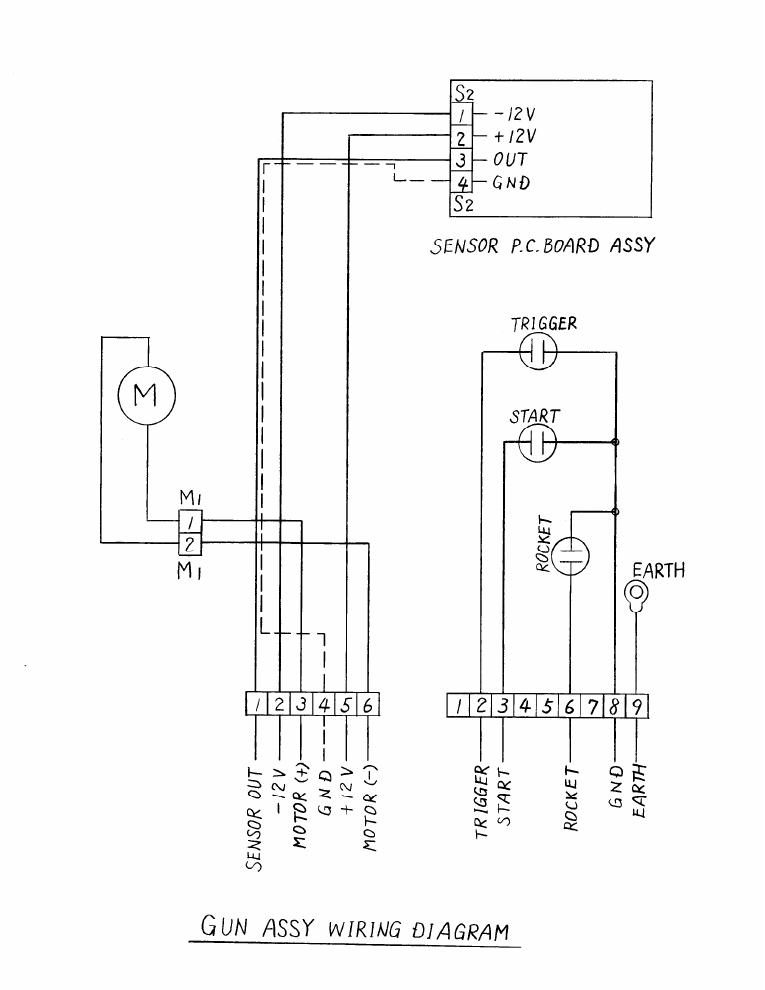
Taito America’s own operating manual settles it. Its Gun Assy Wiring Diagram shows exactly what is inside the gun: a “SENSOR P.C. BOARD ASSY” with four connections (−12 V, +12 V, OUT, GND), the sensor output on a shielded lead to pin 1 of the gun’s six-pin connector (“SENSOR OUT”), a motor on two pins, and the trigger, start and rocket switches on a nine-pin connector.12 There is no potentiometer anywhere in the gun’s wiring. The cabinet service sheet adds: “Do not remove the R F Filter caps from the gun. FCC regulations require they be used.”13
The MAME emulator’s driver, written by people who documented the real board, agrees from the other side: its notes on the PCB list “Optical sensor input from gun”, describe the gun board as carrying “three small opto-related 8-pin ICs”, and identify a register bit “used to signal light gun position can be latched to inputs on v-blank”.14 The gun is a light gun on a swivel. What swivels is the player’s hand, not a measurement.
The mistake is understandable, because Taito’s next two gun games really were positional. Operation Thunderbolt (1988) and Space Gun (1990) use two 5 kΩ potentiometers geared to the mount, and the MAME notes say so in as many words: “The gun is NOT a light gun, it uses two 5k-ohm potentiometers for the X-Y position.”15 Volume 3 has the drawings. The correction for this hub, which has been reported to the controlling session rather than edited in the live dive, is that Operation Wolf belongs in family A and Operation Thunderbolt in family B.
1.5 How to Read a Gun Parts List
Arcade manuals were written for technicians, and their parts lists repay a few minutes of decoding.
The assembly number versus the parts. Most makers give the whole gun one number and then list its parts. Midway’s Terminator 2 gun is “A-14415 Gun Assembly”, containing “A-14455 Coil & Bracket Assembly”, “03-8528 Gear Drive” and “5014-12909-00 Potentiometer, 5K, Long Life”.5 Namco’s Time Crisis SD lists the gun as “Gun ASSY (blue) 296-903” and its twenty-one parts below.1 When buying a used gun, the assembly number is what identifies it; when repairing one, the part numbers are what a dealer can match.
Colour suffixes. Two-player cabinets have two coloured guns, and the colour lives in the last digits: Time Crisis II’s red gun is 296-902 and its blue gun 296-903;16 Area 51’s guns are A054890-01 (blue) and -02 (red);3 Time Crisis 3’s are PB03-03141-00 (pink) and -01 (blue).17 Only the shells and the trigger usually differ.
Shared parts across games. The same sensor, solenoid and lens numbers recur across a maker’s games, which is how a dead gun gets fixed from a parts machine. Namco’s ST-0860A2 solenoid (004-056), the lens (NA-V1472050) and the 296-467 sensor PCB appear in both the Time Crisis SD and Time Crisis II lists.116 Sega’s JPT-2030 sensor unit and its 838-13144 board appear in The House of the Dead III, Ghost Squad and The House of the Dead 4, and the screen boards in all three are named “LED BD GUN SENSE HOD” — the HOD being, on the evidence of the name, The House of the Dead.81819 Atari Games’ gun PCB A051987-01 is in both Area 51 and Maximum Force.320
Distributor numbers. UK manuals often replace the maker’s part numbers with the distributor’s own. The Brent Leisure edition of Point Blank lists the guns as “XPB-GUNRED” and “XPB-GUNBLUE”;4 the UK Lethal Enforcers manual lists “GUN + LEAD (RED)” as 21236.21 These numbers identify a part only to that distributor.
OCR is not a source. Many manuals exist only as scans whose text layer is a machine’s guess. The part numbers in this dive were checked against the page image wherever the text layer was doubtful; where a scan was illegible (the Time Crisis SD lens number has a handwritten correction over it), that is said.
1.6 What the Manuals Do Not Say
The manuals describe what to replace, not how the electronics work. None of the optical-gun manuals read for this dive includes the circuit of the gun’s sensor board, the timing of the position board, or the filtering that rejects a lamp; the Point Blank schematic shows the position board only as a box.4 None of the infrared-era manuals says what the LED boards emit, at what wavelength, or how the gun’s sensor resolves position. Those questions belong to CRT Timing and IR Point Tracking, and the honest answer from the manuals is that the makers did not publish them.
1.7 Where the Rest Lives
Table 2 — Where the Rest Lives
| Volume | Covers |
|---|---|
| 2 · Optical Guns | The CRT cabinets: Exidy, Operation Wolf, Lethal Enforcers, Point Blank, Virtua Cop, Time Crisis I–3, Area 51, Maximum Force, CarnEvil |
| 3 · Positional Guns | Potentiometers on a mount, 1988 to 2014 |
| 4 · Infrared Guns | Sega’s and Namco’s LED-ring systems; Raw Thrills’ camera guns |
| 5 · Arcade Recoil | Solenoids, cranks, motors and knockers |
| 6 · Keeping One Running | Maintenance, repair, calibration, and what an LCD does to each family |
1.8 What could not be verified
- Crossbow and Chiller recoil. Neither the Crossbow preliminary manual nor MAME’s driver describes recoil; none is claimed.
- Revolution X and Gunblade NY sensing. Taken from MAME’s input definitions (analog stick inputs through an A/D converter), not from a manual. Revolution X’s own operations manual (16-40019-101, May 1994) is listed on the Internet Archive but its scan was not available.
- Big Buck Hunter Pro. The manual calibrates the gun “three feet (1m) from the monitor” but never names the sensing method.
- The meaning of “HOD”. Read from the board’s name; no Sega document expanding it was found.
- Release years for the Time Crisis series and Time Crisis 4 come from secondary sources, as in Solenoid Recoil.
Sources
Footnotes
-
Namco, Time Crisis SD Operation Manual, §9-5 Gun ASSY (manual p. 69), §7-2-5 troubleshooting. Internet Archive item
arcademanual_Time_Crisis_SD_Manual; copy in the central Library. Read 2026-10-19. ↩ ↩2 ↩3 -
Sega, Virtua Cop Owner’s Manual, Manual No. 4201-6149-05, © Sega 1994, §9-2 Replacing the Sensor Board, parts lists. Internet Archive item
virtua-cop-manual. Read 2026-10-19. ↩ -
Atari Games, Area 51 Operator’s Manual, © 1995, 1996, Fig. 4-2 Gun Assembly. Internet Archive item
arcademanual_Area51.man. Read 2026-10-19. ↩ ↩2 ↩3 -
Namco / Brent Leisure, Point Blank Operators Manual, Part No. 90500078, © 1994, §4 Parts and §5 Schematic. Internet Archive item
pointblank; Library copy. Read 2026-10-19. ↩ ↩2 ↩3 -
Midway Manufacturing, Terminator 2: Judgment Day Operations Manual, 16-40009-101, December 1991, A-14415 Gun Parts (p. 2-13). Internet Archive item
arcademanual_T2_Judgement_Day_16400091011_Dec_1991. Read 2026-10-19. ↩ ↩2 -
Taito / Electrocoin Automatics, Space Gun Service Manual, gun assembly parts lists (pp. 14–17). Internet Archive item
arcademanual_Space_Gun. Read 2026-10-19. ↩ -
Sega, Line of Fire Upright Temporary Manual, © Sega 1989, §16 Gun Unit V.R. Adjustment (p. 13). Internet Archive item
arcademanual_Line_of_Fire_Temporary_Manual. Read 2026-10-19. ↩ -
Sega Amusements Europe, The House of the Dead III DX Service Manual, 420-6742-01UK, © Sega 2002, §8.4 Assy Mask, §8.12–8.13, game board frequency jumper. Internet Archive item
manualzz-id-978359. Read 2026-10-19. ↩ ↩2 -
Namco Bandai Games, Time Crisis 4 DX Operators Manual, Issue 2, Part No. 90500167, §7-1-2, §7-4, §10-14. Internet Archive item
time_crisis_4_dx_manual_issue2_ptm; Library copy. Read 2026-10-19. ↩ -
Play Mechanix / Raw Thrills, Aliens Armageddon Setup and Operation Service Manual (55” Deluxe and 42” Fixed Gun cabinets), © 2014, maintenance procedure and parts pp. 51–56. Internet Archive item
manualzilla-id-6032150. Read 2026-10-19. ↩ -
Play Mechanix / Raw Thrills, Terminator Salvation 42” Deluxe Setup and Operations Manual, revision 7.30.12, © 2010, system tests. Internet Archive item
manualzilla-id-6035891. Read 2026-10-19. ↩ -
Taito America Corporation, Operation Wolf Operating Manual, Gun Assy Wiring Diagram and Gun Assy drawings. Internet Archive item
operation_wolf_operating_manual_ptm. Read 2026-10-19. ↩ -
Taito America Corporation, Operation Wolf cabinet service sheet. Internet Archive item
arcademanual_Operation_Wolf_Cabinet_Service_Manual. Read 2026-10-19. ↩ -
MAME,
src/mame/taito/opwolf.cpp, PCB notes andspritectrl_wcomments, mamedev/mame master, read 2026-10-19. ↩ -
MAME,
src/mame/taito/othunder.cpp, PCB notes, mamedev/mame master, read 2026-10-19. ↩ -
Namco, Time Crisis II Operation Manual, §10-8 Gun Assy. Internet Archive item
arcademanual_Time_Crisis_2; Library copy. Read 2026-10-19. ↩ ↩2 -
Namco America, Time Crisis 3 SD Operation Manual (2003), §10-5 Gun Assy, §7-5-1. Internet Archive item
time-crisis-3-sd. Read 2026-10-19. ↩ -
Sega Amusements USA, Ghost Squad Deluxe Owner’s Manual, Manual No. 4201-6831-01, first printing November 2004, Assy Mask and Sensor Unit parts lists. Internet Archive item
sega-ghost-squad; Library copy. Read 2026-10-19. ↩ -
Sega, The House of the Dead 4 Owner’s Manual (2005), output test and Control Unit (HDF-2100) parts list. Internet Archive item
ArcadeGameManualHod4-manual. Read 2026-10-19. ↩ -
Atari Games, Maximum Force 25” Dedicated Manual, April 1997, gun assembly parts. Internet Archive item
arcademanual_Maximum_Force. Read 2026-10-19. ↩ -
Konami, Lethal Enforcers Operators and Service Manual (UK distributor edition), parts list. Internet Archive item
arcademanual_lethal-enforcers-manual. Read 2026-10-19. ↩
Comments (0)