Arcade Light Guns · Volume 5
Arcade Recoil — Cranks, Solenoids, Coils, Motors and Knockers
Every way the cabinets in this dive made a gun kick, from Operation Wolf's geared motor and crank to Raw Thrills' brass knocker, as the parts lists and test menus show it; the Namco blowback slide is left to Solenoid Recoil
Recoil was in the arcade from the first mounted guns, and it was never one mechanism. The manuals in this dive show at least five: a motor turning a crank, a solenoid throwing a weight, a solenoid “coil” shaking a mounted gun, a solenoid driving a slide, and an eccentric-weight motor. They also show that every maker treated the recoil as the gun’s most fragile part, with a fuse or a circuit protector, a test screen and a replacement procedure.
How a solenoid turns current into a kick, how hot it gets and how to drive it belongs to Solenoid Recoil, whose Volume 1 already covers Namco’s Point Blank and Time Crisis blowback and Sega’s Ghost Squad “reaction” from their manuals. Motors as an actuator belong to Motors and Rumble (planned). This volume records the mechanisms themselves.
5.1 Five Ways to Kick
Table 1 — Five Ways to Kick
| Mechanism | Cabinets (year) | What moves | Evidence |
|---|---|---|---|
| Geared motor, crank and weight | Operation Wolf (1987) | A weight shaft, driven back and forth by a crank | Taito America manual, “MECHA ASSY”1 |
| Solenoid and weight or plunger | Operation Thunderbolt (1988), Beast Busters (1989), Line of Fire (1989), Space Gun (1990) | A plunger, in some guns a weight | Parts lists2345 |
| ”Coil” shaking a mounted gun | Terminator 2 (1991) | The gun on its mount | ”Guns do not shake … Coil inside gun assembly could be bad”6 |
| Solenoid blowback slide | Point Blank (1994), Time Crisis series (1995–2006) | A visible upper slide | Solenoid Recoil Vol 1 |
| Vibrate motor (motor and eccentric weight) | Laser Ghost (1991), Alien3 (1993), House of the Dead 4 (2005) | A weight on a motor shaft | ”VIBRATE MOTOR”, “MOTOR WEIGHT”, “GUN MOTOR”789 |
| Solenoid and brass knocker | Aliens Armageddon deluxe (2014) | A rod striking a knocker | Parts list10 |
5.2 The Motor and Crank: Operation Wolf, 1987
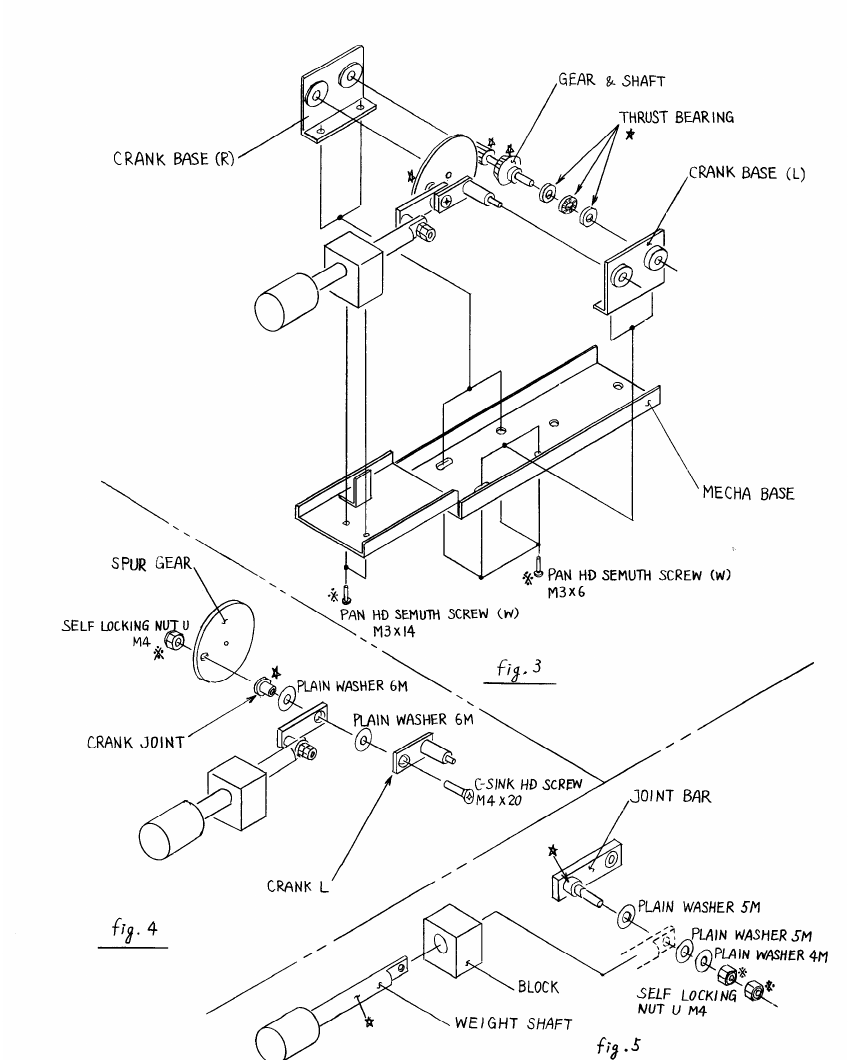
Operation Wolf’s Uzi kicks with a motor. The manual’s gun pages show a “GEARED MOTOR” on a motor bracket, removed with two M2.6 screws, whose pinion drives a spur gear on a “GEAR & SHAFT” running in thrust bearings between two crank bases. A crank and a “JOINT BAR” drive a “BLOCK” on a “WEIGHT SHAFT”.1 Each turn of the motor pushes the weight forward and back. The motor’s detail drawing shows two small components marked “103” soldered at its terminals with a lead marked “E01”, the joint covered in vinyl tape; the note “TWIST & SOLDER (CAUTION SHORT)” goes with them.1 On the cabinet sheet Taito warns “Do not remove the R F Filter caps from the gun. FCC regulations require they be used.”11 The two are consistent: a brushed motor sparks, and capacitors across it suppress the interference (the “103” marking is the usual code for 10 nF; the manual does not give the value).
The game board drives it through transistors. MAME’s documentation of the board register reads “bit 0 -> MOTOR1 transistor”, “bit 1 -> MOTOR2 transistor”, and “If data & 3, the Piston Motor is activated via M-1/M-2 connector”.12 The manual’s gun wiring has the motor on pins 3 and 6 of the gun’s six-pin connector, “MOTOR (+)” and “MOTOR (−)”.1 KLOV’s collectors describe the effect as a “rachet effect” and the motor as one that “commonly failed after a few years”.13
A motor and crank gives a continuous, rhythmic shake that matches automatic fire, which is what Operation Wolf’s Uzi did (“Continuous firing can be made by holding the trigger”1). A solenoid gives one hit per pulse. The difference is the reason both survived.
5.3 Solenoids in the Mounted Guns, 1988 to 1991
Taito changed to a solenoid for its next two games. Operation Thunderbolt’s gun parts list has a solenoid bracket, a solenoid (C1101225), a plunger (E1000882), and a “SOLENOID ASSY” (M9001569; Taito America 140-913023), and its board’s edge connector carries “1 P Gun Solenoid” and “2 P Gun Solenoid”.214
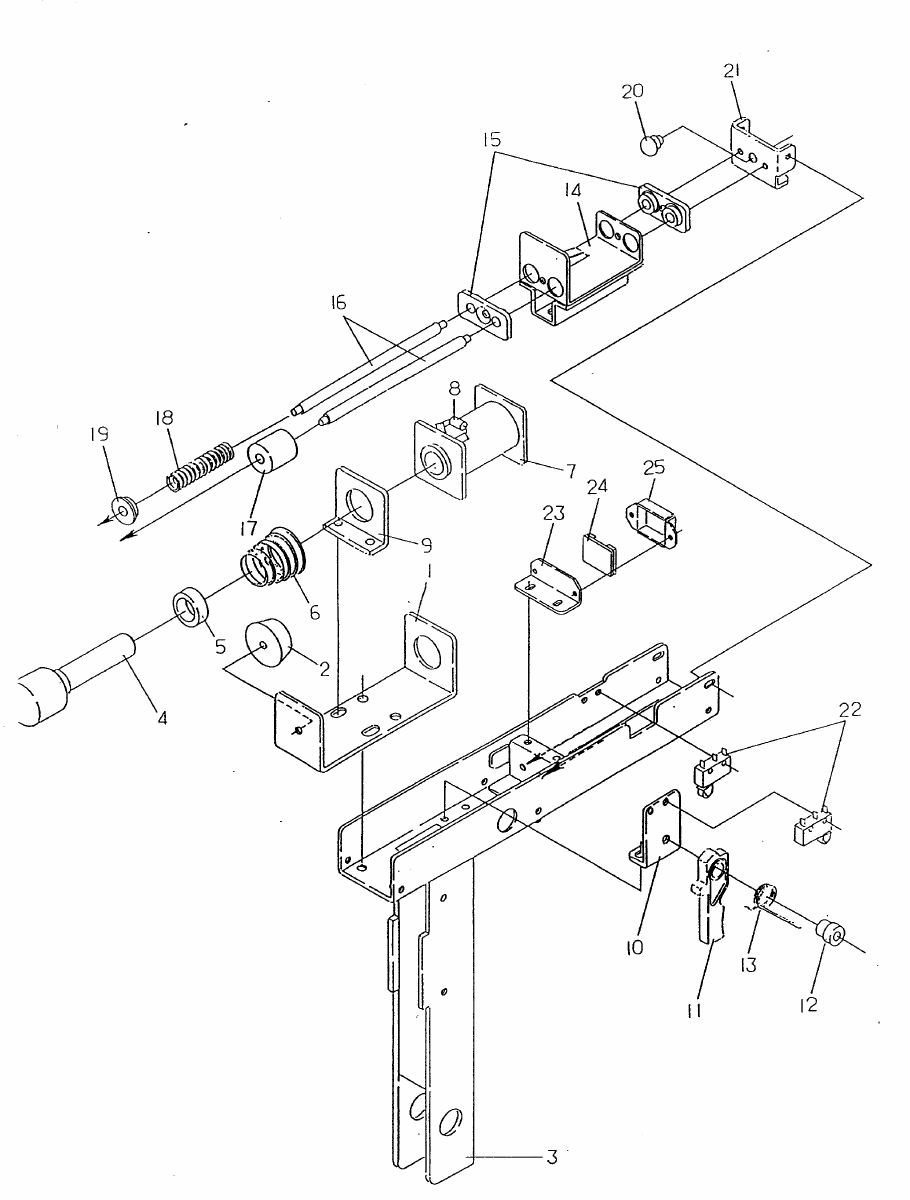
Space Gun’s list is the most detailed: a solenoid bracket, rubber leg, frame, plunger, cushion rubber, solenoid spring, the solenoid itself, a diode, and a slide base, bush, shaft, stopper rubber and return spring.5 The diode is the flyback diode at the coil that Solenoid Recoil found inside the Time Crisis II harness connector, here listed as a gun part in 1990. The cushion rubber and stopper rubber are the dampers at each end of the stroke.
SNK’s Beast Busters gun, “featuring solenoid activated recoil effect”, lists a solenoid base, solenoid assembly, and a “Weight” with a “Weight Sheet”:3 the plunger throws a mass, as the hobby recoil guns do today. Sega’s Line of Fire protects its “electromagnetic solenoid” with two circuit protectors on the service bracket, “used to prevent overcurrent of the GUN UNIT SOLENOID. When the center button is in a projected position, first turn the power OFF, push the button back”.4
Midway’s Terminator 2 (1991) calls its recoil a coil. The gun contains a “Coil & Bracket Assembly” (A-14455) mounted at the top of the post; the Driver Board Test “cycles through and pulses the Gun Coils (left, then right)”; and the troubleshooting entry for “Guns do not shake during play mode” reads “Coil inside gun assembly could be bad. Fuse 1 (Player 1), or fuse 2 (Player 2) on the Coil Lamp Driver Board could be open.”6 The word “shake” is Midway’s: the coil moves the whole mounted gun rather than a slide.
5.4 Namco’s Blowback Slide
Namco’s guns are the ones every home builder knows, and Solenoid Recoil Volume 1 covers them: the ST-0860A2 tubular solenoid on its 16 mm nut, the silencer rubber, the 24 V supply, the thermal fuse and the SLA4060 driver on the Time Crisis II board, and the box-frame solenoid unit with its rubber spacer in Time Crisis 4. Two facts from this dive’s reading add to it.
- Point Blank’s supply. The schematic carries “+24V” twice on harness J16 from the PCB rack to the play panel, with SOL1 and SOL2 lines alongside; each gun’s “SOLENOID ASSY” is on two wires.15 The arrangement implies a common 24 V supply with each solenoid switched by its SOL line; the schematic does not show the driver.
- Time Crisis 3 keeps the mechanism: its troubleshooting entry for “The gun blowback mechanism does not operate” gives “The connector is disconnected” and “The solenoid is worn — Replace the solenoid”.16 A solenoid that wears out is the same assumption Namco made in every manual.
5.5 Vibration Motors: Laser Ghost, Alien3, Gunbuster, House of the Dead 4
Some guns did not kick; they buzzed. Sega’s Laser Ghost manual’s procedure for “REPLACING THE LED BOARD AND THE MOTOR” removes “the MOTOR WEIGHT” with two set screws and the motor with two M2 screws, and warns “When replacing the MOTOR, be sure to wind a new cushion around the motor”.7 A weight on a motor shaft, cushioned in the gun, is a vibration motor.
Alien3: The Gun (1993) makes it explicit. Its output test “allows the gun’s VIBRATE MOTOR to be tested”; a setting “GUN VIBRATION ON / OFF” lets the operator turn it off; a fuse protects it (“When the Gun is subject to an overload, the circuit fuse to protect the motor”); and section 9-3 is “REPLACEMENT MOTOR BRUSH”.8 A brushed motor with replaceable brushes in a game gun says how hard the arcade expected to run it.
Taito’s Gunbuster (1992) had both: its partial manual’s test lists a motor and a solenoid for each of up to four players (“1P MOTOR”, “1P SOLENOID” … “4P SOLENOID”) and a “GUN VIBRATION” setting.17 Sega’s The House of the Dead 4 (2005) output test lists “GUN MOTOR1” and “GUN MOTOR2”.9 That settles a question Solenoid Recoil left open: the House of the Dead 4 gun has a motor, by Sega’s own test menu; the manual read here does not show what the motor drives.
5.6 The Knocker: Aliens Armageddon, 2014
Raw Thrills’ deluxe rifle shows the arcade’s latest arrangement. The parts list has a “Solenoid F/Raw Thrills Rifle” (96-1040-00) in a “Solenoid Housing Bracket” (96-0986-00), a “Brass Knocker” (96-0987-00), a “Recoil Rod” (96-1041-00) with a “Recoil Rod Spring” (96-1044-00), flange bushings, “Miner General” bumpers, a urethane bumper and a “Kick Board” (500-00038-01).10 The solenoid drives a rod that strikes a brass mass: a hammer and anvil inside the stock. The fixed-gun cabinet’s mount carries “mounting bracket coil pads”, and its service section has “Gun Coil Assembly Service”: “The coil assembly provides the force-feedback recoil when the gun is fired.” Replacing it ends with a warning in bold — “Be sure to secure the ground wire to the ground lug of the coil assembly mounting plate … Important: Be sure to reconnect this wire!”10 The operator can switch recoil off with a “Force Feedback” setting.10
5.7 What the Cabinets Agree On
Table 2 — What the Cabinets Agree On
| Practice | Where it appears |
|---|---|
| The recoil actuator is a replaceable wear part with its own procedure | Every manual in this volume |
| It is protected separately: a fuse, a circuit protector or a thermal fuse | Terminator 2 fuses 1 and 2; Line of Fire circuit protectors; Alien3 motor fuse; Time Crisis II thermal fuse (Solenoid Recoil) |
| It has its own test screen | Point Blank GOUT test; Terminator 2 Driver Board Test; Alien3 output test; Time Crisis solenoid test; House of the Dead 4 output test |
| The operator can turn it off | Alien3 “GUN VIBRATION”; Gunbuster “GUN VIBRATION”; Ghost Squad “REACTION”; Aliens “Force Feedback” |
| Dampers at the stops | Space Gun cushion and stopper rubbers; Time Crisis silencer rubber and rubber spacer; Aliens urethane bumpers |
| Suppression at the actuator | Space Gun’s diode; Operation Wolf’s RF caps; Time Crisis II’s diode in the connector |
| A metal path to earth | Aliens’ ground wire on the coil plate; Operation Wolf’s earth pin on the gun connector |
For the guns this category is building, the table is a checklist more than a history: fuse the recoil separately, give it a test, let the user turn it off, damp both stops, suppress at the coil, and earth the frame. Solenoid Recoil and Power Supplies have the engineering for each line.
5.8 What could not be verified
- The value of Operation Wolf’s “103” motor capacitors; read as the usual 10 nF code, not stated.
- Ratings of any solenoid or motor in this volume; no manual gives voltage, current or resistance except by implication (Point Blank’s +24 V).
- What the House of the Dead 4 gun motor drives (a weight, a slide, or a pump-action feel).
- Gunbuster’s gun sensing; only its partial manual’s test list was read.
- Raw Thrills’ coil and solenoid ratings and suppliers.
Sources
Footnotes
-
Taito America Corporation, Operation Wolf Operating Manual: How to play; Fig. 1–5 (Mecha Assy, geared motor, crank); Gun Assy Wiring Diagram. Internet Archive item
operation_wolf_operating_manual_ptm. Read 2026-10-19. ↩ ↩2 ↩3 ↩4 ↩5 -
Taito America Corporation, Operation Thunderbolt Operating Manual, Gun Assy parts list. Internet Archive item
arcademanual_Operation20Thunderbolt. Read 2026-10-19. ↩ ↩2 -
SNK, Beast Busters manual, introduction and gun parts. Internet Archive item
arcademanual_BeastBusters.man. Read 2026-10-19. ↩ ↩2 -
Sega, Line of Fire Upright Temporary Manual, © Sega 1989, circuit protectors, §12. Internet Archive item
arcademanual_Line_of_Fire_Temporary_Manual. Read 2026-10-19. ↩ ↩2 -
Taito / Electrocoin Automatics, Space Gun Service Manual, Gun Assy parts (pp. 16–17). Internet Archive item
arcademanual_Space_Gun. Read 2026-10-19. ↩ ↩2 -
Midway Manufacturing, Terminator 2: Judgment Day Operations Manual, 16-40009-101, December 1991, Driver Board Test, troubleshooting, A-14415 Gun Parts. Internet Archive item
arcademanual_T2_Judgement_Day_16400091011_Dec_1991. Read 2026-10-19. ↩ ↩2 -
Sega, Laser Ghost owner’s manual, © Sega 1991, Replacing the LED Board and the Motor. Internet Archive item
arcademanual_laser-ghost. Read 2026-10-19. ↩ ↩2 -
Sega, Alien3: The Gun Owner’s Manual, © Sega 1993, §8-6 Output Test, settings, §9-3. Internet Archive item
arcademanual_Alien_3_The_Gun_Manual. Read 2026-10-19. ↩ ↩2 -
Sega, The House of the Dead 4 Owner’s Manual (2005), output test. Internet Archive item
ArcadeGameManualHod4-manual. Read 2026-10-19. ↩ ↩2 -
Play Mechanix / Raw Thrills, Aliens Armageddon Setup and Operation Service Manual, © 2014, Gun Coil Assembly Service, settings, Fixed Gun and Deluxe Gun parts lists (pp. 51–56). Internet Archive item
manualzilla-id-6032150. Read 2026-10-19. ↩ ↩2 ↩3 ↩4 -
Taito America Corporation, Operation Wolf cabinet service sheet. Internet Archive item
arcademanual_Operation_Wolf_Cabinet_Service_Manual. Read 2026-10-19. ↩ -
MAME,
src/mame/taito/opwolf.cpp,spritectrl_w, mamedev/mame master, read 2026-10-19. ↩ -
KLOV / International Arcade Museum, “Operation Wolf”, https://www.arcade-museum.com/Videogame/operation-wolf, read 2026-10-19. ↩
-
MAME,
src/mame/taito/othunder.cpp, PCB edge connector notes, mamedev/mame master, read 2026-10-19. ↩ -
Namco / Brent Leisure, Point Blank Operators Manual, Part No. 90500078, © 1994, §5 Schematic. Internet Archive item
pointblank; Library copy. Read 2026-10-19. ↩ -
Namco America, Time Crisis 3 SD Operation Manual (2003), §8-2-5. Internet Archive item
time-crisis-3-sd. Read 2026-10-19. ↩ -
Taito, Gunbuster manual (partial). Internet Archive item
arcademanual_GunbustersManualpartial. Read 2026-10-19. ↩
Comments (0)