MP7 Light Gun: Printed Build · Volume 1
Why Print First — the Gun This Build Has to Be
The first MP7 light gun is printed, not converted: what it must hold and do, what printing buys against the airsoft donors at dated prices, why it starts from someone else's editable CAD file, the order of work, and which sibling dive owns each part of the problem
1.1 The decision
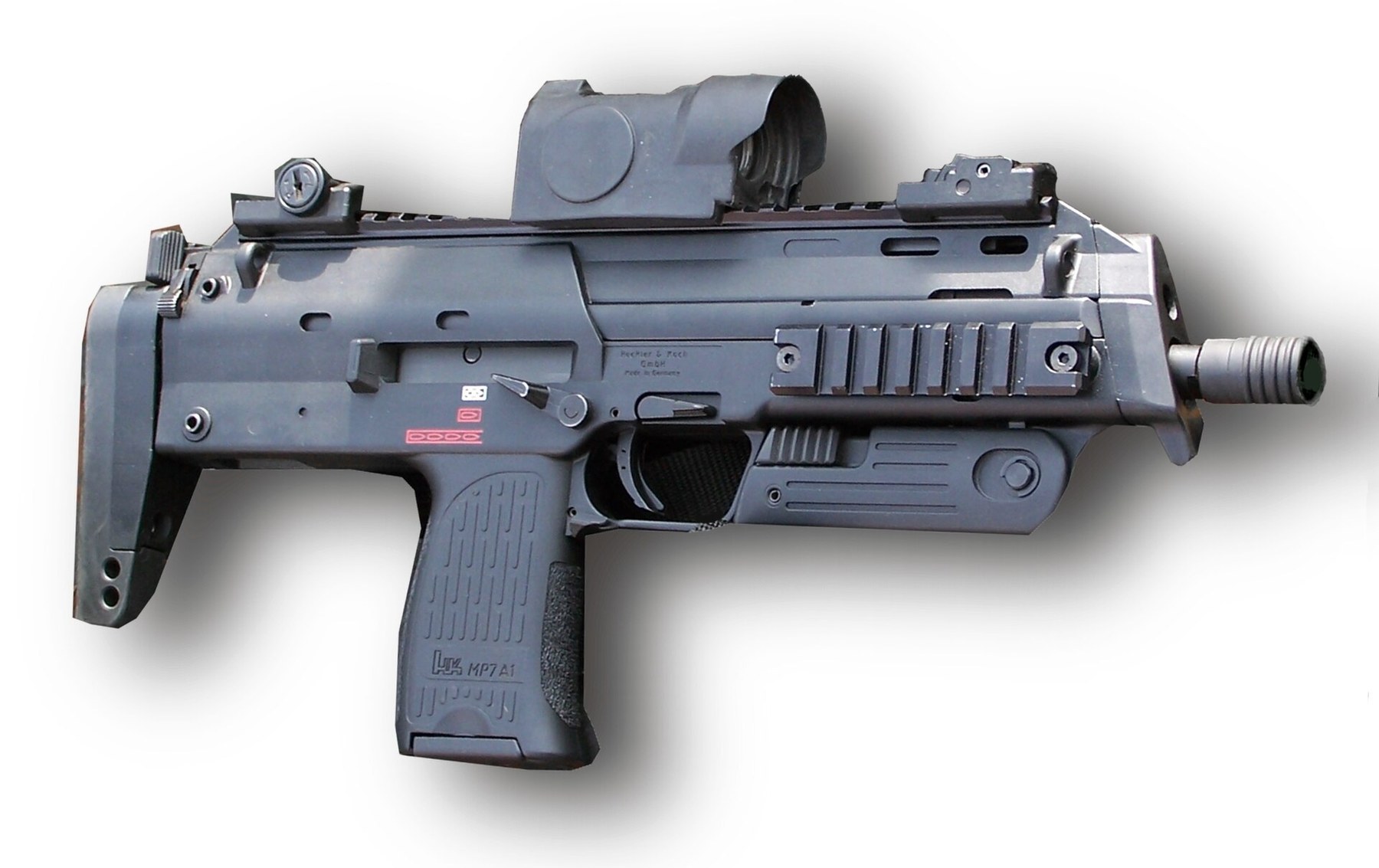
Decision D35 (19 October 2026): the first build is a 3D-printed MP7. In the owner’s words: “As we move into the first build, I think we will start with a 3D printed gun to help save on costs and get a working model.” The same instruction sets the starting point: “find a good starter CAD file for our first MP7”, one that “we can import into Fusion360 and modify”, because “stl files are out as they are nearly impossible to edit” and “Step files are also very helpful”. Two conditions frame everything after it: “The more work that is done by someone else the better”, and “of course we want realism here.”
Until D35 the plan ran donor first, printed shell second, machined aluminium last (the category plan’s decision 5). The MP7 Donor Build dive was written for that order and recommended buying three airsoft MP7s for a side-by-side comparison (D4). D35 moves the printed gun to the front. It does not cancel the donors: whether the D4 purchases still go ahead is an open question in the decision log, and Section 1.3 sets out what each route is good for so that it can be answered.
The build belongs to the owner and his son Michael. The owner draws the electronics in Altium and is, in his words, good at Fusion 360 “but am certainly no expert”; Michael builds. Nothing in this dive has been printed or measured yet, so it is written as reference and plan, with markers where their own work will go.
1.2 What the gun has to be
The requirements are not new. Most were decided for the donor build and carry straight across; three are new on 19 October. Each row names the decision that set it.
Table 1 — 1.2 What the gun has to be
| Requirement | Decision | What it means for a printed gun |
|---|---|---|
| Full size, realistic outside | D35, plan decision 4 | 1:1 with the real MP7A1: about 415 mm long with the stock in, 169.5 mm high, 1.9 kg without a magazine, by H&K’s figures (HK MP7 Vol 4). The outside is what the player sees and holds; the inside is free. |
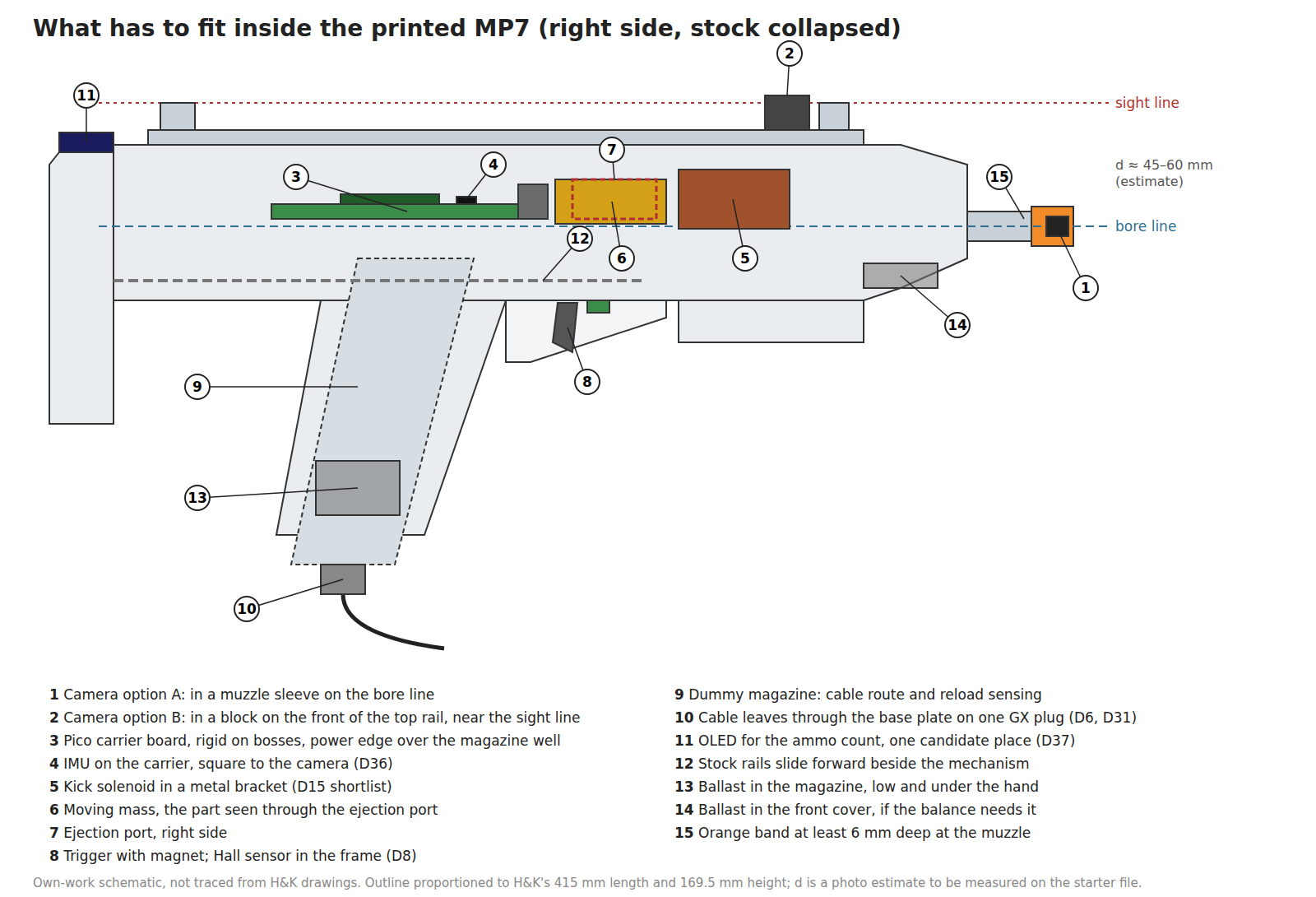
| Kick only, plus a moving ejection port | Plan decision 4; D5 (try both port concepts) | A solenoid drives a mass that recoils; the part seen through the ejection port moves. No slide, no full bolt action. In a printed gun both are designed from scratch, so mass and stroke are chosen rather than inherited from a donor. |
| Solenoid from the bench shortlist, on a regulated 24 V rail | D1, D13, D14, D15 | The bay must take any of five candidate solenoids until the bench ranks them (Solenoid Recoil Vol 8). Recoil and port stages never fire at the same instant (D16). |
| Camera at the front, looking out | D18 (kit camera PAJ7025R3) | A muzzle position, or one near the sight line; Volume 5 shows why that choice is a real trade on an MP7. |
| Pico on a carrier board, inside | D2, D7, D20, D34 | A four-layer carrier rigidly mounted in the receiver (Reference Electronics Vol 8). |
| Hall-effect trigger | D8 | A magnet in the trigger, a sensor in the frame (Reference Electronics Vol 4). |
| IMU on the carrier | D36 | Rigid to the receiver and square to the camera (Positional and Inertial Vol 6). |
| OLED kept, for an ammo count later | D37 | A small display somewhere the player can see it: not on a real MP7, so a realism trade (Volume 5). |
| Cable out through the magazine base plate, on one GX plug | D6, D31 | The magazine is a dummy that carries the cable; one locking aviation connector carries USB and the 24 V rail. D6 said “revisit for the printed build”; Volume 5 does. |
| Orange marking at the muzzle | House rule D29 | An orange band at least 6 mm deep round the outside of the muzzle, leaving the bore clear for a camera (MP7 Donor Build Vol 3). |
| Kits may be sold | D11 | Every file, licence and mark in the gun has to be clean enough to sell. Volume 3. |
| Files stay private until a working model exists | D12 | The CAD lives in the private repository; nothing is published until the publish decision. |
1.3 What printing buys, and what it costs
Money. The three-donor comparison costs $794.89 before tax and shipping at Airsoft GI’s prices of 18 October 2026, and $869.88 with the spare KWA magazine that would be machined for the cable exit (MP7 Donor Build Vol 1 §1.10). A single gas donor with its spare magazine is $419.94. The printed gun’s outside costs a few dollars of files and a few spools of filament.
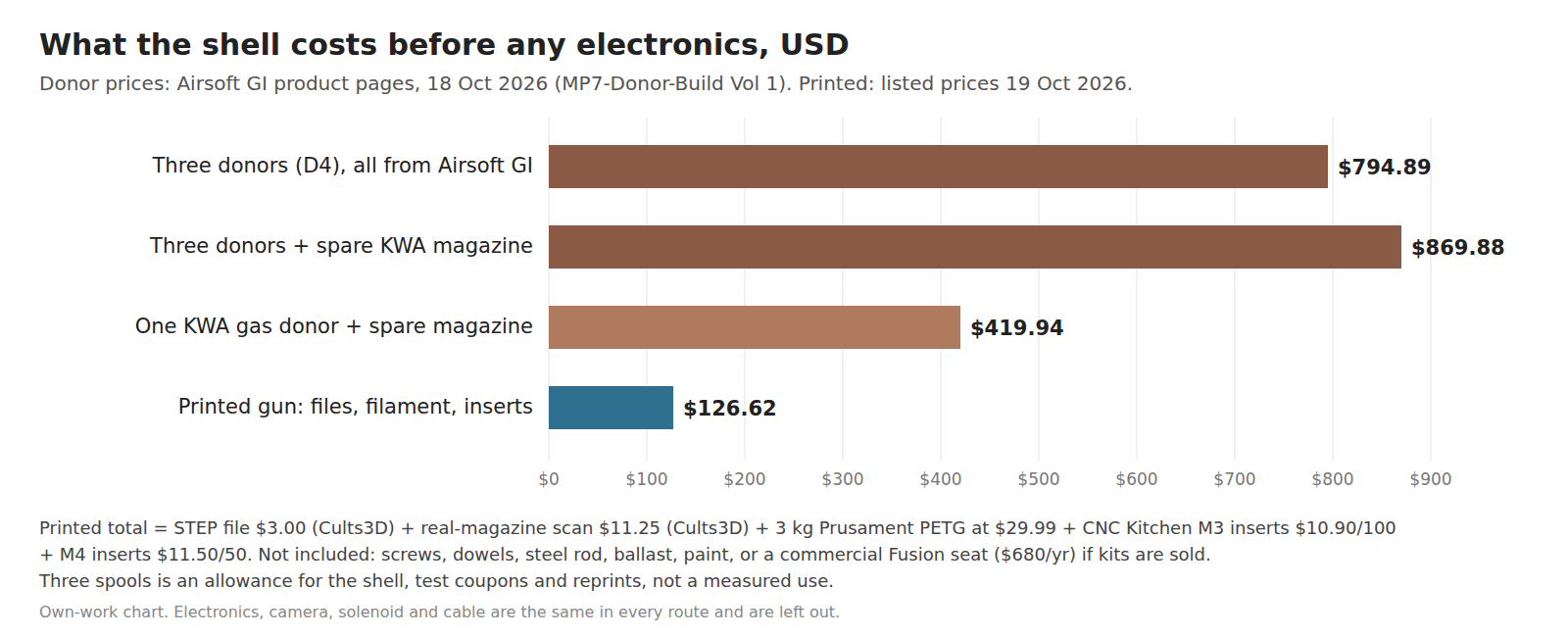
The comparison is honest only with two additions. The electronics, camera, solenoid and cable cost the same in every route and are left out of both. And if kits are sold, the CAD for them has to be drawn on a licence that allows it: Autodesk’s free personal-use Fusion is “For personal, non-commercial projects only” and limited to people earning “less than $1,000 USD annually” from it, while commercial Fusion was listed at $680 a year on 19 October 2026 (Autodesk’s comparison page). Which licence the owner holds is a question for him (Volume 3).
Iteration. A donor is a fixed shape that has to be cut to fit the electronics. A printed shell is drawn around them. When the solenoid shortlist is ranked on the bench, the bay is redrawn and reprinted overnight; nothing has to be milled out of a metal action housing. A failed part costs a spool-hour rather than a $345 gun. For a first build whose camera, solenoid and board are all still being chosen, that is the main argument.
Ownership of the design. Everything in a donor is someone else’s: the shell, the mechanism, the marks. A printed gun can be made entirely of geometry the builders own or have a licence for, which is the only kind of gun that can become a kit (D11). The starter file complicates this, and Volume 3 sets out how.
What printing costs in realism.
- Weight. The real MP7A1 is about 1.9 kg without a magazine. A thin printed shell with the electronics in it is a fraction of that; Volume 7 estimates it and places ballast. A light gun also kicks harder for the same solenoid impulse, which is a feel difference, not only a weight one (MP7 Donor Build Vol 2 makes the same point about the 600 g spring shell).
- Surface. A licensed airsoft MP7 arrives with H&K’s moulded texture, sharp edges and real markings. A print arrives with layer lines. Filling, priming and painting a convincing polymer finish is real work (Volume 7).
- Moving parts. The gas donor already has a metal carrier moving behind its port; the printed gun has to be given one (Volume 5).
What the donors still do better, and why D35 does not settle D4: a donor is a ready-made, fully realistic reference to measure and to hold beside the print; its gas carrier is concept A of the moving port, already built; and the cheap Umarex spring gun ($49.99) is a full-size handling mock-up for the price of a spool and a half. A reasonable reading of D35 is that the printed gun is the build and one donor, at most, is a reference. That is a recommendation for the owner, not a decision.
1.4 Starting from someone else’s file
Drawing an MP7 from photographs is a large modelling job, and the owner asked for the opposite: as much of the work done by someone else as possible, in a file Fusion can edit. A STEP file is the format that meets that brief. It carries exact solid geometry (boundary representation, B-rep) that Fusion imports as real bodies with real faces, edges and holes, which can be measured, cut, shelled and pushed. An STL or OBJ carries only triangles: Fusion can display it, and convert it to solids that are either one face per triangle or, on a commercial licence only, an approximation (Volume 4). The owner’s “stl files are out” is right for any part that has to be cut and fitted.
Volume 2 surveys every MP7 model findable on 19 October 2026 across eleven sites and the commercial model stores. The short answer:
- Only one whole-gun STEP of an MP7 was found anywhere: a $3.00 listing on Cults3D, “HK MP7 CAD model” by the designer practitioners (design 3583166), a full assembly with internals, offered under Cults’ private-use licence. It is the recommended starter for the first gun, with conditions.
- Everything else is a mesh: game and rendering models (TurboSquid, CGTrader, Sketchfab, 3DModels.org) and STL “props” (Cults3D, Thingiverse, MakerWorld). Some are useful as references; none is a starter in the owner’s sense.
- No MP7 light-gun shell exists to start from (the MP7 Donor Build dive found the same).
Volume 3 explains why the starter file, whatever its quality, cannot go into a kit as it stands, and the two ways round that.
1.5 The order of work
The sequence the volumes follow, and the order the work is proposed to happen in:
- Buy and check the starter file (Volume 2). Measure it against H&K’s published dimensions before trusting a single face.
- Bring it into Fusion as a private, organised project (Volume 4): components, a skeleton of datums (bore line, sight line, camera axis), user parameters for every clearance.
- Hollow it and fit the inside (Volume 5): delete the firearm internals, place the carrier, camera, solenoid bay, moving mass, trigger and magazine.
- Split it for the printers and design the joints (Volume 6): split lines, keys, inserts, fasteners, wall and infill rules.
- Print test coupons, then parts (Volume 6): tolerances, insert holes, orientation, material.
- Assemble on the bench with the Reference Electronics bring-up and the Solenoid Recoil shortlist.
- Make it look and weigh like an MP7 (Volume 7): ballast, finish, marking.
1.6 Who owns what
This dive owns the gun’s mechanical design: the starter file, Fusion, the shell, its split, joints, printing, packaging and finish. It links to the dives that own everything else, and never restates their figures.
Table 2 — 1.6 Who owns what
| Topic | Owned by |
|---|---|
| Real MP7 dimensions, mechanism, markings, variants | HK MP7 (Vols 4, 5, 7) |
| Airsoft donors, their prices, internals, the camera aperture rule, the base-plate exit, law | MP7 Donor Build (Vols 1–3) |
| Pico, carrier board, camera wiring, Hall trigger circuit, driver stages, BOM | Reference Electronics |
| Trigger feel, buttons, selector and reload inputs | Controls and Inputs (being written) |
| Solenoid choice, pulse, heat, moving mass, measuring kick | Solenoid Recoil |
| The moving ejection port as a mechanism | Moving Ejection Port (planned) |
| Supply, GX connector rating, TVS | Power Supplies |
| Camera placement and parallax | Aiming Maths and Calibration Vol 5 |
| IMU choice and placement | Positional and Inertial Vol 6 |
| Firmware | Open-Source Firmware |
| Lessons from guns used as hosts | Modding Classic Light Guns |
| Imitation-firearm marking and kit law; licences, trademarks and kits | Imitation Firearm Law, Licensing, IP and Kits (planned) |
| The machined aluminium gun that follows | MP7 Machined Aluminum (planned) |
1.7 What this dive does not do
- It contains no firearm content. The starter file models a real select-fire weapon’s internals; they are deleted in Volume 5 and never reproduced, dimensioned or discussed here. The printed gun has no barrel bore, chamber, bolt or fire control; its “barrel” is a tube that holds a camera. The HK MP7 dive covers the real weapon as reference only.
- It does not publish CAD. The build’s files stay private (D12). Screenshots appear where they explain a method; files do not.
- It does not download, buy or log in. The survey in Volume 2 records what each listing offers on the day it was read. The owner buys and downloads.
Sources
- Owner decisions D1–D39,
Light-Guns/DECISIONS.md(D35–D39 dated 19 October 2026); the category plan,docs/superpowers/plans/2026-10-18-light-guns-plan.md. - Heckler & Koch dimensions and weights as tabulated in the HK MP7 dive, Volume 4, “The dimensions that never agree”.
- Donor prices: MP7 Donor Build, Volume 1, §1.10, Airsoft GI product pages read 18 October 2026.
- Cults3D listings “HK MP7 CAD model” (design 3583166, US$3.00) and “Heckler & Koch H&K HK MP7 SMG 30 round mag … real size scan” (design 1931690, US$11.25), read 19 October 2026.
- Prusa Research store, Prusament PETG 1 kg $29.99, read 19 October 2026, https://www.prusa3d.com/category/prusament-petg/.
- CNC Kitchen US store, Heat Set Insert M3 x 5.7 (100) $10.90 and M4 x 8.1 (50) $11.50, read 19 October 2026, https://cnckitchenus.store/.
- Autodesk, “Compare Autodesk Fusion vs Autodesk Fusion for Personal Use”, read 19 October 2026, https://www.autodesk.com/products/fusion-360/personal.
Comments (0)