MP7 Light Gun: Printed Build · Volume 7
Making It Real — Dimensions, Weight, Balance, Finish and Marking
What separates a printed MP7 from a convincing one: checking the outside against H&K's own figures, an estimated weight budget and where ballast goes without spoiling the kick, a finish that reads as H&K's polymer, the markings a private gun and a kit should and should not carry, the orange band, and the checklist before the first game
7.1 What “realistic” means for this gun
The owner’s brief says “of course we want realism here”. For a light gun that has four parts, in the order a player notices them: the look from a metre away, the hand (grip, trigger, controls where they should be), the weight and balance when it comes up to the shoulder, and the motion (the kick and the port). The look and the hand come from the starter file and the finish. The motion is Volume 5. Weight is where a printed gun falls furthest short, so it gets the most space here.
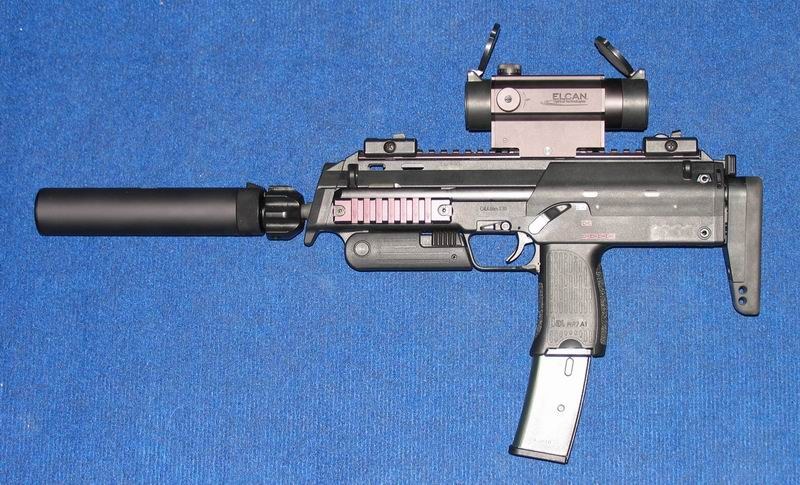
7.2 Dimensions: checking against H&K
H&K has published several sets of dimensions for the MP7A1 that do not agree, because they describe different stocks, conventions and years. HK MP7 Vol 4 tabulates them all and warns against averaging them. For this build the useful ones:
Table 1 — H&K has published several sets of dimensions for the MP7A1 that do not agree, because they describe different stocks, conventions and years. [HK MP7 Vol 4](/actual-firearms/smgs-and-pdws/hk-mp7/vol-4/) tabulates them all and warns against averaging them. For this build the useful ones
| Dimension | Figure | Source (via HK MP7 Vol 4) |
|---|---|---|
| Length, stock in / out | 415 / 638 mm | H&K technical data V002.02.11; Bundeswehr |
| 420 / 640 mm | H&K manuals 2006, 2011 | |
| Height | 169.5 mm | H&K technical data |
| 172 mm | H&K manuals | |
| Width | 42, 45 or 51 mm | depends on what is counted (side-rail bushings, levers, a fitted rail) |
| Barrel | 180 mm | every source |
| Weight, no magazine | about 1.9 kg (1.8 kg in the manuals) | H&K; Bundeswehr |
| Magazine, empty | about 100 / 150 / 200 g (20 / 30 / 40 rounds) | H&K technical data, HK MP7 Vol 5 |
What to do with them. Pick one set and say which. The 2011 technical-data set (415 / 169.5 mm) is the most recent H&K figure and agrees with the Bundeswehr’s length, so it is the proposed target. The starter file is measured against it at import (Volume 2, §2.8) and again before printing (Volume 4, §4.12). Where the starter disagrees by more than a millimetre or two, a calibrated canvas of H&K’s own manual figure (Volume 4, §4.8) and the real-magazine scan decide which is right.
Widths that matter to the hand. The grip’s front-to-back depth (set by the 4.6 × 30 magazine, HK MP7 Vol 5) and its width are what a player’s hand reads as “MP7”. Check them against the magazine scan, which is the one piece of geometry measured from a real H&K part.
7.3 Weight and balance
An estimate, not a measurement. The outside surface of the receiver, grip, backplate, front cover and foregrip is roughly 1,600 cm², estimated from the gun’s envelope. At a 2.4 mm wall that is about 380 cm³ of plastic; at about 1.27 g/cm³, a typical figure for PETG, about 0.49 kg, and up to 30 % more for bosses, ribs and solid regions. The metal parts (top rail, stock rails, kick-module plate, moving mass, guide rods) and the electronics and cable add perhaps 0.4–0.65 kg between them. The printed gun is likely to weigh about 0.9–1.3 kg, against the real gun’s 1.9 kg plus 0.15 kg for an empty 30-round magazine. The gap, about 0.75–1.1 kg, is ballast.
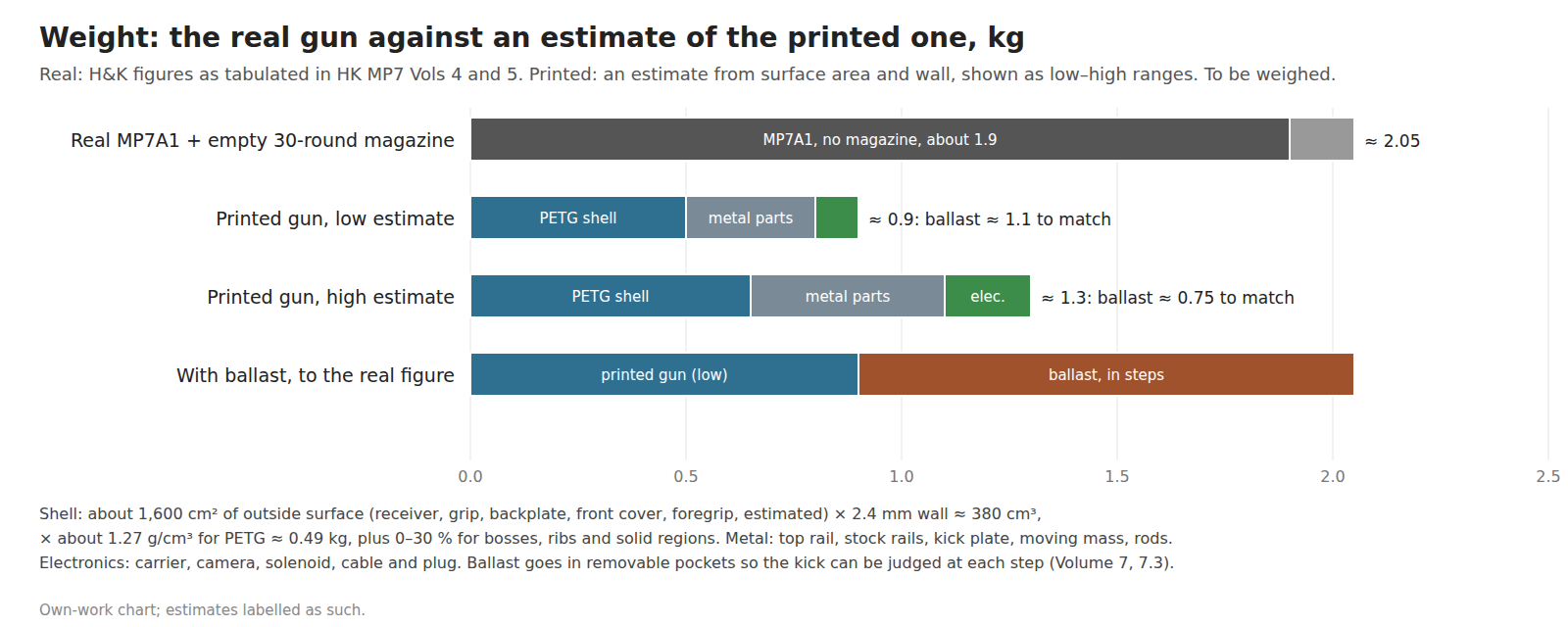
Ballast and the kick pull against each other. For the same solenoid impulse, a lighter gun recoils faster and feels it more; ballast makes the gun more realistic in the hand and the kick weaker in the shoulder. Solenoid Recoil Vol 5 covers what the hand feels and how moving mass buys momentum; the MP7 Donor Build made the same point about its 600 g spring shell. So:
- Ballast goes in removable pockets, in steps, and the kick is judged at each step on the bench and in play. The right weight is the heaviest at which the kick still feels right, which may be less than 1.9 kg.
- Where. Low and near the hand first: the dummy magazine (Volume 5, 5.6), which on the real gun is where the cartridges’ weight is. Then, if the gun is tail-heavy with the kick module behind the grip, a little in the front cover. The real gun’s centre of mass is not published; if one of the airsoft donors is bought after all, its balance point (DWJ gives a licensed replica as 1,940 g, HK MP7 Vol 4) is a fair reference to match.
- What. Steel slugs or plates, or tungsten putty where space is tight, glued or screwed into printed pockets. Nothing loose, nothing that rattles against the moving mass.
7.4 Surface and finish
A real MP7’s receiver is moulded polymer: a smooth, low-sheen, even black with crisp edges and moulded texture on the grip (HK MP7 Vol 4, “Finish”). A print starts with layer lines, seams and support scars. The sequence, as working practice:
- Print it as clean as possible. Cosmetic faces up, no supports on them (Volume 6); a fine layer height on the parts where the face curves gently, since layer steps show worst on shallow slopes.
- Fill the seams after assembly, with a two-part filler or putty suited to PETG, and sand flush. Seams on the real gun’s part lines can be left as crisp lines; clamshell and transverse seams must disappear.
- Sand in steps, coarse to fine, keeping edges sharp with a block.
- Filler primer, sanded back, repeated until the layer lines are gone. High-build primer does most of the work that sanding alone cannot.
- Colour coat, thin and even.
- A matt or satin clear to set the sheen. H&K’s polymer is not dead flat; compare against the photographs in this volume under the same light.
Texture: the grip’s moulded pattern comes from the model if the starter has it; the large receiver faces on the real gun are smooth, so the finish should be too. Metal parts (rails, pins, the moving mass seen in the port) read as metal against the polymer, which is what the real gun shows: leave them black-anodised or finished as metal, not painted to match the shell.
7.5 Colour
Black is the default. H&K also offers a brown: its image of the MP7A2 is filed as “MP7A2_links_RAL” and shows a brown finish, and DWJ reported Umarex selling its licensed MP7A1 replica “in der Farbe RAL 8000”, a green-brown (HK MP7 Vol 4). A brown MP7 is therefore a real configuration, and RAL 8000 is a standard colour any paint supplier can match.
7.6 Markings
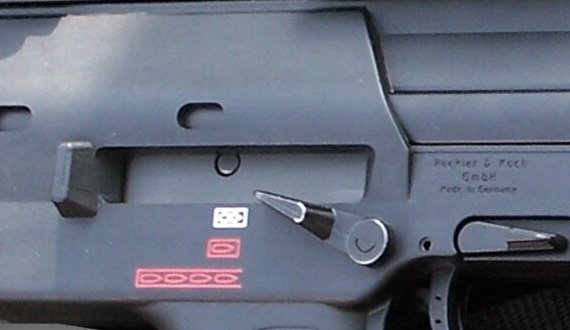
The real gun carries the H&K logo and model on the grip, the calibre on the receiver, the company name, and the selector pictograms (HK MP7 Vol 4, “Markings”). The starter file may model some of them.
- A kit carries none of H&K’s names, logos or model designations (Volume 3, 3.7). They are removed from the kit’s model with Delete (Volume 4, 4.6).
- The private gun is the owner’s choice, but there is no reason to add H&K’s marks to something H&K did not make, and good reasons not to: a gun-shaped object carrying a real maker’s name looks more like the real thing to anyone who sees it out of context. The proposal is to leave the private gun unmarked as well, except for the orange band.
- The selector pictograms are where the player looks to read a selector position. If the selector becomes an input (Controls and Inputs), neutral markings that say what it does in the game are clearer than copies of H&K’s.
7.7 The orange band
House rule D29 adopts the MP7 Donor Build’s transport and storage rule, which keeps the orange marking visible. The marking the law approves for a gun with a camera at the muzzle is a blaze-orange band round the outside of the barrel at least 6 mm deep (MP7 Donor Build Vol 3). On the printed gun it is the muzzle sleeve itself, printed in orange (Volumes 5 and 6), bonded or pinned rather than screwed so that it is “permanently affixed”. It costs some realism and is not optional on a kit (Volume 3, 3.8).
7.8 Sound and feel
- Sound. A solenoid and a mass hitting a stop make a sharp click, not a report. How loud, and how to damp it, is Solenoid Recoil Vol 5’s “Noise”.
- Trigger. The real MP7’s pull is 30–45 N (HK MP7 Vol 5): realistic and tiring in a long game. The feel is Controls and Inputs’s call.
- Stock and foregrip. The click of the stock into each position and the foregrip into its locks are a large part of “it feels like the real one”, and both come from the detents in Volume 5, 5.8.
- The cable. It leaves through the magazine base plate, under the hand and out of sight, which is the most realistic place a cable can leave a gun.
7.9 Before the first game
Table 2 — 7.9 Before the first game
| Check | Pass |
|---|---|
| Length, height and barrel against the chosen H&K figures | Within a millimetre or two |
| Weight and balance | As settled in 7.3, with the kick still right |
| Every screw into an insert; nothing loose to the shake | No rattle |
| Stock slides and clicks in every position; foregrip locks open | Repeatable |
| Camera rigid; calibrated from the usual playing position, aiming with the sights | Aiming Maths Vol 5 |
| Kick and port fire in sequence, never together (D16) | On the bench with the ADP3450 |
| GX plug mated before the brick is plugged in (D31) | Habit |
| Orange band intact | Always |
| House rule D29 for storage and any trip out of the house | Always |
7.10 What carries forward
To the MP7 Machined Aluminum build: the skeleton of datums, the internal layout and the kick module, which belonged to the builders from the start; the measured weight and balance target; and the lessons of the printed joints, which become machined ones. Not the starter’s outer surfaces, for the licence reasons in Volume 3. To a kit, if one is made: route 2 of Volume 3 (our own geometry), the electronics-only alternative, or a non-MP7 shell.
7.11 What could not be verified
- Every weight figure for the printed gun: estimated from area and wall, to be weighed. PETG’s density is taken as a typical 1.27 g/cm³, not from the spool’s own data sheet.
- The real MP7’s centre of mass: not found in any H&K document.
- Which filler, primer and paint suit PETG on the owner’s bench: to be tested on coupons.
Sources
- HK MP7, Vol 4 (“The dimensions that never agree”, “Finish”, “Markings”, “Replicas”) and Vol 5 (“The magazine”, “The mechanism in numbers”).
- Solenoid Recoil Vol 5, on felt recoil, moving mass and noise.
- MP7 Donor Build, Vol 2 (the spring shell’s weight and kick) and Vol 3 (marking, the house rule).
- Aiming Maths and Calibration Vol 5, calibration from the playing position.
- Owner decisions D16, D29, D31,
Light-Guns/DECISIONS.md. - Photographs: Remigiusz Wilk, “Heckler & Koch MP7A1.jpg”, Wikimedia Commons, CC BY-SA 2.5; KrisfromGermany, “H&K MP7.jpg”, Wikimedia Commons, public domain.
Comments (0)