MP7 Light Gun: Printed Build · Volume 3
Licences, Marks and the Kit Question
Why a $3 private-use STEP is the right start for the first gun and the wrong base for a kit: the licences met in the survey in their own words, what personal-use, non-commercial and remix terms mean for a modified file sold as printed parts, the design tool's own licence, H&K's marks and the MP7's look, keeping our files private, and two clean routes to a kit
This volume is planning, not legal advice. The category’s Licensing, IP and Kits dive (planned) owns the full treatment, and any kit decision belongs with a lawyer. What follows is what the licences say, read against what this build intends to do.
3.1 Why licences bind this build
Two owner decisions make this volume necessary. D11: kits may be sold later, so “licences, trademarks and USB rules are binding, not advisory”. D12: STEP, CAD and firmware stay private until a working model exists, with a publish decision then. A file that is fine for one gun in a workshop can be the wrong foundation for a product, and the time to know that is before months of Fusion work are built on it.
3.2 Three separate sets of rights
A printed MP7 light gun sold as a kit touches three different owners’ rights, and a licence for one says nothing about the others.
- The model file. A 3D model is a creative work; its author holds copyright in it and licenses it on the site where it is sold. That licence governs what may be done with the file and with things made from it.
- The design tool. Fusion is licensed software, and its personal-use tier forbids commercial use. Designs made under it inherit that limit for as long as the work is done under it (Section 3.6).
- The real gun’s identity. H&K’s names and logos are trademarks, and the MP7’s distinctive look may be protected as trade dress. These belong to H&K whoever drew the model, and no model licence can grant them (Section 3.7).
3.3 The licences in their own words
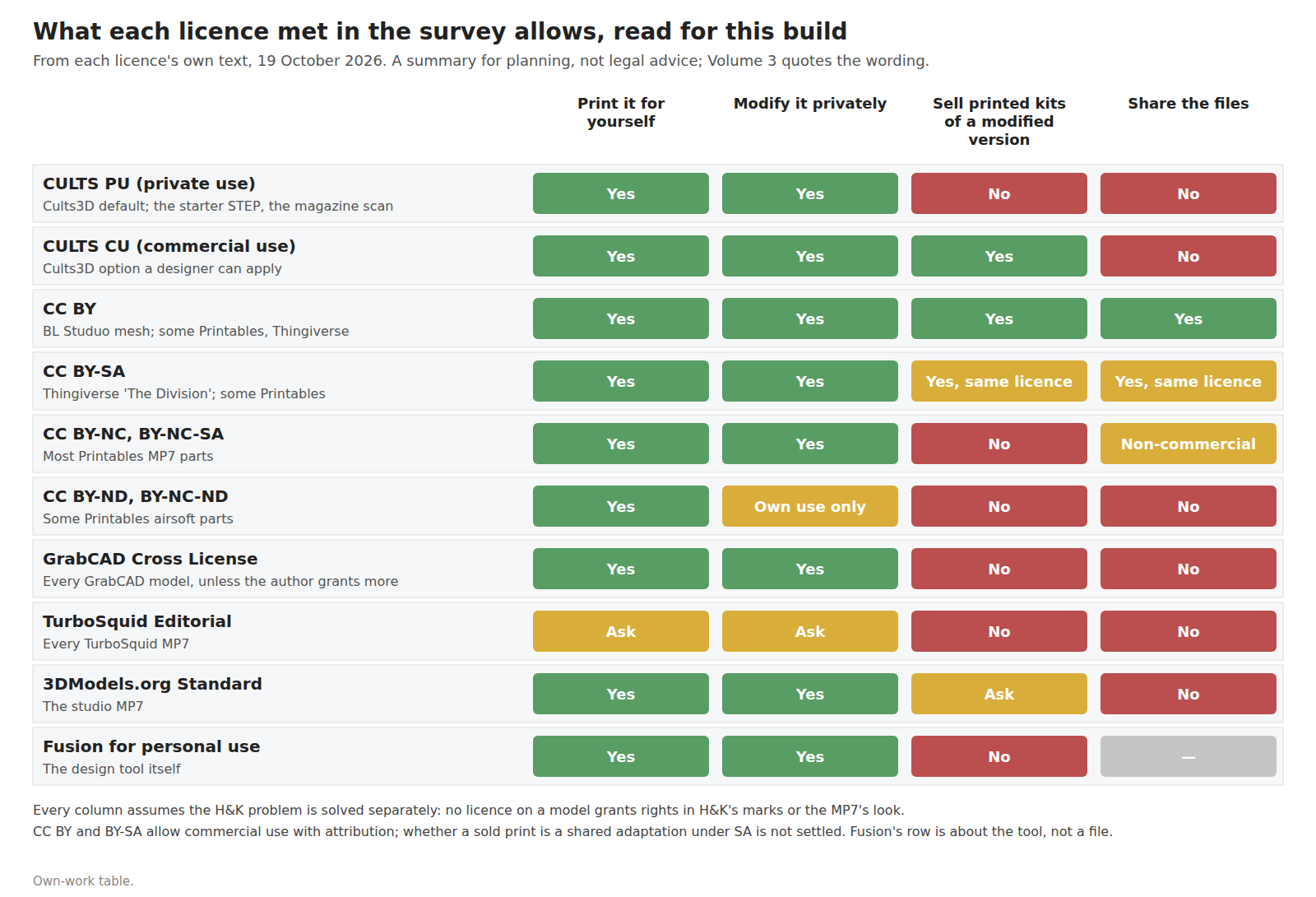
Cults3D (the starter STEP, the magazine scan, every Cults listing in Volume 2). All carry Cults’ default:
CULTS PU - PRIVATE USE. You are authorized to: Print and use the 3D prints of the 3D model for private use; Share the images of your 3D prints … What is not allowed: No commercial use or public sharing of the 3D model; No modification or adaptation of the 3D model for public sharing or sale; No distribution, sale, donation or exchange of the digital files of the 3D model.
Cults also offers designers a commercial licence:
CULTS CU - COMMERCIAL USE. You are authorized to: Print — sell and distribute 3D prints of the 3D model and its adapted models for any use, including commercial use, in unlimited quantities; Adapt — remix, transform and create from the digital files of the 3D model. What is not allowed: No sharing of your 3D prints, nor adaptation of the 3D model without attribution; No distribution, sale, donation or exchange of the digital files of the 3D model and the digital files of 3D models adapted from it.
And the rule for anything in between: “Cults require members who download digital files on the website to get permission from the designers, the right holders, to do any of the things that the license does not expressly allow.”
GrabCAD (the foregrip STEP). GrabCAD’s terms give every user a “Cross License” in every other member’s upload “to use, reproduce, copy, modify, adapt, arrange, translate, and create derivative works of such User Submissions for such user’s own benefit and non-commercial, internal use”. Anything more needs the author’s permission.
TurboSquid (22 MP7 meshes). Every one is “Editorial Uses Only”: “The intellectual property depicted in this model, including brands, is not affiliated with or endorsed by the original rights holders and must be used under editorial use restrictions.” Editorial means illustrating news and commentary; a product is the opposite.
3DModels.org (the studio mesh). The buyer “MAY: Use the PRODUCT in any type of projects (presentations, advertising, applications and other customer projects); Modify the original PRODUCT for business purposes”, and “may NOT: Distribute the PRODUCT or any modifications/parts of the PRODUCT outside the purchasing organization without the express written permission of 3DModels Team”. The terms add that “the 3D model may contain copyrights and/or trademarks of third parties, and in some cases their use must be agreed with the owners.”
Creative Commons (the BL Studuo mesh, most Printables and Thingiverse files). Cults’ summary of the variants, which matches the Creative Commons deeds: CC BY lets anyone “Adapt — remix, transform and create from the material for any use, including commercial”, with attribution; BY-SA adds “No sharing or adaptation under different conditions”; any NC licence adds “No commercial use”; any ND licence adds “No modification”.
3.4 Personal use, non-commercial, and a modified file
The starter STEP will not be printed as it comes. It will be hollowed, split, re-joined, fitted with bosses and bays, and given a camera mount, until it is substantially a new design built on the starter’s surfaces. Under the licences above that new design is an adaptation of the starter (Cults’ word) or a derivative work (GrabCAD’s). Three consequences:
- For the first gun, all is well. Printing and using it privately, and modifying the file privately to do so, is exactly what CULTS PU and GrabCAD’s Cross License allow. Showing photographs of it is expressly allowed by CULTS PU.
- A kit made from the modified file is “sale” of an adaptation, which CULTS PU forbids (“No modification or adaptation of the 3D model for public sharing or sale”) and GrabCAD’s licence excludes (non-commercial, internal use only). How much modification would make the starter disappear from the result is not a question the licences answer, and the safe assumption is that a shell whose outside surfaces came from the starter is still an adaptation however much its inside changed.
- Even a commercial licence does not let the files go out. CULTS CU allows selling prints of adapted models but still forbids “distribution, sale, donation or exchange of the digital files … of 3D models adapted from it”. A kit under CULTS CU would ship printed parts, never STL or STEP files.
3.5 Remix licences
A CC BY model is the one licence in the survey that already allows a sold kit of a modified version, with attribution. CC BY-SA allows it too, but anything adapted from the model must be shared under the same licence, which would mean releasing the kit’s adapted model files under BY-SA if they are shared at all, and collides with D12 the moment they are. Whether selling a physical print counts as “sharing” adapted material under SA is not something the licence text settles; the safe reading treats the kit’s files as BY-SA. NC and ND licences rule out a kit outright.
The only CC BY model in the survey with any claim to accuracy is BL Studuo’s mesh. It is a mesh, not a starter; its licence makes it the cleanest reference to remodel over (Section 3.9), provided its author confirms it is original work.
3.6 The design tool’s licence
Autodesk’s comparison page, read on 19 October 2026, gives the personal-use terms in one line: “For personal, non-commercial projects only. Limited to individuals generating less than $1,000 USD annually and not for use in primary employment, company environments, or commercial training.” The paid Fusion subscription was listed at “$680 /YEAR (OR $85 /MONTH)”. Autodesk also limits personal use in features; one that matters to this build is mesh conversion, where Autodesk’s Fusion blog (June 2026) says the prismatic method “is available to commercial license users” (Volume 4).
For the first gun the personal tier is enough. Before kit design starts, the work moves to a commercial seat. Which licence the owner holds today is not recorded, and is a question for him.
Decided (19 October 2026, D41–D42): the design is done on a personal Fusion 360 licence, which covers building this gun but not commercial design work, and any kit geometry is the build’s own, drawn in a separate project (route 2 of §3.9), never derived from the bought file. If kits are pursued, the design moves to a commercial Fusion seat or another CAD package before any kit file is made.
3.7 H&K’s marks and the MP7’s look
No model licence can grant rights the model’s author never had, and the author of an MP7 model never had H&K’s.
- Marks. H&K’s name, the HK logo and the “MP7” designation appear on the real gun’s grip and receiver (HK MP7 Vol 4 lists where). Licensed airsoft MP7s carry them because Umarex and Elite Force sell them as H&K-licensed products. A kit carries none of them, and the starter file’s grip and receiver are checked for moulded logos and text, which are deleted from any kit version. The private first gun is a separate question, and keeping it unmarked costs nothing.
- Trade dress. The MP7’s shape is distinctive, and H&K has shown it will defend a gun’s look: it sued German Sport Guns and American Tactical Imports over the GSG-5, a .22 rifle patterned on the MP5 (S.D. Ind., No. 1:09-cv-00039), and the case settled in October 2009 with production and import of the original-design GSG-5 stopping, per the parties’ announcement as reported by AmmoLand. Reports disagree on whether the claim was trade dress or design patent. The USPTO’s own records do show word marks: “MP 7” is registered for toy weapons (Reg. 3,635,554, class 28) as well as for firearms (Reg. 3,274,715), and “HK” (Reg. 4,085,639) also covers class 28, so the name is protected on exactly the kind of product a kit is; no registration for the MP7’s shape was found (Licensing, IP and Kits, Volume 2). (Corrected 2026-10-20; this paragraph first said no MP7 registration had turned up.)
So a full-size, realistic MP7 sold as a kit is the riskiest product this category could make, whatever file it was drawn from. Three ways to live with that, for the owner and a lawyer to weigh: sell the electronics as a kit for a customer’s own licensed airsoft MP7 (the MP7 Donor Build route), with no shell at all; seek a licence the way the airsoft makers have; or sell a shell that is not an MP7, an original compact-PDW design that uses everything this dive learns about packaging. The realistic MP7 stays a private gun in every case.
3.8 The orange marking on a kit
A light gun in an MP7 shell is a “look-alike firearm” under 15 U.S.C. § 5001 (as a replica nongun), and § 5001 applies to whoever manufactures, enters into commerce, ships, transports or receives one. A kit shipped to a customer therefore carries an approved marking from 16 C.F.R. § 1272.3; for a camera at the muzzle that is option (b), a blaze-orange band round the outside of the barrel at least 6 mm deep, which leaves the bore clear. MP7 Donor Build Vol 3 has the statute and the regulation in full; the Imitation Firearm Law dive (planned) owns kit shipping. The private gun follows house rule D29 and keeps the band too (Volume 7).
3.9 Two clean routes to a kit
Route 1: a written licence from the designer. Ask the starter’s author for a commercial licence that covers selling printed parts adapted from the file (Section 3.11). On Cults3D the simplest form is for the designer to sell the model under CULTS CU; a one-off written licence is the alternative. It is quick if the designer agrees. Its weaknesses: it inherits whatever doubt hangs over the starter’s own provenance (Volume 2, §2.3), it still forbids shipping files, and it does nothing for H&K’s rights.
Route 2: the builders’ own geometry. Use the bought file for the first, private gun, and draw the kit’s shell from scratch in a separate Fusion project, from H&K’s published dimensions, calibrated photographs, measurements of a real or licensed airsoft MP7, and references under licences that allow it (CC BY). The rules that keep that clean:
- The starter file is never inserted into, derived into or traced in the kit project. Two projects, never linked.
- Every dimension in the kit model is written down with its source: an H&K figure, a measurement with a date and an instrument, or a calibrated canvas.
- What carries across is knowledge: where the board fits, how big the solenoid bay is, which joints worked. That belongs to the builders.
Route 2 costs a second modelling job, but by the time a kit is in sight that job is half done: the inside of the gun, which is most of the design effort, belonged to the builders from the start.
3.10 Keeping the build’s files private
D12 in practice, for the files this dive creates:
- Fusion: the project is not shared, no public link is generated, and nothing is posted to the Fusion gallery.
- Exports: STEP, F3D archives and print-ready 3MF files go in this dive’s
04-templates/in the private Firearms repository (the category plan’s place for CAD), under the Standard’s repository and large-file rules. The bought starter file goes there too, and is never copied anywhere public. - Model sites: nothing is uploaded to Printables, Thingiverse, Cults3D or anywhere else.
- The site: these volumes show screenshots and photographs, never files. A screenshot of the bought starter file is the listing’s own preview image, credited, or a view of the derivative.
3.11 Asking for a licence
The owner sends any such message himself, through the site’s own contact feature. A draft for the starter’s designer:
Hello. I bought your HK MP7 CAD model (Cults3D design 3583166) to build a light-gun controller for video games: a non-firing replica shell with a camera and electronics inside. Before I go further, three questions. First, what did you model it from: drawings, photographs, a real or airsoft gun, or another model? Second, do you have it in a native format (SolidWorks, Creo or similar) as well as STEP? Third, would you grant a commercial licence that allows me to sell printed parts adapted from your model as part of a kit, without any files being distributed, either by offering it under CULTS CU or in writing, and on what terms? The kit would carry no H&K markings. Thank you.
The questions for 3DModels.org and BL Studuo are in Volume 2 §2.9.
3.12 Why this, and why not the others
Table 1 — 3.12 Why this, and why not the others
| Option | Status | Why, and why not |
|---|---|---|
| Build the first gun on the bought STEP under CULTS PU | Proposed | Allowed by the licence as written: private printing and private modification. Fastest start, which is what D35 asks for |
| Kit route 2: the builders’ own geometry in a separate project | Proposed for any kit | Clean of every model licence; the inside is the builders’ anyway; the outside is redrawn from sourced dimensions |
| Kit route 1: commercial licence from the starter’s author | Ask, keep as a fallback | Fast if granted; still forbids files; inherits the starter’s provenance doubt |
| Build on a CC BY mesh | Rejected as a starter | The licence is right; the format is wrong (mesh); kept as a reference for route 2 |
| Build on TurboSquid, CGTrader game meshes, or NC/ND files | Rejected | Editorial-only, non-commercial or no-derivatives; game provenance |
| A realistic MP7 kit without H&K’s permission | Not recommended | Trade dress risk whatever the file; alternatives in Section 3.7 |
3.13 What could not be verified
- Whether the starter’s designer holds the rights to grant a commercial licence (provenance, Volume 2).
- Whether the MP7’s shape is registered or asserted as trade dress in the US; the USPTO’s records were not searched directly. The GSG-5 settlement’s terms are confidential.
- The owner’s current Fusion licence type.
- Whether a sold physical print is “shared” adapted material under CC BY-SA.
Sources
- Cults3D, “About the licenses on Cults”, https://cults3d.com/en/licenses, read 19 October 2026 (CULTS PU, CULTS CU and the Creative Commons summaries quoted above).
- GrabCAD Terms of Use, §3 and §6.2 (“Cross License”), https://grabcad.com/terms, read 19 October 2026.
- TurboSquid product 1043841, licence block, read 19 October 2026.
- 3DModels.org Terms and Conditions, https://3dmodels.org/terms-and-conditions/, read 19 October 2026.
- Autodesk, “Compare Autodesk Fusion vs Autodesk Fusion for Personal Use”, https://www.autodesk.com/products/fusion-360/personal, read 19 October 2026; Shannon McGarry, “Mastering Mesh Conversion in Autodesk Fusion: Unlocking the Power of Face Groups”, Autodesk Fusion blog, 3 June 2026.
- AmmoLand, “Heckler and Koch vs. German Sport Guns & American Tactical Imports”, October 2009, https://www.ammoland.com/2009/10/heckler-and-koch-vs-german-sport-guns-american-tactical-imports/; The Firearm Blog, 16 October 2009, “H&K suing ATI over their MP5 patterned .22 rifle”.
- 15 U.S.C. § 5001 and 16 C.F.R. § 1272.3, as quoted in MP7 Donor Build Vol 3.
- Owner decisions D11, D12, D29 and D35,
Light-Guns/DECISIONS.md.
Comments (0)