The .45-70 Government · Volume 9
Supersonic Ammunition — The Brand Survey
This volume is the conventional half of the ammunition question: what to feed a .45-70 when you are not trying to be quiet. Volume 10 is the suppressed shortlist.
Read Volume 4 before buying anything here. Several of the best-regarded .45-70 loads on the market are deliberately loaded above SAAMI maximum, and the tier is a property of your rifle, not of the cartridge.
9.1 The Standard-Pressure Field — Safe in Anything
Loads at or under the SAAMI 28,000 CUP maximum. Safe in any .45-70 in sound condition, including original Trapdoors, and the only tier to put through a rifle whose manual has not been read.
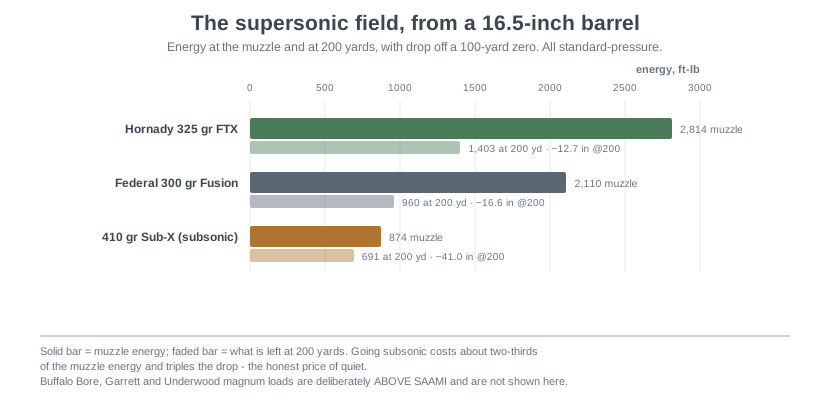
Hornady LEVERevolution 325 gr FTX — the flat-shooting default, and the one most often named best-overall for lever guns. The elastomer Flex Tip makes a pointed bullet safe in a tube magazine, which is the whole innovation: it recovers the ballistic coefficient that flat-nose .45-70 bullets throw away. Commonly cited as among the most accurate factory .45-70 and showing the least drop at distance. From a 16.5-inch barrel, roughly 1,975 fps and 2,814 ft-lb, carrying 1,403 ft-lb to 200 yards with only 12.7 inches of drop off a 100-yard zero.
⚠ One caveat carried from the Henry SPD HUSH dive: a reviewer testing the .45-70 HUSH reported “a slight hangup when chambering the Hornady LEVERevolution,” the pointed tips catching the barrel shank. One reviewer, one rifle, and not something to generalise into a defect — but check it on your own gun before a hunt, because the entire point of a Flex Tip is that it should be invisible.
Federal Fusion 300 gr bonded soft point — the value choice, and widely recommended as the best budget .45-70 deer load. Bonded construction holds together, terminal performance is solid, and it costs meaningfully less than the premium offerings. About 1,780 fps / 2,110 ft-lb from 16.5 inches.
Remington and Winchester 300–405 gr soft points — the traditional loads. Unexciting, cheap, everywhere, and entirely adequate inside 150 yards. Winchester Super-X is named alongside LEVERevolution for accuracy in more than one comparison.
9.2 The Above-SAAMI Field — Platform-Specific
🔴 These are excellent products that are not safe in every .45-70. All three makers are explicit about it; the danger is in third-party “best ammo” lists that rank by muzzle energy and omit the tier.
Buffalo Bore — the most transparent of the three, publishing distinct pressure levels: a standard-pressure line described as safe in any sound .45-70, plus mid-range and magnum offerings. Their 300 gr JHP and 405 gr JFN are frequently named for bear defence. The magnum ammunition is explicitly for the strongest actions.
Garrett Cartridges — hard-cast, dangerous-game oriented. The 420 gr Hardcast is the flagship and appears on essentially every “big bear” list. Deep penetration is the entire design goal.
Underwood — high-performance loadings across the weight range, regularly named alongside Hornady as a best-of choice by people who have a rifle that can take it.
9.3 What to Buy for the HUSH, Supersonic
Assuming — per Volume 4 — that the manual specifies standard pressure:
Table 1 — Assuming — per Volume 4 — that the manual specifies standard pressure
| Job | Load | Why |
|---|---|---|
| Deer, general | Federal Fusion 300 gr | Bonded, accurate enough, inexpensive, standard pressure |
| Deer/hog, flattest | Hornady LEVERevolution 325 gr FTX | Best trajectory available in the cartridge; check feeding |
| Practice | Remington/Winchester 405 gr soft point | Cheap, mild, and it is the original bullet weight |
| Bear backup | Buffalo Bore standard-pressure hard cast | Penetration without leaving the tier |
Nothing on that list is a magnum load, and that is deliberate. A 6.7-pound rifle firing magnum .45-70 is punishing to the point of being counterproductive — the flinch costs more accuracy than the extra 400 ft-lb buys, and Volume 12 argues that terminal performance in this cartridge is not energy-limited anyway.
9.4 The Bullet-Shape Constraint
Anything fed through the HUSH’s tube magazine must have a flat, round or elastomer-tipped nose. A conventional spitzer point resting on the primer of the round ahead of it under recoil is the classic chain-fire hazard, and it is why .45-70 has been a flat-nose cartridge for 150 years.
In practice this is a non-issue — essentially all factory .45-70 is loaded flat-nose or Flex-Tip precisely because of this, so it constrains handloaders rather than buyers. Volume 11 has the full treatment alongside the overall-length limit.
9.5 Why Supersonic Still Earns a Place
Even committed to a suppressor, there is a real case for keeping supersonic ammunition on hand.
A can still transforms a supersonic .45-70. The blast is gone, the flash is gone, the concussion is gone, recoil is meaningfully down, and it is hearing-safe. American Hunter’s HUSH review found the can “definitely hid the fact I was shooting a .45-70” on full-power ammunition. What remains is the crack — you have bought comfortable, not quiet.
On a cartridge with this much muzzle blast, that is arguably a bigger change than on anything else, because .45-70 has more gas to deal with than most.
And it doubles your effective range. Volume 7 caps the subsonic load around 125 yards. The 325 gr FTX is a genuine 200-yard load with 1,400 ft-lb still on tap. One rifle, two ammunition choices, two quite different capabilities — which is the same argument the HUSH dive makes for the .44 Magnum/.44 Special model, and it applies here just as well.
9.6 Bibliography
- Wideners, “Best 45-70 Ammo: Our Top Picks”; Ammo.com, “The Best 45-70 Ammo For Hunting & Target Shooting”; The Big Game Hunting Blog, “Best .45-70 Ammo For Hunting Deer, Bear, Moose & Other Big Game”; Athlon Outdoors, “Testing The Top Hunting & Self Defense .45-70 Cartridges” — brand surveys and accuracy comparisons.
- Buffalo Bore Ammunition .45-70 product pages — the maker’s own pressure tiering, including the standard-pressure line.
- Garrett Cartridges 420 gr Hardcast; Underwood Ammunition .45-70 listings.
- Hornady LEVERevolution product data and the FTX / Flex Tip tube-magazine rationale; Wide Open Spaces and GunsAmerica LEVERevolution coverage.
- American Hunter, “Hardware Review: Henry SPD HUSH” — the LEVERevolution chambering observation and the suppressed full-power impression.
- Trajectory and energy figures per the model documented in Volumes 7 and 8, with barrel-length adjustment per Volume 5.
Comments (0)