The .45-70 Government · Volume 8
Trajectory, Zero, and the Drop You Will Actually Hold For
Volume 7 established that the useful range ends around 100–125 yards. This volume is about hitting things inside it, and it contains one firm recommendation.
All figures from the calibrated G1 model described in Volume 7, at a 980 fps muzzle estimate, 1.5-inch sight height.
8.1 🔴 Zero at 100, Not 50
The reflex for a big slow cartridge is a close zero. For this load it is the wrong call, and the two tables show why.
100-yard zero:
Table 1 — 100-yard zero:
| Range | Velocity | Energy | Path |
|---|---|---|---|
| 0 | 980 | 874 | 0.0 |
| 25 | 964 | 846 | +3.6” |
| 50 | 949 | 819 | +4.8” |
| 75 | 934 | 795 | +3.7” |
| 100 | 920 | 771 | 0.0 |
| 125 | 907 | 750 | −6.2” |
| 150 | 895 | 729 | −15.1” |
| 175 | 883 | 710 | −26.6” |
| 200 | 871 | 691 | −41.0” |
50-yard zero:
Table 2 — 50-yard zero:
| Range | Velocity | Energy | Path |
|---|---|---|---|
| 0 | 980 | 874 | 0.0 |
| 25 | 964 | 846 | +1.2” |
| 50 | 949 | 819 | 0.0 |
| 75 | 934 | 795 | −3.6” |
| 100 | 920 | 771 | −9.6” |
| 125 | 907 | 750 | −18.3” |
| 150 | 895 | 729 | −29.6” |
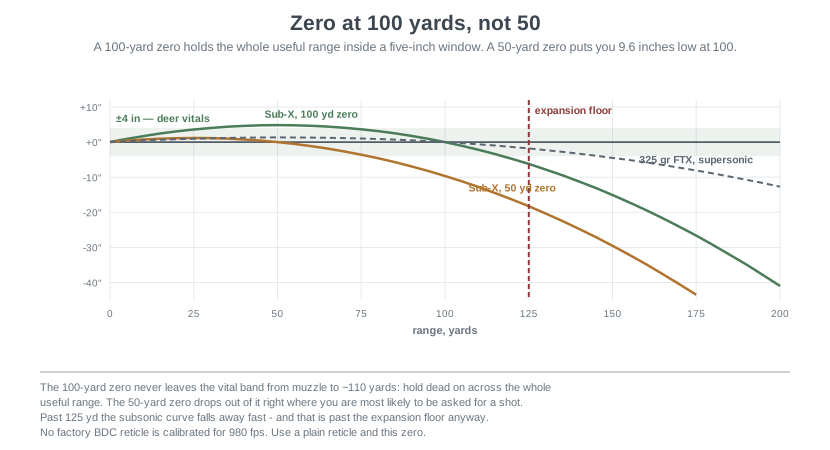
The 100-yard zero holds the entire path inside +4.8 / −0.0 inches from muzzle to 100 yards. On a deer’s vitals — call it an eight-inch circle — that is hold dead on, everywhere, out to the end of the useful range. No estimation, no holdover, no ranging.
The 50-yard zero puts you 9.6 inches low at 100 — a holdover at precisely the distance you are most likely to be asked for a shot, and a miss or a wound if you forget it under pressure.
The maximum ordinate of 4.8 inches sounds like a lot. It is not, for this application: it occurs at 50 yards, it is well inside the vital zone of everything in Volume 12, and it buys you a completely mindless hold across the whole range band.
8.2 Point-Blank Range
Formally: with a 100-yard zero and an 8-inch vital zone (±4 inches), the load stays inside that window from the muzzle to about 110 yards — the high point just touching the top of it.
Widen the acceptable window to a hog-sized 10 inches (±5) and nothing changes, because the path never exceeds 4.8 inches high; the far limit extends to roughly 120 yards, where it falls 5 inches low.
⭐ Point-blank range and the expansion floor land in the same place, around 110–125 yards. Two completely independent limits — one geometric, one about bullet construction — agree on the answer. That is a pleasing result and it is the strongest argument for treating 125 yards as the hard ceiling.
8.3 Past the Floor, the Drop Gets Ugly Fast
Beyond 125 yards the trajectory falls apart quickly — −15 inches at 150, −27 at 175, −41 at 200.
That steepening is not a coincidence; it is the same physics as the low ballistic coefficient. A 980 fps bullet spends a long time in the air, and drop grows with the square of flight time.
This is a second, independent reason not to stretch past the floor. Even if you accepted a non-expanding hit at 150 yards, you would need to range the target precisely and hold fifteen inches high — and a ten-yard ranging error at that distance moves the impact several inches. Everything about the load says inside 125.
8.4 What Supersonic Buys, for Comparison
Same rifle, same 100-yard zero:
Table 3 — Same rifle, same 100-yard zero
| Load | Muzzle | 100 yd | 200 yd | Path @ 200 |
|---|---|---|---|---|
| 410 gr Sub-X (subsonic) | 980 fps / 874 ft-lb | 920 / 771 | 871 / 691 | −41.0” |
| Federal 300 gr subsonic | 930 / 576 | 860 / 493 | 801 / 428 | −47.1” |
| Federal 300 gr Fusion | 1,780 / 2,110 | 1,454 / 1,409 | 1,200 / 960 | −16.6” |
| Hornady 325 gr FTX | 1,975 / 2,814 | 1,662 / 1,994 | 1,394 / 1,403 | −12.7” |
Going subsonic costs roughly two-thirds of the muzzle energy and triples the drop at 200 yards. That is the honest price of quiet, and it is why the suppressed .45-70 is a sub-150-yard rifle while the supersonic one is a genuine 200-yard rifle.
Both are worth owning. They are not the same tool, and the ammunition is what switches between them.
8.5 🔴 A BDC Reticle Will Not Help You
Bullet-drop-compensating reticles are calibrated to a velocity band — typically 2,700–3,000 fps for centrefire rifles, sometimes down to 2,000 for lever-gun-specific designs.
Nothing is calibrated for 980 fps. The subtensions on any factory BDC will be wrong by a wide margin, and the error grows with range.
Practical consequences, developed further in Volume 13:
- Inside 110 yards you do not need one — the 100-yard zero makes it a dead hold.
- Beyond that you should not be shooting anyway — Volume 7.
- If you want holdover marks, use your own measured drops. A plain duplex or a simple dot is better here than a BDC that is confidently wrong.
⭐ A second-focal-plane scope offers a genuine trick if you want it. Subtensions scale with magnification, so dialling down increases the drop each hash mark covers — the same fix the .22 Rimfire dive uses for a rimfire BDC being run subsonic. It works, it needs verifying on paper, and for a 110-yard rifle it is almost certainly more complexity than the problem deserves.
8.6 Wind
Rarely discussed for this cartridge and worth one honest paragraph.
A 410-grain .458 bullet at 980 fps has high mass and low velocity — the mass resists deflection, the long flight time increases exposure. The two partly cancel, and the practical result inside 125 yards is that wind is a minor factor compared with drop and with your ability to range the target.
No wind table is printed here. The model is calibrated for drag along the flight path, not validated for lateral deflection, and inside the range this load actually works, wind is not what will cause the miss.
8.7 Bibliography
- All trajectory figures from the G1 point-mass solver written for this dive, calibrated against Hornady’s published 410 gr Sub-X data as documented in Volume 7 (0.1 fps RMS on both published downrange points). Sight height 1.5 in, standard conditions.
- Muzzle-velocity estimates for the 16.5-inch barrel per Volume 5.
- Comparison loads: Hornady LEVERevolution 325 gr FTX; Federal Fusion 300 gr; Federal 300 gr subsonic — published data, adjusted for barrel length per Volume 5.
- Second-focal-plane magnification technique: .22 Rimfire dive.
Comments (0)