The .45-70 Government · Volume 1
Overview — A Black-Powder Cartridge With a Second Career
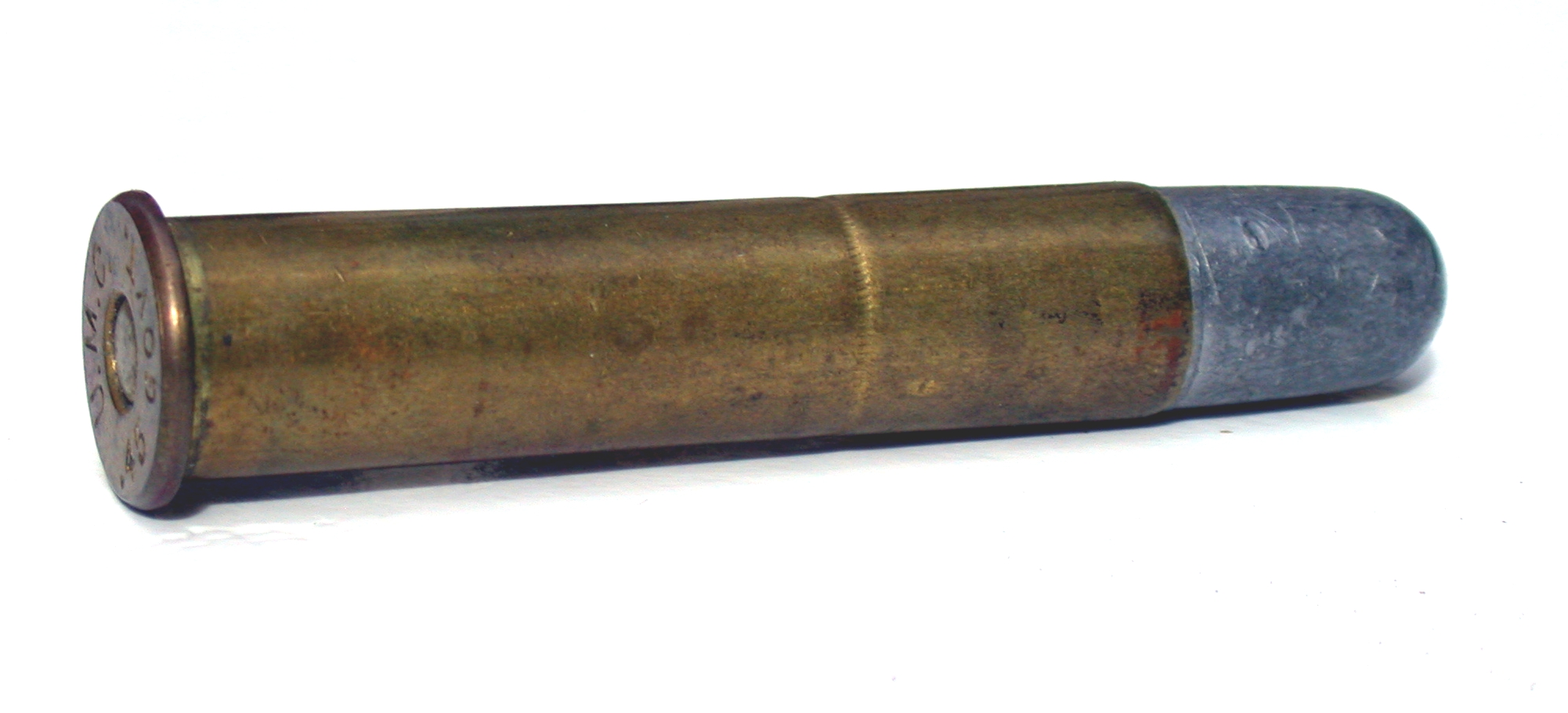
The .45-70 Government was designed in 1873, for a single-shot rifle with a hinged breechblock, to be loaded with black powder. It should be a museum piece. Instead it is in continuous production from every major American ammunition maker, chambered in new rifles every year, and — this is the part that makes it interesting again — it turns out to be one of the best suppressed hunting cartridges in existence.
That last fact is not a coincidence and it is not nostalgia. A cartridge designed to push a very heavy, very large-diameter bullet at a modest velocity is, without changing anything, the exact specification a subsonic round is written to. Everything a modern subsonic designer wants — mass, frontal area, a big case that works with tiny charges of fast powder — the .45-70 already had, 150 years before anyone wanted it for this.
1.1 What This Dive Is For
This is the cartridge dive. Its sibling, Henry SPD HUSH, is the rifle dive — that one covers one rifle across five chamberings; this one covers one cartridge across every rifle.
But it is written against a specific decision — the one a buyer of a suppressed .45-70 lever gun faces — and makes no pretence otherwise: the worked example throughout is a Henry SPD HUSH in .45-70 with a suppressor on it. So wherever a general .45-70 answer and a suppressed 16.5-inch carbine answer diverge, this dive gives both and says which is which. The questions that decision actually turns on get their own volumes:
- Which ammunition is best suppressed, and why (Volumes 9 and 10)
- How far it is useful on deer, hog and bear while suppressed (Volumes 7 and 12)
- What the drop looks like, and where to zero (Volume 8)
- What optic belongs on a suppressed big-bore carbine (Volume 13)
1.2 Two Things Worth Knowing Before Anything Else
First: every velocity you have ever read for this cartridge came from a 24-inch barrel.
That is not a guess. SAAMI’s own standard specifies the reference test barrel as 24.000 ± .010 inches — read directly off the drawing, and reproduced in Volume 5. The HUSH has a 16.5-inch barrel. Seven and a half inches shorter than every number on every box.
Most people assume that is bad. For the suppressed use of this cartridge it is the opposite, and Volume 6 is about why.
Second: SAAMI publishes exactly one pressure maximum for the .45-70, and the famous “three pressure levels” is not it.
The tiered scheme everyone quotes — Trapdoor loads, lever-action loads, Ruger No. 1 loads — is a handloading and boutique-ammunition convention. Two of its three tiers are above the SAAMI maximum. That distinction is the difference between ammunition that is safe in your rifle and ammunition that is safe in somebody else’s, and Volume 4 draws it properly.
1.3 The Cartridge in One Table
Table 1 — 1.3 The Cartridge in One Table
| Introduced | 1873, Springfield Armory, for the Model 1873 “Trapdoor” |
| Original loading | 405 gr lead bullet, 70 gr black powder |
| Bullet diameter | .4580 in (SAAMI, −.0030 tolerance) |
| Case length | 2.105 in |
| Max cartridge OAL | 2.550 in — and a tube magazine enforces it |
| Bore / groove | .450 / .456 in |
| Twist (SAAMI) | 1:20 RH — and the standard marks it “OPTIONAL” |
| SAAMI max pressure | 28,000 CUP — one figure, not three |
| SAAMI test barrel | 24.000 in |
Two of those rows surprise people who have handled this cartridge for years. The twist is optional — SAAMI does not mandate one, which is why a maker can ship 1:22 and be entirely in spec. And the maximum is a single number in CUP, not a menu.
1.4 The Shape of the Argument
The dive runs in four movements.
Where it came from (Volumes 2–3). An 1873 military cartridge, what its name literally means, and what the modern standard actually specifies — read off the standard rather than off the internet.
What it does (Volumes 4–8). Pressure tiers, barrel length, the subsonic transition, the expansion floor, and trajectory. This is the technical core and it is where the counter-intuitive results live.
What to feed it (Volumes 9–11). Brand by brand, supersonic and subsonic, plus the bullet-weight ceiling that twist and the magazine tube impose together.
What it kills, and how to aim it (Volumes 12–13). Terminal performance by species, then optics — and a straight recommendation at the end.
1.5 What Is Not Claimed Here
The .45-70 is not a 400-yard cartridge, and nothing here pretends otherwise. Suppressed and subsonic it is a sub-150-yard proposition, and Volume 7 puts a number on exactly where it stops being one — a number that turns out to be set by the bullet’s expansion threshold, not by energy and not by drop, which is not where most people look.
Nothing here converts between PSI and CUP. They are different measurement systems and the conversion people reach for does not exist. Volume 4 explains why the two numbers you keep seeing are not contradicting each other.
Nothing here claims the heavy subsonic loads work in a 1:22 barrel. Nobody has tested it. Volume 11 shows the arithmetic that makes them doubtful and then stops short of the claim, because “outside what anyone has demonstrated” and “does not work” are different statements.
And the ballistics tables here are modelled, not chronographed. A G1 solver was written for this dive and calibrated against Hornady’s own published figures — it reproduces their 100- and 300-yard numbers to a tenth of a foot per second, which is good evidence the curve shape is right. It is still a model. Every table says so, and the single most valuable thing anyone reading this could do is put a chronograph in front of a 16.5-inch barrel on a cold morning and replace the estimate with a measurement.
1.6 Bibliography
- ANSI/SAAMI Z299.4-2015, Voluntary Industry Performance Standards for Pressure and Velocity of Centerfire Rifle Ammunition — cartridge and chamber drawing (printed p.146); .45-70 Government V&P test barrel (printed p.342). Held in the project’s Reference Library.
- Wikipedia, “.45-70”; Military Wiki, “.45-70” — designation and adoption history.
- American Rifleman, “The .45-70 Gov’t: History, Performance & Handloading.”
- Hornady product data, 45-70 Government 410 gr Sub-X Subsonic.
Comments (0)