The .45-70 Government · Volume 6
Going Subsonic — Temperature, and Why the Short Barrel Helps
This is the volume that decides whether a suppressed .45-70 is quiet or merely comfortable, and it turns on a number most people have wrong.
6.1 The Threshold Moves
A suppressor removes muzzle blast. It cannot touch the ballistic crack of a bullet travelling faster than sound, because that shock cone is generated along the whole flight path, downrange of anything attached to the rifle. The How Suppressors Work dive covers the mechanism; what matters here is the threshold.
The speed of sound in dry air depends only on temperature:
c ≈ 49.02 × √T ft/s, T in degrees Rankine (°F + 459.67)
Table 1 — 6.1 The Threshold Moves
| Air temperature | Speed of sound |
|---|---|
| −10 °F | 1,039 fps |
| 0 °F | 1,051 fps |
| 20 °F | 1,074 fps |
| 32 °F | 1,087 fps |
| 50 °F | 1,107 fps |
| 68 °F | 1,126 fps ← the figure everyone quotes |
| 90 °F | 1,149 fps |
🔴 Colder air lowers the bar. The threshold comes down to meet your bullet, so a load that is subsonic in July can crack in November. This is counter-intuitive — the reflex is that dense cold air must slow the bullet more — but air density governs how fast the bullet decelerates downrange; it does not change the speed of sound, which depends on temperature alone. And the bullet is fastest at the muzzle, which is exactly where the threshold has dropped.
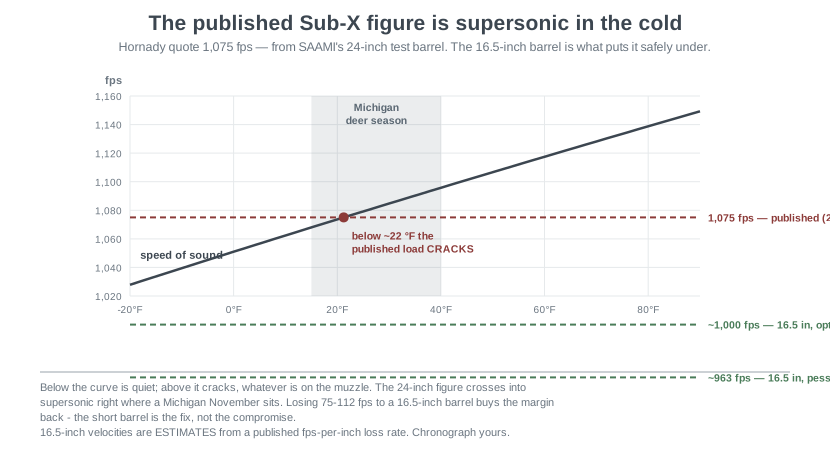
Michigan’s firearm deer season is 15–30 November. Mornings in the twenties are ordinary. The number a load must stay under in the field is therefore about 1,075–1,085 fps, not 1,126.
6.2 🔴 The Published Sub-X Figure Is Supersonic in the Cold
Hornady publish the 410 gr Sub-X at 1,075 fps.
The speed of sound at 20 °F is 1,074 fps.
The flagship subsonic .45-70 load, at its published velocity, is supersonic on a cold morning — by one foot per second at 20 °F, and by 24 fps at 0 °F.
That is not a defect in the ammunition and it is not a gotcha. It is what happens when a load is engineered to sit as close to the threshold as possible to maximise energy, and then tested at standard conditions in a 24-inch barrel — which, per Volume 5, is what SAAMI specifies and what nobody hunting with a carbine is using.
6.3 ⭐ And the Short Barrel Fixes It
Apply Volume 5’s factory loss rate — 10–15 fps per inch over 7.5 inches — and the same cartridge out of a 16.5-inch barrel leaves at an estimated 963–1,000 fps.
Table 2 — 6.3 ⭐ And the Short Barrel Fixes It
| Barrel | Est. muzzle velocity | 68 °F | 32 °F | 20 °F | 0 °F | −10 °F |
|---|---|---|---|---|---|---|
| 24 in (published) | 1,075 fps | ✅ | ✅ | 🔴 super | 🔴 super | 🔴 super |
| 16.5 in, optimistic | ~1,000 fps | ✅ | ✅ | ✅ | ✅ | ✅ |
| 16.5 in, pessimistic | ~963 fps | ✅ | ✅ | ✅ | ✅ | ✅ |
The short barrel is what makes this ammunition do what the box says, in the conditions it will actually be hunted in.
It is worth being careful about how strong a claim that is. The 963–1,000 fps figure is an estimate, derived by applying a published loss rate to a published velocity. It is not a measurement. But the direction is not in doubt, the magnitude is well supported by multiple independent chronograph reports, and even the most conservative end of the loss range (10 fps/in, giving 1,000 fps) puts the load safely under the threshold at −10 °F with 39 fps to spare.
6.4 The Mirror Image, and Why It Matters
The Henry SPD HUSH dive contains the opposite finding for the same rifle in a different chambering, and the two belong side by side:
Table 3 — The [Henry SPD HUSH](/actual-firearms/rifles/henry-spd-hush/) dive contains the opposite finding for the same rifle in a different chambering, and the two belong side by side
| .45 Colt (HUSH dive, Vol 5) | .45-70 (this dive) | |
|---|---|---|
| Published velocity from | a revolver | a 24-inch rifle |
| What the HUSH’s barrel does | adds ~200 fps | subtracts ~75–112 fps |
| Effect on a “subsonic” load | pushes it over the line | keeps it under the line |
| Verdict | ⚠ verify before trusting the box | ✅ better than the box |
Same rifle. Same barrel length. Opposite outcomes. The variable is whether the powder had finished burning by the time the bullet reached 16.5 inches — and for a pistol cartridge in a rifle barrel it emphatically had not, while for a low-pressure .45-70 it had.
⭐ The general rule, which is the useful thing to take away: a published velocity is a measurement made in a specific barrel, and moving to a different barrel can push a load in either direction. “Naturally subsonic” is a property of a load, in a barrel, at a temperature — never of a cartridge.
6.5 What Still Has to Be Measured
Two numbers decide whether your rifle is quiet, and both are yours:
- Your actual muzzle velocity with your chosen load, out of your barrel.
- The air temperature when you shoot it.
Neither is printed anywhere. Chronographing one box of ammunition takes twenty minutes and converts this entire volume from a well-supported estimate into a fact about your rifle.
If you can only test in warm weather, subtract: the threshold falls about 50 fps between 68 °F and 20 °F, so leave at least that much margin.
6.6 The Other Half of Quiet
Subsonic gets you past the crack. Two smaller factors decide how well the can does its remaining job, and the .45-70 is favourably placed on both:
Gas volume. A suppressor works better with less total gas to handle. Subsonic .45-70 uses small charges of fast powder, so there is comparatively little of it — one reason the cartridge suppresses better than its bore size suggests.
Powder selection. The subsonic handloading literature is consistent that fast, bulky, clean-burning powders — Trail Boss, Unique, Vihtavuori N32C — are what work down here, and that slow rifle powders are doubly wrong: they need more charge and they burn dirtier in the can.
A published handload reference point worth having: 405 gr with 13 gr of Trail Boss, chronographed at 1,010 fps from a 16-inch barrel — essentially this rifle, and comfortably subsonic even at 0 °F.
6.7 Bibliography
- Speed-of-sound values computed from c = 49.02 √T (T in °R), the standard dry-air relation.
- Hornady product data, 45-70 Government 410 gr Sub-X Subsonic — 1,075 fps published, G1 BC 0.285, SD 0.279.
- Barrel-length loss rates as sourced in Volume 5 (Marlin Owners and Shooters Forum chronograph reports).
- Marlin Owners, “45-70 subsonic loads and molds”; xxlreloading .45-70 Govt CIP subsonic load data — the 405 gr / 13 gr Trail Boss / 1,010 fps from 16 in reference, and powder-selection guidance.
- Michigan Department of Natural Resources, 2026 Deer Hunting Regulations Summary — firearm season dates.
- The mirror-image .45 Colt finding: Henry SPD HUSH, Volume 5.
- Blast-versus-crack mechanism: How Suppressors Work.
Comments (0)