The .45-70 Government · Volume 12
Terminal Performance by Species
Volume 7 said the suppressed .45-70 works to about 100–125 yards. This volume is about what it does when it arrives, and about the one choice that matters more than any other.
12.1 🔴 Energy Thresholds Do Not Work Here
You will find tables asserting minimum energy for each species — 1,000 ft-lb for deer, 1,500 for black bear, and so on. Do not use them for this cartridge.
Those figures were derived from expanding bullets at high velocity, where the wound mechanism is energy transfer: the bullet arrives fast, expands violently, and dumps kinetic energy into tissue. Energy is a reasonable proxy for effect in that regime.
A 410-grain .458 bullet arriving at 920 fps does not work that way. It kills by cutting a large permanent hole and continuing through, using momentum and frontal area. Its 771 ft-lb at 100 yards would, by the tables, disqualify it for deer. In practice it is decisively effective on deer, and reported effective on black bear.
⭐ The honest framework at subsonic velocity is:
Frontal area × penetration depth, not kinetic energy.
A .458 bullet makes a 0.165 square inch hole before any expansion at all — 1.6 times a .357’s frontal area, and 2.2 times a .308’s. That is guaranteed by the bore, not contingent on the bullet performing. It is the whole reason big slow bullets work.
12.2 The Real Decision: Expansion or Penetration
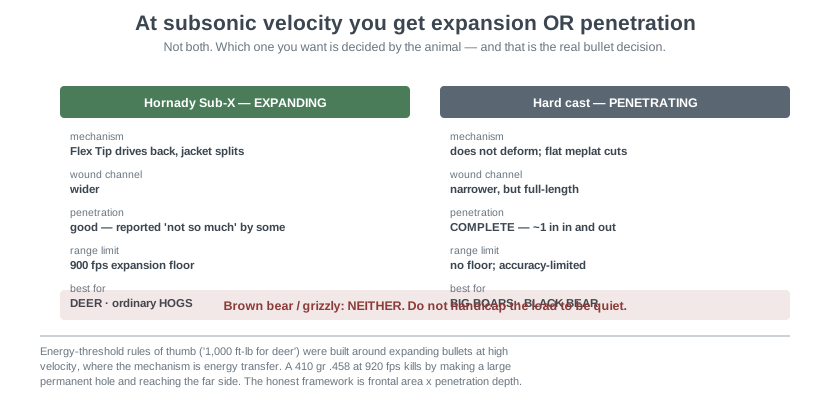
At 900–1,000 fps there is not enough velocity to do both well, and the two available bullet types sit at opposite ends:
Table 1 — At 900–1,000 fps there is not enough velocity to do both well, and the two available bullet types sit at opposite ends
| Hornady Sub-X (expanding) | Hard cast (Garrett, Steinel, Buffalo Bore) | |
|---|---|---|
| Mechanism | Flex Tip drives back, jacket splits, bullet opens | Does not deform; wide flat meplat cuts |
| Wound channel | Wider | Narrower, but full-length |
| Penetration | Good — but reported “not so much” by subsonic users | Complete. Reported entrance and exit ~1 in, zero meat loss |
| Range limit | 🔴 Expansion floor at 900 fps (Vol 7) | No expansion to lose; limited by accuracy |
| Bone and barriers | Adequate | ”Cuts through bone, brush and barriers alike” |
| Weight available | 410 gr | 405–777 gr — ⚠ see Volume 11 |
Neither is the right answer in general. The animal decides.
12.3 Whitetail Deer — ✅ Excellent
Load: Hornady 410 gr Sub-X. Range: inside 125 yards; 100 comfortable.
This is the application the suppressed .45-70 is best at, and it is not marginal. At 100 yards the bullet arrives at 920 fps with 771 ft-lb, well above its 900 fps expansion threshold, through .458 inches of frontal area before it opens at all.
Deer are not hard to kill and they are not hard to penetrate. Expansion is worth more than extra penetration here — you are not short of the latter — so Sub-X is the correct choice over hard cast.
Reported field experience with subsonic .45-70 in the 300–405 grain class under 1,200 fps is consistent: animals typically run about 30 yards before bleeding out, which is unremarkable for any well-placed hunting round.
The 100-yard zero from Volume 8 makes this a dead-hold rifle across the whole range band, which matters more for clean kills than any amount of extra energy.
12.4 Hog — ✅ Excellent, and Arguably the Best Fit
Load: Sub-X for ordinary hogs; hard cast for big boars. Range: inside 125; reports cluster much closer.
Hogs suit this cartridge better than anything. They are shot in thick cover at short range, often at night, frequently in groups — and the suppressor’s real advantage on hogs is not stealth from the animal but the ability to shoot again, plus not deafening yourself doing it.
A wide flat .458 meplat is close to ideal on hogs: it cuts rather than slips, and it puts a large hole through the shoulder shield that stops lesser bullets.
Reported experience: hogs under 200 lb are effectively taken inside 75 yards. That is well within everything Volumes 7 and 8 establish.
⚠ For big boars, consider hard cast. A mature boar’s shoulder shield is genuinely tough, and this is a case where guaranteed penetration beats a wider wound channel. 405–420 grain hard cast, not the heavy stuff — Volume 11.
12.5 Black Bear — ✅ At Modest Range, With the Right Bullet
Load: ⚠ hard cast, not Sub-X. Range: close — call it inside 75 yards.
Hornady rate the 410 gr Sub-X for “medium game such as deer, wild hogs, and most black bear at modest range,” so the expanding bullet is not disqualified.
But hard cast is the better choice, and the reasoning is about failure modes rather than averages. A black bear is heavier-boned than a deer, sometimes shot at close range from an awkward angle, and a bear you have wounded is a materially different problem from a deer you have wounded. The subsonic user’s report that Sub-X shows “good expansion but penetration not so much” is exactly the wrong failure mode to accept on an animal where you need to reach the vitals through heavy structure from whatever angle you are given.
Hard cast gives up the wider wound channel and buys complete penetration. On black bear that is the correct trade.
12.6 🔴 Brown Bear and Grizzly — No
Not with subsonic ammunition. Not at any range.
This is the one place in the dive with a flat prohibition. Full-power .45-70 with heavy hard cast is a legitimate and widely used big-bear cartridge — that is what Garrett’s 420 gr Hardcast and Buffalo Bore’s magnum loads exist for. Subsonic .45-70 is a different cartridge in every way that matters: roughly a third of the energy, a third of the penetration margin, and a trajectory that punishes any range misjudgement.
If the animal can kill you, do not handicap the load to be quiet. Put full-power ammunition in it and wear hearing protection.
12.7 The Summary Table
Table 2 — 12.7 The Summary Table
| Species | Verdict | Bullet | Practical range |
|---|---|---|---|
| Whitetail deer | ✅ Excellent | 410 gr Sub-X | 100 yd; 125 ceiling |
| Hog (< 200 lb) | ✅ Excellent | 410 gr Sub-X | Reports cluster inside 75 yd |
| Hog (big boar) | ✅ Good | ⚠ 405–420 gr hard cast | Inside 75 yd |
| Black bear | ✅ Modest range | ⚠ hard cast | Inside 75 yd |
| Brown bear / grizzly | 🔴 No | Full-power only | n/a |
| Elk / moose | ⚠ Not evaluated | — | See below |
⚠ Elk and moose are deliberately blank. No body of reported subsonic .45-70 experience could be found on either, and they are large enough that extrapolating from black bear would be guessing. Full-power .45-70 is a well-established moose cartridge; no range can responsibly be put on the subsonic version.
12.8 Shot Placement Matters More Than Usual
One consequence of the momentum-and-frontal-area mechanism deserves stating plainly.
A subsonic bullet is less forgiving of marginal placement than a fast expanding one. A high-velocity bullet’s temporary cavity and energy transfer buy some margin on a slightly-off shot. A slow heavy bullet does almost exactly what its path says it does — it makes a hole where it goes and keeps going.
That cuts both ways, and mostly in your favour: the wound is predictable, penetration is reliable, and meat damage is minimal (the hard-cast report of “zero meat loss” is a genuine advantage). But it means the shot has to be right, and the fact that this is a 100-yard rifle with a dead-hold trajectory is exactly what makes that achievable.
12.9 Bibliography
- Hornady product data, 45-70 Government 410 gr Sub-X Subsonic — expansion to 900 fps, FBI protocol, and the “deer, wild hogs, and most black bear at modest range” application statement.
- Marlin Owners, “45-70 suppressed/subsonic hunting results”; Accurate Shooter, “45-70 subsonic Hunting”; Rokslide, “Subsonic hunting & cartridges” — field reports including the 405 gr hard cast complete-penetration result (~1 in entrance and exit, zero meat loss), the ~30 yd recovery distance, and the hogs-under-200-lb-inside-75-yd observation.
- Silencer Shop, “Subsonic Ammunition Guide” — heavy-bullet momentum rationale for suppressed hunting.
- Steinel Ammunition and Garrett Cartridges hard-cast product material — penetration and terminal-stability claims.
- Frontal-area and sectional-density figures computed from nominal bullet diameters; velocity and energy at range per the model documented in Volumes 7 and 8.
- Buffalo Bore .45-70 magnum and Garrett 420 gr Hardcast product pages — the full-power big-bear context in § 12.6.
Comments (0)