The .45-70 Government · Volume 7
The Expansion Floor — Where the Range Actually Ends
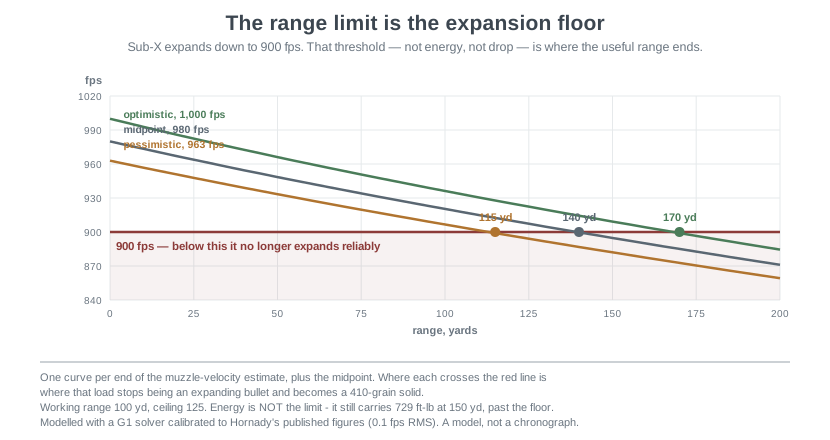
Ask how far a suppressed .45-70 is good for and you will get answers between 75 and 200 yards, all confidently stated. This volume works out the actual limit, and it turns out to be set by something most of those answers never mention.
7.1 Three Candidate Limits
Any hunting cartridge’s effective range is the shortest of three distances:
- Where you can hit — precision and drop management.
- Where you still have energy — enough to do the work.
- Where the bullet still performs — where it stops expanding, or stops penetrating.
For most modern rifle cartridges the binding limit is (1) or (2). For subsonic .45-70 it is (3), and by a wide margin.
7.2 The Number Hornady Publishes
The Sub-X bullet is built for low-velocity expansion: a polymer Flex Tip seated over a large hollow cavity, with long grooves cut in the gilding-metal jacket. On impact the tip is driven back into the cavity and forces the grooved jacket to split open.
Hornady rate it to expand reliably at impact velocities as low as 900 fps. The bullet meets FBI protocol for terminal ballistic testing.
900 fps is therefore the number that ends the useful range, because below it you no longer have an expanding bullet — you have a 410-grain solid, which behaves very differently and was not what you selected.
7.3 How the Numbers Were Derived
A G1 point-mass trajectory solver was written for this dive and calibrated against Hornady’s own published data for this exact load:
Table 1 — A G1 point-mass trajectory solver was written for this dive and calibrated against Hornady's own published data for this exact load
| Published | Model | |
|---|---|---|
| Muzzle (24 in) | 1,075 fps | 1,075 fps |
| 100 yd | 992 fps | 992 fps |
| 300 yd | 879 fps | 879 fps |
A single drag-scale constant reproduces both downrange points to 0.1 fps RMS. That is strong evidence the G1 curve shape is right for this bullet and only the scale needed fitting — so extrapolating the same model to a different muzzle velocity is defensible.
⚠ It is still a model. Everything below is a calculation, not a chronograph, and it inherits Volume 5’s estimate for what a 16.5-inch barrel produces.
7.4 Where the Floor Falls
Modelled from 980 fps at the muzzle — the midpoint of Volume 5’s 963–1,000 fps estimate:
Table 2 — Modelled from 980 fps at the muzzle — the midpoint of Volume 5's 963–1,000 fps estimate
| Range | Velocity | Energy | Expands? |
|---|---|---|---|
| 0 | 980 fps | 874 ft-lb | ✅ |
| 25 | 964 | 846 | ✅ |
| 50 | 949 | 819 | ✅ |
| 75 | 934 | 795 | ✅ |
| 100 | 920 | 771 | ✅ |
| 125 | 907 | 750 | ✅ barely |
| 150 | 895 | 729 | 🔴 no |
| 175 | 883 | 710 | 🔴 no |
| 200 | 871 | 691 | 🔴 no |
And bracketed across Volume 5’s full estimate range:
Table 3 — And bracketed across Volume 5's full estimate range
| Muzzle velocity | Crosses 900 fps at |
|---|---|
| 1,000 fps (optimistic) | ~168 yd |
| 980 fps (midpoint) | ~139 yd |
| 963 fps (pessimistic) | ~113 yd |
7.5 The Answer
Working range: 100 yards. Ceiling: 125 yards. Beyond that you are shooting a solid, whether you meant to or not.
Hold to 100 as the number to plan around, for three reasons:
The bracket is wide and its lower end is 113 yards. Until somebody chronographs this load out of a 16.5-inch barrel, the honest answer spans fifty-five yards — 113 to 168. Planning to the pessimistic end costs nothing.
Expansion “at 900 fps” is a threshold, not a cliff edge with a guarantee above it. Performance degrades approaching it. A bullet arriving at 905 fps is not doing what a bullet arriving at 980 fps does.
Field conditions push the wrong way. Cold air is denser and increases drag, so a November bullet sheds velocity slightly faster than the standard-conditions model says. The same cold that helps you stay subsonic (Volume 6) hurts you slightly here. Both effects are small; both point the same direction as caution.
7.6 What Is Emphatically Not the Limit
Energy is not the limit. At 150 yards — past the expansion floor — the load still carries 729 ft-lb. That is more than a .357 Magnum carbine produces at the muzzle. You run out of bullet performance long before you run out of energy, which is exactly backwards from most cartridges and is why energy-threshold tables mislead here. Volume 12 develops that.
Drop is not the limit either. With a 100-yard zero the path stays inside ±5 inches from the muzzle to 110 yards — a dead-hold window covering the entire useful range. Drop only becomes awkward at 150 and beyond, which is past the floor anyway. Volume 8 has the tables.
So both of the things people normally worry about are non-issues inside the range where this load works, and the thing that actually stops you is a bullet-construction threshold printed in small type on the manufacturer’s website.
7.7 If You Want More Range
Three options, in order of preference:
Shoot supersonic. The obvious answer, and it costs you the entire point of the suppressor. Hornady’s 325 gr FTX carries 1,403 ft-lb to 200 yards and drops 12.7 inches doing it. A completely different rifle — comfortable rather than quiet.
Use a hard-cast subsonic instead. A non-expanding bullet has no expansion floor to fall below, so its limit becomes penetration and accuracy rather than terminal upset. This genuinely extends useful range for penetration-first applications, and Volume 12 covers when that is the right choice. ⚠ It also brings the twist question in Volume 11 with it, because hard-cast subsonic loads trend heavy.
Accept 100 yards. Which, for a suppressed lever gun in thick country hunting deer and hogs, is not a limitation at all. It is the distance the rifle was going to be used at regardless.
7.8 Bibliography
- Hornady product data, 45-70 Government 410 gr Sub-X Subsonic — G1 BC 0.285, SD 0.279, published velocities 1,075 / 992 (100 yd) / 879 (300 yd) fps, expansion rated to 900 fps impact, FBI protocol compliance.
- Ultimate Reloader, “Hornady 410 Grain Sub-X .45-70 Hunting Rounds”; American Rifleman, “Review: Hornady Super Subsonic Hunting Loads” — Sub-X construction and low-velocity expansion design.
- Trajectory figures: G1 point-mass solver written for this dive, calibrated to the published data above (single drag-scale constant, 0.1 fps RMS against both downrange points). Muzzle velocity for the 16.5-inch barrel per Volume 5’s estimate.
- Barrel-length loss rates as sourced in Volume 5.
Comments (0)