The .45-70 Government · Volume 3
The Cartridge Itself — What SAAMI Actually Specifies
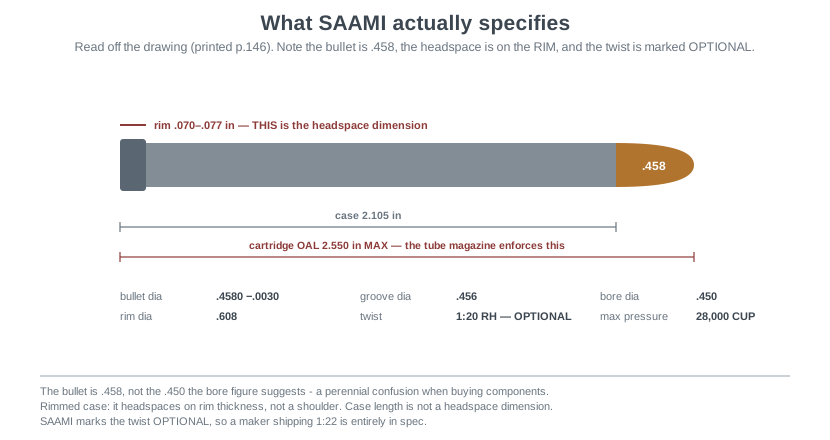
Almost everything written about the .45-70 online is downstream of somebody else’s summary. The actual specification is a published standard, and the project holds a copy — ANSI/SAAMI Z299.4-2015, in the Reference Library. This volume reads the numbers off the drawing.
Two of them are not what most people expect.
3.1 The Dimensions
From the cartridge and chamber drawing, printed page 146:
Table 1 — From the cartridge and chamber drawing, printed page 146
| Dimension | Value (in / mm) |
|---|---|
| Bullet diameter | .4580 −.0030 (11.633 −0.076) |
| Rim diameter | .608 −.010 (15.44 −0.25) |
| Rim thickness | .070 −.010 (1.78 −0.25) |
| Case head diameter | .5055 △ (12.840) |
| Base body diameter | .5039 (12.799) |
| Case mouth | .4800 △ (12.192) |
| Case length | 2.105 −.020 (53.47 −0.51) |
| Cartridge overall length | 2.490 MIN / 2.550 MAX (63.246 / 64.77) |
| Bore diameter | .450 (11.43) |
| Groove diameter | .456 (11.58) |
| Grooves | 6, .141 +.002 wide |
| Chamber headspace | .070 MIN / .077 MAX |
The bullet is .458, not .450 — a distinction that matters when you are buying components, and the source of a perennial confusion with the .450 bore figure. Groove diameter is .456 and the bullet is .458, giving the usual two-thousandths of interference that makes a gas seal.
3.2 The Rim Is the Headspace
The ⊗ symbol on a SAAMI drawing marks the headspace dimension, and on the .45-70 it sits on the rim thickness: .070–.077 inches.
This is a rimmed cartridge. It headspaces on the rim, seated against the barrel’s breech face — not on a shoulder, not on the case mouth, not on a belt. That has three practical consequences worth knowing:
- Case length is not a headspace dimension. Trimming affects chambering and crimp, not headspace.
- Rim thickness variation across brands is a real, if small, source of ignition inconsistency, because it changes how far the case sits from the breech face.
- It is the most forgiving headspace arrangement there is, which is part of why 130-year-old rifles still function. The full treatment of what a headspace number means and how to measure one is in the Headspace dive; this is just where the .45-70’s lives.
3.3 🔴 The Twist Is Marked “OPTIONAL”
The chamber drawing specifies TWIST 20 (508) RH — and immediately beneath it, the word OPTIONAL.
SAAMI does not mandate a rifling twist for the .45-70 Government. 1:20 is the reference figure, used in the test barrel, and makers are free to depart from it.
This matters directly. Henry’s SPD HUSH uses 1:22, and that has been described — including in earlier writing on that rifle in the sibling dive — as “slower than the norm,” with the implication that it deviates from a standard. It does not. There is no standard to deviate from. A maker choosing 1:22 is exercising a latitude the specification explicitly grants.
That does not make the twist question go away. A slower twist still spins a given bullet more slowly, and at subsonic velocity there is not much spin to spare — Volume 11 works that through properly, and the conclusion there is unchanged. But the framing matters: this is a design choice with consequences, not a rifle that is out of spec.
3.4 The Overall-Length Limit Nobody Cites
Maximum cartridge overall length: 2.550 inches.
For a single-shot rifle this is nearly academic — you can seat long and let the bullet jump. For a tube-magazine lever action it is absolute, because the cartridge has to fit the carrier and stack in the tube.
The consequence shows up in Volume 11 and it is not obvious: very heavy bullets are long bullets. Seating a 500-grain-plus projectile inside 2.550 inches drives it deep into the case and eats the powder space you need to push it. So a tube-fed lever gun has two independent ceilings on bullet weight — the twist, and the overall length — and they are not the same limit. Most discussions of heavy subsonic .45-70 mention neither.
3.5 The Test Barrel — Read This Before Any Velocity Table
The standard specifies the reference velocity and pressure test barrel on printed page 342:
24.000 ± .010 inches, 1:20 RH twist, 6 grooves, bore .450, groove .456.
🔴 Every velocity figure published for this cartridge by every manufacturer is measured in a 24-inch barrel, unless the box explicitly says otherwise.
If you are shopping for a 16.5-inch carbine, every number you are reading was produced by a barrel seven and a half inches longer than the rifle you are considering. Volume 5 quantifies what that costs, and Volume 6 explains why — for the suppressed use of this cartridge — it turns out to be an advantage rather than a penalty.
3.6 One Maximum, in CUP
The standard publishes a single maximum average pressure for the .45-70 Government: 28,000 CUP.
Not three. One.
Everything else you will read — Trapdoor loads, lever-action loads, Ruger No. 1 loads — is a convention that grew up outside the standard to describe ammunition that is, in two cases out of three, above it. That is Volume 4, and it is the most safety-relevant thing in this dive.
3.7 Bibliography
- ANSI/SAAMI Z299.4-2015, Voluntary Industry Performance Standards for Pressure and Velocity of Centerfire Rifle Ammunition. Cartridge and chamber drawing, printed p.146 (PDF p.158). .45-70 Government V&P test barrel drawing, printed p.342 (PDF p.354). Held in the project’s Reference Library; read as page images, because the columnar tables do not survive text extraction.
- Drawing conventions per the standard’s own legend: B = basic, △ = reference dimension, ⊗ = headspace dimension, dimensions to intersections of lines, all calculations at maximum material condition.
- Cross-reference: the Headspace dive, built on the same standard, for what a headspace dimension means and how to measure one.
Comments (0)