The .45-70 Government · Volume 4
The Three Pressure Tiers, and Why SAAMI Publishes One
This is the volume that can hurt you. Everything else in this dive is about performance; this one is about not destroying a rifle or a hand.
4.1 The Standard Says One Number
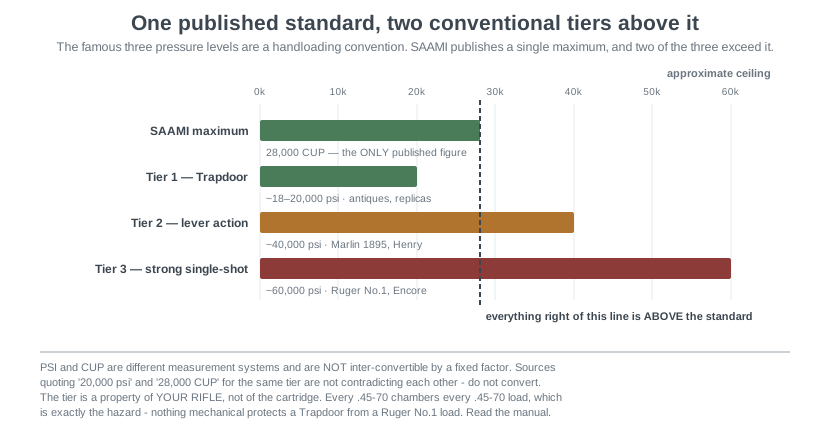
ANSI/SAAMI Z299.4-2015 publishes a single maximum average pressure for the .45-70 Government: 28,000 CUP.
That is the whole specification. There is no tiered SAAMI standard, no “SAAMI +P” for this cartridge, and no official sanction for anything above that figure.
Every box of ammunition marked as SAAMI-compliant is loaded to that ceiling or below, and that ammunition is safe in any .45-70 in sound condition, including an original Trapdoor. This is the entire reason the standard exists: it is the guarantee that lets a 150-year-old rifle and a 2026 rifle share a cartridge name.
4.2 The Three Tiers Are a Convention
What you will actually encounter, in every loading manual and on every boutique ammunition site, is a three-level scheme:
Table 1 — What you will actually encounter, in every loading manual and on every boutique ammunition site, is a three-level scheme
| Tier | Ceiling (as usually quoted) | Intended platforms |
|---|---|---|
| 1 — “Trapdoor” | ~18,000–20,000 psi | Original Springfield Trapdoors, antiques, replicas, anything weak or unknown |
| 2 — “Lever action” | up to ~40,000 psi | Modern Marlin 1895, Henry, other strong repeaters |
| 3 — “Strong single-shot” | up to ~60,000 psi | Ruger No. 1 / No. 3, T/C Encore, Siamese Mauser |
🔴 Tiers 2 and 3 are above the SAAMI maximum. They are not grades within a standard. They are a handloading and specialty-ammunition convention, built on the observation that certain actions demonstrably tolerate far more than the standard allows — and the standard cannot raise its ceiling, because the installed base includes rifles from 1873.
Reputable manuals separate their .45-70 data into clearly labelled sections by platform for exactly this reason. The tier is a property of your rifle, not of the cartridge.
4.3 ⚠ The PSI-versus-CUP Trap
You will see the same tier quoted as “20,000 PSI” and as “28,000 CUP”, and conclude that one of your sources is wrong.
Neither is. They are different measurement systems.
- CUP (Copper Units of Pressure) is a crusher measurement: a calibrated copper cylinder is compressed by the firing event and its deformation read against a table.
- PSI here means a piezoelectric transducer measurement — the method the SAAMI test barrel in Volume 3 is built for, with its .250-inch transducer and .206-inch piston hole.
🔴 There is no fixed conversion factor between them. The relationship varies by cartridge, by pressure level, and by pressure-curve shape. A cartridge can read higher in one system and lower in another than a simple ratio would suggest. Any source that hands you a single multiplier is overselling.
So: do not convert, and do not treat a PSI figure and a CUP figure as directly comparable. Note which system a number is in and compare like with like. Where this dive quotes 28,000 CUP, it is because that is the unit the standard uses.
4.4 What This Means for a Henry SPD HUSH
Direct, because the HUSH is the worked example throughout this dive.
Buy standard-pressure ammunition unless Henry’s manual for that specific model says otherwise.
The evidence around Henry rifles and high-pressure .45-70 is genuinely mixed, and it is set out in full here rather than trimmed to the most convenient answer:
- Buffalo Bore has publicly supplied .45-70 Magnum ammunition to a Henry brass lever action, with the maker describing it as able to handle the higher pressures.
- Hornady rate the .45-70 in modern lever rifles to 40,000 CUP.
- Other published guidance holds modern lever actions to the SAAMI figure.
🔴 None of that is a statement about the HUSH. It is a new platform on Henry’s large-frame action with a carbon-fibre-wrapped barrel, and the authority on what it may be fed is the manual in the box. Inferring a pressure rating from what a different Henry model tolerated is exactly the reasoning that damages rifles.
If the manual says standard pressure, that is not a limitation worth mourning. Volume 10 shows that the entire suppressed subsonic case is built on low-pressure ammunition anyway — the loads this rifle is actually for sit far below any of these ceilings.
4.5 The Brands That Sell Above the Standard
Three names come up constantly in “best .45-70 ammo” lists, and all three build their reputation on ammunition above SAAMI:
- Buffalo Bore — publishes explicit tiers, including a standard-pressure line described as safe in any sound .45-70, plus mid-range and magnum offerings. The tiering is honest and clearly labelled; read it.
- Garrett Cartridges — hard-cast dangerous-game loads, the 420 gr Hardcast being the best known.
- Underwood — high-performance loadings across the board.
These are excellent products and they are platform-specific ammunition. A “best .45-70 ammo” list that does not tell you which action a load belongs in is not giving you a recommendation; it is giving you a hazard sorted by muzzle energy.
⚠ Recoil deserves a mention here too. The HUSH is a 6.7-pound rifle. Magnum-tier .45-70 out of a rifle that light is genuinely punishing, and — separately from the pressure question — it is not ammunition anyone shoots well. Volume 9 covers what to hunt with; Volume 10 covers what to suppress with; neither answer is a magnum load.
4.6 The Rule
Match the tier to the action. When in doubt, standard pressure. The cartridge headstamp does not tell you what the rifle will take, and neither does the fact that it chambers.
Every .45-70 ever made will chamber every .45-70 load ever made. That is precisely the danger — there is no mechanical interlock protecting a Trapdoor from a Ruger No. 1 load, only the box label and the person reading it.
4.7 Bibliography
- ANSI/SAAMI Z299.4-2015 — the single published maximum average pressure for .45-70 Government, and the transducer-based V&P test-barrel specification (printed p.342).
- Buffalo Bore Ammunition, .45-70 product pages — the maker’s own three-tier presentation, including the standard-pressure line described as safe in any sound .45-70.
- Marlin Owners and Shooters Forum threads on .45-70 maximum pressure by platform — the origin and usage of the three-tier convention, and the Hornady 40,000 CUP figure for modern lever rifles.
- Barnes Reloading data, “.45-70 1895 Marlin” — an example of platform-segregated published load data.
- The Gun Zone, “Are Henry .45-70 rifles rated for Buffalo Bore ammo?”; AmmoLand, “Henry All Weather 45/70 Rifle Review” — the Henry/Buffalo Bore reporting, model-specific and not applicable to the HUSH.
- On CUP versus PSI: SAAMI’s own use of transducer measurement in the V&P specification; the absence of a published general conversion is itself the point.
Comments (0)