The .45-70 Government · Volume 11
Bullet Weight, Twist, and the Tube Magazine
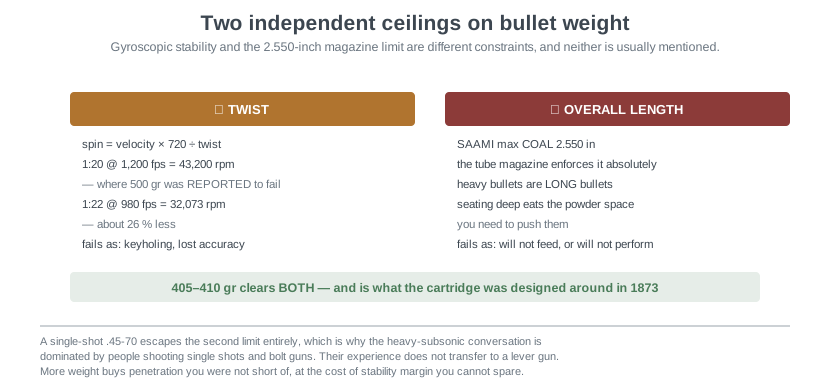
Subsonic shooting rewards heavy bullets. Everything in Volume 12 about penetration and momentum points toward buying the heaviest thing you can find.
Two independent limits stop you, and most discussions of heavy subsonic .45-70 mention neither.
11.1 Limit One: Going Subsonic Costs You Spin
A bullet is stabilised by spin, and spin comes from velocity:
spin (rpm) = velocity (fps) × 720 ÷ twist (inches per turn)
Halve the velocity in a given barrel and you halve the spin. The gyroscopic stability factor does not fall quite that fast — Miller’s rule carries a velocity correction of roughly (v ÷ 2800)^⅓ — but for .45-70 dropping from a supersonic 1,800 fps to a subsonic 980, that is about a 17 % loss of stability at the same twist.
A barrel cut for full-power hunting loads is being asked to work in a regime it was not chosen for. That is not a defect; it is a consequence of using one rifle for two very different jobs.
11.2 What the Evidence Actually Says
The published experience clusters around 1:20, which is SAAMI’s reference twist:
- 405-grain bullets stabilise without trouble at 1:20. This is the common, unremarkable case, and it is the weight the cartridge was designed around in 1873.
- A 500-grain cast bullet, by contrast, “hasn’t been able to stabilise in Marlins below about 1,200 fps.”
That second report is the useful one, because it gives a failure point with a velocity attached.
11.3 The Arithmetic for a 1:22 Barrel
Henry’s SPD HUSH is 1:22. Volume 3 established that this is entirely within spec — SAAMI marks the .45-70 twist “OPTIONAL” and mandates nothing. But slower is still slower:
Table 1 — Henry's SPD HUSH is 1:22. Volume 3 established that this is entirely within spec — SAAMI marks the .45-70 twist "OPTIONAL" and mandates nothing. But slower is still slower
| Configuration | Spin rate |
|---|---|
| 1:20 at 1,200 fps — the reported 500 gr failure point | 43,200 rpm |
| 1:20 at 980 fps — subsonic in a standard barrel | 35,280 rpm |
| 1:22 at 980 fps — the HUSH, subsonic | 32,073 rpm |
The HUSH at subsonic velocity spins a bullet about 26 % slower than the configuration in which a 500-grain bullet was already reported to fail.
11.4 🔴 What That Justifies, and What It Does Not
Precision matters here, because this is the one place in the dive where the evidence genuinely runs out and it would be easy to overclaim in either direction.
Justified:
- 405–410 grains is the weight the published evidence covers. It is what both major factory subsonic loads use, and it is the weight to buy.
- Steinel’s 730 gr and 777 gr subsonics are outside any published stability envelope for a 1:22 barrel at subsonic velocity. If you buy them, test for keyholing on paper before trusting them on game.
🔴 Not justified, and not claimed here:
- That those loads fail in this rifle. Nobody has published a 1:22 result with a 730-grain bullet. The arithmetic says the margin is thin; it does not say the answer.
There is a real difference between “outside what anyone has demonstrated” and “does not work,” and collapsing the two is how a reference document ends up confidently wrong. If you own this rifle and you test heavy subsonics in it, write the result down — it is a number that does not currently exist publicly.
11.5 Limit Two: The Magazine Tube Does Not Care About Twist
Even with a fast enough twist, a second limit binds, and it is absolute.
SAAMI maximum cartridge overall length: 2.550 inches. In a single-shot rifle you can ignore it and seat long. In a tube-fed lever action you cannot — the cartridge has to fit the carrier and stack in the tube.
The consequence is not obvious: heavy bullets are long bullets. A 730-grain .458 projectile is a substantial column of lead, and seating it to stay within 2.550 inches drives it deep into the case, displacing the powder space you need to push it.
So the tube-fed lever gun has two ceilings that are not the same limit:
Table 2 — So the tube-fed lever gun has two ceilings that are not the same limit
| Limit | Mechanism | Consequence of exceeding |
|---|---|---|
| Twist | Insufficient spin at subsonic velocity | Keyholing, lost accuracy |
| Overall length | 2.550 in max, enforced by the magazine | Will not feed; or seated so deep it will not perform |
A single-shot .45-70 escapes the second limit entirely, which is exactly why the heavy-subsonic conversation is dominated by people shooting single shots and bolt guns. Their experience does not transfer to a lever gun, and that is worth knowing before reading a forum thread as if it applied to your rifle.
11.6 The Third Constraint, Briefly: Bullet Nose
Cartridges in a tube sit nose-to-primer. A pointed bullet resting on the primer of the round ahead of it under recoil is a chain-fire hazard — the reason .45-70 has been a flat-nose cartridge for 150 years, and the reason its ballistic coefficients are historically dreadful.
Hornady’s Flex Tip solved it: a spire point with a soft elastomer tip that deforms harmlessly against the primer in the magazine and resumes shape in the chamber. It is the same technology that makes Sub-X expand at low velocity, doing a completely different job.
For subsonic use this constraint is nearly free. At 980 fps over 125 yards, ballistic coefficient is not what limits you, so a flat nose costs essentially nothing — and a wide flat meplat is desirable for terminal effect (Volume 12). The nose-shape limit only bites on supersonic loads, where BC actually matters.
11.7 The Practical Answer
Stay at 405–410 grains for a tube-fed 1:22 .45-70.
That weight is: the cartridge’s original design weight, what both factory subsonic loads use, inside the published stability evidence, comfortably within the overall-length limit, and — per Volume 12 — entirely sufficient for everything you would reasonably shoot with a suppressed .45-70.
The heavier bullets are not obviously better even if they stabilise. Volume 7 showed that terminal range is limited by the expansion floor, and Volume 12 argues that a 410-grain .458 already penetrates completely on the species in question. More weight buys penetration you were not short of, at the cost of stability margin you do not have to spare.
11.8 Bibliography
- ANSI/SAAMI Z299.4-2015 — maximum cartridge overall length 2.550 in; twist 1:20 RH marked OPTIONAL; V&P test barrel 24.000 in at 1:20.
- Marlin Owners, “45-70 subsonic loads and molds”; Accurate Shooter, “45-70 subsonic loads” — 405 gr stabilising unremarkably at 1:20, and the 500 gr RCBS cast bullet reported not stabilising in Marlins below approximately 1,200 fps.
- Cast Bullet Association and Sniper’s Hide subsonic-twist discussions — general subsonic stability guidance.
- Miller twist rule and its velocity correction term, as used throughout the subsonic handloading literature.
- Steinel Ammunition 730 gr WFN and 777 gr “Lucky Ram” subsonic product pages.
- Hornady LEVERevolution / FTX background; Wide Open Spaces and GunsAmerica coverage of the tubular-magazine chain-fire hazard and the elastomer-tip solution.
- Spin-rate figures computed as velocity × 720 ÷ twist; stability loss per the Miller velocity term.
Comments (0)