The .45-70 Government · Volume 10
Subsonic Ammunition — The Suppressed Shortlist
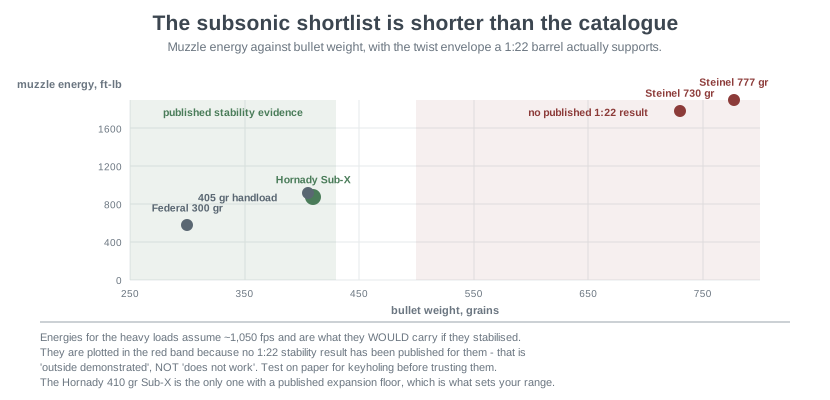
This is the volume the whole dive was written for: what to actually buy for a suppressed .45-70.
The answer is shorter than the catalogue makes it look, and the reasons some options drop out are more interesting than the recommendation itself.
10.1 The Field
Table 1 — 10.1 The Field
| Load | Bullet | Published vel. (24 in) | Est. 16.5 in | Notes |
|---|---|---|---|---|
| Hornady Subsonic 410 gr Sub-X | Flex Tip expanding | 1,075 fps | 963–1,000 | BC .285, SD .279, expands to 900 fps |
| Federal Subsonic 300 gr | Target soft point | 1,000 fps | ~890–925 | No published expansion floor |
| Steinel 405 gr RNFP | Cast, low recoil | subsonic | — | Conventional weight, in the twist envelope |
| Steinel 730 gr WFN | Hard cast | subsonic | — | ⚠ see § 10.4 |
| Steinel 777 gr “Lucky Ram” | Hard cast | subsonic | — | ⚠ see § 10.4 |
10.2 ⭐ The Recommendation: Hornady 410 gr Sub-X
This is the load. Buy this one.
It wins on every axis that matters and it is not close:
It is the only one with a published, engineered expansion threshold. Flex Tip over a large hollow cavity, grooved gilding-metal jacket, rated to expand at 900 fps impact, FBI-protocol tested. Volume 7 shows that threshold is your effective range — and a load without a published floor is a load whose range you cannot calculate at all.
It carries the most energy of any expanding subsonic option. 410 grains at an estimated 980 fps is 874 ft-lb at the muzzle, 771 at 100 yards — roughly 300 ft-lb more than the Federal 300 gr at every distance.
Its weight sits inside the twist envelope. 410 grains is essentially the classic 405-grain weight the cartridge was designed around and which Volume 11 shows is the weight the published stability evidence actually covers.
It is properly documented. Hornady publish BC, sectional density, velocities at range, and the expansion floor. That is what made Volume 7’s calculation possible. Most subsonic offerings publish a velocity and nothing else.
And it is genuinely quiet from this rifle. American Hunter’s HUSH test found subsonic loads “extremely quiet” with the “absence of the supersonic ‘crack’” — the difference Volume 6 is about.
10.3 The Runner-Up, and Why It Is Second
Federal Subsonic 300 gr is a real product and a reasonable choice, but it gives up a lot:
- ~300 ft-lb less at every range — 576 ft-lb at the muzzle against 874.
- No published expansion floor. It is described as a target soft point, which is a different design brief from Sub-X’s hunting-specific low-velocity expansion. Without a published threshold you cannot calculate an effective range, and it should not be used on game without a wet-media test of your own.
- Lower sectional density — 300 gr in .458 gives roughly 0.204, against Sub-X’s 0.279.
Where it earns its place: practice and recoil. It is milder, and if the job is putting rounds through a suppressor on paper or steel, it does that for less money and less punishment. Just do not confuse a target subsonic with a hunting subsonic.
10.4 ⚠ The Heavy Hard-Casts — Outside Published Support
Steinel’s 730 gr WFN and 777 gr “Lucky Ram” are the heaviest subsonic .45-70 loads on the market, and they are genuinely interesting: enormous momentum, complete penetration, no expansion to fail.
They are not recommended for the HUSH, and the reason needs stating precisely — because it is not that they do not work.
Volume 11 does the arithmetic. In short: the HUSH is 1:22, which at subsonic velocity turns a bullet roughly 26 % slower than the 1:20-at-1,200-fps configuration where a 500-grain cast bullet was reported failing to stabilise. A 730-grain bullet is heavier still, and heavier means longer.
🔴 What that justifies: these loads are outside any stability envelope anyone has published for a 1:22 barrel at subsonic velocity, and they are not a sight-unseen purchase for a new rifle.
🔴 What it does not justify, and what is not claimed here: that they fail. Nobody has published a 1:22 HUSH result with a 730-grain bullet. The arithmetic says the margin is thin. It does not say the answer. If you buy them, shoot them at paper at 50 yards and look for keyholing before trusting them — and if you do, that result is a number the internet does not currently contain.
⚠ A second constraint applies independently of twist: SAAMI’s maximum cartridge overall length is 2.550 inches and a tube magazine enforces it absolutely. Very heavy bullets are long, so seating them within that limit drives them deep into the case. See Volume 11.
10.5 Handloading
The published reference point worth having, because it is almost exactly this rifle:
405 gr cast over 13 gr of Trail Boss — 1,010 fps from a 16-inch barrel.
Comfortably subsonic even at 0 °F. If you handload, this is the known-good starting point, and Volume 6 explains why the powder choice is not incidental: fast, bulky, clean-burning powders — Trail Boss, Unique, Vihtavuori N32C — are what work at these charge weights. Slow rifle powders are wrong twice, needing more charge and burning dirtier in the can.
⚠ Cast bullets foul a suppressor faster than jacketed or coated ones. Lead fouling in a can is cumulative and tedious to remove. If you shoot volume through a suppressor, that is an argument for the jacketed Sub-X over cast alternatives that has nothing to do with terminal performance.
10.6 The Shortlist
Hunting, suppressed: Hornady 410 gr Sub-X. One load, and it is not a close call.
Practice, suppressed: Federal 300 gr subsonic, or handloaded 405 gr cast if you reload.
Deep penetration on heavy game: hard cast — but at 405–420 grains, not 730. Volume 12 covers when penetration beats expansion.
Everything above 500 grains: unproven in a 1:22 barrel. Test before trusting.
10.7 What Still Needs Measuring
Everything in this volume rests on Volume 5’s estimate that a 16.5-inch barrel produces 963–1,000 fps. That estimate brackets the effective range from 113 to 168 yards — a fifty-five-yard uncertainty on the single most practical question in the dive.
One box of Sub-X, one chronograph, one cold morning. That measurement collapses the bracket, fixes the effective range exactly, and confirms the subsonic margin at the temperature you actually hunt in. It is twenty minutes of work and, as far as can be found, nobody has published it.
10.8 Bibliography
- Hornady product data, 45-70 Government 410 gr Sub-X Subsonic — BC 0.285, SD 0.279, published velocities, 900 fps expansion threshold, FBI protocol; Ultimate Reloader coverage.
- SSUSA, “New: Federal Subsonic Rifle Target Loads”; The Firearm Blog, “Keep Quiet With New Federal Subsonic Loads” — the .45-70 300 gr target load at 1,000 fps.
- Steinel Ammunition .45-70 product pages — 405 gr RNFP subsonic, 730 gr WFN subsonic, 777 gr “Lucky Ram” subsonic.
- Marlin Owners, “45-70 subsonic loads and molds”; Accurate Shooter, “45-70 subsonic loads”; xxlreloading .45-70 Govt CIP subsonic load data — the 405 gr / 13 gr Trail Boss / 1,010 fps from 16 in reference, powder selection, and the 500 gr stability report underlying Volume 11.
- American Hunter, “Hardware Review: Henry SPD HUSH” — subsonic sound impressions with a Banish 46 V2.
- Barrel-length estimates per Volume 5; trajectory model per Volumes 7 and 8.
Comments (0)