The .45-70 Government · Volume 5
Barrel Length — The 24-Inch Problem
Volume 3 established the fact; this volume works out what it costs. It is the setup for Volume 6, which is where it stops being a cost.
5.1 The Fact
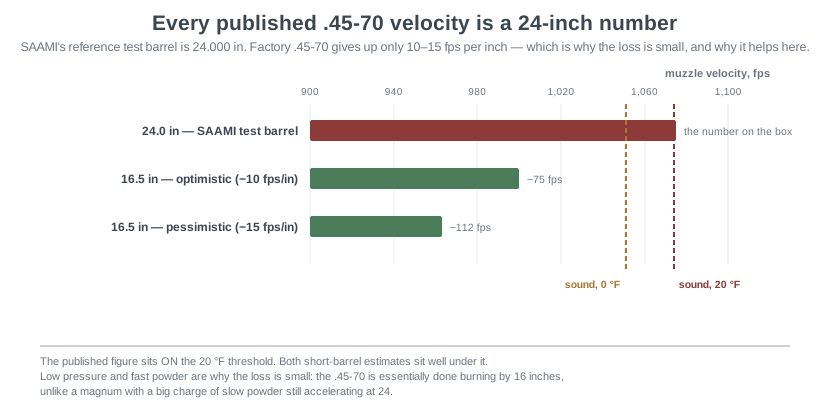
SAAMI’s velocity and pressure reference barrel for the .45-70 Government is 24.000 ± .010 inches, 1:20 twist. It is on printed page 342 of the standard and it is not ambiguous.
Manufacturers test to that specification. So the velocity printed on a box of .45-70 is a 24-inch number unless the box explicitly says otherwise — and boxes very rarely say otherwise.
The rifle used as the worked example — a Henry SPD HUSH — has a 16.5-inch barrel. That is a 7.5-inch deficit against every published figure.
5.2 What It Costs — and It Is Less Than You Think
The intuition is that a third of the barrel gone must cost a great deal of velocity. For this cartridge it does not, and the reason is worth understanding because it drives Volume 6.
Community chronograph work on .45-70 across barrel lengths is fairly consistent:
- 25–40 fps total between a 22-inch and an 18.5-inch barrel — about 10–15 fps per inch.
- 83 fps between a 26-inch and an 18.5-inch barrel at 1,400–1,500 fps — about 11 fps per inch.
- Factory ammunition loses little; hot handloads lose more — roughly 25 fps per inch for maximum charges, because there is more slow powder still burning.
Applied to the HUSH’s 7.5-inch shortfall:
Table 1 — Applied to the HUSH's 7.5-inch shortfall
| Ammunition type | Loss per inch | Loss over 7.5 in |
|---|---|---|
| Factory, standard pressure | 10–15 fps | 75–112 fps |
| Hot handloads, maximum charge | ~25 fps | ~190 fps |
Roughly 75 to 112 feet per second for factory ammunition. On a cartridge whose loads run from 1,000 to 2,000 fps, that is a few percent.
5.3 Why the Loss Is So Small
Three reasons, and they compound.
The .45-70 is a low-pressure cartridge. Peak pressure is reached and released early; there is less residual pressure left to keep accelerating the bullet in the last third of the barrel.
Its powders are fast. Standard-pressure loads use relatively quick-burning propellant that is largely finished well before 16 inches. A cartridge like a .300 Win Mag, with a huge charge of slow powder, is still accelerating hard at 24 inches and loses far more to a short barrel.
The bore is enormous. A .458 bore has a lot of cross-sectional area, so a given pressure produces a lot of force — but it also means the gas volume expands and its pressure drops quickly. The useful work happens early.
The community summary is exactly right: the .45-70’s loads are low velocity to begin with, and the difference made by a shorter barrel is nowhere near what it would be with a faster cartridge.
5.4 The Numbers That Matter Here
Applying the factory loss rate to the loads this dive cares about:
Table 2 — Applying the factory loss rate to the loads this dive cares about
| Load | Published (24 in) | Estimated (16.5 in) |
|---|---|---|
| Hornady 410 gr Sub-X subsonic | 1,075 fps | 963–1,000 fps |
| Federal 300 gr subsonic | 1,000 fps | ~890–925 fps |
| Federal 300 gr Fusion | ~1,850 fps | ~1,740–1,775 fps |
| Hornady 325 gr FTX LEVERevolution | ~2,050 fps | ~1,940–1,975 fps |
⚠ These are estimates, derived by applying a published loss rate to a published figure. Nobody has chronographed these loads out of a 16.5-inch HUSH and published the result. Every table downstream in this dive carries that caveat, and replacing it with a measurement is the single most useful thing an owner of this rifle could do.
5.5 What a Short Barrel Buys
The trade is not one-sided, and for this application the other side is substantial.
Length budget for the suppressor. A 16.5-inch barrel plus a 7-to-9-inch can lands around 41–43 inches overall — about the length of an ordinary 24-inch bolt-action deer rifle. Put the same can on a 24-inch .45-70 and you are past 49 inches, which is an unpleasant object in thick country. The Henry SPD HUSH dive does that arithmetic in detail.
Weight, and where it sits. Mass removed from the muzzle end is mass removed from the end of a lever, which is the whole balance argument for a suppressed rifle.
No meaningful loss of the thing you are buying. At the ranges Volume 7 establishes for suppressed use — inside 150 yards — 75 fps of muzzle velocity changes nothing about whether the shot works.
5.6 And the Part That Is Actually an Advantage
Here is the finding this dive is built on, stated once here and developed properly in Volume 6.
Hornady’s 410 gr Sub-X is published at 1,075 fps. The speed of sound at 20 °F is 1,074 fps.
Out of the 24-inch barrel it was tested in, the subsonic load is supersonic on a cold morning.
Out of a 16.5-inch barrel, at an estimated 963–1,000 fps, it is comfortably subsonic down past −10 °F.
🔴 The short barrel is not a compromise for this application. It is what makes the ammunition work as advertised.
That is the exact inverse of the trap in the Henry SPD HUSH dive’s .45 Colt chapter, where a carbine barrel makes a pistol cartridge faster and pushes a nominally subsonic load over the line. Both are true. The difference is whether the powder was still burning when the bullet reached the shorter barrel’s muzzle — and for a pistol cartridge in a rifle it emphatically was, while for a .45-70 at 16 inches it was not.
Barrel length is not a one-directional effect, and these two cartridges in the same rifle prove it.
5.7 Bibliography
- ANSI/SAAMI Z299.4-2015, .45-70 Government V&P test barrel drawing, printed p.342 — the 24.000 ± .010 in reference barrel.
- Marlin Owners forum, “How much does barrel length affect velocity in the 45/70?” and “45-70 barrel length”; Shooters Forum, “The long and short of 45/70 barrels” and “How much does barrel length effect 45-70 velocities? (up to 34”)” — community chronograph reports giving 10–15 fps/in for factory ammunition and ~25 fps/in for maximum handloads.
- Ballistic Studies, “.45-70 U.S. Government” — cartridge overview and velocity ranges.
- Hornady product data, 45-70 Government 410 gr Sub-X Subsonic — the 1,075 fps published figure.
- Speed-of-sound values as computed in Volume 6.
- Suppressed overall-length arithmetic: the Henry SPD HUSH dive, Volume 12.
Comments (0)