The .45-70 Government · Volume 13
Optics, and What to Actually Buy
The last volume. What to put on top of a suppressed .45-70 carbine, and then a straight answer to the decision a buyer of a suppressed .45-70 lever gun faces.
13.1 What the Ballistics Actually Ask For
Before any product names, the requirement falls out of Volumes 7 and 8:
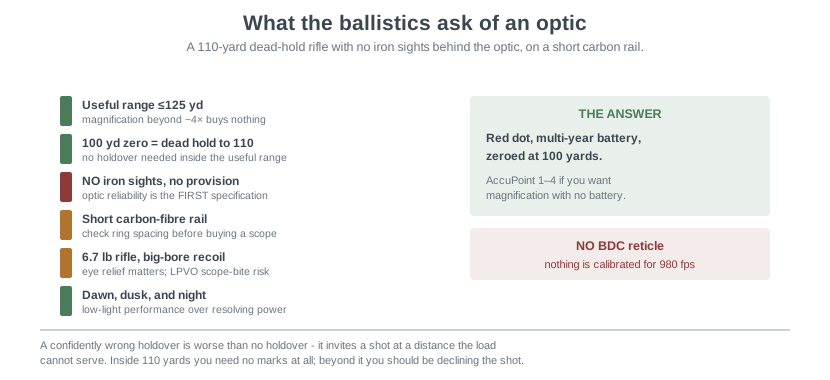
- Maximum useful range ~125 yards, working range 100.
- A 100-yard zero holds dead-on from the muzzle to ~110 yards. No holdover inside the useful range.
- Beyond that the drop is severe — and you should not be shooting there anyway.
- Low light matters. Deer at dawn and dusk; hogs at night.
- Recoil is real — a 6.7-pound rifle and a big-bore cartridge.
Read that list and the conclusion is almost forced: this rifle does not need magnification. A 110-yard dead-hold rifle asks for speed, a wide field of view, and reliability in poor light — not resolving power.
13.2 The Constraints the Rifle Imposes
Three, and they bind harder than the ballistics do.
🔴 There are no iron sights, and no provision for them. If the optic fails, the rifle is out of the hunt. That is a deliberate weight decision on Henry’s part, and it makes optic reliability the first specification, ahead of glass quality and ahead of reticle features.
⚠ The rail is short, and it is carbon fibre. American Rifleman’s HUSH review wanted “a longer, metal” rail and noted it limits what magnified optics will mount. Check ring spacing against the rail before buying a scope. The forged carbon rail did hold zero under .45-70 recoil in testing, so the material is not the problem — the length is.
⚠ Eye relief matters more than usual. LPVOs are designed around ARs and often have short, unforgiving eye boxes. On a light big-bore rifle that is a scope-bite risk, and it is reported in the lever-gun forums specifically.
13.3 🔴 A BDC Reticle Is Worse Than Useless Here
Volume 8 covered this; it is worth repeating in the optics volume because it is where people go wrong.
No factory BDC is calibrated for 980 fps. They are built for 2,700–3,000 fps centrefire, or occasionally down to ~2,000 for lever-gun-specific designs. At subsonic velocity the subtensions are wrong by a wide margin and the error grows with range.
A confidently wrong holdover is worse than no holdover, because it invites a shot you should not take at a distance the load cannot serve. Inside 110 yards you need no marks at all. Beyond it, you should be declining the shot.
A plain duplex, a simple dot, or a fine crosshair is the right reticle for this rifle.
13.4 The Three Options That Make Sense
① Red dot — the recommendation for most uses.
Matches the ballistics exactly. No eye-relief problem, no magnification you do not need, fastest target acquisition, excellent in low light, works with a light or a thermal clip-on for hogs at night, and light enough not to disturb the balance argument the rifle is built on. The HUSH reviewer used a Shield SIS2 and found it entirely adequate.
The failure mode is batteries, which — with no iron sights behind it — is a real consideration. Buy something with a multi-year runtime, leave it on, and carry a spare battery.
② 1–4× or 1–6× LPVO — if you want daylight identification at distance.
The case is target identification rather than aiming: being able to confirm what you are looking at before committing. Leupold’s VX-Freedom 1.5–4 and the Trijicon AccuPoint 1–4 come up repeatedly for .45-70; the AccuPoint’s fibre-optic and tritium illumination needs no battery at all, which directly answers the no-iron-sights problem.
⚠ Check eye relief against this rifle before buying, and check the ring spacing against that short carbon rail.
③ Fixed prism sight — the durability answer.
An etched reticle that works with the illumination dead, short overall length, and very good recoil tolerance. A 1× or 3× prism gives you a usable sight picture with no battery dependency. Less common, but it answers the reliability constraint better than anything else.
13.5 What to Buy
A red dot with a multi-year battery life, and a 100-yard zero.
It matches a 110-yard dead-hold rifle better than any magnified option, it does not fight the short carbon rail, it has no eye-relief risk on a light big-bore, and it is fastest in exactly the thick-cover, low-light situations this rifle is for.
If daylight identification at 100+ yards matters for your hunting, the AccuPoint 1–4 is the better answer specifically because it does not depend on a battery.
13.6 The Actual Recommendation
Pulling the whole dive together, for a Henry SPD HUSH in .45-70 with a suppressor:
Table 1 — Pulling the whole dive together, for a Henry SPD HUSH in .45-70 with a suppressor
| Decision | Answer | Volume |
|---|---|---|
| Is the cartridge right? | ✅ Yes — best subsonic hunting cartridge available | 1, 6 |
| Is the short barrel a problem? | ✅ No — it is an advantage. It is what keeps the Sub-X subsonic in the cold | 5, 6 |
| Hunting ammunition | Hornady 410 gr Sub-X. Not close | 10 |
| Practice ammunition | Federal 300 gr subsonic, or handloaded 405 gr cast | 10 |
| Avoid | 730/777 gr subsonics — unproven at 1:22 | 10, 11 |
| Pressure tier | Standard pressure. Read Henry’s manual; infer nothing | 4 |
| Effective range | 100 yd working, 125 ceiling — set by the 900 fps expansion floor | 7 |
| Zero | 100 yards, not 50 | 8 |
| Deer | ✅ Excellent, Sub-X | 12 |
| Hog | ✅ Excellent; hard cast for big boars | 12 |
| Black bear | ✅ Close range, ⚠ hard cast | 12 |
| Big bear | 🔴 Not subsonic | 12 |
| Optic | Red dot, or AccuPoint 1–4 if you want magnification | 13 |
| Suppressor | .458-bore, rifle-rated. Thread pitch is not bore diameter | HUSH Vol 11 |
13.7 The One Thing Still Unmeasured
Everything above is bracketed by a single unmeasured number: what a 16.5-inch barrel actually does with Hornady’s 410 gr Sub-X.
The estimate is 963–1,000 fps, derived by applying a published velocity-loss rate to a published 24-inch figure. That bracket moves the effective range from 113 yards to 168 — a fifty-five-yard uncertainty on the most practical question in the dive.
One box of ammunition, one chronograph, one cold morning. That measurement:
- fixes the effective range exactly, by locating the 900 fps crossing;
- confirms the subsonic margin at the temperature you will hunt in;
- and, as far as can be found, does not exist anywhere publicly.
It is twenty minutes of work and it would be the most useful thing in this entire dive. Everything else here is somebody’s specification, carefully read. That part would be yours.
13.8 Bibliography
- American Rifleman, “Review: Henry SPD Hush Rifle” — the carbon rail criticism (“a longer, metal” rail) and its limits on magnified optics; the Shield Sights SIS2 red dot used in testing.
- NRA Women, “Review: Henry’s SPD HUSH Lever-Action Rifle” — the forged carbon fibre ARRIS rail holding zero under .45-70 recoil.
- Rokslide, “Lever gun LPVO” and “LPVO vs Red dot”; Maryland Shooters, “HUNTING optic for 45-70”; The High Road, “red dot or ‘scout’ scope for a 45/70” — eye-relief and scope-bite reports on big-bore lever guns, and the Leupold 1–4 / Trijicon AccuPoint 1–4 recommendations.
- Scopes Field, “Best .45-70 Scopes” — recoil-tolerance considerations.
- Trajectory, zero and expansion-floor figures per Volumes 7 and 8; ammunition per Volume 10; suppressor bore-versus-thread guidance per the Henry SPD HUSH dive, Volume 11.
Comments (0)