A History of Muzzleloaders · Volume 9
Muzzleloaders at Sea: Naval Arms, the Blunderbuss & the Pirates
Everything about the muzzle-loading firearm changed meaning when you took it to sea. On land, a slow reload was a problem you solved with drill and formation — ranks firing in sequence, volley answering volley. But a fight at sea did not build slowly across a field; it exploded all at once when two hulls ground together and men poured across the rail. In that violent, seconds-long chaos of a boarding action, there was no time to reload anything. The whole logic of naval and pirate small arms flows from that single fact, and it produced some of the most characterful weapons of the flintlock age.
9.1 The Royal Navy’s Sea Service arms
Navies recognized early that a shipboard firearm was a different animal from an infantry musket. From as early as 1738 Britain’s Admiralty had muskets made specifically for sailors and Marines, and over the next century the Sea Service musket kept three constant features: a short barrel — handier in the crush of a deck and the confines of a companionway — two ramrod pipes, and a distinctly flat, square-cornered buttplate. It was, in effect, the Brown Bess adapted for a world where a long barrel was a liability and salt air ate everything.
The Sea Service pistol was even more revealing. Carried through the French and Indian War, the American Revolution, and the Napoleonic Wars, it began with a 12-inch barrel — but in the 1790s that barrel was cut down to 9 inches, explicitly for handier use in the press of a boarding party. A pistol, at sea, was not a target weapon; it was something you fired once into the man in front of you and then swung as a club, and its dimensions were tuned for exactly that.
9.2 The blunderbuss — a shotgun for the rail
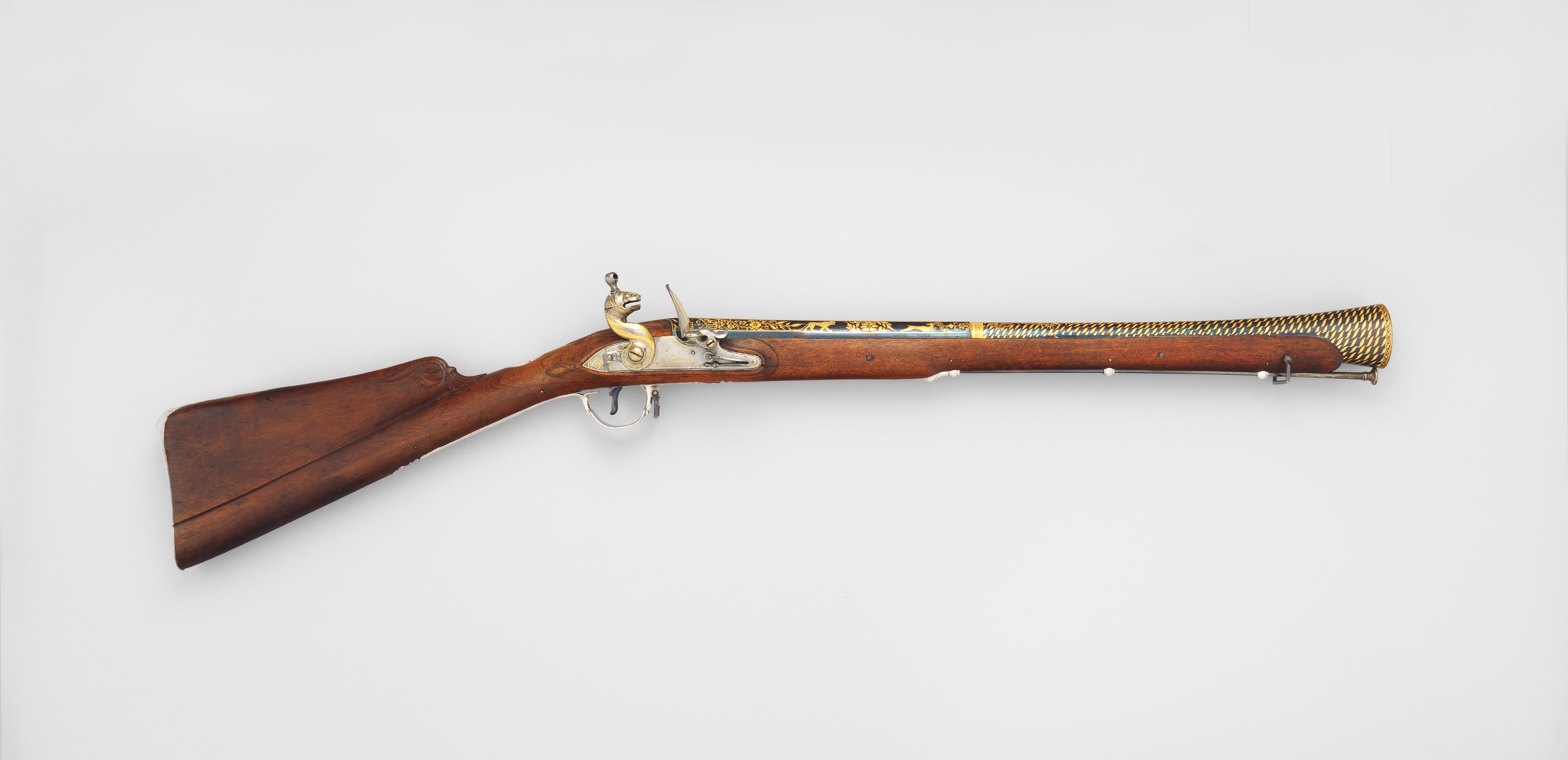
The signature naval firearm, though, was the blunderbuss: short, large in the bore, with a flared, trumpet-shaped muzzle, and loaded with a scatter of shot rather than a single ball. Everything about it suited the boarding action. You did not need to aim a blunderbuss precisely — you pointed it into the mass of a boarding party and its spreading charge of shot swept the rail. At the confined range of two ships locked together, a weapon that threw a cone of lead was worth more than any aimed long arm, because in that scrum you were rarely going to get a second shot.
Its one drawback at sea was recoil — a heavy charge of shot kicks hard — and the naval answer was elegant: the larger blunderbusses were swivel-mounted, clamped to a forked pivot on the ship’s or the boat’s rail so the timber, not the shooter’s shoulder, absorbed the shove. A swivel blunderbuss could be trained across the deck and fired again and again into successive rushes, a fixed defensive weapon guarding the point where boarders would try to come aboard. The flared muzzle, incidentally, did little to widen the shot pattern — its real purpose was to make the weapon easy to pour a charge into on a heaving deck.
9.3 Pirates and the brace of pistols
Nowhere was the reload problem felt more sharply than among the pirates of the Golden Age of Piracy, whose entire method was the boarding action. Their favored personal firearm was the flintlock pistol — light, usable in one hand, leaving the other free for a cutlass. But it was single-shot, its effective range was only about fifteen metres, and reloading it took thirty to sixty seconds — an eternity when men are swarming across a rail with blades drawn. Fire your one pistol, and in the time it took to pour powder, seat a ball, ram it home, and prime the pan, you would be dead three times over.
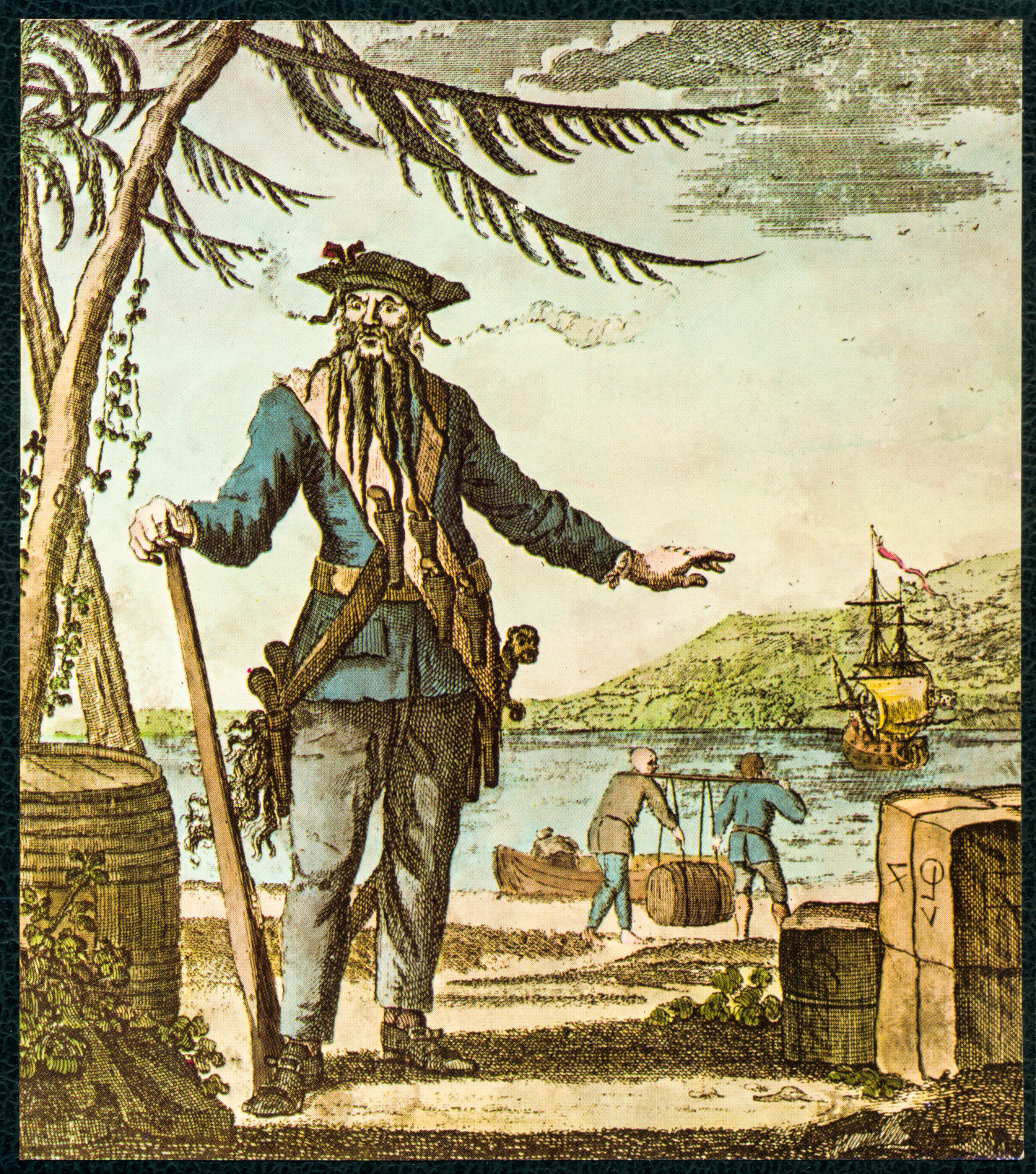
The solution was not a better pistol. It was more pistols. A pirate went into a boarding hung with several pre-loaded, primed flintlock pistols and simply drew a fresh one each time the last was spent — firing four, five, six times in the span it would have taken to reload a single gun once. The enduring image of this is Blackbeard — Edward Teach — who according to contemporary accounts wore multiple braces of pistols slung across his chest on ribbons, commonly described as three braces, six pistols, dangling ready. The theatrical menace of it was real, but it was also pure engineering logic: carry six single-shot guns because reloading one in a melee is impossible. Pirates carried blunderbusses for the same reason, throwing a spread of shot into a knot of defenders where a single aimed ball would have been wasted.
9.4 The three tiers of a boarding
Put together, the whole business of taking a ship worked in three tiers, each matched to a range and a moment. First came the ship’s artillery — cannon and light swivel guns on the rails — to batter and soften the prize and clear her decks from a distance. Then, as the hulls closed and grappled, came the personal firearms — pistols, muskets, and blunderbusses — fired once into the defenders during the approach and the first rush across the rail, every man discharging what he carried because there was no reloading it. And then, guns empty, the fight collapsed into the third tier: edged and blunt weapons — the cutlass, the boarding axe, the boarding pike, the belaying pin — for the savage close melee that actually decided who owned the ship.
The muzzleloader, in other words, did not dominate a sea fight the way a musket line dominated a field. It got you aboard, or kept boarders off, in one or two shattering discharges — and then men settled it with steel. That is a fitting note on which to close the flintlock’s tour of the world it armed. The next volume follows the same lock into the hands of samurai, Mughal soldiers, Afghan marksmen, and African hunters — the muzzleloader as a truly global technology.
Sources
Military Heritage (Sea Service musket and pistol); NRA Museum (British Sea Service blunderbuss); World History Encyclopedia (“Pirate Weapons in the Golden Age of Piracy”); History Hit (“Pirate Weapons from the Golden Age of Piracy”); Lt. William Mowett (boarding weapons).
Comments (0)