A History of Muzzleloaders · Volume 13
The Great, the Good, and the Worthless: A Verdict on the Designs
Twelve volumes have laid out the mechanisms in order of their appearance. This one steps back and passes judgment. Across five hundred years, dozens of ignition systems and loading schemes were tried; a handful were genuinely great — right idea, right time, era-defining — while others were clever but crippled, and a few were simply dead ends. The verdict below is not about which gun was most beautiful or most ingenious. It is about which designs actually solved the problem the muzzleloader existed to solve: get fire to the powder, reliably, in any weather, fast enough to matter. Judged that way, the winners are not always the ones you would expect.
13.1 Genuinely great
These are the designs that got it right and changed history in doing so.
- The matchlock arquebus and musket. Not elegant, but the great democratizer. It was cheap, simple, robust, and repairable by a village blacksmith, and it could be mass-issued to conscript infantry with minimal training. That single fact ended the age of the armored knight and the crossbow and put lethal firepower in the hands of common soldiers — from the fields of Nagashino to the pike-and-shot armies of Europe. Measured by historical consequence, it is arguably the most important ignition system of all.
- The true flintlock. The workhorse of roughly 1610 to the 1840s. It out-lasted every competitor for about a century and a half because it hit the exact sweet spot: reliable and weatherproof enough for war, cheap and rugged enough to mass-issue, and safe to carry thanks to the internal half-cock. Brown Bess and Charleville armed the world’s armies for over a hundred years on the strength of this lock. It is the standard the other designs are measured against — the picture above.
- The American long rifle. A craft masterpiece: the stubby German Jäger refined by immigrant gunsmiths into a long, elegant, small-bore arm of superb accuracy. It was outstanding at exactly what it was built for — individual marksmanship on the frontier — even though its slow load kept it off the firing line.
- The percussion cap. A tiny part with outsized impact. All-weather, faster, and with far fewer misfires, it obsoleted the flint pan almost overnight, and its direct descendants — the Berdan and Boxer primers — still fire essentially every cartridge gun on Earth.
- The Minié ball and the rifle-musket. Arguably the single most decisive muzzleloader innovation: rifle accuracy at musket loading speed, mass-issued to entire armies. It made every line infantryman a rifleman — and produced the Crimean and Civil War casualty catastrophe. Technically brilliant, humanly terrible.
13.2 Good, but flawed
These worked, and some were genuine engineering leaps, but each carried a fatal compromise that kept it from greatness.
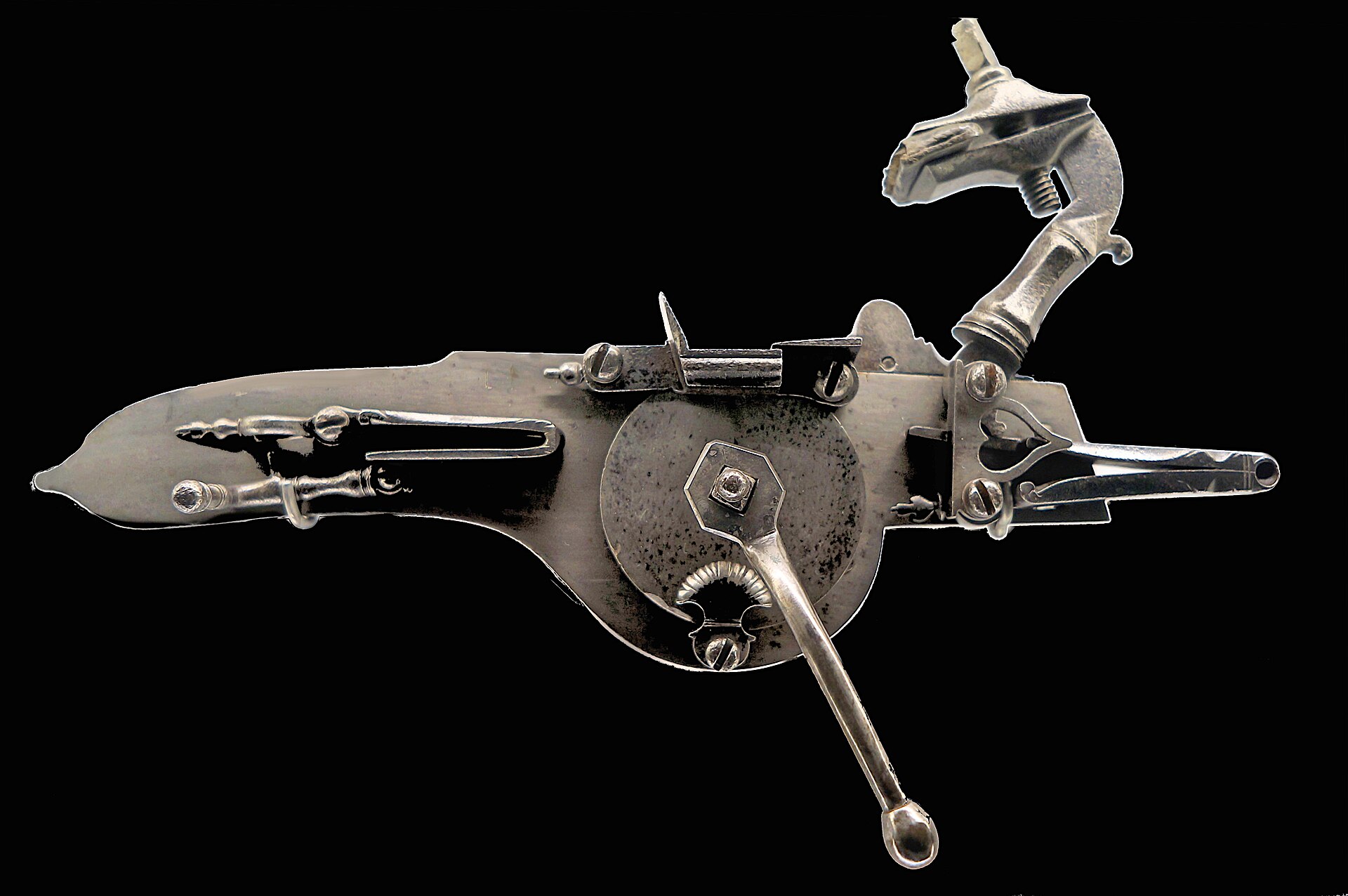
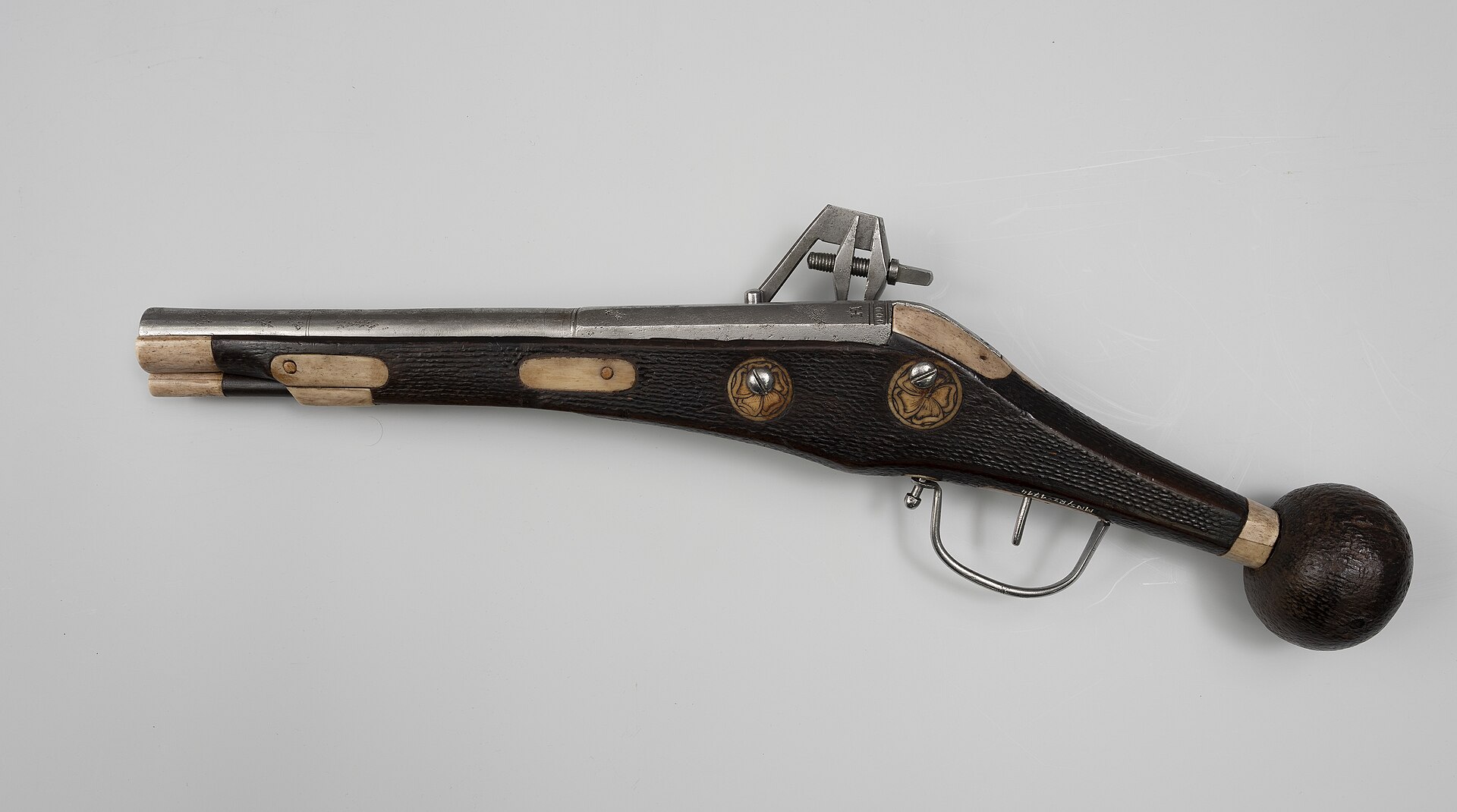
- The wheellock. A real breakthrough — the first self-igniting lock, the enabler of the pistol and the cavalry firearm, a gun that could be carried loaded and ready. But it was crippled by cost, fragility, and the spanner. It ran about twice the price of a matchlock, needed a trained gunsmith rather than a blacksmith to repair, and had to be wound with a separate key before firing — lose the spanner and the gun was useless, so it was tied to the stock. It stayed a rich man’s and a cavalryman’s arm and never displaced the matchlock for the infantry. Clever, but impractical.
- The early muzzle-loading rifle. Deadly accurate but too slow to load and too quick to foul for line service, because the tight patched ball had to be forced down against the grooves. It stayed a specialist and hunter’s arm for more than two centuries — right accuracy, wrong loading speed — until the Minié ball finally reconciled the two.
- The snaphance and the doglock. Sound transitional flint locks that genuinely worked, but were superseded: the snaphance’s separate pan cover and the doglock’s external safety catch were both rendered obsolete by the true flintlock’s combined frizzen and internal half-cock. Useful bridges, quickly outmoded.
13.3 Duds and dead ends
- The bare hand cannon. A historically necessary first step, but as a weapon it was a two-handed, hot-wire tube with no lock, no sights, and glacial rate of fire. Every later lock in this series exists specifically to escape its limitations. Essential to the story, useless as a design.
- The over-complex multi-shot novelties. The occasional eight-shot matchlock “revolver” or multi-barreled wheellock “puffer” were clever attempts to beat the single-shot reload, but they were too complex, too costly, and too dangerous — chain-fire and flash-over were real risks — to be anything but curiosities. They point at the repeating firearm without delivering it.
- The muzzle-loading architecture itself, by about 1866. This is the deepest dead end of all. Load from the front, ramrod every shot: the entire scheme became obsolete once the self-contained metallic cartridge let a soldier load from the breech, lying down, several times faster. Even the superb Minié rifle-musket could not save the architecture — it survived afterward only as a conversion host and, much later, as a sporting revival.
The pattern in the verdict is consistent and worth naming: the designs that won were the ones that balanced reliability, cost, and simplicity, not the ones that were most ingenious. The wheellock was more clever than the flintlock and lost to it. The bare hand cannon was simpler than the matchlock and lost to it too. Greatness lived in the middle — good enough to trust, cheap enough to issue, simple enough to fix. Volume 14 tells how even the best of them finally ran out of road.
Sources
Wikipedia (Hand cannon, Matchlock, Wheellock, Snaphance, Flintlock, Muzzle-loading rifle, Percussion cap, Minié ball); Rock Island Auction; Warfare History Network; Guinness World Records; Boise Gun Club handbook.
Comments (0)