A History of Muzzleloaders · Volume 14
The End and the Afterlife: Cartridges, Obsolescence & the Revival
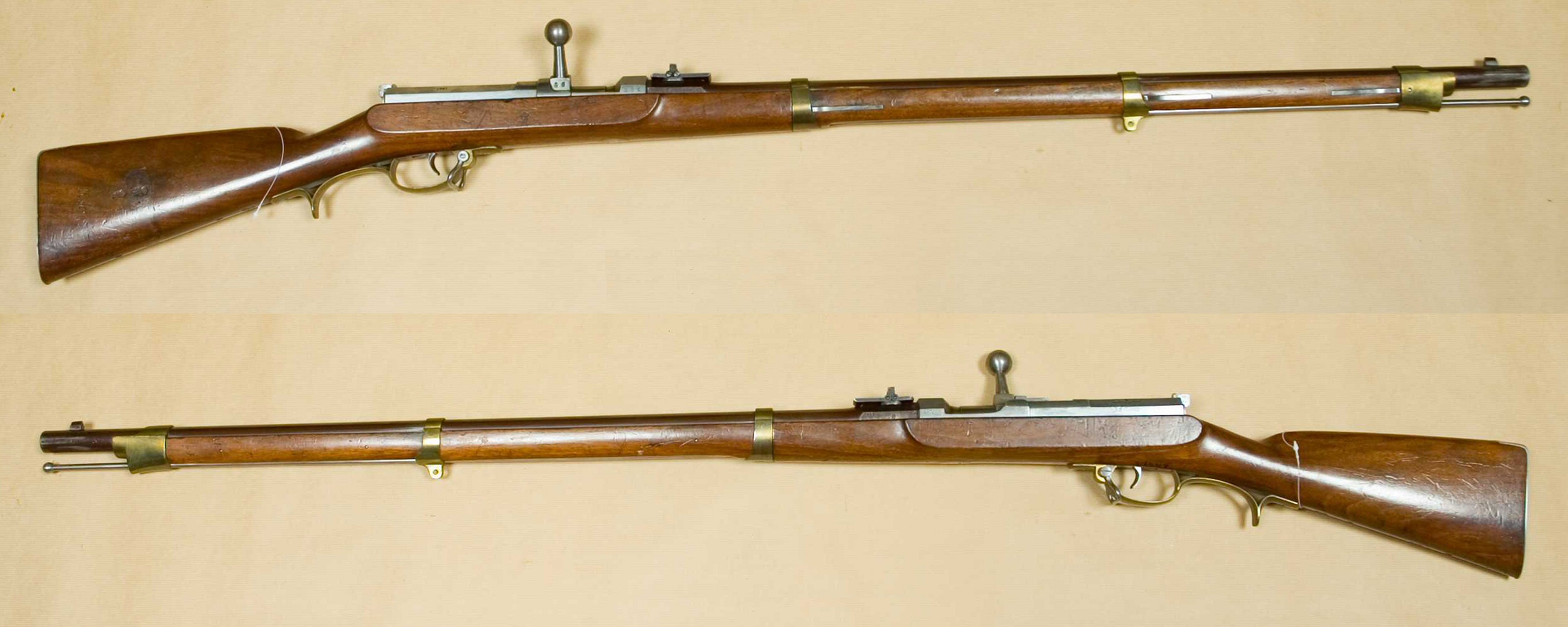
The rifle-musket had brought the muzzleloader to its lethal summit. And then, in the space of barely a decade, five hundred years of loading a gun from the front simply ended. The instrument of that ending was not a better muzzleloader — no such thing was possible — but an entirely different way of putting powder and ball into a gun: from the breech, in a single self-contained package, at a speed the ramrod could never approach. This final volume traces that abrupt end, and then the unlikely afterlife that keeps flint, cap, and powder horn alive on ranges and in hunting seasons today.
14.1 The needle gun and Königgrätz
The gun that announced the change was Prussian. The Dreyse “needle gun” was a bolt-action breech-loader firing a self-contained paper cartridge that combined bullet, powder, and percussion primer in one unit; a long firing needle drove through the paper to strike the primer at the base of the bullet. The system dated from 1836 and was adopted as the Model 1841. Its advantages over any muzzleloader were transformative: a Prussian infantryman could load his Dreyse from the breech lying down — behind cover, presenting no target — and fire it several times faster than an enemy standing to ram a rifle-musket.
The decisive proof came in the 1866 Austro-Prussian War, above all at the battle of Königgrätz, where Prussian infantry with breech-loading needle guns cut down Austrian troops still working muzzle-loading rifles from a standing position. The lesson was not lost on any army in Europe: breech-loading was the future, and the muzzleloader was the past.
14.2 Conversions and the metallic cartridge
No nation was going to scrap millions of serviceable rifle-muskets overnight, so the first response was to convert them. Rather than build entirely new rifles, Britain, the United States, and Austria cut open the breeches of their existing muzzleloaders and fitted breech-loading actions. Britain adopted Jacob Snider’s cartridge conversion of the Enfield in September 1866 — its first breech-loading service rifle, and a direct transplant onto the old rifle-musket. The muzzleloader’s own body became the host for the technology that killed it.
The deeper revolution was the ammunition. The paper cartridge of the Dreyse still leaked gas at the breech; the fix was the self-contained metallic cartridge, whose brass case expanded on firing to seal the breech perfectly — the problem of obturation solved by the case itself. In 1866 both Hiram Berdan in the United States and Edward Mounier Boxer in Britain patented centerfire primer systems, and their two designs still define ammunition to this day: nearly every cartridge fired anywhere in the world uses a Berdan or a Boxer primer. By the Franco-Prussian War of 1870–71, fixed brass cartridges were standard issue, and the muzzleloader was finished as frontline military technology.
14.3 The revival
And yet it did not die. Removed from the battlefield, the muzzle-loading gun found a second life as a sporting and historical pursuit, and that afterlife is thriving.
The organized revival took root in the twentieth century. The National Muzzle Loading Rifle Association (NMLRA), founded in 1933 at Friendship, Indiana, became the main sanctioning body for traditional black-powder competition and did much to preserve the craft of flint and cap shooting as a sport. For decades the hobby was resolutely traditional — flintlocks and caplocks, patched round balls, powder horns.
Then, in 1985, Tony Knight introduced the modern inline muzzleloader, placing the ignition — a percussion cap, and later a 209 shotshell primer — directly behind and in line with the powder charge, for a short, fast, weather-resistant ignition path. The inline made the muzzleloader reliable and accurate in a way that suited modern hunters, and it drove a boom in muzzleloader hunting seasons, the special primitive-weapon seasons that most U.S. states now offer. Modern inlines such as the CVA Paramount Pro are advertised as sub-MOA at 400 yards — a performance that would have astonished a Civil War soldier and that quietly retires the old assumption that a muzzleloader is only good to a hundred yards.
Three living families of muzzleloader remain in use today, and they map neatly onto this whole series: the flintlock, the oldest survivor and the traditionalist’s choice; the caplock, the percussion arm of the mid-nineteenth century; and the inline, the modern hunter’s tool and the most reliable of the three. A shooter today can load and fire, by choice, at any point along the arc this series has traced.
That is where a reader who wants to do this, rather than only read about it, can begin. The sibling dive in this collection — Traditions Blunderbuss Kits — walks through actually assembling and shooting a muzzle-loading flintlock from a kit: the single best way to feel, first-hand, what five centuries of gunmakers were wrestling with every time they poured powder down a barrel and reached for a spark.
From a tube on a stick lit with a glowing wire, to a rifle-musket that reshaped warfare, to a breech-loading cartridge that ended the whole architecture in a decade, to a living sport that keeps all of it alive — that is the five-hundred-year arc of the muzzleloader, loaded, as it always was, from the front.
Sources
Wikipedia (Dreyse needle gun); Gun Digest; Armourers Bench; Gun Mag Warehouse (Berdan vs. Boxer); NMLRA; Muzzle-Loaders.com.
Comments (0)