A History of Muzzleloaders · Volume 6
The Flintlock: The Lock That Ruled a Century and a Half
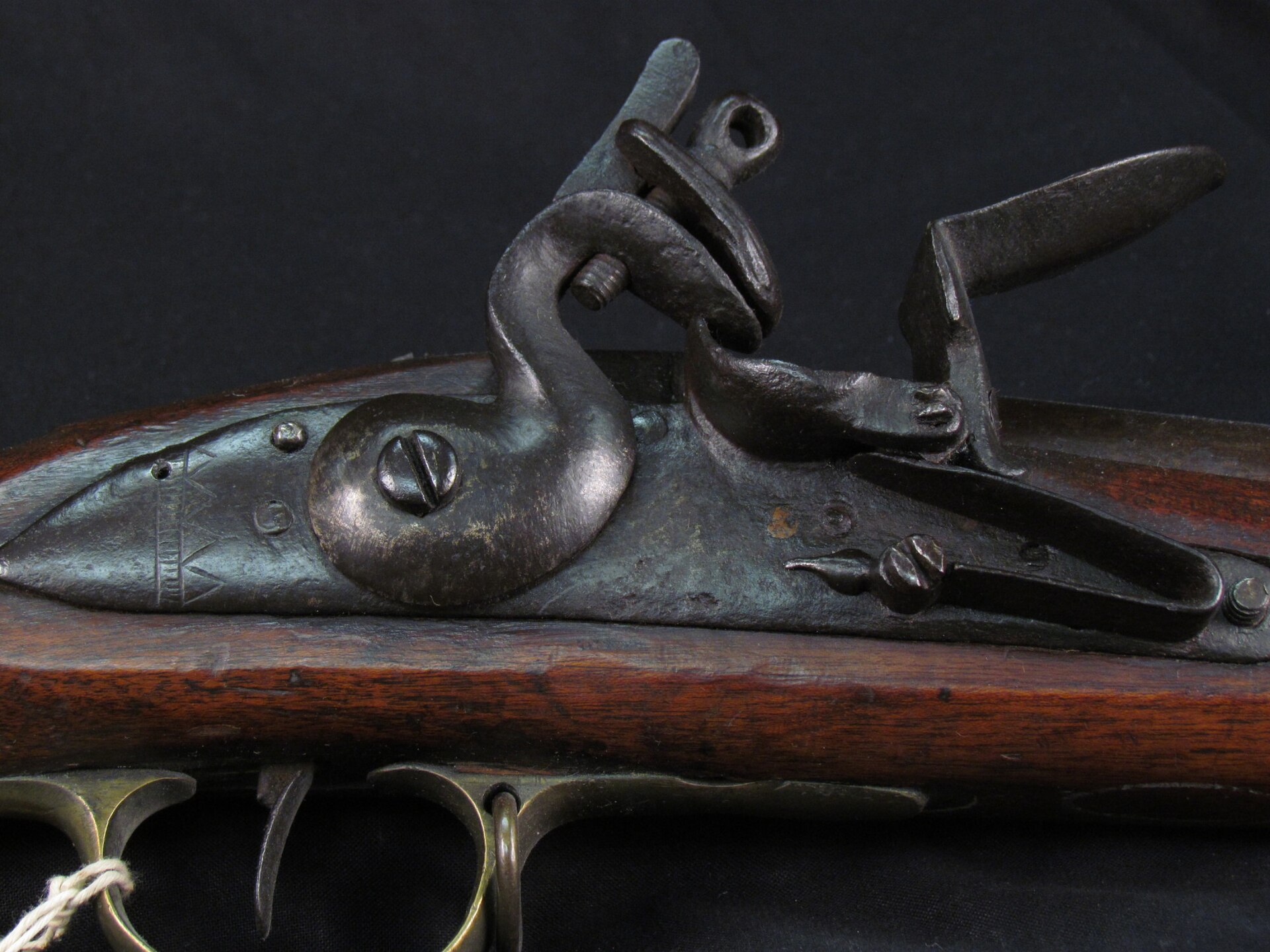
By the early seventeenth century the pieces of the flint-ignition puzzle were all on the table. The snaphance, the miquelet, and the English doglock (Volume 5) had each proved that a flint held in a spring-driven cock, scraping a hardened steel, would reliably throw sparks into a pan of priming powder — no smoldering match, no wound-up wheel. What none of them had was elegance. Each carried some awkward compromise: a pan cover that was a separate part from the striking steel, or an external catch bolted to the outside of the lock to hold the cock at rest. The lock that swept all of them aside did so not by inventing flint ignition but by tidying it up — and that tidying was enough to define the next century and a half.
6.1 Two innovations, one definitive lock
The credit goes to Marin le Bourgeoys, a gunsmith, painter, and mechanic in the service of Louis XIII of France, who assembled the first “true” flintlock sometime between about 1610 and 1615. Guinness World Records recognizes his mechanism as the first true flintlock. What made it true — as opposed to one more transitional flint lock — was the combination of two features into a single, coherent design.
The first was the combined frizzen. In a snaphance the striking steel and the pan cover are two separate parts; the pan has to be uncovered and the steel swung into place, and any misalignment between them costs you sparks or a face full of flash. Le Bourgeoys fused the two into one L-shaped piece of hardened steel. The upright face is what the flint strikes; the horizontal foot is the pan cover. When the flint hits, the same blow that scrapes the sparks also knocks the frizzen forward, snapping the pan open at the exact instant the sparks arrive. One part now does two jobs, in perfect time, with nothing to misalign.
The second was the internal half-cock. Inside the lock, the cock is driven by the mainspring through a rotating piece called the tumbler, and le Bourgeoys cut two notches into that tumbler. A sear engaging the deeper notch holds the cock in a half-cock position: the mainspring is partly loaded, the frizzen can be raised and the pan primed, but the trigger will not release it. The gun can be loaded and carried safely in this state. Draw the cock back to the second notch — full cock — and it is ready to fire. This put the safety inside the lock, worked by the same parts that fired the gun, rather than bolting an external “dog” onto the outside as the doglock had done. (It is the ancestor of the phrase “going off half-cocked” — a gun that fires when it should have been held safe.)
Neither idea was wildly complicated. That was precisely the point. Gunsmiths across Europe could see what le Bourgeoys had done, understand why it was better, and copy it — and they did, from France outward, until by the 1660s the French lock was displacing every rival.
6.2 Why it ruled for roughly 180 years
A technology dominates for a century and a half only when it is better than everything below it in the ways that actually matter to the people paying for it. The flintlock was, on every axis at once.
Against the matchlock, it needed no burning cord. There was no glowing match to give away a night ambush, no lit ember to be doused by rain or snuffed by wind, no open flame carried inches from loose powder and paper cartridges. A flintlock could be loaded, primed, half-cocked, and slung ready — inert until the trigger was pulled — which a matchlock, with its ever-burning match, never could.
Against the wheellock, it was cheap and it was robust. The wheellock was a jeweler’s mechanism: a wound wheel, a delicate sear, a spanner you dared not lose. A flintlock had far fewer moving parts, could be repaired by an ordinary gunsmith rather than a specialist, and cost a fraction as much. Where the wheellock stayed a rich man’s and a cavalryman’s arm, the flintlock could be issued to a whole army.
And against the earlier flint locks it superseded, it was simply cleaner and more reliable — the combined frizzen ended the snaphance’s misalignment troubles, and the internal half-cock ended the doglock’s external clutter. It hit the sweet spot no rival could: reliable and weatherproof enough for war, safe enough to carry loaded, and cheap and rugged enough to mass-produce and mass-issue by the hundreds of thousands.
So it did exactly that. From the early eighteenth century through the first half of the nineteenth, the flintlock was the standard ignition on essentially every European and American firearm — military musket, hunting fowler, dueling pistol, trade gun. The great smoothbore muskets that fought the age of linear warfare — the British Brown Bess and the French Charleville — were flintlocks, and so was the elegant American long rifle of the frontier. Whether a gun rode on a warship, a cavalry saddle, or a Pennsylvania hunter’s shoulder, the lock throwing the spark was almost certainly some descendant of the mechanism le Bourgeoys had assembled around 1612.
6.3 The limits it never escaped
For all its dominance, the flintlock never solved two stubborn problems, and they are worth naming because they set up the volumes to come. The first was weather: the priming sat in an open pan, and a hard rain or a soaking damp could still wet the powder and produce a click instead of a bang. The second was lock time — the perceptible delay between pulling the trigger and the main charge going off. First the flint scraped the frizzen, then the pan flashed, then the flash burned through the touch hole to the main charge: a chain of small events, each taking a moment. A hunter aiming at a bird felt that delay, and felt the puff of the pan flash warn the game before the shot arrived. That very annoyance would eventually push a Scottish minister named Forsyth toward the percussion cap (Volume 11) — the innovation that finally retired the flint after its 180-year reign.
But that reckoning was a century and a half away. First the flintlock had a world to arm — and the next volume puts it in the hands of the redcoats and the grenadiers who fought shoulder to shoulder across the eighteenth century’s battlefields.
Sources
Marin le Bourgeoys (Wikipedia); Guinness World Records (first true flintlock mechanism); Flintlock mechanism (Wikipedia); Rock Island Auction (“What is a flintlock”); NPS (“Brown Bess”).
Comments (0)