A History of Muzzleloaders · Volume 4
The Wheellock: Clockwork Ignition and the First Pistols
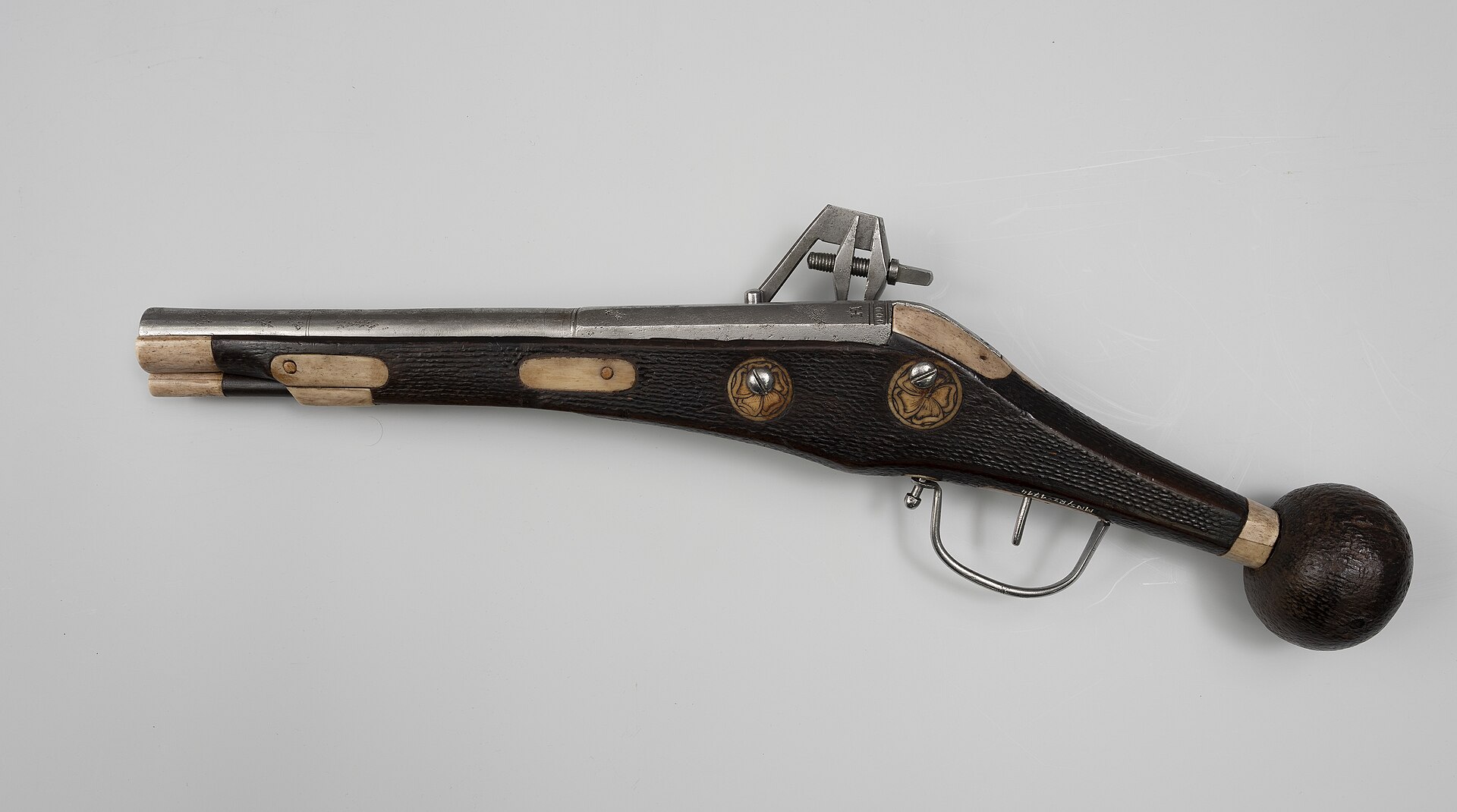
The matchlock’s fatal flaw was the match itself — a live coal the shooter had to keep burning, shield from the rain, and hide at night. What if the gun could make its own fire, on demand, with no cord to tend? That is the question the wheellock answered, and in answering it the wheellock became the first self-igniting firearm in history. It is one of the genuine engineering leaps of the whole story. It is also a cautionary tale about how a brilliant mechanism can be defeated not by a rival idea but by cost, fragility, and a small losable part.
4.1 A cigarette lighter, three centuries early
The mechanism is best understood by comparison with a thing every modern reader has handled: the flint-wheel lighter. Inside a wheellock, a spring-loaded serrated steel wheel is wound up under tension against a strong mainspring. A piece of iron pyrite — a soft, spark-shedding mineral — is clamped in the jaws of an arm called the dog and pressed down against the wheel. Pull the trigger and the wheel spins hard against the pyrite, showering sparks straight into the priming pan. The priming flares, the touch hole carries fire to the charge, and the gun fires. Trigger release, wheel spin, sparks, priming, and ignition happen almost in one instant — no cord, no coal, no waiting.
The wheellock is commonly dated to around 1509, with attributions to Nuremberg, and Leonardo da Vinci sketched a wheellock concept around 1500 in the Codex Atlanticus — one of the earliest illustrations of the idea. Whoever perfected it, the wheellock was a piece of precision clockwork: springs, a wheel, a chain or link, a sear, all fitted together with a watchmaker’s tolerances at a time when watches themselves were brand new.
4.2 Why self-ignition changed everything
The advantage over the matchlock is easy to state and enormous in its consequences: there is no lit match. That means a wheellock could be loaded, wound (spanned), and then carried ready to fire — primed, closed, and safe in a holster or under a coat until the instant it was needed. A matchlock with its glowing cord could never be carried that way; it announced itself and demanded constant tending. The wheellock could sit silent and hidden and then fire at a touch.
Two whole categories of weapon flow directly from that one capability. The first is the pistol. A one-handed gun is useless if you need your other hand to manage a burning match, but a self-igniting lock needs no such tending — so the wheellock is what made the practical pistol possible for the first time. The elegant German puffer in the photograph above, with its heavy ball pommel that let a horseman draw and club with the same weapon, is the archetype. The second category is cavalry firepower. By the mid-sixteenth century a German mercenary horseman — a reiter — rode with a pair of wheellock pistols in his saddle holsters, and often three, four, or five about his person. Their signature tactic was the caracole: successive ranks of horsemen trotted up to the enemy, discharged their pistols into the front rank, then wheeled aside to reload while the next rank came forward and fired. Concealable, ready-to-fire, one-handed ignition made mounted gunnery a real thing.
4.3 The three things that held it back
If the wheellock was so much better, why did the matchlock soldier on for another century and a half? The answer is a study in why the best mechanism does not always win.
First, cost. A wheellock cost roughly double a matchlock. Every one was a precision assembly of springs and gears that a specialist had to make and fit; you could not stamp them out for conscripts. Second, fragility. Where a matchlock could be fixed by any village blacksmith with a forge and a hammer, a broken wheellock needed a trained gunsmith with fine tools. On campaign, far from a workshop, a fouled or broken wheel was very often a dead gun. Third, and most maddening, the spanner. The wheel had to be wound under spring tension before every shot using a small key — the spanner — and here is the catch that defines the whole weapon: lose the spanner and the gun is useless. You cannot wind the wheel without it, and an unwound wheellock will not fire. Soldiers tied the spanner to the stock or to the wrist for exactly this reason, but a lost or dropped key in the middle of a fight turned an expensive weapon into an expensive club.
4.4 A rich man’s arm
Put those three limitations together and the wheellock’s place in history writes itself. It was never a mass-issue infantry lock. It armed the people who could afford it and needed what it offered: wealthy hunters who wanted a gun that could be carried loaded and ready as game was flushed, gentlemen who wanted a concealable pistol, and mounted troops who needed a one-handed weapon that fired without a burning cord. Beautifully made, often inlaid with bone, antler, and engraved steel like the puffer above, the wheellock was as much a status object as a weapon. For the common foot soldier, the cheap, robust, blacksmith-fixable matchlock stayed the sensible choice.
So the wheellock lands in an interesting place in the ledger: a genuine, era-opening invention — the first lock to carry its own fire — that was crippled as a general-issue weapon by economics and fragility rather than by any conceptual flaw. It proved that self-ignition was possible and showed exactly what self-ignition made possible — the pistol, the cavalry gun, the ready-carried firearm. The task left for the next generation of gunsmiths was to deliver all of that self-igniting promise cheaply and robustly, in a lock a blacksmith could mend. The answer would come from a much older, much simpler idea: a piece of flint struck against steel.
Sources
Wikipedia (Wheellock); Boise Gun Club handbook on the wheellock as the first self-igniting firearm; Warfare History Network on the wheellock and the history of the pistol; Rock Island Auction on identifying and dating wheellocks; the puffer pistol image via the Rijksmuseum and Wikimedia Commons.
Comments (0)