A History of Muzzleloaders · Volume 7
The Great Muskets: Brown Bess, Charleville & the Age of Linear Warfare
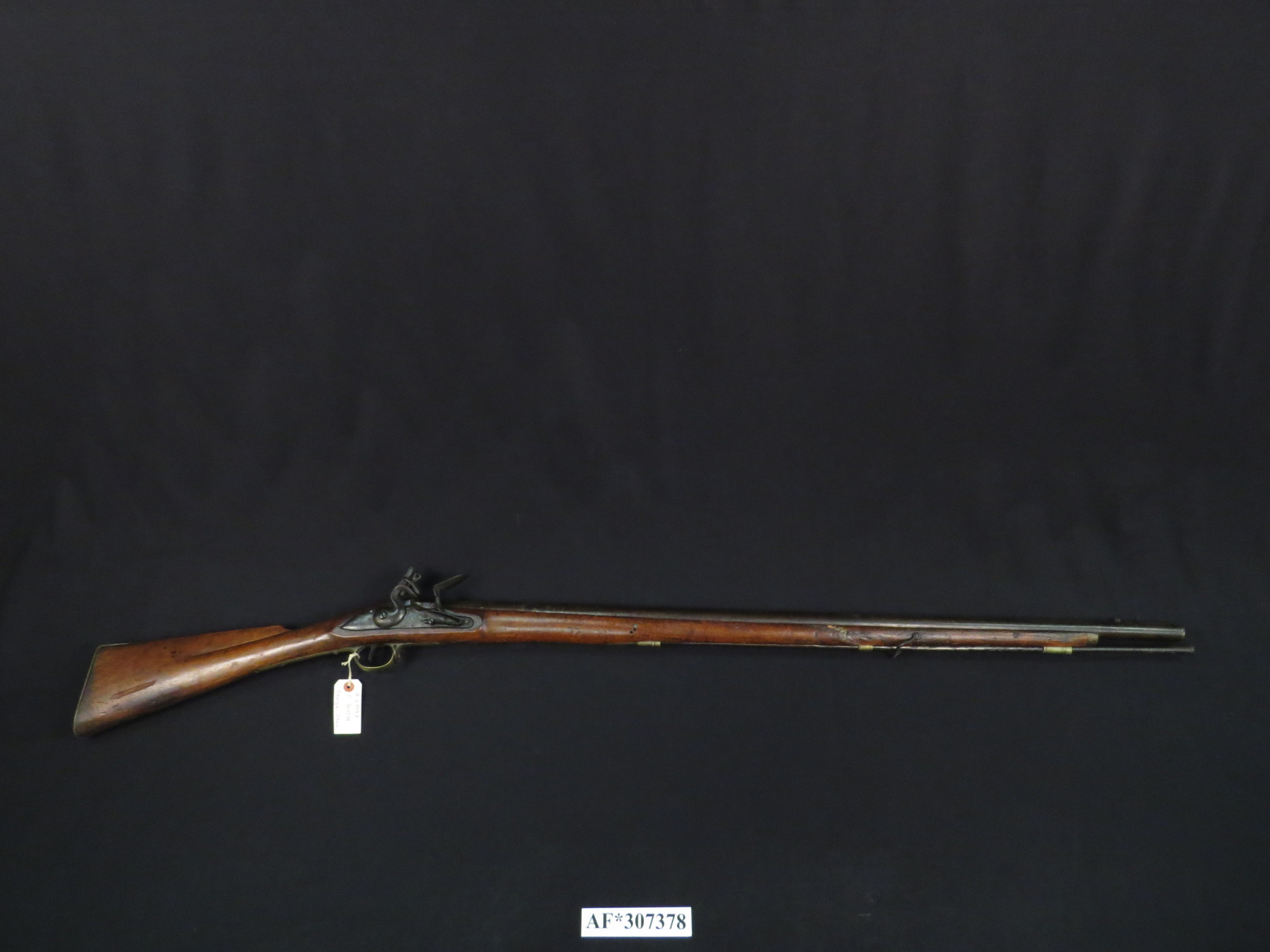
Once the flintlock had matured (Volume 6), the eighteenth century belonged to a single kind of weapon: the smoothbore flintlock musket. It was a muzzle-loading, single-shot arm firing a loose-fitting round lead ball, capable of perhaps two or three aimed shots a minute in trained hands, and it carried a bayonet so that the man holding it was a musketeer and a pikeman in one. Two national patterns above all others defined the age — the British Brown Bess and the French Charleville — and understanding them, and the honest reality of what they could and could not do, explains why armies of the era fought the strange, formal, shoulder-to-shoulder way they did.
7.1 The Brown Bess
The British Land Pattern Musket, universally nicknamed the “Brown Bess,” was commissioned under King George I and adopted in 1722. It and its derivatives served as the standard British long arm until 1838, when a percussion smoothbore finally replaced it — well over a century in the line. Across that span roughly 4.3 million were built, arming the redcoats from the Seven Years’ War through the American Revolution and the Napoleonic Wars, and making the musket a familiar symbol of the expanding British Empire.
Its most quietly revealing detail is the caliber. The Bess was a nominal .75-caliber bore, but the issue ball was deliberately undersized — around .69 to .71 — so that it dropped down the barrel with room to spare. This was not sloppiness; it was survival. Black powder fouls, coating the bore with a hard crust that grows with every shot, and a ball sized to fit a clean barrel would jam solid in a dirty one halfway through a battle. An undersized ball kept loading fast even as the fouling built. The cost was accuracy — a ball rattling down an oversized bore leaves the muzzle at an unpredictable angle — but in the smoothbore world accuracy was already a lost cause, and speed of loading was everything.
The pattern evolved chiefly by getting shorter and cheaper. The original Long Land Pattern carried a 46-inch barrel; the Short Land Pattern (from 1740) trimmed it to 42; and the mass-produced India Pattern, adopted to speed wartime production during the Napoleonic Wars, came down to 39. Each change traded a little reach for handiness and manufacturing economy — the recurring logic of a weapon that had to be made by the million.
7.2 The Charleville — and its American offspring
Across the Channel, France standardized earlier and more thoroughly. The muskets collectively called “Charleville,” after the arsenal that made many of them (others came from Maubeuge, Saint-Étienne, and Tulle), were .69-caliber smoothbore flintlocks. The Model 1717 was France’s first standardized, government-issued flintlock infantry musket — a milestone in the idea that a nation’s soldiers should all carry the same gun, built to the same drawings. Experience refined it: the early models were judged too long and fragile for the North American wilderness, prompting the shorter, sturdier Model 1763; that gun proved heavy at over ten pounds, so gunsmiths thinned the barrel and slimmed the stock into the lighter Model 1766.
The line culminated in the Modèle 1777 and its Napoleonic revision, the Modèle 1777 corrigé an IX (1800) — the primary French line musket of the Revolutionary and Napoleonic Wars, and reckoned the most advanced military firearm of its day. Roughly 7 million Model 1777-pattern muskets were produced across all its variants, a number no firearm would exceed until the industrial mass production of the First World War, and its design rippled outward into the Austrian pattern of 1798 and the Prussian pattern of 1809.
Its most consequential export, though, was to America. France supplied the Continental Army with muskets by the tens of thousands during the Revolution — Charlevilles were the single largest type in American arsenals — so when the young United States began making its own long arms, it copied what it already had. The Springfield Model 1795, the first standardized U.S. martial arm, was essentially an exact copy of the M1763/1766 Charleville, right down to the .69 caliber. American infantry would carry that French DNA, through the Models 1816 and 1842, until the rifle-musket arrived in the 1850s.

7.3 The honest accuracy of a smoothbore — and the tactics it forced
Here is the fact that explains everything about how these guns were used: a smoothbore musket was not accurate. Fired at a man-sized target, it was genuinely reliable only to about 50 to 75 yards. Even a good marksman firing at an individual man at 100 yards might hit him only half the time; the round ball, undersized and spinning randomly, simply would not group. And loading was slow — two or three shots a minute was good work, three or four a rarity.
You cannot win a battle with a weapon that misses half its shots at 100 yards and fires three times a minute — not one weapon. But a hundred of them, fired together, is a different proposition. Against a formation — a battalion-sized block of men — the effective range of massed fire stretched to 150 or even 200 yards, because at that range the target was not a man but a wall of men, and a poorly aimed volley still found flesh. Individual inaccuracy was drowned in volume of fire.
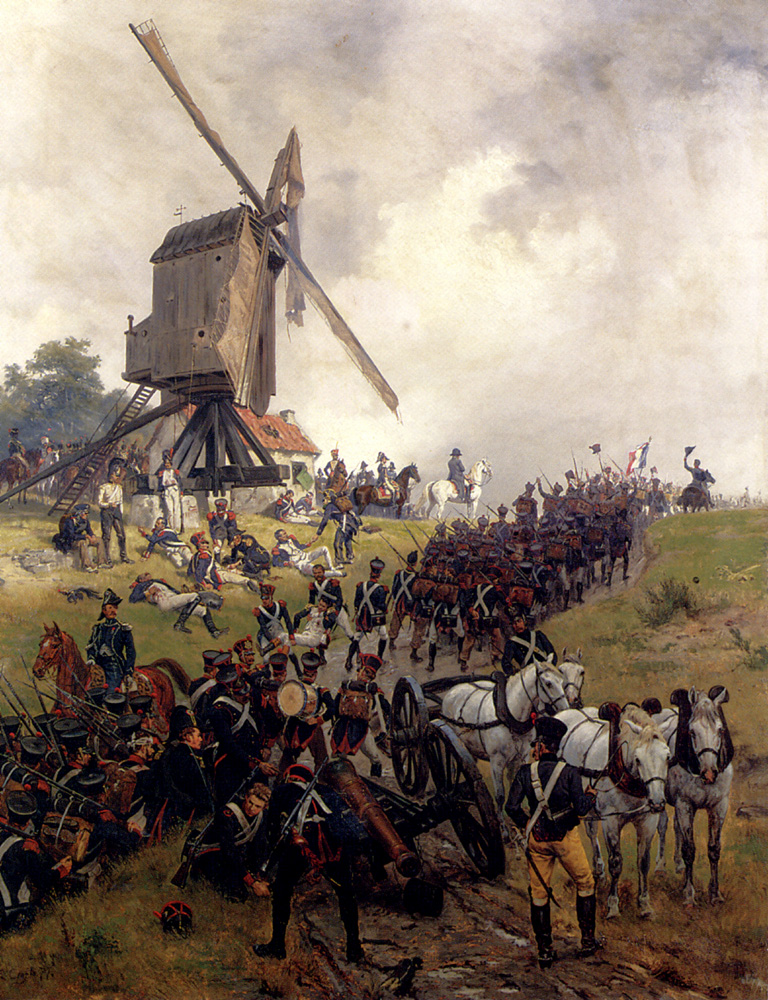
This is the whole logic of eighteenth-century linear warfare. Armies formed dense lines two or three ranks deep, shoulder to shoulder, drilled relentlessly so that frightened men could load and level and fire in unison under fire. The doctrine was brutally simple: close to short range — many commanders preferred 50 yards or less — deliver one shattering volley, and follow it instantly with a bayonet charge before the enemy could recover and reload. The bayonet mattered as much as the ball. A 17-inch socket bayonet turned the musket into a six-and-a-half-foot spear, preserving the shock role of the old pike and making each infantryman his own pikeman — the direct descendant of the pike-and-shot formations of the previous century.
So the formal, geometric, seemingly suicidal spectacle of eighteenth-century battle — men standing in the open in bright coats, marching shoulder to shoulder into each other’s fire — was not stupidity or bravado. It was the only rational way to wring decisive power out of an inaccurate, slow-loading, single-shot smoothbore. The tactics fit the tool exactly. Change the tool — make it accurate — and the whole edifice would have to change. That is the story the rifle was already beginning to tell on the frontier, and it is where the next volume goes.
Sources
Brown Bess (Wikipedia); GunsAmerica (“The Musket That Changed the World”); Charleville musket (Simple Wikipedia); Army History Foundation (“Charleville Musket”); American Rifleman (“The French Charleville”); Musket Model 1777 (Wikipedia); Model 1795 Musket (Wikipedia); NPS (“Brown Bess”); Colonial Williamsburg (tactics); Crate Club (smoothbore accuracy); Encyclopedia.com (“Muskets and Musketry”).
Comments (0)