A History of Muzzleloaders · Volume 2
Before the Lock: Gunpowder, Fire Lances & the Hand Cannon (1300s–1400s)
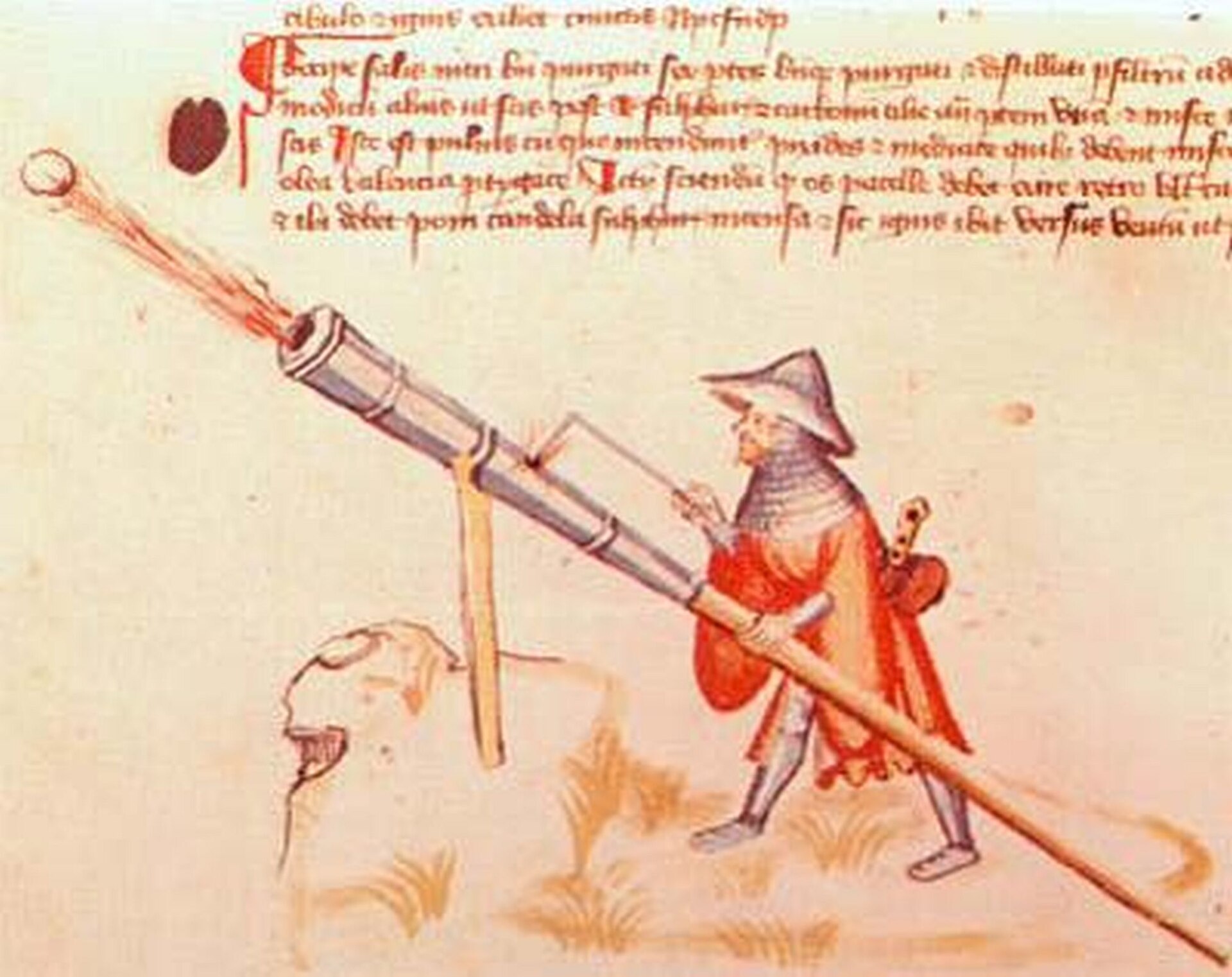
Every gun in this series descends from a single crude idea: pack gunpowder into one end of a closed metal tube, drop a projectile on top of it, and set the powder alight so the expanding gas hurls the projectile out the open end. That idea is roughly seven hundred years old, and it did not arrive with a trigger, a lock, sights, or anything a modern shooter would recognize as a mechanism. It arrived as a tube on a stick, and the whole rest of this history is the long argument over how to fire that tube better.
2.1 Powder before guns
The powder came first, and it came from China. Chinese alchemists of the Tang era stumbled onto the saltpeter–charcoal–sulfur mixture centuries before anyone thought to shoot a ball with it, and by the Song dynasty gunpowder was formalized in military texts. The crucial intermediate weapon was the fire lance — literally a spear with a tube strapped to the shaft that could spit flame and, eventually, a projectile. Chinese records describe a “fire-emitting lance” made from a bamboo tube stuffed with a pellet wad as early as 1259. Widen the tube, make it out of metal instead of bamboo, and take the spear away, and you have a hand cannon. The Chinese were firing metal-barrel hand cannon from the thirteenth century onward, and the oldest datable metal guns in the world are Chinese: a bronze cannon carrying a Zhiyuan-era (1332) inscription from the Yuan dynasty, and bronze guns dated to 1351.
How the technology reached Europe is not perfectly documented, but the most likely carrier was the Mongol expansion of the mid-thirteenth century, which slammed the gunpowder empires of Asia against the Turkic states and the edge of Eastern Europe. However it traveled, it was in European hands within a generation or two: the earliest European depiction is the illustrated treatise of Walter de Milemete, dated 1326–1327, which shows a vase-shaped “pot-de-fer” gun firing a large arrow. The point worth holding onto is that the gun was never a European invention refined for the world — it was a Chinese invention that Europe received, copied, and then spent five centuries reworking.
2.2 What a hand cannon actually was
Strip away the romance and the hand cannon — also spelled handgonne, or just gonne — is the simplest possible firearm: a metal tube, closed at one end, with a small touch hole drilled through the wall near that closed end so fire could reach the powder inside. It is the direct small-scale cousin of the siege cannon, built on exactly the same principle and often by the same founders. Most were fitted to a wooden tiller or pole, either socketed onto the end or laid alongside it, so the shooter had something to hold and to brace.
Firing one was a two-handed, two-person-ish affair with no mechanism at all. The shooter tucked the tube under one arm against the chest, or rested the muzzle on a wall or a forked stand as in the Bellifortis image above, aimed as best he could down a barrel with no sights, and with his free hand brought an ignition source to the touch hole — a hot iron “pricker” heated in a fire, or a length of smoldering match cord. One hand aims; one hand lights. There was no way to keep the fire ready on the gun, no trigger, and no possibility of firing quickly. When it went off, it went off after a lurching delay, and the shooter was as likely to be looking at the touch hole as at the target.
2.3 The oldest survivors
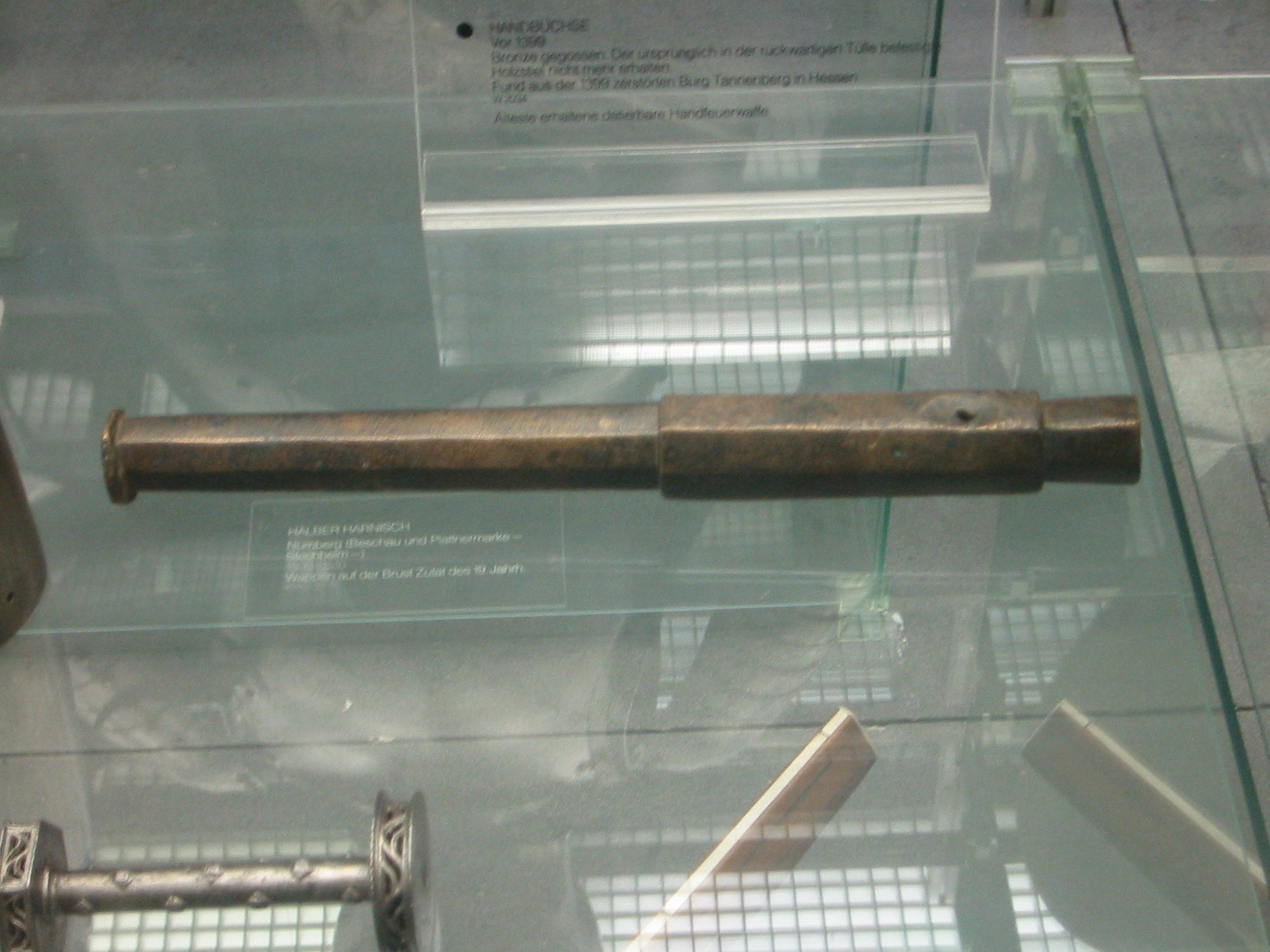
A handful of these guns survive, and they allow real dates to be pinned to the type. The most important is the Tannenberg gun, recovered in 1849 from the cistern of Burg Tannenberg in southern Hesse. The castle was destroyed in 1399, so the little bronze hand cannon at the bottom of its well must predate that — current assessments put it around 1390 — which makes it the oldest surviving firearm in the world that can be dated with certainty. It is a small bronze tube meant to be fired from a wooden tiller, exactly the pattern described above.
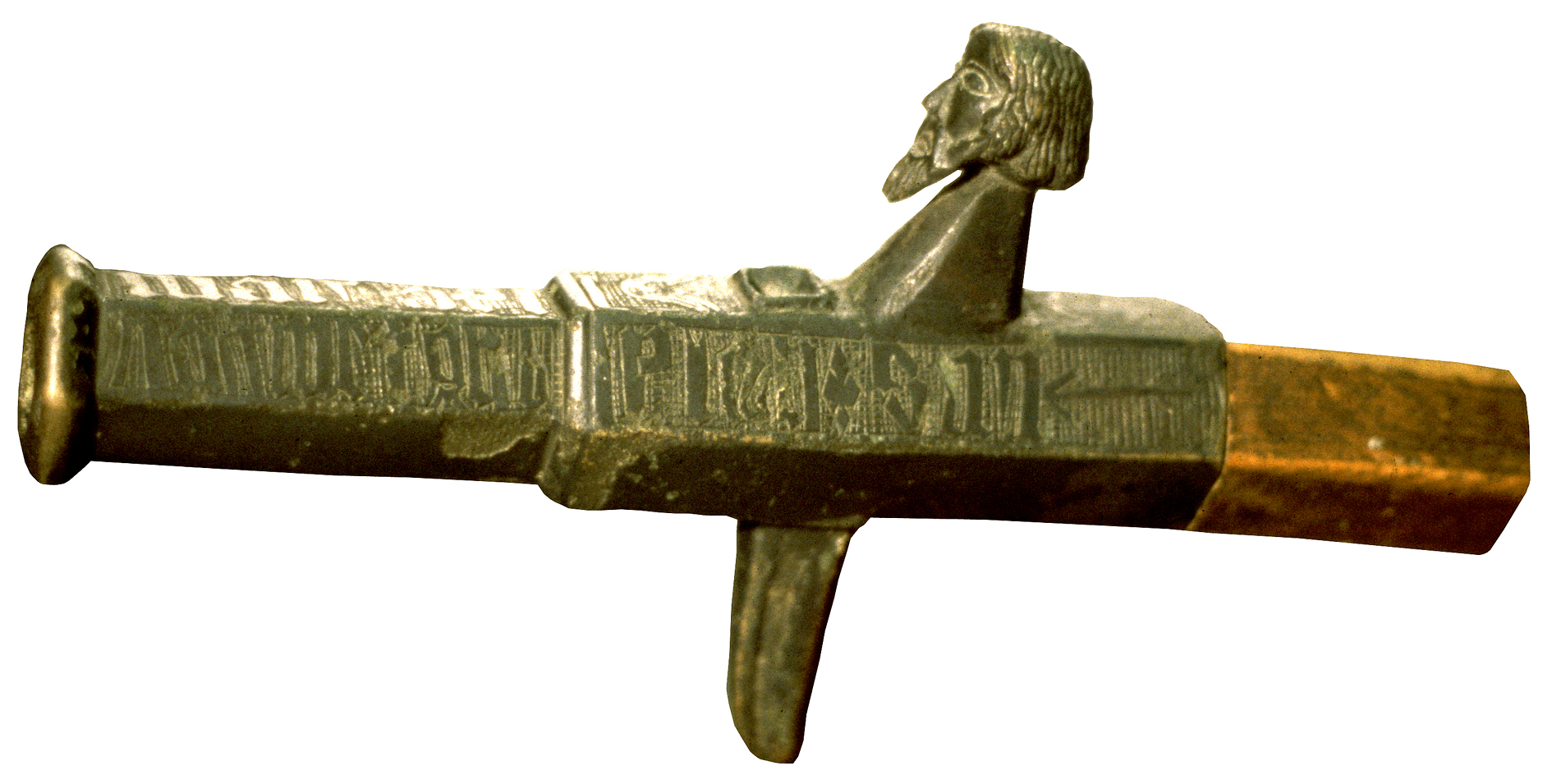
Its Scandinavian contemporary is the Mörkö gun of about the same date, a small bronze piece with a cast bearded face worked into the metal near the muzzle and a socket for the wooden shaft — a reminder that even the crudest gun was an object a craftsman took pride in. A western-European hand bombard of around 1380, now in the Musée de l’Armée in Paris, rounds out the group. Three tubes, three countries, one decade: by the closing years of the fourteenth century the personal firearm existed all across Europe, and it was everywhere the same rough thing.
2.4 Why it mattered, and why it wasn’t enough
It is tempting to dismiss the hand cannon. It was slow past belief, wildly inaccurate, sightless, and demanded a free hand and a live flame at all times — a genuine dead-end as a weapon, superseded by everything that followed. But that misses its real significance. The hand cannon proved that the firepower of a siege cannon could be carried by one man and pointed at another, and that a commoner with a few weeks of nerve could kill an armored knight who had trained since childhood. That promise — cheap, personal, lethal firepower — is what every later inventor was chasing.
What the hand cannon lacked was not power but control of the fire. As long as ignition depended on a loose hot wire or a hand-held match brought to the touch hole, the gun could never be aimed properly, fired quickly, or trusted in weather. The entire five-hundred-year story that follows is the effort to fix precisely that: to put the fire source on the gun, and to make it strike when the shooter chooses. The first real answer would arrive within a few decades of the Tannenberg gun, in the form of a bent piece of metal called a serpentine — the first firearm lock, and the subject of the next volume.
Sources
Wikipedia (Hand cannon; Matchlock); oldest.org survey of the earliest handguns; museum documentation of the Tannenberg gun, the Mörkö gun, and the Musée de l’Armée hand bombard. Manuscript imagery: the Bellifortis of Konrad Kyeser and the Walter de Milemete treatise, via Wikimedia Commons.
Comments (0)