A History of Muzzleloaders · Volume 5
Flint's False Starts: Snaphance, Miquelet & Doglock
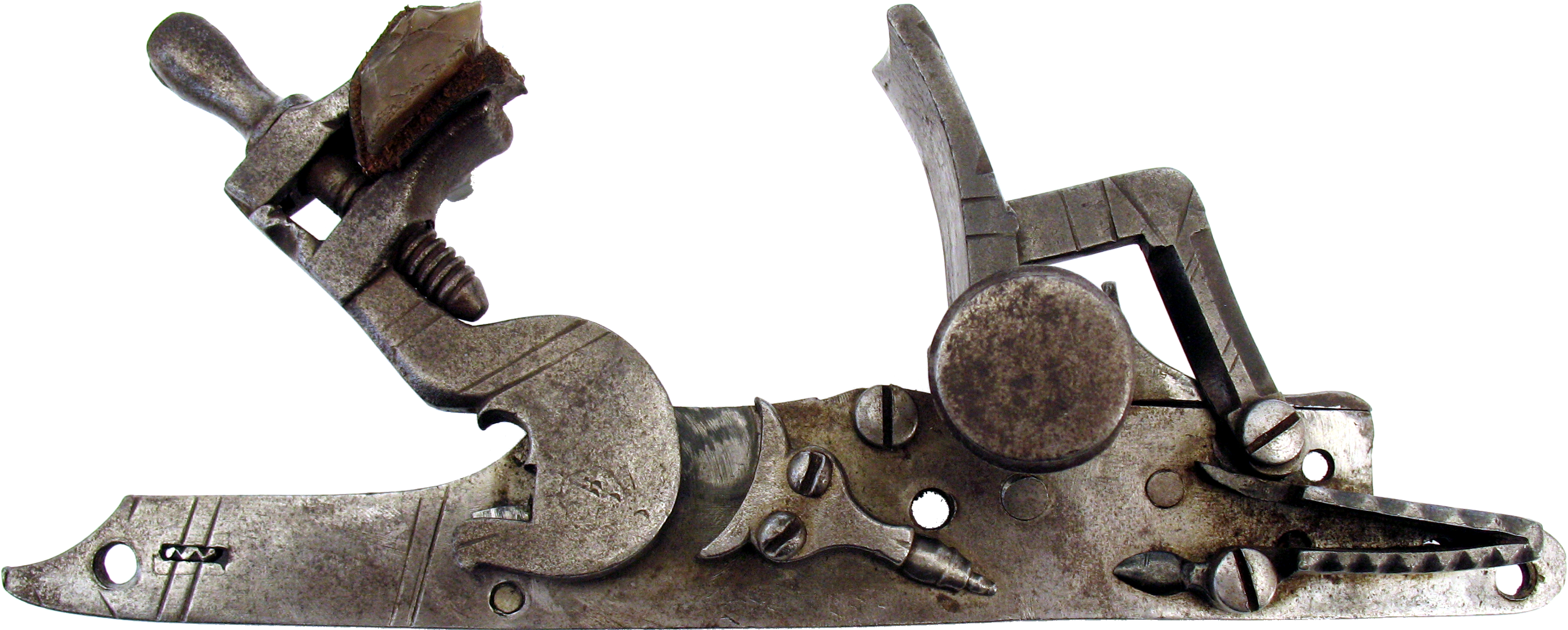
The wheellock had proven that a gun could carry its own fire, but at a price too high and a mechanism too delicate for the common soldier. The solution, when it came, threw away the whole clockwork idea and reached for something far older and cheaper: strike a piece of flint against a piece of hardened steel, and it throws a shower of sparks. Anyone who has ever used a fire steel knows the principle. Building a reliable, repeatable, spring-driven version of that strike, aimed precisely into a pan of priming powder, is the story of the flint locks — and this volume is about the three important false starts that came before the design got it exactly right.
5.1 One idea, several near-misses
It helps to say at the outset what all these locks share and where they differ. Every one of them clamps a shard of flint in the jaws of a cock (the arm that swings) and drives it, under spring power, against a hardened steel to shower sparks into the priming pan. The word “flintlock” is often used loosely for the whole family. Within it, historians distinguish several forms — snaphance, miquelet, English doglock, the Baltic lock, and finally the French or “true” flintlock. The differences between them are not cosmetic; they are specific, and they are exactly what the perfected design would resolve. Two problems in particular preoccupied these transitional locks: how to keep the priming powder dry and covered until the moment of firing, and how to make the loaded, cocked gun safe to carry without it going off.
5.2 The snaphance: a separate pan cover
The snaphance appeared in the mid-sixteenth century and is the senior member of the group. Its defining structural feature — the thing to look for, and the thing that ultimately dated it — is that its pan cover is separate from the steel. On a snaphance, the striking steel (often called the battery, seen upright at right in the photograph above) and the sliding pan cover are two distinct parts, each with its own linkage. When the gun is cocked, some snaphance designs automatically slide the pan cover clear as the cock falls; the flint then strikes the separate steel and the sparks drop into the now-open, exposed pan.
That two-piece arrangement works, but it is more parts to make, more parts to break, and more parts to fall out of alignment. If the steel and the cover are not perfectly timed and positioned, sparks miss the pan or the pan opens at the wrong instant. Still, it was cheaper and more robust than a wheellock, and it caught on: the snaphance stayed popular around Brescia in northern Italy well into the mid-eighteenth century, long after the rest of Europe had moved on, and it was common across the Baltic and Scandinavia. It was a sound, working lock — just not the final word.
5.3 The miquelet: a Mediterranean strongman
The miquelet lock was invented around the same time — the mid-sixteenth century — and served an astonishingly long life, from the late sixteenth century into the mid-nineteenth. It is the Mediterranean and Spanish–Ottoman answer to the same problem, and its signature is a powerful external mainspring that acts directly on the heel or toe of the cock, mounted on the outside of the lock plate where a gunsmith could see and service it. That external, muscular construction made the miquelet distinctive to the eye and famously strong.
Geographically it was the great success story of the transitional locks. The miquelet dominated across the Spanish, Portuguese, and Ottoman empires, Italy, the Balkans, Russia, North Africa, and the Caucasus — an enormous swath of the world, much of it well outside the Franco-British sphere where the “true” flintlock would later reign. Two main patterns are worth naming: the Spanish patilla, in which the mainspring pushes up on the cock’s heel, and the Italian or Roman form, in which it presses down on the toe. Wherever it went, the miquelet tended to stay, and richly decorated miquelet long guns remained in production and use in the Mediterranean and Islamic world for centuries.
5.4 The doglock: a manual safety
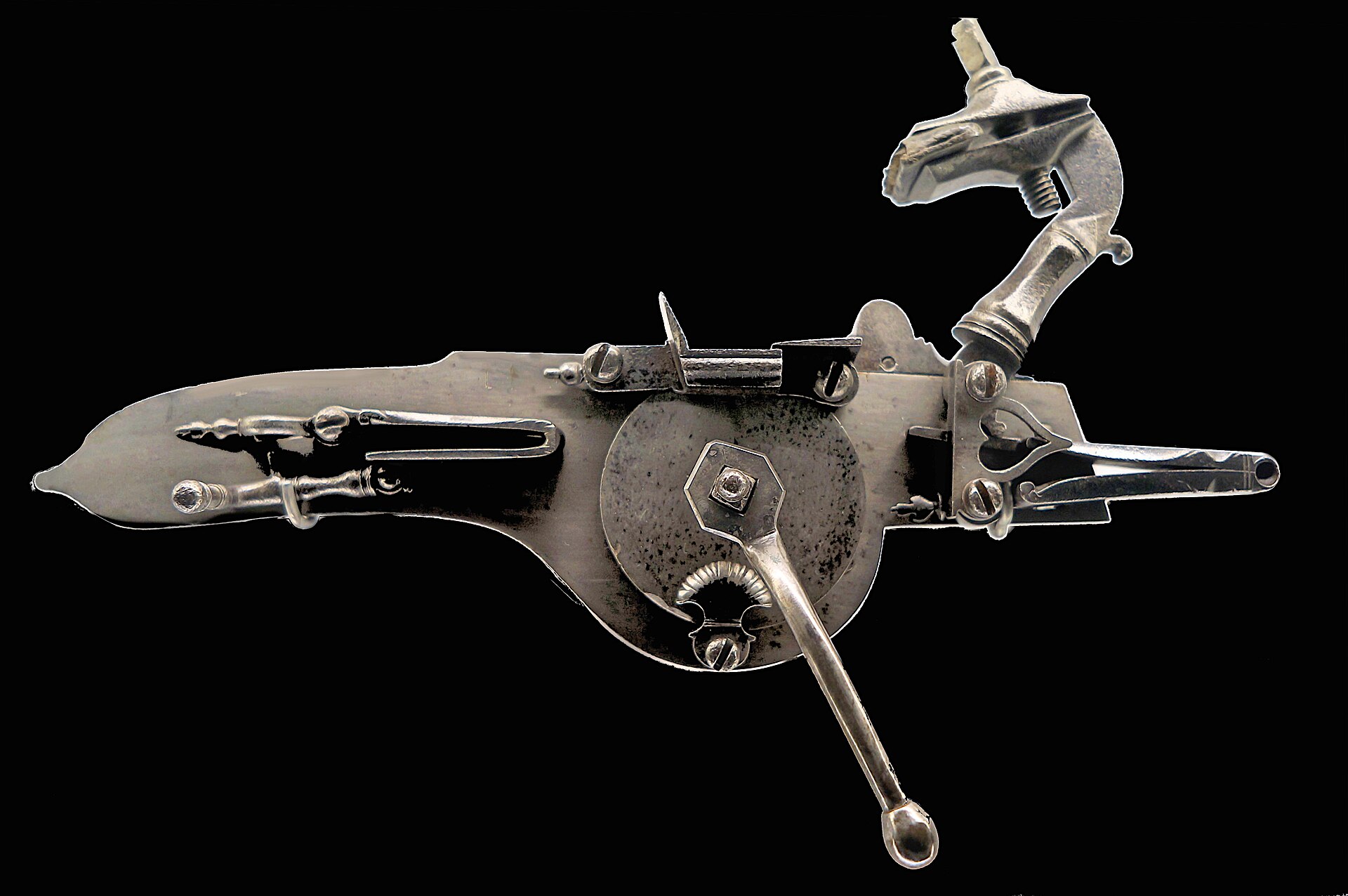
The third false start solved a different problem: safety. The doglock, or English lock, was found on nearly all English- and Dutch-made guns until about 1715, and its contribution is a small external catch — the dog — hooked behind the cock. Pull the cock back partway and the dog drops in behind it, physically locking it in a half-cock position from which the gun cannot fire until the dog is manually flipped clear. It is a manual half-cock safety, and it is an important intermediate step: it let a soldier carry a loaded, primed, partly cocked flint gun without the constant fear of an accidental discharge — but it did the job with an external hook that had to be worked by hand, rather than with an internal mechanism built into the lock itself.
5.5 Bridges, quickly outmoded
Here is the honest verdict on the three. The snaphance, the miquelet, and the doglock were sound transitional locks that genuinely worked — self-contained, spark-igniting, far cheaper and more field-repairable than the wheellock, and collectively they carried firearms across the gap between the matchlock and the definitive flintlock. Snaphance and miquelet developed separately but at roughly the same time in the mid-sixteenth century, a sign of how many hands were converging on the same flint-and-steel idea at once.
But each carried a specific compromise that the true flintlock would erase. The snaphance’s separate pan cover and its misalignment troubles, and the doglock’s external dog-catch safety, were both rendered obsolete by two elegant strokes in the French lock perfected around 1610–1615: a combined frizzen — a single L-shaped steel that is both the striking face and the hinged pan cover, so the pan is uncovered and struck in one motion with nothing to misalign — and an internal half-cock, a sear engaging a notch inside the lock so the gun is made safe with no external hook at all. That perfected lock, and the century and a half it ruled, is the subject of the next volume. The snaphance, miquelet, and doglock were the necessary experiments that showed exactly which problems still needed solving.
Sources
Wikipedia (Snaphance; Miquelet lock; Flintlock mechanism); Rock Island Auction on identifying antique firearm locks; the snaphance lock and bare flint-mechanism images via Wikimedia Commons.
Comments (0)