A History of Muzzleloaders · Volume 8
Rifling and the American Long Rifle: Accuracy on the Frontier
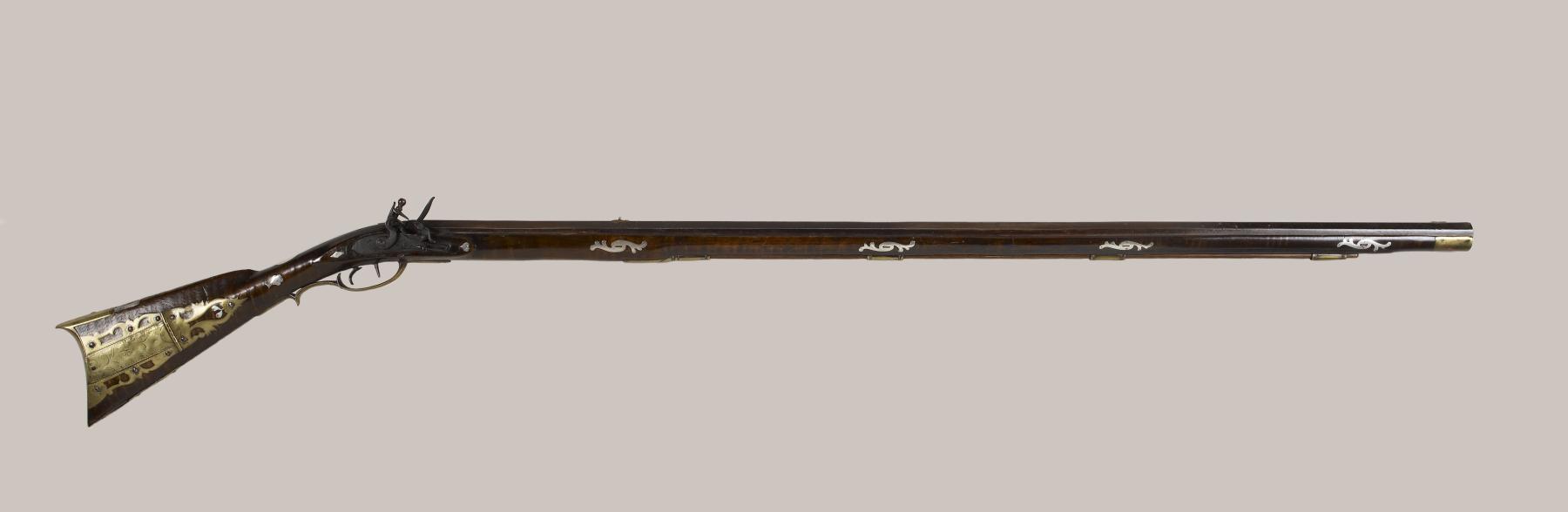
The great muskets of the previous volume were, by design, inaccurate. Their round balls rattled down oversized smoothbore barrels and left the muzzle at the mercy of chance. Yet the cure had existed for two centuries, hiding in plain sight in the workshops of German gunmakers. It was called rifling, and the puzzle of this volume is why a technology that made a gun dramatically more accurate stayed off the battlefield’s firing line for three hundred years — and how, in the hands of Pennsylvania craftsmen, it became one of the most beautiful firearms ever made.
8.1 What rifling does, and the price it charges
Rifling is a set of shallow helical grooves cut down the inside of the bore. As the ball is forced past them it is made to spin, and a spinning ball — like a thrown football — resists tumbling and holds a true line far better than a ball with no spin at all. Rifling was developed in Germany in the late 1400s or early 1500s, with surviving examples from the 1540s; the physics that made it work would not be formally understood for centuries, but gunsmiths knew empirically that a grooved barrel shot straighter.
So why did it not simply replace the smoothbore everywhere at once? Because the same grooves that grip the ball and spin it also make the gun agonizingly slow to load. To take the rifling, the ball must fit the bore tightly — and a tight ball cannot be dropped down the muzzle the way a musket’s loose ball can. The elegant solution, described by the Spanish writer Alonzo Martínez de Espinar in 1644, was the patched round ball: the ball is wrapped in a greased cloth patch, which fills the grooves, seals the gases behind the ball, and lets a slightly undersized ball be started down the bore. But even patched, the ball had to be physically rammed down against the grip of the rifling, stroke by stroke — and the bore fouled with powder residue faster than a smoothbore, until it had to be cleaned before it would load at all.
The arithmetic is unforgiving. A soldier with a smoothbore musket could load and fire two or three, even four, times a minute. An expert with a muzzle-loading rifle managed perhaps two aimed shots a minute, occasionally three — and the rifle mounted no bayonet. On a battlefield ruled by the volley-and-bayonet doctrine (Volume 7), a weapon that fired half as fast and could not fend off a bayonet charge was a liability in the line, no matter how well it shot. And so the rifle stayed what it had always been: a specialist’s arm — a hunter’s tool, a marksman’s instrument, a skirmisher’s weapon — for over two centuries, until the Minié ball (Volume 12) finally let a rifle load like a musket.
8.2 From the Jäger to the long rifle
Rifling came to America in the baggage of German-speaking immigrants — many of them Jäger (“hunter”) gunsmiths from the German and Swiss lands, who settled the Pennsylvania backcountry beginning around 1720. The rifle they brought, the Jäger, was short, heavy, and large in the bore: a stout central-European hunting gun made for driven game in forests.
On the American frontier it evolved into something quite different, and the reasons were practical before they were aesthetic. Lead and powder were scarce and expensive on the frontier, so gunsmiths reduced the caliber to fire a smaller, cheaper ball — and to keep such a small ball stable and to burn the powder efficiently, they lengthened the barrel, sometimes past four feet. The result was the American long rifle, known variously as the “Pennsylvania rifle,” the “Kentucky rifle,” or simply the long rifle: a long, slim, small-bore flintlock, often stocked in figured curly maple, with a hinged brass patchbox in the butt to carry greased patches and a scattering of silver and brass inlays. For a hundred years it was among the most accurate firearms in the world, and it remains one of the enduring masterpieces of American craft — a working tool made with the care of furniture.
That accuracy had a battlefield consequence the musket could never offer: a rifleman could deliberately pick off an individual man — an officer, a gun crew — at ranges from which a musket line could not meaningfully reply. It was a novel, unsettling, and to European sensibilities faintly ungentlemanly kind of war.
8.3 The riflemen of the Revolution — myth and reality
The long rifle occupies a large and romantic place in the American founding story, and the honest version is more interesting than the legend. The reality is that riflemen were an elite skirmishing and sharpshooting minority, not the backbone of Washington’s army. The Continental line — the force that had to stand and hold ground against British regulars — fought with smoothbore muskets and bayonets, because that is what holding a line required. The rifle’s slow load and lack of a bayonet made it useless for the line and deadly only in the specialist’s role: harassing, sniping, picking off leaders from cover, then falling back before the bayonets closed.
In that role riflemen did real and celebrated work, and popular accounts credit them heavily at Saratoga (1777), King’s Mountain (1780), and Cowpens (1781) — engagements where marksmanship and skirmishing from cover told against exposed British and Loyalist troops. But the frontier rifle did not “win the Revolution,” and it is worth being clear where the legend outruns the facts. The most persistent overstatement attaches to the Battle of New Orleans (1815), where the frontier rifleman is often cast as the hero who cut down the advancing British. In truth the decisive killing there was done by artillery and massed musketry fired from behind earthworks — the long rifle contributed, but the picture of buckskinned marksmen single-handedly deciding the day is myth built on the elite-minority reality, not a description of it.
That tension — extraordinary accuracy shackled to a crippling slowness of loading — is the whole story of the muzzle-loading rifle for three centuries. It was the right answer to the wrong half of the problem: it solved accuracy while the battlefield was still ruled by loading speed. Not until a French officer named Minié found a way to make a rifle load as fast as a musket would the two halves finally meet — and when they did, the consequences were catastrophic. That is Volume 12. First, though, the flintlock has one more world to conquer: the sea.
Sources
Muzzle-loading rifle (Wikipedia); Firearms History (rifling history); Warfare History Network (“The History of the American Long Rifle” and “Revolutionary War Weapons: The American Long Rifle”); NRA Family (“The Revolutionary Kentucky Long Rifle”); Pew Pew Tactical (“Kentucky Long Rifle History”); Outdoor Revival (“Rifle”); Long rifle (Military History Fandom).
Comments (0)