The .22 Rimfire · Volume 9
Choosing Ammunition — by Job, and by Gun
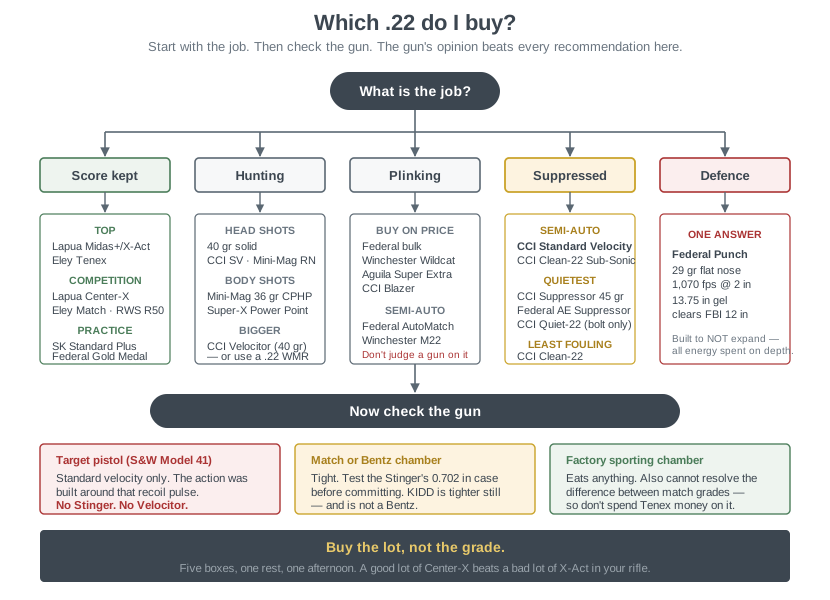
Everything in Volumes 3 through 8 exists to make this volume short. Here are the shortlists.
9.1 Target and Competition
The job: smallest group, at a known distance, from a rest or from position, with score being kept.
What matters: velocity SD, lot consistency, and whether your rifle happens to like it. Nothing else.
Table 1 — 9.1 Target and Competition
| Tier | Loads |
|---|---|
| Practice / club | SK Standard Plus, SK Rifle Match, Federal Gold Medal Target (711B), Norma |
| Competition | Lapua Center-X, Eley Match or Team, RWS R50, Federal Gold Medal Ultra Match |
| Top level | Lapua Midas+ or X-Act, Eley Tenex |
The rule that beats the table: buy the lot, not the grade (Volume 8 §8.6). A good lot of Center-X will out-shoot a bad lot of X-Act in your rifle, and the only way to find out is to shoot five candidates over one session from one rest and read the groups.
Do not buy match ammunition for a gun that cannot resolve it. A factory sporter with a sporting chamber will not tell Center-X from Standard Plus.
9.2 Hunting
The job: a clean kill on small game, usually inside 50 yards, often at an odd angle, sometimes through brush.
- Squirrel, head shots: 40 gr solid — CCI Standard Velocity, CCI Mini-Mag 40 gr CPRN, Winchester Super-X solid. No meat damage, no bullet in the carcass.
- Squirrel and rabbit, body shots: CCI Mini-Mag 36 gr CPHP (the best all-round performer in comparative testing), Winchester Super-X Power Point, CCI Segmented HP where energy transfer matters more than the meat.
- Raccoon, woodchuck, the bigger stuff: CCI Velocitor (hyper-velocity that keeps a 40-grain bullet rather than trading weight for speed), or accept that the answer is a .22 WMR.
- Lead-restricted ground: CCI Copper-22, inside 50 yards.
- Suppressed hunting: see §9.5 — this is where the two requirements start fighting.
Michigan: rimfire is legal for cottontail and for fox, gray and red squirrel in season; suppressed hunting has been legal since 2016; and watch the 10–14 November carry restriction. Check the current DNR digest each year — it is reissued annually (Volume 6 §6.6).
9.3 Plinking
The job: cans, steel, gongs, reactive targets. Volume matters, cost matters, precision does not.
Buy on price per round with an acceptable failure rate, in that order. Federal bulk, Winchester Wildcat or M22, Aguila Super Extra, Remington Golden Bullet by the brick, CCI Blazer.
Two caveats:
- In a semi-auto, buy the loads specifically built for semi-autos — Federal AutoMatch, Winchester M22 — because the failure mode you actually care about is not accuracy, it is a stoppage every fifty rounds.
- Do not judge a rifle on bulk ammunition. If your groups open up, that is the ammunition’s variance, not the gun’s.
9.4 Defence
If the question is genuinely constrained to .22 LR: Federal Punch, 29 gr, engineered to minimise expansion and maximise straight-line penetration, clearing the FBI 12-inch protocol at 13.75 inches in gel (Volume 6 §6.5). It is a well-reasoned answer to a hard question, and it does not make .22 LR a good defensive cartridge.
9.5 Suppressed
Full treatment is Volume 10. The short version:
- Subsonic is not optional if you want quiet. A supersonic bullet makes a crack the can cannot touch.
- In a bolt gun or a pistol, take the quietest thing that shoots well: CCI Suppressor 45 gr, CCI Quiet-22, Federal American Eagle Suppressor, Eley Subsonic, RWS or SK subsonic.
- In a semi-auto, you also need it to cycle. CCI Standard Velocity at 1,070 fps is the workhorse answer — already subsonic, and carrying enough energy to run a blowback action.
- CCI Clean-22 deserves its own line. The polymer coating replaces the wax lubricant and CCI claims up to 60 percent less lead fouling inside a suppressor. Clean-22 Suppressor is 45 gr at 1,000 fps; Clean-22 Sub-Sonic is 40 gr at 1,070 fps. If you own a rimfire can, this is the most interesting product on the shelf (Volume 10 §10.4).
9.5.1 Where the ammunition lives is also an ammunition decision
Every selection axis above — velocity, bullet, brand, price — assumes the ammunition is stored somewhere reasonable. For a rifle kept in a vehicle, a shed, or a garage, storage environment is a genuine selection input and it is the one nobody lists.
The governing number is SAAMI’s: avoid sustained exposure above 150 °F, with a sane band of roughly 55–85 °F.1 The mechanism is propellant, not lubricant — nitrocellulose decomposes cumulatively and irreversibly with heat, and nothing on the outside of the bullet affects it. A measured parked vehicle gains about 40 °F over ambient in an hour, most of it in the first thirty minutes, because glazing traps re-radiated infrared.1 On a 90 °F day that is a cabin at ~130 °F, and a dashboard far above it.
Two consequences that change what you buy:
- Polymer-coated ammunition (Clean-22) is not heat protection. It solves the melted-wax problem — sticky boxes, lubricant migrating off the bearing surface, grit pickup — and does nothing at all for the propellant. It is worth buying for hot storage; it is not a licence to store hot.
- 🔴 The lubricant hierarchy runs opposite to price. ELEY states plainly that beeswax-tallow — “softer, thicker and stickier” — is what goes on the match rounds, while paraffin, harder and higher-melting, goes on the semi-auto and recreational rounds because it does not clog a semi-auto.2 So the softest lubricant on the shelf is on the most expensive ammunition. Match ammunition is the worst thing you can store in a hot vehicle, and the cheap bulk paraffin everyone apologises for is genuinely the more heat-tolerant product.
⚠ CCI’s paraffin is commonly reported at around a 160 °F melting point. That figure is community-sourced rather than published by CCI and is treated here as medium confidence. Taken at face value it puts a hot cabin below the melt point — the wax goes tacky rather than runs — and a dashboard or a dark case in open sun above it.
The full treatment of vehicle storage, including the container and desiccant question, is in the Overlanding project’s The Truck Rifle dive, volume 2.
9.6 By Gun — A Worked Example Battery
The general advice above gets more specific once you know the gun. Notes for the .22s in the example battery.
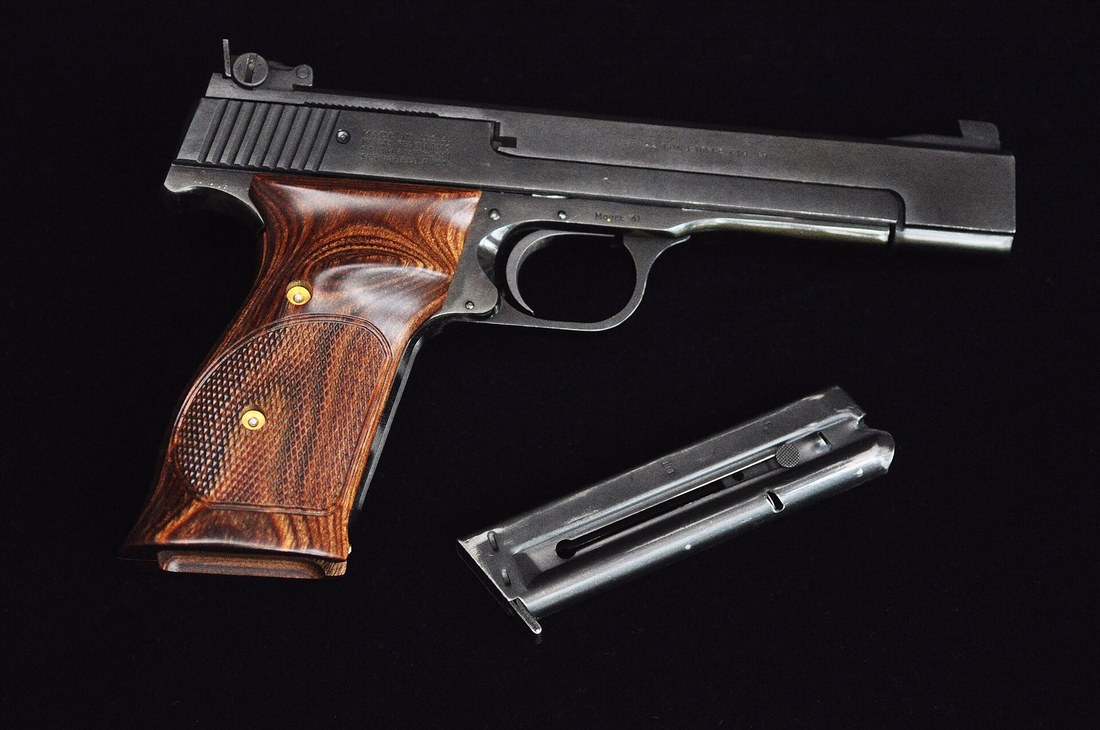
9.6.1 Smith & Wesson Model 41, 5.5 in heavy barrel — standard velocity only
This is the strongest ammunition constraint in the whole battery, and it is worth stating flatly: the Model 41’s action was designed around the recoil impulse of standard-velocity match ammunition. The slide, slide stop, recoil spring, extractor and ejector are all specified to that pulse. High-velocity ammunition is widely reported to cause excessive wear to the slide stop and frame over time, and the S&W manual specifically warns against hyper-velocity ammunition — which in CCI’s catalogue means Stinger.3
There is a real disagreement in the sources about how explicit the manual is on standard-versus-high velocity generally, so treat that part as the community’s read rather than a printed factory rule. What is not in dispute is the design intent and the hyper-velocity prohibition.
Feed it: SK Standard Plus, Lapua Center-X, Eley Match or Tenex Pistol, RWS R50, Federal Gold Medal — all of which sit at the 1,070–1,080 fps the gun was built for. CCI Standard Velocity is the cheap practice round that fits the same envelope.
Never: Stinger, Velocitor, Interceptor, or anything else in the hyper-velocity column.
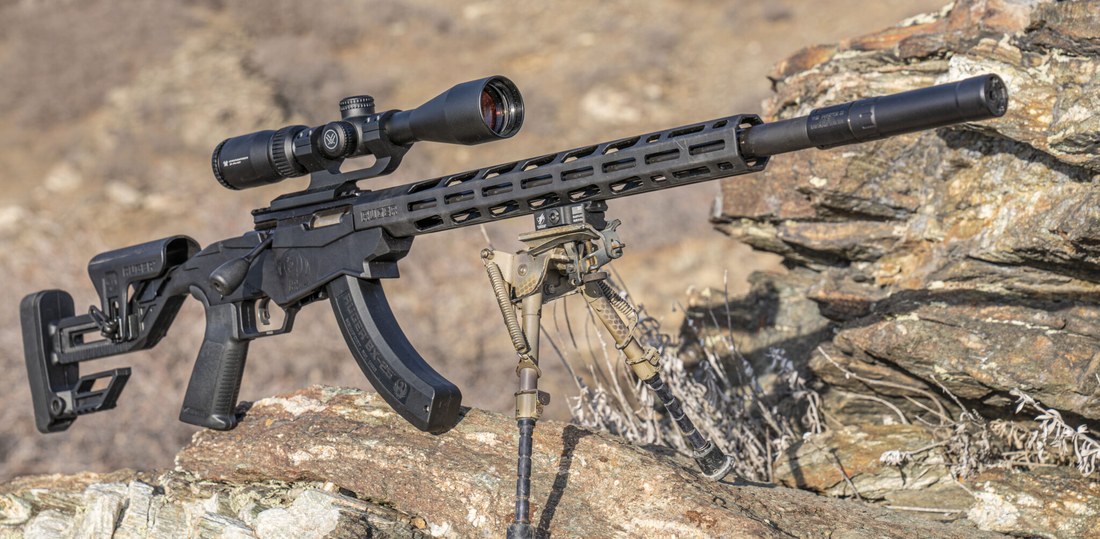
9.6.2 Ruger Precision Rimfire, 18 in
Specs that matter: 18 in heavy free-floated barrel, 1:16 twist, 1/2×28 threaded, adjustable bolt throw (1½ in rimfire / 3 in centerfire-understudy), takes BX-series and 10/22 magazines.4
This is the gun in the battery that most rewards Volume 8. A free-floated heavy barrel on a chassis with a Marksman trigger is enough rifle to resolve the difference between ammunition grades, which the 10/22s largely are not. It is also threaded, so it can wear the Lima.
Feed it: this is the lot-testing candidate. Buy single boxes of SK Rifle Match, SK Standard Plus, Lapua Center-X, Eley Match and RWS R50, shoot them the same afternoon from the bipod at 50 yards, and then buy the winner by lot number in quantity. That one afternoon is worth more than any upgrade you can bolt onto it.
With the Vortex Crossfire 4-12×40: more than enough magnification for 50–100 yard work, and no ammunition-specific reticle calibration to trip over — unlike the 10/22s below.
9.6.3 Ruger 10/22 DSP (blued) and 10/22 Stainless Takedown — both 18.5 in
Both wear the same drivetrain: KIDD single-stage trigger, KIDD bolt / firing pin / extractor, KIDD bolt buffer, KIDD bolt handle, Volquartsen automatic bolt release, in Magpul Hunter X-22 stocks on Harris bipods.
Two observations that follow directly.
These are factory-barrelled guns. The KIDD content here is the action, not the barrel — so both keep Ruger’s sporting chamber, not a match or Bentz chamber (Volume 4 §4.4). That is good news for ammunition tolerance: they will digest bulk, they will digest Stinger’s long case, and they will not get fussy as fouling accumulates. It also means these two are not the guns to spend Tenex money on. They are hunting and plinking rifles with excellent triggers.
The KIDD bolt buffers are exactly the right part to have fitted. In a blowback action, bolt mass is the primary control on cycling and the recoil spring controls bolt velocity. The standard fix for running subsonic ammunition in a suppressed 10/22 is a lighter recoil spring — commonly the 10%-lighter grey spring. The standard warning that goes with it is that a lighter spring plus high-velocity ammunition batters the receiver unless a buffer is fitted.5 With buffers already in both rifles, a lighter spring is a low-risk experiment if either gun proves reluctant on subsonic.
Feed them: CCI Standard Velocity as the default suppressed load; CCI Clean-22 Sub-Sonic (40 gr / 1,070 fps) or Clean-22 Suppressor (45 gr / 1,000 fps) if you want the fouling reduction; CCI Mini-Mag for hunting; bulk for cans.
9.6.4 The scope problem on both 10/22s — the BDC150 reticle
This one is worth acting on.
The Nikon P-Rimfire 2-7×32 with the BDC150 reticle is calibrated for a 50-yard zero with a .22 LR at roughly 1,600 fps, with its ballistic circles falling at 75, 100, 125 and 150 yards.6 That is a hyper-velocity calibration — Stinger territory.
You are running a suppressor, which means the load you actually want is subsonic, around 1,050–1,070 fps. Roughly a third slower. Every circle in that reticle is therefore wrong for the ammunition the rifle is set up to shoot, and wrong in the dangerous direction: not enough holdover.
How wrong? Anchoring on the published tables in Volume 5: from a 50-yard zero, a 1,235 fps load drops about 5.5 in at 100 yards and a 1,070 fps load drops about 7.5 in, while a 1,600 fps load would be flatter than either. So the circle drawn for “100 yards” is optimistically several inches high on subsonic ammunition, and because .22 LR drop accelerates — nearly four feet in the second hundred yards (Volume 5 §5.2) — the error at the 125 and 150 yard circles is much larger than the error at 100.
There is a better fix than taping a card to the stock, and it turns on the scope being second focal plane: dialling the magnification down makes every BDC circle subtend more MOA, which is exactly the extra holdover a slower load needs. Both of your loads — suppressed subsonic and unsuppressed high velocity — appear to land inside the 2–7× range, which means this reticle can be made genuinely correct in both configurations rather than merely worked around.
Volume 11 §11.3 works the whole thing through: separating the suppressor’s constant zero offset from the ammunition’s trajectory scaling, the magnification estimates, the range procedure to nail them down, and the one-load shortcut that deletes half the problem.
Nikon’s Spot On tool, which the reticle guide directs you to for non-standard loads, is discontinued — Nikon exited the riflescope business in December 2019.7 Do not plan around it.
Do this separately for each rifle. The takedown’s joint and the blued gun’s fixed barrel are different systems, and there is no reason to expect the same numbers to serve both.
9.6.5 Ruger Mark III (5.5 in) and Mark IV
Both are subsonic-or-nearly-so with almost any ammunition, because a 5-inch-class barrel simply cannot deliver rifle velocities (Volume 4 §4.2) — chronographed .22 LR from a 4-inch barrel runs 938 to 1,060 fps. Which means a suppressed .22 pistol is quiet on nearly everything you feed it, unlike the rifles.
The practical differences between the two are handling, not ammunition: the Mark IV’s one-button takedown versus the Mark III’s famously aggravating reassembly, and the Mark IV’s factory threaded-barrel configurations.8
Feed them: bulk for volume, CCI Standard Velocity or Mini-Mag for anything that matters, match ammunition only if you shoot them for score.
With the Lima on: these are the easiest quiet guns in the battery — nothing to calibrate, no reticle to argue with, and subsonic velocity comes free from the barrel length. The one thing that gets worse on a pistol is first-round pop, which is more pronounced on short barrels because less powder has burned before the gas reaches the can (Volume 10 §10.5). A permitted ablative is the standard answer if it bothers you.
9.6.6 The suppressor is shared — track it centrally
The Lima fits the Takedown, the DSP, the Precision Rimfire, the Mark III and the Mark IV — everything in the battery on 1/2×28. That is convenient, and it has two consequences worth planning around:
- Round count accumulates on the can, not on any one gun. The commonly cited rimfire cleaning interval is 300–500 rounds (Volume 10 §10.4). Keep the tally on the can — a note in its case — or you will badly under-count.
- Every host needs its own can-on/can-off zero offset, recorded in clicks. Five hosts, five offsets. This is a one-afternoon job that pays for itself the first time you swap the can and do not have to re-zero from scratch.
9.7 The Shortest Possible Version
If you kept only five kinds of .22 in the house:
- CCI Standard Velocity — suppressed default, practice, and the Model 41’s diet
- CCI Mini-Mag 36 gr CPHP — hunting
- A bulk brick (Federal, Winchester M22, Aguila) — plinking
- SK Standard Plus or Lapua Center-X — the Precision Rimfire and the Model 41 when it counts
- CCI Clean-22 Suppressor — when you would rather not clean the can
9.8 Bibliography
Footnotes
-
SAAMI sporting-ammunition storage guidance — avoid sustained exposure above 150 °F; recommended band roughly 55–85 °F; smokeless propellant (nitrocellulose) degrades cumulatively and irreversibly with heat. Measured parked-vehicle heating of approximately 40 °F over ambient in one hour, the majority within the first thirty minutes, driven by glazing trapping re-radiated infrared. https://saami.org/wp-content/uploads/2018/01/SAAMI_ITEM_202-Sporting_Ammunition.pdf (confidence: high on the 150 °F guidance and the propellant mechanism; medium on the specific vehicle-heating figure, which is widely reported measured work rather than a single controlling study — and note that it is a glazed cabin number and does not transfer to an unglazed enclosure). ↩ ↩2
-
ELEY on rimfire lubricants — beeswax-tallow “produces a softer, thicker and stickier lubricant as opposed to pure paraffin” and is used in match products; paraffin “is a much thinner lubricant and remains harder than beeswax at any given temperature,” has the higher melting point, and is “more suited to semi-auto firearms as it doesn’t clog the mechanism.” ELEY separately advises keeping ammunition at a stable temperature. https://eley.co.uk/waxing-lyrical-about-22lr-lubricants-beeswax-or-paraffin-wax/ ; https://eley.co.uk/how-does-temperature-affect-eley-ammunition-and-its-lubricant/ (confidence: high — this is the manufacturer describing its own products). The CCI ~160 °F paraffin melting point is community-sourced and is flagged as medium confidence in the text. ↩
-
S&W Model 41 designed around standard-velocity match ammunition — slide, slide stop, recoil spring, extractor and ejector specified to that recoil pulse; high-velocity ammunition reported to cause excessive wear to the slide stop and frame; the manual specifically warns against hyper-velocity ammunition (CCI Stinger). Sources disagree on how explicit the manual is about standard versus high velocity generally. https://www.smithandwessonforums.com/threads/model-41-why-sv-ammo-only.75449/ ; https://www.rimfirecentral.com/threads/s-w-41-and-hv-ammo.1181137/ ; manual: https://s3.amazonaws.com/files.ammunitiondepot.com/smith-and-wesson-firearms/pistols/sw-model-41-pistol.pdf (confidence: high on the design intent and the hyper-velocity prohibition; medium on the broader standard-versus-high-velocity reading, which is flagged as the community’s interpretation). ↩
-
Ruger Precision Rimfire, 18 in heavy free-floated barrel, 1:16 RH twist, 1/2×28 threaded muzzle, adjustable bolt throw via a removable bolt-stop clip (1½ in / 3 in), accepts BX-series and 10/22 magazines. https://ruger.com/products/precisionRimfire/specSheets/8400.html ; https://www.americanrifleman.org/content/tested-ruger-s-precision-rimfire-rifle/ ; https://gundigest.com/rifles/new-rimfire-ruger-precision-rimfire (confidence: high). ↩
-
In a blowback action bolt mass is the primary control on cycling and spring strength controls bolt velocity; a ~10% lighter recoil spring is the common fix for subsonic cycling in a suppressed 10/22; a lighter spring combined with high-velocity ammunition risks battering unless a buffer is fitted. https://www.rimfirecentral.com/threads/10-22-subsonic-cycling-action-weight.1278168/ ; https://www.snipershide.com/shooting/threads/10-22-lighter-spring-bolt-more-reliable.97357/ ; https://www.rimfirecentral.com/threads/kidd-supergrade-recoil-spring-and-subsonic-ammo.523823/ (confidence: upgraded to high on the ~10% figure — the KIDD guide rod and spring kit’s own instructions specify three interchangeable tuning springs at white = standard, red = +10% tension, green = −10% tension, so the community’s “~10% lighter spring” consensus and the manufacturer’s actual product are the same number. 🔴 Note also that the colour mapping is the opposite of what is widely repeated online, where red is often named as the subsonic spring — red is the +10% spring. Green is the subsonic spring. Individual guns still vary.) ↩
-
Nikon BDC 150 reticle: designed for .22 LR at approximately 1,600 fps, zeroed at 50 yards, with ballistic circles for 75, 100, 125 and 150 yards; non-standard loads are directed to Nikon’s Spot On tool. https://cdn-1.nikon-cdn.com/pdf/sportoptics/riflescopes/Nikon%20BDC_Reticle%20Guide.pdf ; https://www.opticsplanet.com/nikon-prostaff-rimfire-3-9x40mm-riflescope-matte-w-bdc-150-reticle.html (confidence: high on the calibration velocity and circle distances). The estimated magnitude of the error on subsonic ammunition is this series’ inference from the trajectory tables in Volume 5, not a measured figure — which is why the text says to measure it. ↩
-
Nikon announced its exit from the riflescope market in December 2019; the Spot On ballistic software has been discontinued and is no longer available. https://www.outdoorlife.com/story/gear/nikon-will-no-longer-make-riflescopes/ ; https://www.opticsplanet.com/nikon-spot-on-ballistic-software.html (confidence: high). ↩
-
Ruger Mark IV one-button takedown versus the Mark III’s tool-and-patience reassembly; factory threaded-barrel configurations available on the Mark IV. https://www.americanfirearms.org/ruger-mark-iv-review/ ; https://www.guns.com/news/reviews/plinker-review-ruger-mark-iv-22-45-threaded-bull-barrel (confidence: high). Pistol velocity range from a 4 in barrel, 938–1,060 fps: https://www.shootersforum.com/threads/22lr-velocities-4-barrel.54522/ (confidence: medium). ↩
Comments (0)