The .22 Rimfire · Volume 10
Suppressors — Why .22 Is the Best Host and the Worst Guest
The .22 LR is the cartridge suppressors were made for. It carries so little propellant that the gas a can has to manage is trivial by centerfire standards, which is why a four-ounce aluminium tube can take a .22 rifle from painful to genuinely comfortable.1 It is also, by a wide margin, the filthiest thing you can put in front of a suppressor. Both halves of that are worth understanding, because they lead to opposite conclusions about what to buy and how to run it.
10.1 The Two Noises
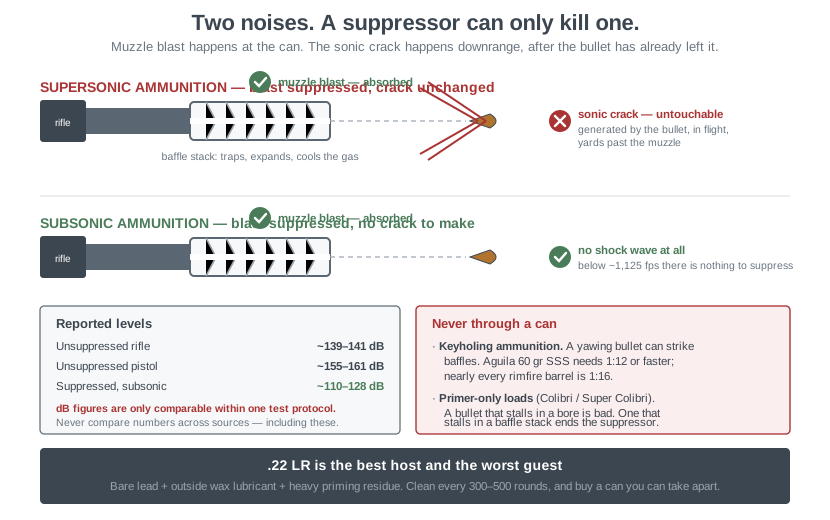
A suppressor is fighting two separate sounds, and it can only win one of them.
Muzzle blast is the propellant gas exiting and expanding. It is what the baffle stack exists to absorb — the gas is trapped, expanded, cooled and slowed before it reaches the atmosphere. This is where all the dB reduction comes from.
The sonic crack is the shock wave from a bullet travelling faster than sound. It is generated by the bullet, in flight, downrange — after it has left the suppressor entirely. No suppressor can do anything about it. It is not a muzzle event.
This is the whole reason subsonic ammunition matters. Put a supersonic round through a can and you have eliminated the blast and kept the crack, which is like fixing one of two flat tyres. It will be quieter. It will not be quiet.
10.2 The Numbers, With the Caveat
Reported sound levels for .22 LR:
Table 1 — Reported sound levels for .22 LR
| Configuration | Reported level |
|---|---|
| Unsuppressed rifle | ~139–141 dB |
| Unsuppressed pistol | ~155–161 dB |
| Suppressed, subsonic | ~110–128 dB |
That is a reduction of roughly 20–30 dB with good ammunition.2 Specific measurements from one comparative test: CCI Suppressor Subsonic 45 gr HP at 112.62 dBZ from a suppressed pistol — the quietest in that test, and reliably cycling — and Federal American Eagle Suppressor 45 gr at 119.34 dB average.2
The caveat matters more than the numbers. Decibel figures are not comparable across tests. Different labs use different meters, microphone placements, distances, weightings and standards, and dB is logarithmic, so small methodology differences produce large-looking numbers. A dB figure is only meaningful relative to other figures from the same test. Any comparison chart that mixes sources is decoration.
The most useful non-numeric calibration comes from an independent analysis: a suppressed 40-grain subsonic at about 1,000 fps produces a peak level roughly the same as manually cycling the action of the gun firing it — about 120 dB.3 That is a benchmark you can verify by ear, and it is the correct mental model for what a well-fed rimfire can actually sounds like.
10.3 Ammunition Selection
Rule one: subsonic, or you are wasting the can. The speed of sound is about 1,125 fps; the ammunition industry labels below roughly 1,080 fps as subsonic.4
Rule two, for semi-autos: it also has to cycle. This is the constraint that catches people. A blowback action needs bolt momentum, and the quietest loads are the ones with the least of it. A factory 10/22 is not reliably a true-subsonic gun.
The workable answers, in ascending order of quiet and descending order of reliability:
- CCI Standard Velocity, 40 gr at 1,070 fps — the workhorse. Already subsonic, and carrying enough energy to run most semi-autos as delivered. If you buy one suppressed load, buy this.
- CCI Suppressor 45 gr HP and Federal American Eagle Suppressor 45 gr — purpose-built subsonic hollow points, quieter, and generally still able to cycle.
- CCI Quiet-22 Semi-Auto, 45 gr — engineered specifically to be quiet and cycle an autoloader.
- CCI Quiet-22, 40 gr at ~710 fps — dramatically quieter, and will not cycle a semi-auto. Single-shot operation, and superb in a bolt gun.
If a semi-auto will not run subsonic ammunition, the mechanical fixes are a lighter recoil spring (commonly a 10% reduction) or a lighter bolt — with the standing warning that a lighter spring plus high-velocity ammunition batters the action unless a bolt buffer is fitted.5 Bolt mass is the primary control on cycling in a blowback; spring rate controls bolt velocity.
10.3.1 Two things never to run through a can
Keyholing ammunition. A bullet that is not stabilised leaves the muzzle yawing, and a yawing bullet in a baffle stack can strike the baffles. The canonical case is Aguila’s 60-grain Sniper Subsonic, which needs 1:12 twist or faster and keyholes in the 1:16 that ships on essentially every rimfire (Volume 4 §4.3). Check twist before you buy it, and if you see keyholes on paper, stop.
Primer-only ammunition. Colibri and Super Colibri carry no powder charge and have repeatedly been reported to lodge in rifle barrels (Volume 2 §2.3). A bullet that stalls in a bore is a serious problem; a bullet that stalls in a baffle stack is a destroyed suppressor. This series’ rule is absolute: not through a can, ever.
10.4 The Fouling Problem
Here is the part that separates rimfire suppressor ownership from every other kind.
.22 LR is the dirtiest suppressor host by a wide margin. Three sources of filth, all structural to the cartridge:
- Lead. The bullets are bare or copper-washed lead, and they shed.
- Wax lubricant. The .22 LR uses a heeled, outside-lubricated bullet (Volume 2 §2.2), so it carries its lubricant on the outside of the case where it is free to end up in your baffles.
- Priming and powder residue. Rimfire priming leaves heavy residue, and bulk ammunition sheds unburnt powder.
Commonly cited cleaning interval: every 300–500 rounds. Leave it too long and the fouling can effectively cement the baffle stack together — the failure mode owners call lead-locking, and it is not always recoverable.6
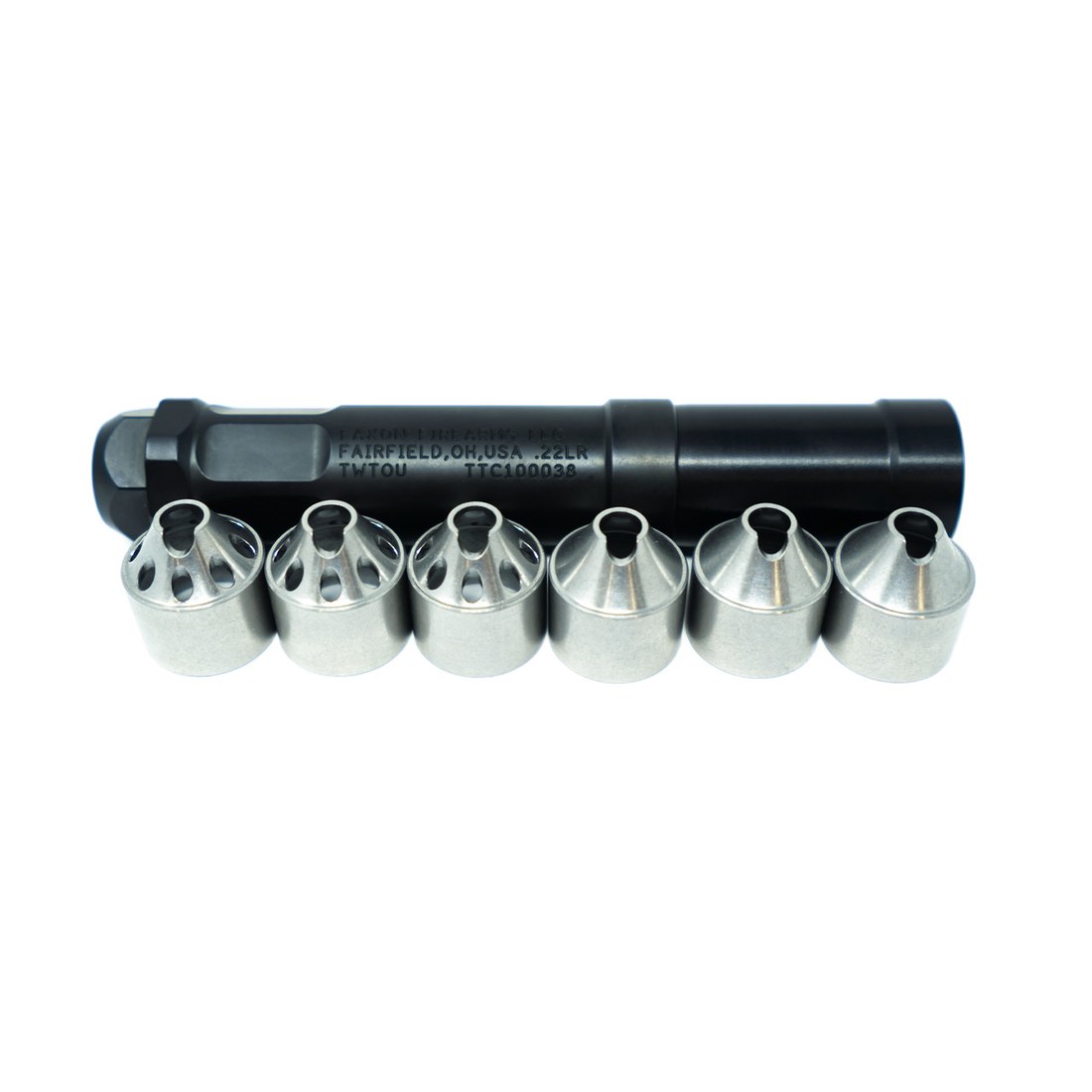
10.4.1 The conclusion that follows: rimfire cans must be user-serviceable
Sealed and welded rimfire designs are lighter, cheaper to build, and marginally quieter when new. They are also reported to fail around the 3,000–5,000 round mark, because there is no way to get the lead out.6 The industry guidance is unambiguous and this series endorses it: before you buy a rimfire can, confirm it fully disassembles for cleaning. A serviceable rimfire suppressor is a lifetime item. A sealed one is a consumable.
Those round-count figures are widely repeated industry guidance rather than measured limits — treat them as order-of-magnitude, and let the actual condition of your baffles set your interval.
10.4.2 The one genuine product innovation: polymer coating
CCI Clean-22 replaces the traditional wax lubricant with a polymer bullet coating, derived from Federal’s Syntech handgun technology, and CCI claims it reduces lead fouling inside a suppressor by up to 60 percent. The line includes Clean-22 Suppressor at 45 gr / 1,000 fps, plus 40 gr Sub-Sonic at 1,070 fps and 40 gr High Velocity at 1,235 fps.7
That 60% figure is CCI’s own and is presented here as a manufacturer’s claim, not an independent measurement. But the mechanism is sound and directly addresses the second of the three filth sources above — if your can is a pain to clean, or is out of production and you would rather it lasted, this is the highest-leverage ammunition change available.
10.5 First-Round Pop, and Ablatives
The first shot through a cold can is often noticeably louder than the ones after it. The cause is residual oxygen inside the suppressor burning when the hot muzzle gas arrives — a one-time combustion event that subsequent shots, fired into an oxygen-depleted can, do not repeat.8
Two things worth knowing:
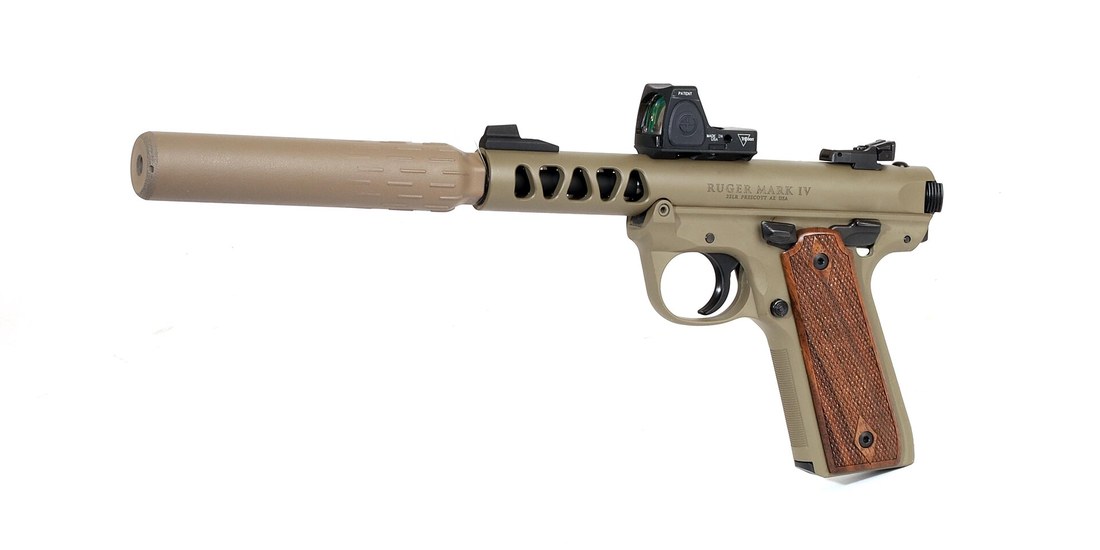
- It is worse on pistols and short barrels than on full-length rifles, because a longer barrel burns more of the powder before the gas reaches the can.8
- Many rimfire and pistol cans tolerate a small ablative — a few drops of water or wire-pulling gel in the baffles — which cools the expanding gas and substantially cuts first-round pop.8 Confirm your manufacturer permits it before you try it.
10.6 Point of Impact
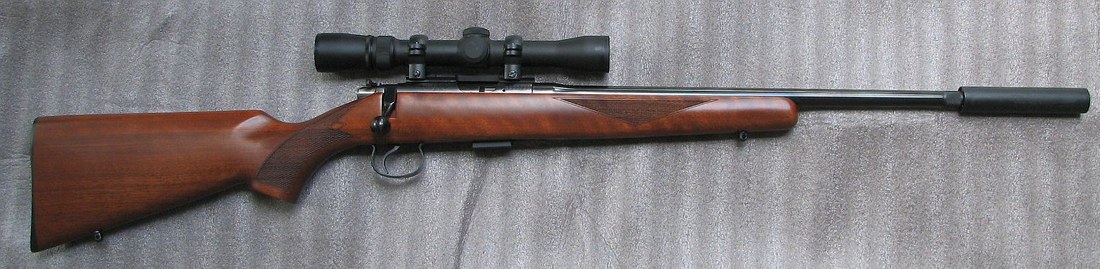
Hanging several ounces on the muzzle changes barrel harmonics, and point of impact will shift when you mount or remove a can. There is no universal figure for how much; it is specific to the rifle, the can, the mount and the load.
The practical rule: zero with the can on, and leave it on. If you must shoot both ways, record two zeros and know which one is dialled. For a rifle that also comes apart between outings, this compounds with the takedown-joint question in Volume 11.
10.7 Legal Posture — 2026
Two things changed recently and both are worth stating precisely, because they are widely misreported.
The federal transfer tax on suppressors is now $0. The One Big Beautiful Bill Act (H.R. 1), signed 4 July 2025, eliminated the $200 NFA transfer tax for suppressors, short-barrelled rifles, short-barrelled shotguns and AOWs, effective for forms submitted on or after 1 January 2026. Forms submitted before that date were still taxed.9
Everything else is unchanged. A suppressor remains an NFA item. You still file a Form 4 (transfer) or Form 1 (make), you still pass the background check, you still wait for ATF approval, and it is still registered. Only the tax is gone.9 Anyone telling you suppressors are now unregulated is wrong.
Michigan: hunting with a legally possessed suppressor has been legal since the Natural Resources Commission repealed the prohibition effective 11 February 2016.10 As always with hunting regulation, the current DNR digest is the controlling document.
10.8 A Note on Out-of-Production Cans
If your rimfire suppressor is no longer manufactured — as is the case for the Mack Brothers Lima in the example battery — three things follow, and none of them are urgent but all of them are cheaper to do now than later.
- Confirm it fully disassembles, and that you have the correct tool. Mack Brothers’ current rimfire offering, the Vapor, is 100% titanium with an integrated tool for user disassembly and cleaning, at 4.3 oz; the Lima’s own construction and service procedure could not be documented in the sources consulted, so verify it against the paperwork that came with the can rather than against anything written here.11
- Buy spares while the maker is still trading — end caps, mounts, O-rings, the disassembly tool. These are the parts that get lost or cross-threaded, and they are the parts that turn a serviceable can into a paperweight.
- Clean it on schedule and consider Clean-22. An irreplaceable can is exactly the case where a 60%-fouling-reduction claim is worth taking a chance on, and where the 300–500 round interval should be treated as a ceiling rather than a suggestion.
Note also that the 41 dB figure recorded for that Lima is a manufacturer’s or owner’s measurement under unknown test conditions — useful for comparing that can against itself over time, and not comparable to any figure in §10.2 or anywhere else.
10.9 Bibliography
Footnotes
-
.22 LR is well suited to suppression because of the low volume of powder gases. https://en.wikipedia.org/wiki/.22_Long_Rifle (confidence: high). ↩
-
Unsuppressed .22 LR ~139–141 dB from a rifle and ~155–161 dB from a pistol; suppressed subsonic ~110–128 dB, a 20–30 dB reduction; CCI Suppressor Subsonic 45 gr HP at 112.62 dBZ (quietest in that test, cycling reliably); Federal American Eagle Suppressor 45 gr at 119.34 dB average. https://www.targetbarn.com/broad-side/quietest-22lr-ammo/ ; https://www.silencershop.com/blog/22-suppressor-test-results ; https://libertycans.net/2026/04/17/22-caliber-suppressor/ (confidence: medium-high — real measurements, but dB figures are not comparable across test protocols, as the text states). ↩ ↩2
-
A suppressed 40 gr subsonic at ~1,000 fps produces a peak level roughly equal to manually cycling the action of the gun firing it, about 120 dB. https://david.bookstaber.com/Interests/2017/08/suppressed-subsonic-sound-levels/ (confidence: medium). ↩
-
Subsonic threshold of ~1,080 ft/s as used in ammunition labelling. https://en.wikipedia.org/wiki/.22_Long_Rifle (confidence: high). ↩
-
Factory 10/22s often will not cycle true subsonic ammunition; fixes are a lighter recoil spring (commonly ~10% lighter), a lighter bolt or buffer, or running CCI Standard Velocity at 1,070 fps; a lighter spring with high-velocity ammunition risks battering unless a buffer is fitted; bolt mass is the primary cycling control in a blowback, with spring rate controlling bolt velocity. CCI Quiet-22 Semi-Auto designed to be quiet and cycle. https://www.mdshooters.com/threads/best-22-rimfire-sub-sonic-ammo-to-cycle-semi-auto-suppressed.226592/ ; https://www.rimfirecentral.com/threads/10-22-subsonic-cycling-action-weight.1278168/ ; https://www.rimfirecentral.com/threads/kidd-supergrade-recoil-spring-and-subsonic-ammo.523823/ ; https://www.targetbarn.com/broad-side/quietest-22lr-ammo/ (confidence: medium — strong and consistent community consensus with sound mechanics; individual guns vary). ↩
-
Rimfire is the dirtiest suppressor category by a wide margin — lead or copper-washed lead bullets, wax lubricant, heavy priming residue, unburnt powder; cleaning interval commonly cited at 300–500 rounds; fouling left too long can cement the baffle stack; sealed rimfire designs reported to fail at 3,000–5,000 rounds; industry guidance that rimfire suppressors must be user-serviceable. https://www.silencershop.com/blog/cleaning-a-suppressor ; https://www.thetruthaboutguns.com/sealed-vs-user-serviceable-suppressors/ ; https://www.rifleconfigurator.com/guides/suppressor-cleaning-guide (confidence: high on the mechanism and the serviceability conclusion; medium on the specific round-count figures, which are widely repeated industry guidance rather than measured limits — the text says so). ↩ ↩2
-
CCI Clean-22: polymer bullet coating replacing wax, derived from Federal Syntech technology, claimed to reduce lead fouling inside a suppressor by up to 60 percent; Clean-22 Suppressor 45 gr at 1,000 fps, Clean-22 Sub-Sonic 40 gr at 1,070 fps, Clean-22 High Velocity 40 gr at 1,235 fps. https://www.cci-ammunition.com/rimfire/cci/clean-22-suppressor/6-980CC.html ; https://www.cci-ammunition.com/news/newest-clean-22-optimized.html ; https://www.cci-ammunition.com/cci-stories/when-rimfire-went-clean.html (confidence: high that these are CCI’s published specifications; the 60% figure is CCI’s own claim and is presented as such). ↩
-
First-round pop caused by residual oxygen in the suppressor burning; more pronounced on pistols and short barrels because longer barrels burn more powder before the gas reaches the can; many rimfire and pistol cans tolerate a small water or gel ablative, which cools the gas and reduces first-round pop. https://www.capitolarmory.com/articles/what-is-first-round-pop (confidence: medium-high). ↩ ↩2 ↩3
-
One Big Beautiful Bill Act (H.R. 1), signed 4 July 2025, eliminated the $200 NFA transfer tax on suppressors, SBRs, SBSs and AOWs effective for forms submitted on or after 1 January 2026; forms submitted before that date were still taxed. Suppressors remain NFA items: Form 4 / Form 1, background check, ATF approval and registration are unchanged. https://silencerco.com/blog/no-more-200-tax-stamps-for-suppressors ; https://www.capitolarmory.com/articles/nfa-tax-stamp-elimination ; https://orchidadvisors.com/2026-nfa-tax-stamp-changes/ (confidence: high). ↩ ↩2
-
Michigan Natural Resources Commission repealed the prohibition on hunting with a legally possessed suppressor effective 11 February 2016. https://www.longrangehunting.com/threads/as-of-feb-11th-its-legal-to-use-silencers-hunting-in-michigan.167535/ (confidence: medium-high — well attested but secondary; verify against the current DNR digest). ↩
-
Mack Brothers’ current rimfire suppressor, the Vapor, is 100% titanium with an integrated tool for user disassembly and cleaning, 4.3 oz, rated for .22 LR, .22 Mag, .17 HMR and 5.7×28. https://macbros.com/product/vapor-22lr-5-7x28-rimfire-suppressor/ ; https://internationalsportsman.com/silencer-shop-authority-mack-brothers-vapor-review/ (confidence: high for the Vapor). The Mack Brothers Lima’s construction, weight and service procedure could not be documented in the sources consulted and are deliberately not stated here — verify against the can’s own paperwork. ↩
Comments (0)